
What Is a VDR? The 2026 Business Professional's Guide
Discover what is a VDR and how it secures your business documents during critical transactions. Learn essential features and benefits now!
July 6, 2026 · 9 min read

A virtual data room (VDR) is a secure, cloud-based repository for storing and sharing confidential business documents during high-stakes transactions such as mergers and acquisitions, fundraising rounds, and IPOs. Unlike general cloud storage, a VDR is purpose-built for controlled access, with granular user permissions, dynamic watermarking, and comprehensive audit logs that track every document interaction. The term “VDR” in business refers exclusively to this transaction-grade platform. In maritime contexts, VDR stands for Voyage Data Recorder, a separate IMO SOLAS standard. Business professionals searching for a data room definition need to know that distinction upfront.
What is a VDR and how does it work?
A VDR is a controlled digital environment where deal participants access sensitive documents without ever receiving a copy they can freely distribute. The platform authenticates each user, assigns them a permission level, and records every action they take inside the room. That audit trail is what separates a VDR from a shared Google Drive folder.

The core mechanism is role-based access control. An administrator assigns each participant a role, such as viewer, commenter, or full editor, and that role determines which folders they can open, whether they can print, and whether they can download. When a document is downloaded, Digital Rights Management (DRM) technology travels with the file. DRM allows sellers to revoke access after download and restrict printing or saving, providing security that standard encryption alone cannot deliver.
Every session generates a timestamped log. Administrators see who opened which document, how long they spent on each page, and whether they attempted any restricted action. That log becomes evidence in dispute resolution and a compliance record for regulated industries.
Key features that set VDRs apart from standard cloud storage
VDRs intentionally limit what users can do with documents. General file-sharing tools prioritize ease of distribution. A VDR does the opposite. VDRs disable printing or downloads by design, preserving the seller’s control over sensitive materials throughout the transaction.
The features that matter most in a transaction context include:
- Granular user permissions: Administrators set access at the folder or individual file level, not just the room level. A junior analyst can see financial summaries without accessing the full cap table.
- Dynamic watermarking: Every page a user views carries their name, IP address, and timestamp. This discourages unauthorized screenshots and makes leaked documents traceable.
- Comprehensive audit trails: Every login, document view, download attempt, and search query is logged with a timestamp. Audit logs track all user activity and support both compliance reporting and post-deal dispute resolution.
- Secure Q&A modules: Buyers and investors submit questions inside the platform. The seller’s team responds in a tracked thread, and the system flags duplicate questions automatically.
- Advanced DRM controls: Administrators can expire access on a specific date, revoke a user mid-session, or disable a document after a deal falls through.
- Encryption standards: Leading platforms apply AES-256 encryption at rest and TLS in transit, meeting SOC 2 Type II and ISO 27001 compliance requirements.
Pro Tip: Test the Q&A module before committing to any platform. The Q&A workflow is a common bottleneck in live deals. A module that tracks who asked what, prevents duplicates, and routes questions to the right expert will save hours during a compressed due diligence timeline.
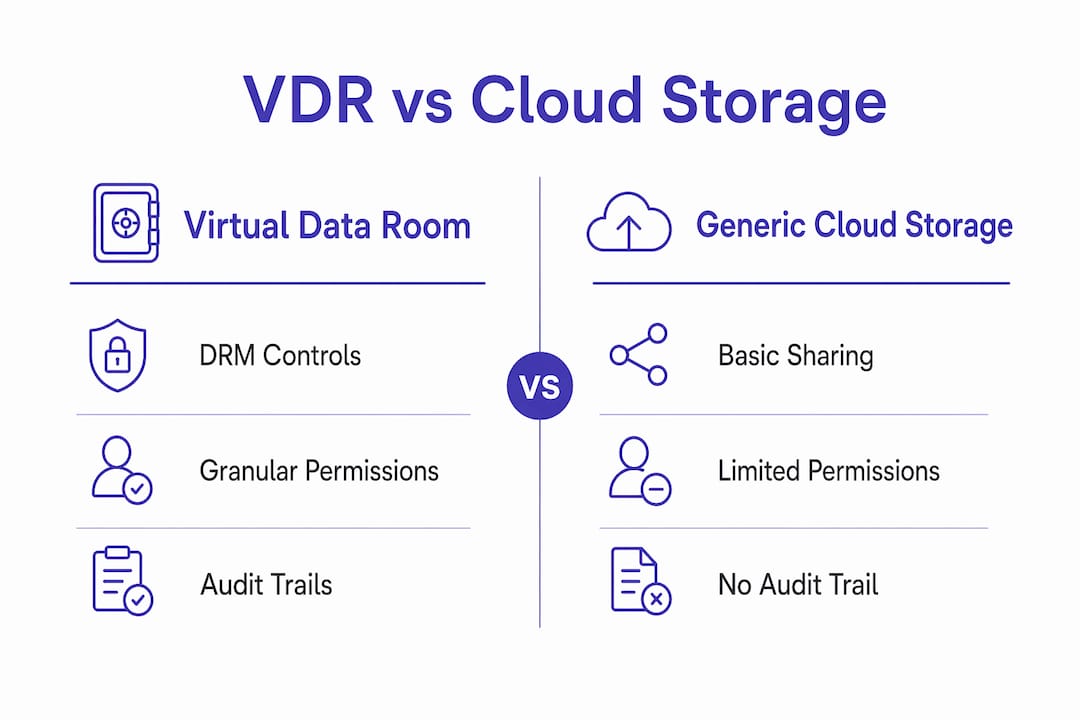
Why VDRs outperform physical data rooms and generic cloud tools
The original data room was a physical space: a locked room full of binders, supervised by lawyers, accessible only during business hours. Buyers flew in, reviewed documents on-site, and took handwritten notes. That model created enormous logistical friction and cost.
VDRs replaced that model with time- and location-independent access, letting global stakeholders review materials simultaneously from any device. The practical results are significant:
- Faster deal timelines. Using a VDR reduces the bidding process by approximately 30 days compared to physical data rooms by eliminating scheduling and travel constraints. Thirty days in a competitive auction is the difference between a closed deal and a lost one.
- Lower transaction costs. Physical rooms require physical space, printing, binding, courier services, and on-site supervision. VDRs eliminate all of those line items.
- Stronger confidentiality. A physical room relies on human supervision to prevent unauthorized copying. A VDR enforces controls automatically through DRM and permission settings.
- Full traceability. Every document interaction is logged. That record supports regulatory compliance, internal audits, and post-deal litigation if a dispute arises.
- Parallel review. Multiple buyer teams can access the room simultaneously without interfering with each other. Physical rooms allowed only one team at a time.
Generic cloud storage tools like Google Drive or Dropbox lack the permission granularity, DRM controls, and audit infrastructure that sensitive transactions require. They are built for collaboration, not confidentiality. A VDR is built for the opposite priority: maximum control over who sees what and when.
Where VDRs are used: fundraising, M&A, and beyond
VDRs have become the standard infrastructure for any transaction where document confidentiality and access control are non-negotiable. Global stakeholders use VDRs to review materials simultaneously, which accelerates timelines across borders and time zones.
The most common use cases include:
- Mergers and acquisitions: The buyer’s legal and financial teams conduct due diligence inside the VDR. The seller controls exactly which documents each team can access and for how long.
- Venture capital and private equity fundraising: Founders share financial models, cap tables, and legal agreements with investors through a controlled room. Investors cannot forward documents to unauthorized parties.
- Initial Public Offerings: Companies preparing for an IPO use VDRs to share prospectus drafts and regulatory filings with underwriters, legal counsel, and the SEC.
- Legal document management: Law firms use VDRs to share discovery materials, contracts, and privileged communications with opposing counsel under strict access controls.
- Investor relations Q&A: Ongoing investor relations programs use VDRs to manage shareholder inquiries through a tracked, auditable Q&A system.
- Cross-border transactions: International deals involve participants across multiple jurisdictions. VDRs provide a single, compliant environment that meets data residency and privacy requirements in multiple regions.
For startup founders specifically, the fundraising use case deserves attention. Sending a pitch deck as a PDF email attachment gives you zero visibility into whether the investor opened it, read it, or forwarded it. A purpose-built raise room, like the one BabyLoveRaise provides, records per-slide engagement and notifies you the moment an investor opens the deck. That is a fundamentally different information position than going dark after hitting send.
How to choose the right VDR: pricing and selection criteria
VDR pricing in 2026 starts around $199/month for entry-level plans, with costs scaling based on user count, data volume, and the depth of security features required. Enterprise platforms serving large M&A transactions can run several thousand dollars per month.
The right selection criteria depend on your transaction type. A startup running a seed round has different needs than a private equity firm managing a $500 million acquisition. The table below maps key evaluation criteria to the two most common buyer profiles.
| Evaluation criterion | Startup fundraising | M&A / enterprise deal |
|---|---|---|
| User count | 5–20 investors | 50–200+ participants |
| Data volume | Low (decks, financials) | High (full data room) |
| DRM controls | Watermarking, view-only | Full DRM, access revocation |
| Q&A module | Basic | Advanced routing and tracking |
| Compliance certifications | SOC 2 Type II | SOC 2, ISO 27001, GDPR |
| Pricing model | Per raise or per month | Per seat or enterprise contract |
Beyond price, evaluate three things before signing a contract. First, test the platform’s Q&A module with a real workflow. Second, confirm the vendor’s compliance certifications match your industry’s requirements. Third, check whether the platform offers a permanent archive after the deal closes, or whether your documents disappear behind a paywall.
Pro Tip: Request a live demo with your actual document types, not a vendor-prepared sample set. A VDR that handles clean PDFs perfectly may struggle with large Excel models or CAD files. Test your real materials before committing.
Key Takeaways
A VDR is the only document-sharing infrastructure that combines DRM controls, granular permissions, and full audit trails into a single platform built specifically for high-stakes business transactions.
| Point | Details |
|---|---|
| VDR definition | A VDR is a secure, cloud-based repository for sharing confidential documents during transactions like M&A and fundraising. |
| Core security advantage | DRM controls allow access revocation after download, going far beyond standard encryption or cloud storage. |
| Time savings | VDRs reduce transaction timelines by approximately 30 days compared to physical data rooms. |
| Q&A is the bottleneck | Built-in Q&A modules prevent duplicate questions and keep deal momentum from stalling. |
| Pricing entry point | VDR solutions start around $199/month in 2026, scaling with user count, data volume, and security depth. |
Why the Q&A module is the feature founders underestimate most
Most founders evaluating a VDR focus on security features and price. That is the wrong starting point. Security is table stakes. Every credible platform offers AES-256 encryption and role-based access. The feature that actually determines whether a deal moves fast or stalls is the Q&A module.
I have watched deals slow to a crawl because investor questions were managed over email. The seller’s team received the same question from three different buyer representatives, answered each one separately, and created three slightly different responses that later became a source of confusion. A proper Q&A module prevents that entirely. It flags duplicates, routes questions to the right expert, and creates a single auditable record of every question and answer.
The second thing founders consistently underestimate is what happens after the deal closes. Most enterprise VDR platforms charge ongoing subscription fees to maintain access to your own documents. That is a real cost that compounds over time. A platform that converts your room to a permanent archive at no additional cost is worth more than its monthly price suggests.
My honest advice for early-stage founders: you do not need a full enterprise VDR for a seed or Series A raise. You need per-slide engagement data, a watermark on downloads, and a clear record of which investors actually read your deck. That is a different product category, and it is priced accordingly.
— Paul
BabyLoveRaise: a raise room built for founders, not enterprises
Founders running a fundraise do not need the same infrastructure as a private equity firm managing a $200 million acquisition. They need to know who opened the deck, which slides held attention, and which investors read to the end.
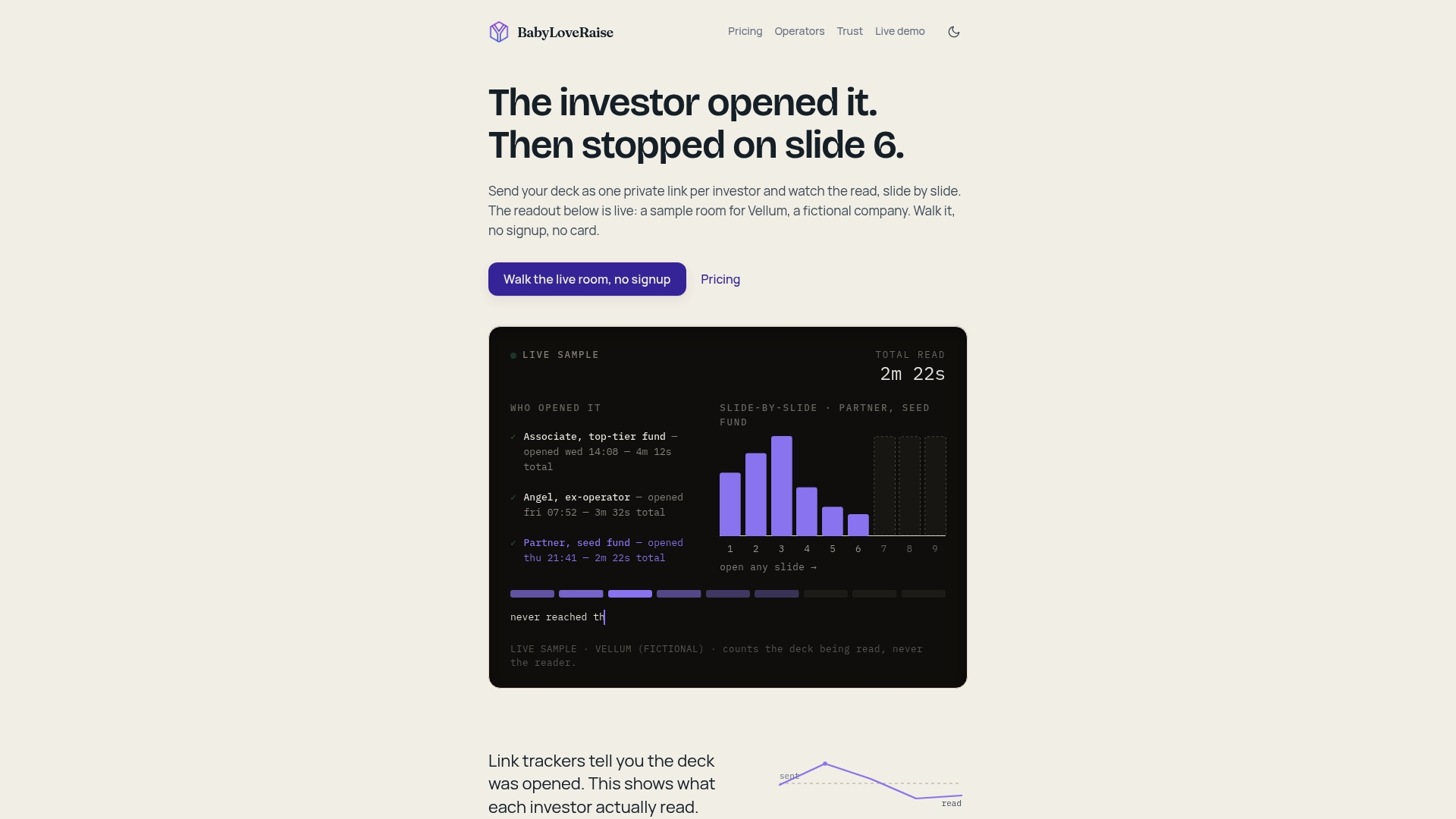
BabyLoveRaise gives founders a hosted raise room that records per-slide engagement, notifies you on first read, and turns the silence after you send a deck into two distinct states: “never opened” versus “read everything and passed.” Share links come in three registers, downloads carry a measured watermark, and when the raise closes, the room converts to a free permanent archive. Fractional CFOs and advisory firms can run firm-branded rooms across multiple client raises through the white-label Operator tier. Start your raise room and know exactly where your investors stand.
FAQ
What does VDR stand for in business?
VDR stands for Virtual Data Room. In business, it refers to a secure, cloud-based platform for storing and sharing confidential documents during transactions like M&A, fundraising, and IPOs.
How is a VDR different from Google Drive or Dropbox?
A VDR includes DRM controls, granular user permissions, dynamic watermarking, and full audit trails. General cloud storage tools prioritize easy sharing and lack the access controls required for sensitive business transactions.
What is the typical cost of a VDR in 2026?
VDR pricing starts around $199/month for entry-level plans, with enterprise solutions scaling significantly higher based on user count, data volume, and compliance requirements.
Do I need a VDR for a startup fundraise?
A full enterprise VDR is rarely necessary for early-stage fundraising. Founders benefit more from a purpose-built raise room that tracks per-slide engagement and investor activity, which is what BabyLoveRaise provides at a fraction of enterprise VDR pricing.
What security standards should a VDR meet?
A credible VDR should hold SOC 2 Type II certification at minimum, apply AES-256 encryption at rest, use TLS for data in transit, and offer DRM controls that allow access revocation after a document has been downloaded.