
Pitch Deck Examples That Win Investor Funding
Discover winning pitch deck examples from top startups. Learn what made Airbnb, DoorDash, and others succeed in securing funding.
July 9, 2026 · 9 min read

A pitch deck is a structured presentation founders use to win investor confidence by showcasing traction, market opportunity, and team credibility in 10–14 slides. The best pitch deck examples share a common architecture: a 30-second hook, one metric per slide, bottom-up market math, and a specific ask. Airbnb, DoorDash, Anthropic, and Slack each raised hundreds of millions using decks that prioritized story clarity over visual polish. This article breaks down what made those decks work, how to analyze any investor presentation for lessons, and how to apply those lessons to your own raise.
1. Top pitch deck examples from legendary startups
The most studied investor presentations share one trait: they convince investors the company deserves to exist, not just that it has a good product. That framing changes everything about how a deck reads.
Airbnb raised $600,000 in 2009 with a deck that was, by design standards, unremarkable. The slides were simple, text-heavy, and direct. What made it work was the problem framing: hotels are expensive and impersonal, and millions of people have spare rooms. The solution followed naturally. Narrative arc outweighs visual sophistication in investor decisions, and Airbnb’s deck proved it before anyone coined the phrase.

DoorDash built a $101 billion company on a deck that treated food delivery as logistics infrastructure, not a convenience app. That single positioning shift changed how investors perceived the market size. The traction slide was the anchor: 31% week-over-week order growth and a 24-minute reduction in delivery times. Those two numbers told investors everything about product-market fit without a single projection.
Anthropic took a different approach entirely. The deck sold inevitability. AI was coming regardless, so the question was whether it would be built safely. Anthropic raised $20B at a $350B valuation by positioning safety as a product moat, not a compliance checkbox. That framing attracted institutional capital that would have ignored a feature-focused AI pitch.
Slack led with behavior change, not software features. The deck showed how internal communication was broken and why email was the wrong tool for teams. The product was the fix, and the traction numbers confirmed adoption was real.
- Hook slide: one sentence that names the broken thing
- Problem slide: evidence the problem is large and underserved
- Solution slide: your fix, stated plainly
- Traction slide: one or two metrics that prove people want it
- Market slide: bottom-up math, not top-down projections
- Team slide: why you are the right people to solve this
- Ask slide: specific dollar amount and what it funds
Pro Tip: Study the traction slide first when reviewing any pitch deck. If the traction slide is vague or missing, the rest of the deck is speculation.
2. How to analyze pitch deck examples for your own raise
The goal of studying other decks is not to copy their slides. The goal is to identify the decisions that made investors say yes, then apply that logic to your own story.
Start with the hook. A strong hook names a broken system in one sentence. DoorDash named slow, unreliable local delivery. Airbnb named expensive, impersonal hotels. If you cannot state your broken system in one sentence, your deck is not ready.
Next, check the traction slide. Investors favor decks with concrete traction metrics like week-over-week growth or measurable performance gains. Vague claims like “strong early adoption” do not move investors. A specific number does. If your traction slide has three metrics, cut it to one. The one metric per slide rule exists because information overload causes investor fatigue and dilutes your strongest data point.
Then evaluate the market slide. The most common mistake founders make is citing a top-down TAM figure from an investment bank report. Behavioral or performance-based metrics make far more credible market-sizing arguments. DoorDash used delivery time reduction as a proxy for market efficiency, not a Gartner report. That approach signals founder-level understanding of the business.
Finally, read the ask slide. A weak ask says “we are raising a seed round.” A strong ask names the amount, the runway it buys, and the milestone it funds. Investors need to know exactly what they are being asked to do.
Pro Tip: Print any deck you are studying and read it without the presenter’s voice in your head. If the story does not hold up on paper, it will not hold up in a room.
3. Common slide elements in winning pitch decks
Analysis of 500+ funded pitch decks from 2024 to 2026 shows that successful presentations consistently cover the same core investor questions across 10–14 slides. The order and emphasis vary by stage, but the questions are always the same.
The eight slides that do the most work
- Hook — one sentence naming the broken system or underserved need
- Problem — evidence the problem is real, large, and painful
- Solution — your product, stated plainly, without jargon
- Market — bottom-up math showing the revenue opportunity
- Traction — one primary metric proving people want the product
- Business model — how you make money, simply stated
- Team — why your specific backgrounds make you the right founders
- Ask — the exact amount, runway, and milestone it funds
| Slide | Common mistake | Better approach |
|---|---|---|
| Hook | Generic problem statement | Name the broken system in one sentence |
| Traction | Multiple metrics with no context | One metric with a clear trend line |
| Market | Top-down TAM from analyst reports | Bottom-up math from your own unit economics |
| Team | List of credentials | Specific past experience that maps to this problem |
| Ask | Vague funding range | Exact amount, runway in months, and key milestone |
The team slide deserves special attention. Investors fund people as much as ideas. The strongest team slides do not list degrees. They show specific past experience that maps directly to the problem being solved. A founder who ran logistics at a major retailer has a credible claim to build a logistics startup. That connection should be explicit, not implied.
4. How pitch deck examples differ by stage and sector
A seed-stage deck and a Series A deck are not the same document. They answer different investor questions because investors at each stage have different risk tolerances.
Seed stage decks lead with vision and problem-solution fit. Traction is often early, so founders compensate with founder insight and market conviction. The deck should answer: why does this problem exist, why has no one solved it well, and why are you the right team to fix it? Slide count typically stays at 10–12.
Series A decks shift emphasis to traction and market validation. Investors at this stage want to see that the product works, that customers pay for it, and that the unit economics make sense. Projections become more relevant here, but only when grounded in actual cohort data.
Growth stage decks focus on defensibility and scale. The question changes from “can you build this?” to “can you own this market?” Competitive moat, retention data, and expansion revenue become the headline metrics.
Sector differences matter just as much as stage:
- AI and deep tech decks benefit from safety or infrastructure framing, as Anthropic demonstrated. Feature lists do not move institutional investors in this space.
- Logistics and marketplace decks need operational metrics: delivery times, fill rates, take rates. DoorDash’s deck is the template.
- Healthtech decks require regulatory awareness. Investors want to see that founders understand the approval pathway, not just the clinical opportunity.
- SaaS decks live and die by net revenue retention and payback period. A strong NRR number on the traction slide signals product stickiness better than any feature description.
Adapting your deck to your audience’s sophistication level is not about dumbing it down. It is about leading with the metrics that matter most to that specific investor at that specific stage.
Key takeaways
The strongest pitch decks win on story clarity and one credible metric per slide, not on design or slide count.
| Point | Details |
|---|---|
| Hook first | Open with one sentence naming the broken system your startup fixes. |
| One metric per slide | Pick your single strongest traction number and let it stand alone. |
| Bottom-up market math | Size your market using your own unit economics, not analyst reports. |
| Stage-specific emphasis | Seed decks lead with vision; Series A decks lead with traction and unit economics. |
| Team slide specificity | Show how each founder’s past experience maps directly to this problem. |
What I’ve learned from watching founders pitch the same deck twice
The founders who iterate fastest are the ones who know which slides investors actually read. That sounds obvious, but most founders have no idea. They send a PDF, hear nothing, and assume the investor passed. The reality is often that the investor opened the deck, spent 45 seconds on the traction slide, and closed it. The problem was not the company. The problem was that the traction slide did not answer the question fast enough.
The decks I have seen work consistently share one quality: the founder’s voice is present even without the founder in the room. That is not a design trick. It is a writing discipline. Every slide should read like the founder is explaining it directly, not like a consultant assembled it from a template.
The Anthropic example is instructive here. That deck did not sell a product. It sold a worldview: AI is coming, safety is the moat, and this team is the only one positioned to build it responsibly. That kind of conviction cannot be faked with better fonts. It comes from founders who have thought deeply about why their company needs to exist.
My honest advice: stop downloading pitch deck templates and start studying the decisions behind the best decks. Ask why DoorDash led with logistics infrastructure instead of food delivery. Ask why Airbnb’s simple slides worked when polished decks from better-funded competitors did not. The answers are in the positioning, not the pixels.
— Paul
What BabyLoveRaise offers founders building their raise
Sending your deck as a PDF and waiting is the worst way to run a raise. You have no idea who opened it, which slides held attention, and which ones lost the room.
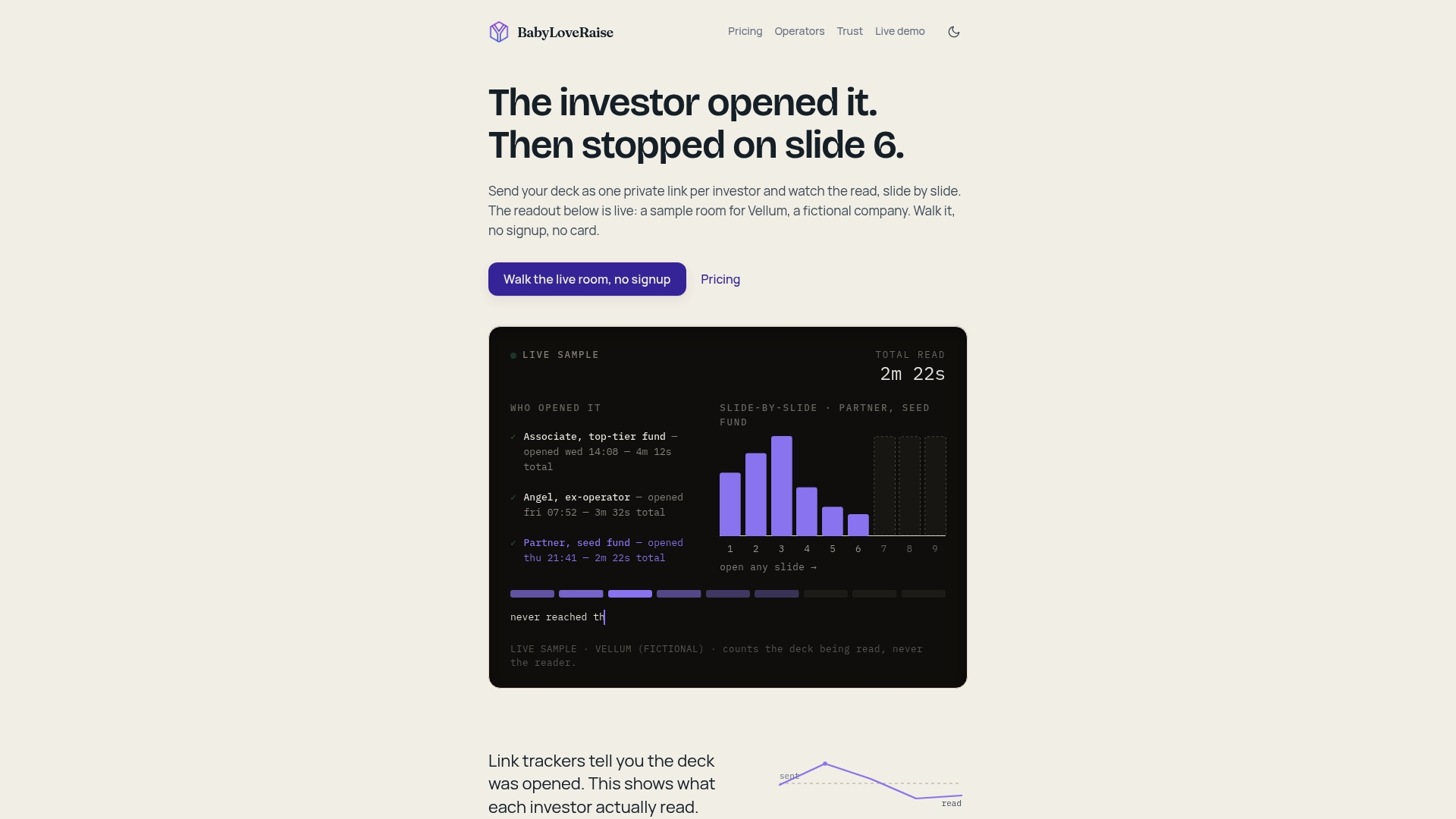
BabyLoveRaise gives founders a hosted raise room where every slide tells you something. You see who opened the deck, how long they spent on each slide, and whether they read to the ask. That per-slide engagement data tells you exactly where to revise and which investors to follow up with first. When the raise closes, the room converts to a free permanent archive. No paywall, no per-seat pricing forever. Just the data you need to raise with confidence.
FAQ
What are the most important slides in a pitch deck?
The hook, traction, and ask slides carry the most weight with investors. Analysis of 500+ funded decks shows that successful presentations consistently cover hook, problem, solution, market, traction, team, and ask across 10–14 slides.
How many slides should a pitch deck have?
Most funded decks run 10–14 slides. Seed-stage decks typically stay at 10–12, while Series A decks may extend to 14 when unit economics and cohort data require more space.
What makes a traction slide convincing?
One specific metric with a clear trend line. DoorDash’s traction slide showed 31% week-over-week order growth and a 24-minute delivery time reduction. Two numbers, no projections, and investors understood the product-market fit immediately.
Should I use a pitch deck template?
Templates are useful for slide structure, but the narrative and metrics must come from your own business. Copying a template without adapting the positioning and traction data produces a generic deck that reads like every other founder’s presentation.
How do pitch decks differ between seed and Series A?
Seed decks lead with vision and problem-solution fit because traction is often early. Series A decks shift to traction, unit economics, and market validation because investors at that stage need proof the business model works at scale.