
Investor Tracking Software: A 2026 Guide for Founders
Discover how investor tracking software can streamline fundraising for founders. Learn core features and strategies for 2026 revenue success.
July 13, 2026 · 10 min read

Investor tracking software is a purpose-built platform that helps startup founders and financial professionals manage fundraising pipelines, institutional relationships, and investor engagement in one place. Unlike a generic CRM, it accommodates the full complexity of institutional investment: multi-year mandates, allocation cycles, committee reviews, and engagement scoring. The difference matters because a standard sales pipeline cannot model a process that spans 12–18 months and requires committee approval before a single dollar moves. This guide covers the core features, pipeline logic, and integration patterns that define effective investor tracking in 2026.
What is investor tracking software and how does it differ from a CRM?
Investor tracking software is defined as a relationship and pipeline management system built specifically for the institutional fundraising process, not adapted from it. A generic CRM tracks leads and deals. Investor tracking tools track mandates, allocation windows, committee structures, and multi-year engagement histories. Those are fundamentally different data models.
The clearest proof of that difference is data depth. Specialized investor CRMs integrate 570,000+ institutional investor profiles enriched from 30+ data sources. That scale of enrichment reflects a core design choice: the software treats each investor as an institution with its own investment thesis, not as a contact record with a phone number.

A standard CRM also assumes a relatively short sales cycle. Institutional fundraising does not work that way. Fundraising pipelines span 12–18 months and involve committee reviews that can stall or restart at any point. Software that cannot model that timeline will lose context, misplace follow-ups, and undercount how close a commitment actually is.
What are the institutional fundraising pipeline stages and why do they matter?
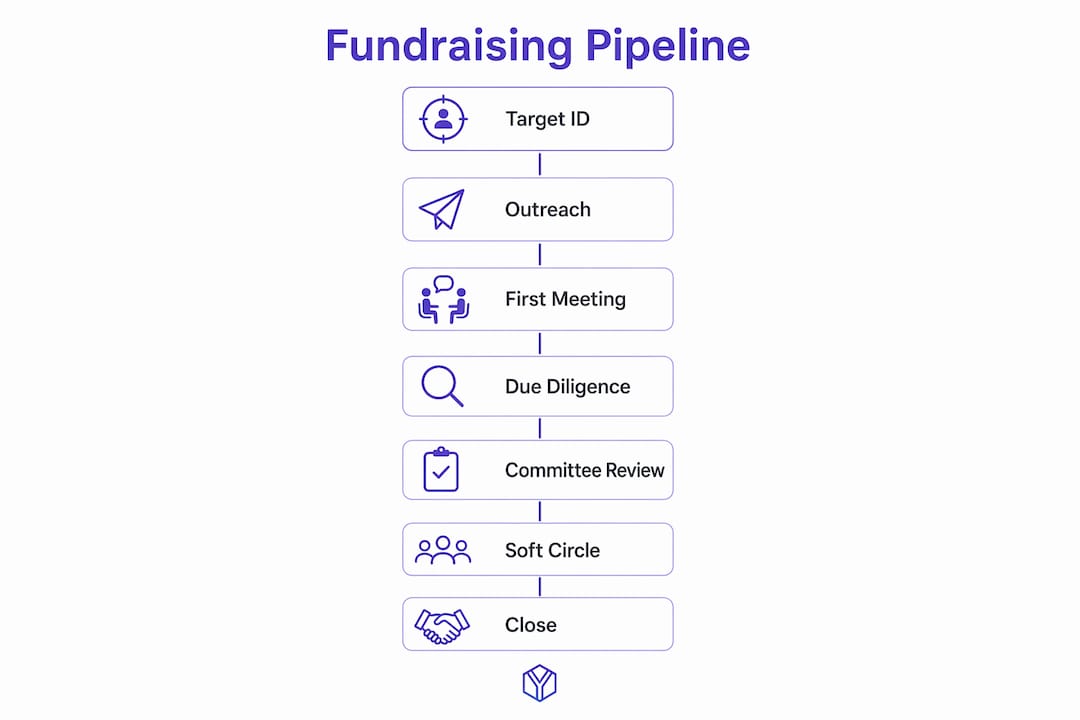
The pipeline stages in investor tracking software reflect how institutional capital actually moves, not how a SaaS deal closes. Stages calibrated to institutional fundraising include Target Identification, NDA exchange, first meeting, due diligence, committee review, soft circle, and hard commitment. Each stage has a distinct exit condition, and none of them can be skipped.
- Target Identification. The investor fits your fund thesis and allocation window. No contact has been made yet.
- Outreach. Initial contact sent. The goal is a first meeting, not a commitment.
- First meeting. Relationship established. The investor has heard the pitch and asked initial questions.
- Due diligence. The investor requests documents, references, and portfolio data. This stage often takes the longest.
- Committee review. The investment committee evaluates the opportunity. The founder has no direct control here.
- Soft circle. The investor signals intent but has not signed. This is not a commitment.
- Hard commitment. Signed subscription documents and capital call scheduled.
The reason these stages matter operationally is velocity. Pipeline velocity data reveals bottlenecks by measuring conversion rates and average time per stage. If investors consistently stall at committee review, that signals a materials problem, not a relationship problem. Founders who track velocity can make that diagnosis in real time rather than after the raise closes.
Pro Tip: Set a maximum number of days for each stage and trigger an automated follow-up when an investor exceeds it. Stale pipeline stages are the most common source of missed commitments.
Institutional pipelines also require a different logic for “lost” deals. A committee rejection is not the same as a disqualified lead. The investor may re-engage in the next fund cycle. Investor tracking tools preserve that history so the relationship survives the rejection.
How integrated investor profiles enhance engagement and lead qualification
The quality of investor data inside the platform determines the quality of outreach. Enriched profiles give founders the context to reach the right investors with the right message at the right time. Without that context, outreach is guesswork dressed up as strategy.
Key data points embedded in enriched institutional profiles include:
- Mandate details. What asset classes, geographies, and fund sizes the investor targets.
- Recent commitments. Which funds they backed in the last 24 months and at what check size.
- Allocation targets. How much capital they plan to deploy in the current cycle.
- Committee structures. Who makes the final decision and what their approval process looks like.
- Engagement history. Every meeting, email, document view, and portal login tied to the investor record.
AI-powered engagement scoring monitors touchpoints like meetings, emails, and document views to surface which investors are warming and which need attention. That scoring replaces the gut-feel assessment that most founders rely on when deciding who to call next.
The practical benefit is prioritization. A founder managing 200 investor relationships cannot give equal attention to all of them. Engagement scoring creates a ranked list based on actual behavior, not perceived interest. The investor who opened your deck three times and downloaded the financials ranks higher than the one who replied “sounds interesting” six weeks ago.
Pro Tip: Cross-reference allocation targets against your fund size before outreach. An investor with a $500M allocation minimum will not write a $2M check regardless of how strong the relationship is.
How investor tracking software supports ongoing investor relationship management
Fundraising ends at close. Investor relationships do not. The most underused capability in investment monitoring platforms is the infrastructure for managing limited partners after the commitment is signed.
Core features for ongoing relationship management include:
- Multi-fund relationship history. A single investor record that spans every fund vintage, capital call, distribution, and communication.
- Engagement timelines. A chronological log of every interaction so new team members can get up to speed without losing institutional memory.
- Automated reporting. Quarterly reports generated directly from portfolio data with document downloads tracked by recipient ID.
- Watermarking and access controls. Sensitive documents carry watermarks tied to the recipient, and access can be revoked after distribution.
- Regulatory reporting. Compliance documents generated automatically and delivered through a secure investor portal.
The reporting automation point deserves emphasis. Fund managers increasingly rely on live reporting generated from portfolio data to reduce operational risk and data fragmentation. Manual report assembly introduces errors and delays. Automated generation from a single data source eliminates both.
Pro Tip: Use engagement data from document downloads and portal logins to time your LP update calls. An LP who just downloaded the quarterly report is primed for a conversation. One who has not opened it in two weeks needs a different approach.
Maintaining institutional memory across team changes is the hidden value of a well-configured investor tracking tool. When a relationship manager leaves, the engagement timeline, meeting notes, and document history stay in the platform. The relationship survives the personnel change because the context is in the system, not in someone’s inbox.
What practical integrations and workflows increase fundraising efficiency?
The efficiency gains from investor tracking software come from integration, not from any single feature. A unified data model spanning fundraising, onboarding, KYC, and reporting eliminates the reconciliation errors that appear when those functions live in separate systems.
Workflows that reduce manual work and errors include:
- Automated follow-up sequences tied to allocation windows and engagement signals, so outreach happens at the right moment without manual scheduling.
- Secure investor portals for document sharing and self-service access to reports, capital call notices, and subscription documents.
- KYC and onboarding integration that pulls investor data from the CRM into subscription workflows without re-entry.
- Fund accounting integration that links commitments, capital calls, and distributions to the investor record in real time.
Separation into disconnected modules leads to increased errors across fund vintages. That finding reflects a real operational cost. Every time a team member copies data from a CRM into a reporting tool, there is a chance for error. A unified platform removes that step entirely.
The comparison between integrated and disconnected workflows is straightforward. Disconnected systems require manual data transfers, create version control problems, and force context switching between tools. An integrated platform maintains a single investor record that updates automatically as the relationship progresses from outreach to commitment to ongoing reporting.
For founders who are earlier in the process and focused on pitch deck engagement before a full CRM is warranted, secure document sharing is the foundational layer. Knowing which investors read your deck, which slides held their attention, and whether they forwarded it gives you the same signal quality as a formal engagement score, at a fraction of the infrastructure cost.
Key Takeaways
Investor tracking software works because it models the full institutional fundraising lifecycle, from first outreach through multi-year LP relationship management, in a single data environment.
| Point | Details |
|---|---|
| Pipeline stages reflect institutional logic | Use the seven-stage model (Target ID through hard commitment) to track real fundraising progress. |
| Velocity metrics expose bottlenecks | Measure average time per stage to diagnose materials or relationship problems before the raise closes. |
| Enriched profiles drive prioritization | AI engagement scoring ranks investors by actual behavior, not perceived interest. |
| Unified data model prevents errors | Connecting fundraising, onboarding, and reporting in one platform eliminates reconciliation mistakes. |
| Institutional memory outlasts personnel | Engagement timelines and document history in the platform protect relationships through team changes. |
What I’ve learned about the gap between fundraising tools and investor management
The most common mistake I see founders make is treating fundraising and investor management as the same problem. They are not. Fundraising is a pipeline problem. Investor management is a relationship problem. The tools that solve one do not automatically solve the other, and conflating them leads to gaps that show up at the worst possible time.
The practical consequence is this: a founder who closes a fund using a lightweight pipeline tool and then tries to manage LP relationships in the same spreadsheet will eventually lose context. A capital call goes to the wrong address. A quarterly report goes out without the right watermark. An LP who asked a specific question six months ago gets a generic update. None of these are catastrophic in isolation, but they compound into a reputation problem over time.
The founders who avoid this pattern are the ones who think about pitch deck tracking as the first layer of a longer engagement system, not as a standalone tool. They start tracking engagement at the deck stage, carry that data into the pipeline, and eventually connect it to an investor management platform that handles reporting and compliance. The data thread runs from first read to final distribution.
My advice for tool selection is simple. Ask whether the platform can model a committee review that stalls for three months without losing the relationship. Ask whether it maintains a single investor record from outreach through ongoing reporting. If the answer to either question is no, you will eventually build workarounds that cost more than the tool saved.
— Paul
BabyLoveRaise and the first layer of investor tracking
Effective investor tracking starts before the CRM. It starts the moment you send your pitch deck.
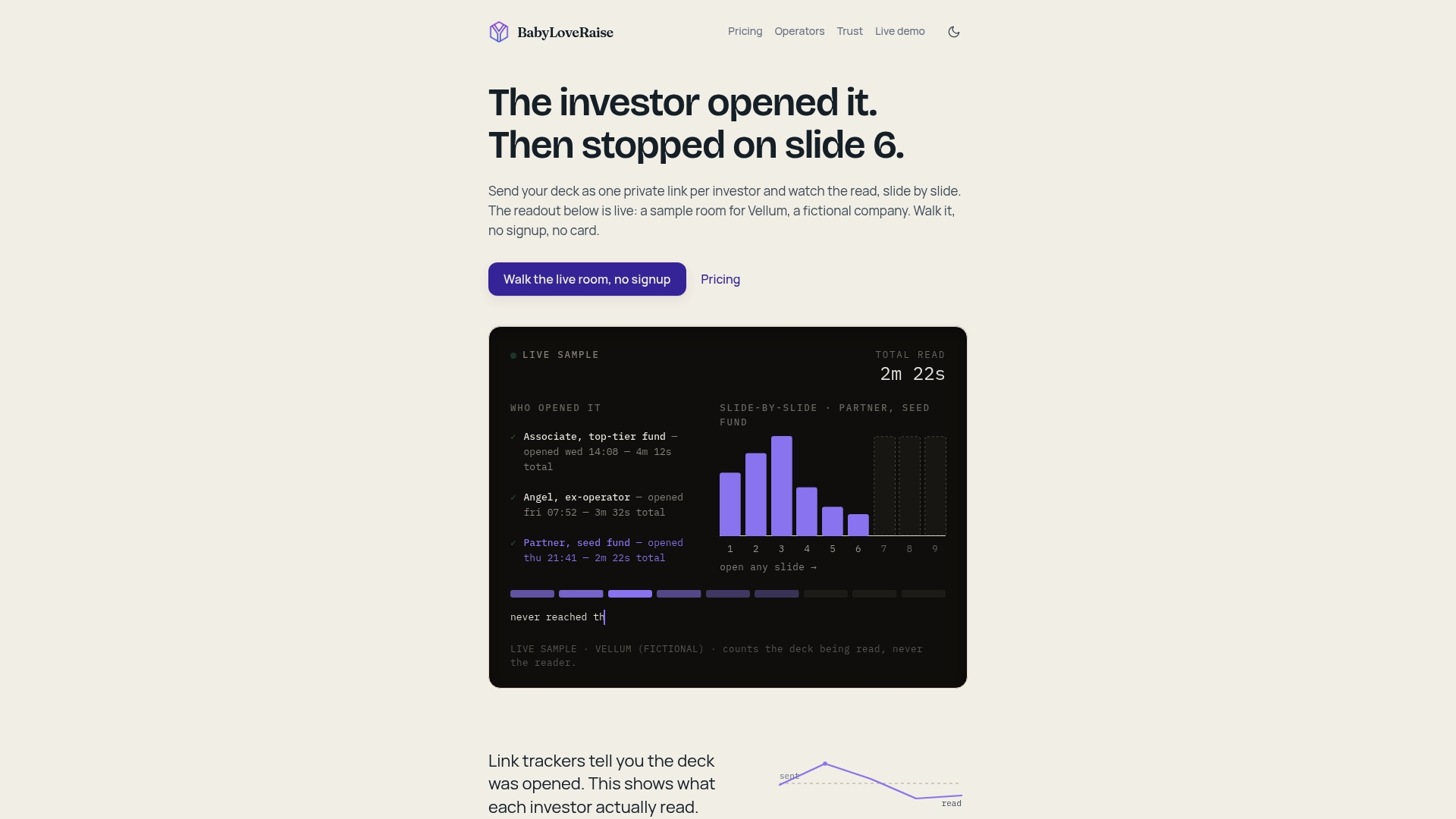
BabyLoveRaise gives founders a hosted raise room that records per-slide engagement from the first read. You see who opened the deck, which slides held attention, and whether the investor read to the end or dropped off at slide four. That data tells you whether a follow-up is warranted and which part of your narrative needs work. Share links come in three registers, downloads carry a watermark, and when the raise closes the room converts to a permanent archive. For founders who want to understand how BabyLoveRaise is priced relative to full virtual data room solutions, the pricing page breaks it down clearly. Fractional CFOs and advisory firms can also run firm-branded rooms across multiple client raises through the Operator tier.
FAQ
What is investor tracking software used for?
Investor tracking software manages fundraising pipelines, institutional investor relationships, and LP reporting in one platform. It replaces disconnected spreadsheets and generic CRMs with a system built around the institutional investment process.
How is investor tracking software different from a standard CRM?
A standard CRM models short sales cycles with individual contacts. Investor tracking software models multi-year institutional relationships with mandate data, allocation cycles, committee structures, and engagement scoring built in.
What pipeline stages should investor tracking software include?
The seven core stages are Target Identification, outreach, first meeting, due diligence, committee review, soft circle, and hard commitment. Each stage reflects a distinct institutional decision point with its own exit condition.
How does AI engagement scoring work in investor tracking tools?
AI engagement scoring monitors touchpoints including meetings, emails, document views, and portal logins to rank investors by actual behavior. It surfaces which relationships are warming and which need attention without requiring manual assessment.
Can investor tracking software handle post-close LP management?
Yes. The best platforms maintain a single investor record from outreach through ongoing reporting, covering capital calls, distributions, quarterly reports, and regulatory filings. A unified investor record is the standard for avoiding errors across fund vintages.