
What Is a Digital Sales Room? A Startup Guide
Discover what a digital sales room is and how it can transform your sales process. Centralize your deal content and track engagement now!
July 16, 2026 · 9 min read

A digital sales room (DSR) is a secure, branded online workspace where sellers centralize all deal content, from pitch decks to contracts, into a single shareable link that tracks buyer engagement in real time. The term “virtual sales space” appears in some contexts, but “digital sales room” is the recognized industry standard used by Gartner and sales enablement professionals. For startup founders and fundraising professionals, a DSR solves a specific and painful problem: you send your pitch deck into the void and hear nothing. A DSR tells you exactly who opened it, which slides held attention, and which investors dropped off before slide three.
What is a digital sales room and how does it work?
A digital sales room functions as a secure microsite where sellers replace disconnected email attachments and file-sharing links with one centralized, trackable URL. Instead of a PDF buried in an inbox, your investor sees a branded workspace containing your deck, financial model, team bios, and any supporting documents you choose to include. The content lives in one place, updates in real time without breaking the link, and records every interaction.

The core mechanics separate a DSR from a simple file share. When an investor opens your room, the platform logs who viewed it, how long they spent on each section, whether they returned for a second look, and whether they forwarded the link to a partner. That behavioral data turns a silent inbox into a readable signal. Buyer engagement analytics replace the guesswork of “did they read it?” with a concrete record of what actually happened.
Most DSR platforms include these core features:
- Per-slide or per-section engagement tracking showing exactly where attention peaked or dropped
- Multiple share link types (first send, forwardable, private) to control who accesses what
- Real-time content updates so you can swap a slide without resending anything
- Commenting and collaboration tools for buying committees or co-investors to discuss internally
- CRM integration to push engagement data directly into your deal pipeline
Pro Tip: Set up a forwardable link as your default share. When an investor passes it to a partner, you see the new viewer’s engagement separately, revealing stakeholders you never knew existed.
What are the key benefits of digital sales rooms for startups?
The primary benefit of a DSR is converting two identical silences into two different signals. “Never opened it” and “read everything and passed” look the same in your inbox. They require completely different responses. A DSR separates them, so your follow-up goes to the right person with the right message at the right moment.
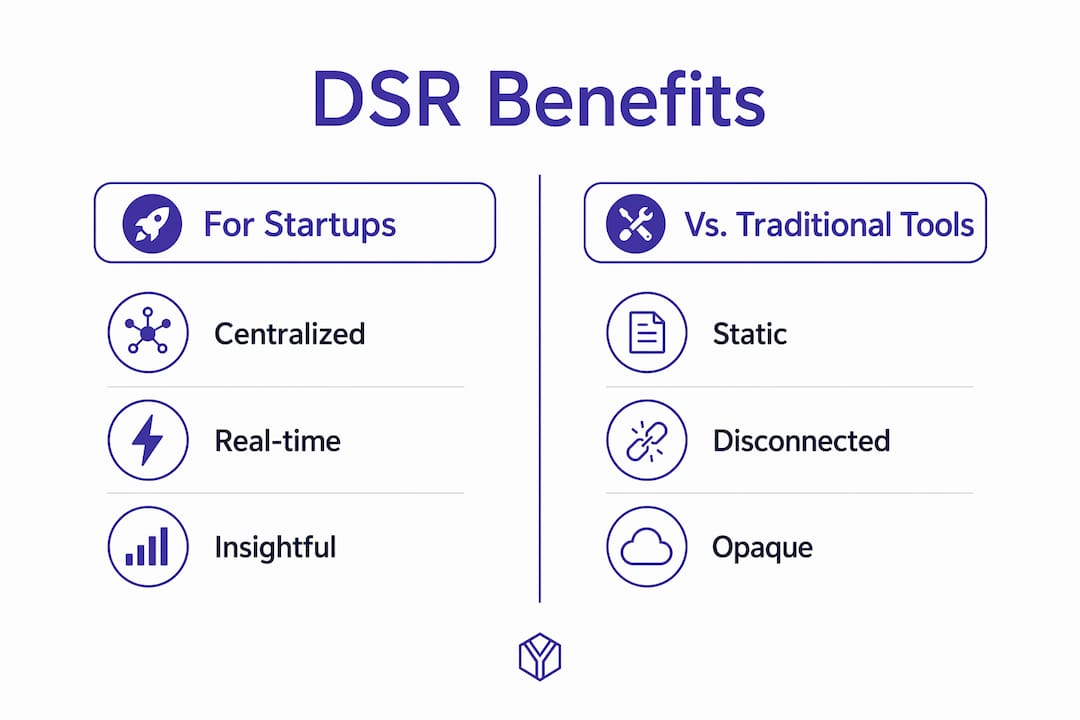
DSRs shift the process from document delivery to buyer enablement by creating a single source of truth for every stakeholder in a deal. In a fundraising context, that means a lead partner, a junior associate, and a CFO can all access the same room at their own pace, without you needing to send three separate emails with three separate attachments. The room holds the conversation together.
The strategic benefits for founders and fundraisers include:
- Reduced deal friction. One link replaces a chain of email threads, version-controlled PDFs, and “can you resend that?” requests.
- Personalized follow-ups. Engagement data identifies exactly where a prospect lost interest, so your next message addresses that specific slide or concern.
- Multi-stakeholder visibility. You see which members of an investment committee engaged and which never opened the room, letting you prioritize outreach accurately.
- Transparent collaboration. Investors can comment, ask questions, or share materials internally without the conversation fragmenting across email threads.
“Digital sales rooms transform the sales process from reactive document delivery into proactive buyer enablement, aligning all stakeholders and reducing deal friction.”
That shift matters most at the early stage, when a solo founder has no co-founder to read the room in a live pitch. Per-slide dwell time becomes a proxy for that missing second opinion.
How do digital sales rooms compare with email, proposals, and CRMs?
Email and static PDFs have one fatal flaw for fundraising: they go dark the moment you hit send. You have no visibility into whether the attachment was opened, forwarded, or deleted. Proposal software improves on this by adding e-signature and basic open tracking, but it is built around document management rather than multi-stakeholder deal momentum.
If your primary challenge is document management, proposal software may be simpler. If managing a multi-stakeholder investor journey and maintaining deal momentum is the real problem, a DSR provides meaningfully greater value. The distinction matters because choosing the wrong tool means paying for features you will not use while missing the ones you need.
CRMs occupy a different role entirely. A DSR is a buyer-facing engagement layer; a CRM is the system of record. They are not substitutes. Revenue operations best practices recommend pushing DSR engagement data into your CRM to inform deal-stage assessments, not replacing one with the other. A founder who treats their CRM as a DSR ends up with a database full of guesses about investor intent.
| Tool | Primary function | Engagement tracking | Multi-stakeholder support |
|---|---|---|---|
| Message delivery | None | Manual forwarding only | |
| Proposal software | Document management | Basic open tracking | Limited |
| CRM | Deal record keeping | Activity logging | Internal team only |
| Digital sales room | Buyer engagement hub | Per-section analytics | Full committee visibility |
Pro Tip: Connect your DSR to your CRM from day one. When an investor views your room three times in 48 hours, that signal should automatically update their deal stage, not sit in a separate dashboard you check manually.
How to use a digital sales room effectively as a founder
The most effective digital sales rooms act as concierge experiences that guide investors through your story, rather than passive content dumps. That distinction changes how you build and maintain the room.
Treat your DSR as a living system, not a static repository. Structure content by investor journey stage: problem framing first, then your solution, then traction, then commercials. As a deal progresses, add materials that match where the investor is in their diligence process. A room that looks the same in week one as it does in week six signals that nothing is moving.
Best practices for founders using a DSR:
- Organize by stage, not by document type. Group materials around investor questions, not file categories. “Why now?” belongs before “financial model.”
- Use the Trojan Horse strategy. Send a forwardable link designed to travel within an investment committee. When it does, you see new viewers and can engage them directly before they become silent blockers.
- Read engagement data empathetically. Identify where prospects lose interest to improve your deck, not to pressure investors. A slide with low dwell time is a content problem, not a reason to send a follow-up email that feels intrusive.
- Assign clear ownership. One person is responsible for keeping the room current. Stale content in a DSR signals disorganization to investors who return expecting updates.
- Control download permissions. Watermarked downloads let materials travel while keeping a record of where they go.
Pro Tip: Review your per-slide engagement data before every investor call. If they spent four minutes on your market size slide, lead with that. If they skipped your team slide, address it proactively.
The pitch deck tracking approach that works best treats analytics as a coaching tool for your narrative, not a surveillance mechanism. Founders who use engagement data to improve their story close faster than those who use it only to time follow-up emails.
Key Takeaways
A digital sales room is the most direct tool a founder has for turning investor silence into a readable, actionable signal about deal momentum.
| Point | Details |
|---|---|
| Core definition | A DSR is a secure, branded workspace that centralizes pitch content and tracks per-section engagement. |
| Distinct from email and CRMs | Email goes dark after sending; CRMs record deals internally. A DSR tracks live buyer behavior. |
| Multi-stakeholder visibility | DSRs reveal which investors engaged, forwarded, or dropped off, enabling targeted follow-ups. |
| Living system, not a file dump | Structure content by investor journey stage and update it as the deal progresses. |
| Engagement data as a coaching tool | Use per-slide analytics to improve your deck and personalize conversations, not to pressure investors. |
The part most founders skip entirely
Most founders I talk to treat their first DSR like a prettier Google Drive folder. They upload the deck, share the link, and wait. That approach captures maybe 20% of the value. The real leverage is in the behavioral layer: which slides held attention, who came back for a second session, and whether the link traveled to someone new inside the firm.
The mistake I see most often is building a room for the first send and never touching it again. An investor who returns to your room in week three is signaling active interest. If they find the same content they saw in week one, you have missed a chance to advance the conversation. A DSR should feel like it is tracking the deal alongside you, not sitting still while you do the work elsewhere.
Early-stage founders often worry that engagement tracking feels invasive. The ethical framing matters here: you are reporting on how your document performs, not profiling the person reading it. That distinction shapes how you use the data. Founders who internalize it use analytics to get better at pitching. Founders who miss it use it to send aggressive follow-ups that burn relationships.
For growth-stage raises, the calculus shifts. You have more stakeholders, more diligence materials, and longer cycles. A DSR becomes less of a pitch tool and more of a deal management layer. The per-slide analytics matter less; the multi-stakeholder visibility and content organization matter more. Knowing which partner in a firm is actively reviewing your financials while another has gone quiet is the kind of signal that changes how you run your next meeting.
The bottom line: a DSR is worth the setup time from your very first raise. The data you collect in round one makes you a better founder in round two.
— Paul
How BabyLoveRaise builds your raise room
BabyLoveRaise is built specifically for founders running a fundraise, not for general document sharing. You send one room link, and the platform notifies you the moment an investor opens your deck. The dashboard separates “never opened” from “read every slide and passed,” so your follow-ups go to actual readers.
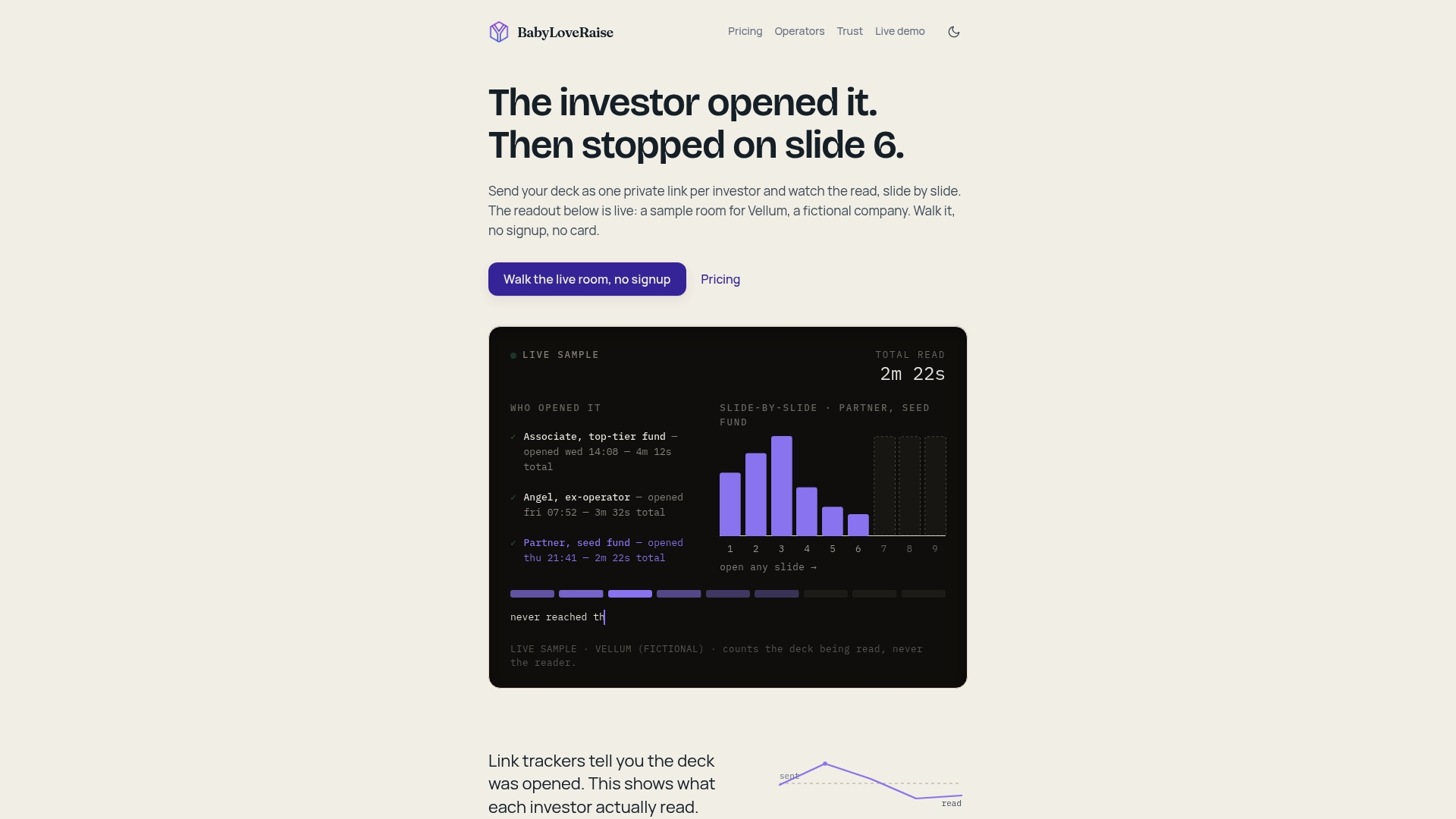
Per-slide dwell time shows you exactly where attention died, so deck revisions target the right slides. Share links come in three registers: first send, forwardable, and private. Downloads carry a watermark. When your raise closes, the room converts to a free permanent archive. See BabyLoveRaise pricing to find the plan that fits your raise, or explore the full platform overview to see how the raise room works end to end.
FAQ
What is a digital sales room in simple terms?
A digital sales room is a secure online workspace where you share your pitch deck and deal materials through one link, and track exactly who viewed them and for how long.
How is a digital sales room different from a CRM?
A CRM stores your deal records internally. A DSR is a buyer-facing tool that tracks how investors actually engage with your content in real time.
What features should a digital sales room have for fundraising?
The core features are per-slide engagement tracking, multiple share link types, real-time content updates, and a dashboard that separates active readers from non-openers.
Can a digital sales room replace email for investor outreach?
No. Email remains the delivery mechanism for your first contact. A DSR replaces the static attachment in that email with a trackable, updatable workspace.
How do I know if a digital sales room is working?
Watch for repeat visits, high dwell time on key slides, and forwarded links reaching new viewers. Those three signals indicate an investor is actively engaged with your raise.