
Custom Pitch Deck Consultant: A Founder's Guide
Discover how a custom pitch deck consultant can elevate your startup. Build compelling investor presentations that secure funding and tell your story.
July 15, 2026 · 10 min read

A custom pitch deck consultant is a specialized expert who works with startup founders to build investor-focused presentations from scratch, combining narrative strategy, content writing, and visual design into a single, fundable document. This role goes far beyond slide formatting. The best consultants follow a three-step process: narrative strategy and argument mapping, content refinement and copywriting, and visual design with data visualization. Founders who treat pitch deck creation as a design task first consistently underperform those who start with story. A pitch deck expert who understands investor psychology gives you a structural advantage before a single slide is built.
How does a custom pitch deck consultant develop your investor narrative?
Narrative architecture is the foundation of every effective pitch deck. Before any slide gets designed, a skilled investor pitch consultant maps the logical flow of your investment story, identifying the core argument, the supporting evidence, and the objections investors will raise before you even finish speaking.
Argument mapping is the specific technique that separates strategic consultants from template services. The consultant identifies the three to five questions every investor asks silently during a pitch: Why this market? Why now? Why this team? Why will this work? Each slide then answers one of those questions directly, in sequence, so the deck reads like a well-built legal brief rather than a product brochure.

Co-creation matters more than most founders expect. Active founder involvement through discovery sessions and iterative feedback improves narrative alignment, which directly increases funding success. A consultant who works without your input produces a deck that sounds polished but misses the specific insight that makes your business defensible.
The narrative-first approach also prevents a costly mistake: spending weeks on visuals before the story is solid. Deft narrative architecture prevents founders from prioritizing aesthetics prematurely, producing decks that look good but lack substance.
Key narrative elements a consultant develops with you:
- The investment thesis: One sentence that explains why your business will generate outsized returns
- Market sizing logic: TAM, SAM, and SOM framed around your specific entry point, not generic industry reports
- Traction framing: Presenting early numbers in the context that makes them meaningful to investors
- Risk acknowledgment: Proactively addressing the two or three objections investors will raise, before they ask
Pro Tip: Lock your narrative outline before you approve a single slide design. If you cannot explain the investment thesis in two sentences after your first strategy session, the deck is not ready for visual production.
What services does a professional pitch deck consultant provide?
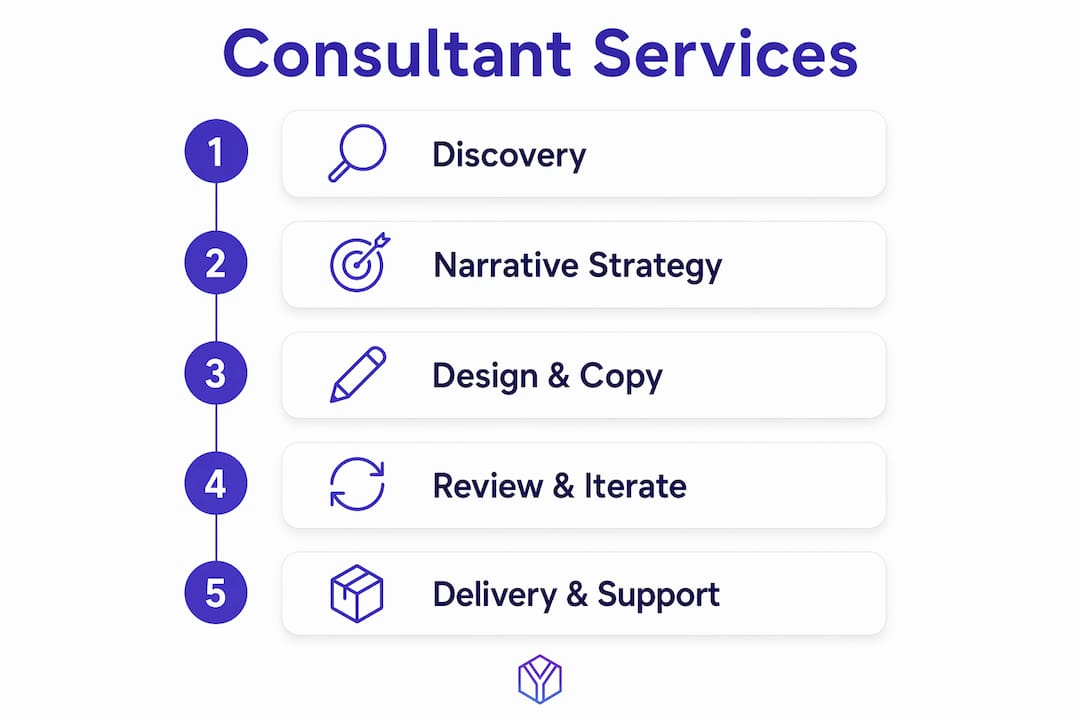
A professional pitch deck service covers four distinct phases, each with specific deliverables that build on the previous one.
-
Discovery phase: The consultant collects raw data, business model documentation, financial projections, and growth goals. Founders must provide this material early so the consultant can identify the strongest narrative angles and flag gaps before writing begins.
-
Content refinement: The consultant rewrites your raw material into investor-grade copy. This means short, direct sentences, specific numbers, and claims that hold up under due diligence. Vague language gets cut. Every slide earns its place.
-
Visual design: A custom presentation designer builds slides that support the story without competing with it. Successful pitch decks balance clarity with polished visuals to simplify complex business models without overwhelming investors. Visuals support the investment story. They do not replace it.
-
Revision rounds: Standard engagements include one to three revision rounds. Revision rounds are the mechanism that aligns the final deck with both the founder’s vision and investor expectations.
| Service tier | Typical startup stage | Turnaround |
|---|---|---|
| Narrative strategy only | Pre-Seed | 3–5 business days |
| Strategy plus content | Seed | 5–7 business days |
| Full service with design | Series A/B | 7–14 business days |
Professional pitch deck services typically deliver projects within a 5–7 business day turnaround, with urgent options available for founders on tight timelines. Pricing tiers scale with startup stage and slide count, so a pre-seed founder pays significantly less than a Series B company with a complex financial story.
One deliverable founders often overlook is the leave-behind version. Founders should prepare two distinct deck versions: a detailed, narrative-dense document for investors reading alone, and a simplified visual version for live presentations. The live deck has fewer words per slide. The leave-behind has more context and supporting data. Using one version for both situations costs you clarity in at least one of them.
Why does choosing the right pitch deck consultant matter?
The difference between a template, a freelance designer, and a strategic consultant is not aesthetic. It is the difference between a document that describes your business and one that argues for your business.
Templates provide structure but lack tailored investor-grade logic. A template tells you to include a “market slide.” A strategic consultant tells you which market framing will resonate with the specific type of investor you are targeting, whether that is a sector-focused VC, an angel syndicate, or a corporate venture arm.
Freelance designers solve a visual problem. Strategic consultants solve a persuasion problem. The distinction matters because most pitch decks that fail do not fail because of bad design. They fail because the investment thesis is unclear, the market sizing is unconvincing, or the traction narrative does not answer the “why now” question.
Consultants with venture capital or fundraising experience understand the critical data points and arguments that drive investor decisions. That experience is not replicable with a template or a generalist designer.
Criteria for evaluating a fundraising presentation consultant:
- Fundraising track record: Ask directly how much capital their clients have raised. Reputable agencies have helped founders raise over $2 billion in combined funding, according to published case studies.
- VC or investor background: Consultants who have sat on the investor side of the table know what triggers a “pass” before the meeting ends.
- Process transparency: A clear, documented process with defined deliverables protects you from scope creep and missed deadlines.
- Founder references: Talk to two or three past clients at your stage, not just the success stories featured on the website.
The greatest misconception in pitch deck creation is that using a template alone is enough. Investors see hundreds of decks built from the same frameworks. What stands out is a business case that is argued, not just described.
How to collaborate effectively with your pitch deck consultant
The quality of your pitch deck is directly proportional to the quality of your input. Founders who treat the engagement as a hand-off, sending raw notes and waiting for a finished product, consistently get weaker results than founders who stay involved.
Active collaboration and feedback rounds produce a pitch deck that holds up under investor scrutiny. That scrutiny is real. Investors ask follow-up questions based on what the deck implies. If the consultant built the narrative without your input, you will struggle to answer those questions fluently.
Practical steps to maximize the engagement:
- Prepare a data package before the first session: Include your financial model, unit economics, customer acquisition data, and any investor feedback you have already received.
- Attend every strategy session: The narrative decisions made in the first two sessions shape everything that follows. Missing them forces the consultant to make assumptions.
- Give specific feedback: “This slide feels off” is not useful. “The market sizing on slide four uses a top-down approach but our investors prefer bottom-up” is useful.
- Set a decision deadline for each round: Revision cycles stall when founders cannot commit to a direction. Agree on a 48-hour feedback window per round before the engagement starts.
Understanding the difference between a presentation deck and a leave-behind deck also changes how you collaborate. The best pitch decks accommodate investor review preferences by offering both detailed and visual versions tailored for different reading contexts. Tell your consultant upfront which version you need first and what the delivery context will be.
Pro Tip: Before your first consultant session, write a one-paragraph answer to this question: “Why will this company be worth ten times its current valuation in five years?” If you cannot write it, the narrative strategy session will surface the gaps. If you can, it becomes the spine of your entire deck.
You can also study pitch deck examples that have secured real funding to calibrate your expectations before the engagement begins.
Key Takeaways
A custom pitch deck consultant delivers the most value when narrative strategy precedes design, and when founders stay actively involved throughout the process.
| Point | Details |
|---|---|
| Narrative before design | Lock your investment thesis and argument map before any slide design begins. |
| Co-creation drives results | Active founder involvement in strategy sessions produces decks that hold up under investor questions. |
| Two deck versions | Prepare a detailed leave-behind and a simplified live presentation version for different investor contexts. |
| Consultant selection criteria | Prioritize fundraising track record and VC experience over design portfolio alone. |
| Revision rounds are standard | Expect one to three revision rounds; build them into your timeline from day one. |
Why I think most founders hire a pitch deck consultant too late
Paul here. After watching hundreds of fundraising rounds, the pattern is consistent: founders hire a pitch deck expert after their first round of investor rejections, not before. By that point, they have already anchored their narrative around the wrong framing, and fixing it takes twice as long as building it correctly from the start.
The other mistake I see constantly is treating the consultant relationship as a vendor transaction. You hand over your notes, they hand back a deck, and you wonder why it does not feel like you. The decks that actually close rounds are the ones where the founder and consultant argued over the investment thesis in session two and came out with something sharper than either of them had going in.
Investor expectations have also shifted. A polished deck is now table stakes. What moves investors in 2026 is a deck that anticipates their objections and answers them before the Q&A. That requires a consultant who thinks like an investor, not just one who designs like a professional. The per-slide engagement data that tools like BabyLoveRaise surface after you send a deck can tell you exactly which slides lost investor attention. That feedback loop, combined with a strong consultant relationship, is how you iterate to a deck that actually closes.
— Paul
How BabyLoveRaise fits into your fundraising process
Once your pitch deck is built, the next problem is knowing what happens after you send it. BabyLoveRaise gives founders a hosted raise room that records per-slide engagement: who opened the deck, which slides held attention, and which got skimmed. That data turns investor silence into a signal you can act on.
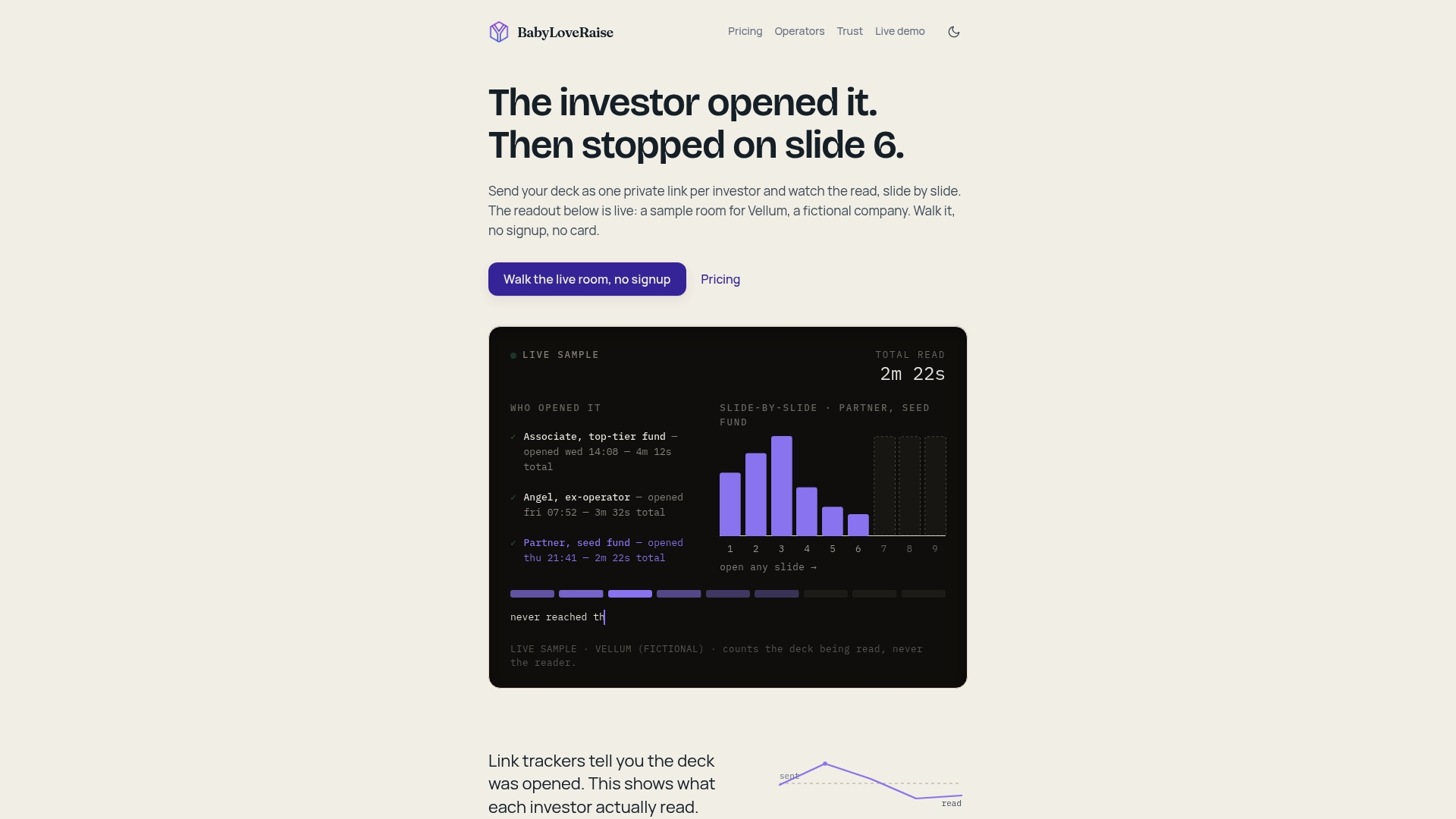
Founders using BabyLoveRaise know whether an investor never opened the deck or read every slide and passed. Those are two completely different follow-up situations, and treating them the same wastes your time. BabyLoveRaise also offers optional concierge services including pitch deck editorial passes and narrative Build Map artifacts for founders who want hands-on help before the deck goes out. Review the pricing options to find the tier that fits your raise stage, and visit the trust page to see how the platform handles investor data responsibly.
FAQ
What does a custom pitch deck consultant actually do?
A custom pitch deck consultant develops your investor narrative, refines your content into investor-grade copy, and oversees the visual design of your pitch deck. The engagement typically covers discovery, content writing, design, and revision rounds.
How long does a professional pitch deck service take?
Most professional pitch deck services deliver within 5–7 business days for standard engagements, with urgent options available. Timelines vary based on slide count, startup stage, and the number of revision rounds included.
Is a template enough, or do I need a consultant?
Templates provide structure but lack the tailored investor logic that persuades sophisticated investors. A strategic consultant builds the argument for your specific business case, which a template cannot do.
How do I know if my pitch deck consultant has the right experience?
Ask for the total capital their clients have raised, request references from founders at your stage, and confirm whether they have direct VC or fundraising experience. Investor-side experience is the strongest signal of deck effectiveness.
What is the difference between a live pitch deck and a leave-behind?
A live presentation deck uses fewer words and stronger visuals for in-room delivery. A leave-behind is a denser, narrative-rich document investors read alone. Using one version for both contexts reduces clarity in at least one situation.