
Data Room Cost: What Founders and CFOs Pay in 2026
Discover the true data room cost in 2026. Understand how pricing models, project factors, and hidden fees can impact your expenses.
July 17, 2026 · 10 min read

Data room cost is the total expense of securing, hosting, and managing confidential documents during critical business transactions, shaped by pricing models, user counts, storage volume, and project scope. Virtual data room (VDR) pricing in 2026 spans four main models: per-user, per-page, flat-rate, and enterprise quote. Most founders and CFOs who experience invoice shock focus on the monthly headline price and ignore the total project cost including setup, overages, and archiving. Getting this right before you sign a contract is the difference between a predictable expense and a bill that doubles mid-deal.
What factors most impact the total data room cost?
Six key cost drivers determine what you actually pay beyond any monthly fee. Founders and CFOs who ignore even one of these often face surprise charges at the worst possible moment in a deal.
- Project length. Longer deals mean more subscription months. A Series B round that drags six months costs twice what a clean three-month close does on a monthly plan.
- User count. Every bidder, advisor, lawyer, and accountant added to the room can trigger a per-user fee. External parties multiply fast in competitive auction processes.
- Document volume. Storage limits and per-page fees scale with the size of your diligence package. A 10,000-page room is a different financial animal than a 500-page seed deck.
- Security level. SOC 2 Type II compliance, dynamic watermarking, and granular permission controls sit in higher pricing tiers. Not every deal needs enterprise-grade security, but many founders pay for it anyway.
- Support access. 24/7 dedicated support and onboarding assistance cost more than self-serve plans. For a first-time founder, the support tier is often worth it. For a repeat CFO, it may not be.
- Archiving and export. After the deal closes, archiving fees can range from $1,000 to $5,000. Most founders never budget for this line item.
Pro Tip: Before signing any VDR contract, map out your expected user list, document count, and deal timeline. Then ask the vendor for a fully itemized quote that covers all six drivers, not just the monthly seat price.
Understanding these drivers lets you build a realistic budget before the deal starts, not after the invoice arrives.
How do common pricing models differ?
Virtual data room pricing falls into four structures. Each suits a different deal profile. Choosing the wrong one is one of the most common and most avoidable data room expenses founders face.

Per-page pricing
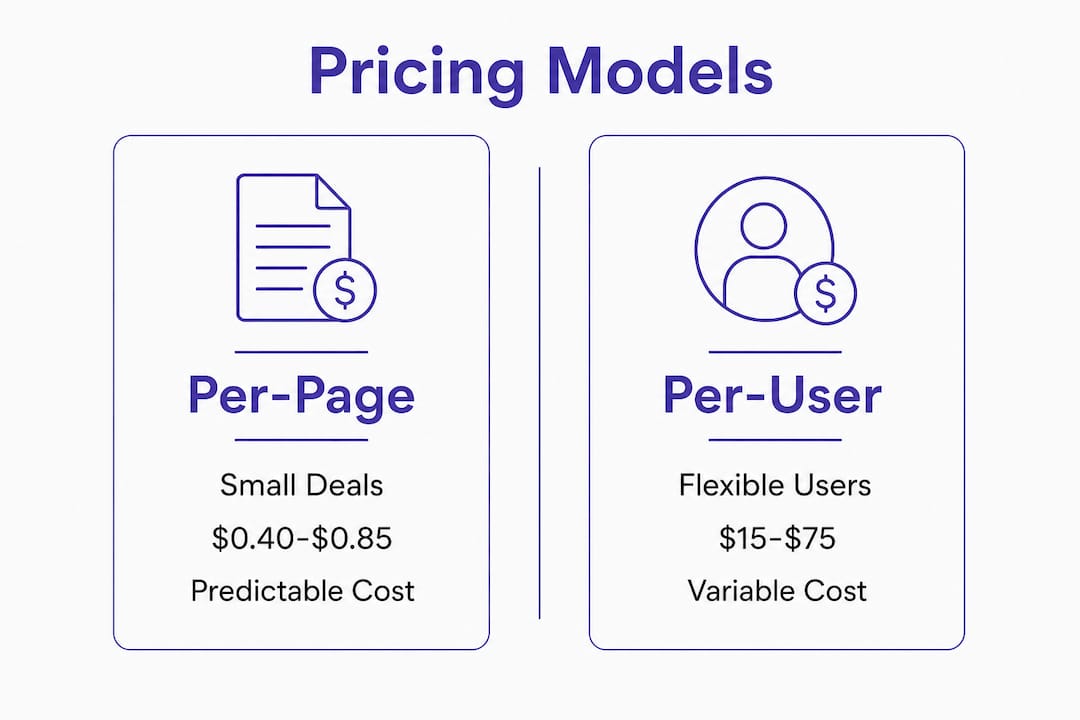
Per-page pricing runs $0.40 to $0.85 per page in 2026. A 10,000-page diligence room costs $4,000 to $8,500 in page fees alone, before any user or support charges. This model made sense when physical document rooms were the norm. For digital deals with large document sets, it creates unpredictable final bills. Avoid it unless your document volume is small and fixed.
Per-user pricing
Per-user pricing typically runs $15 to $75 per user per month, with administrative users billed at the higher end. This model works for small, fixed teams where you control who gets access. It breaks down fast in competitive processes where you add multiple law firms, financial advisors, and bidders. A 30-person diligence process at $50 per user per month adds $1,500 monthly just in seat fees.
Flat-rate pricing
Flat-rate plans range from $2,400 per year for a single-room plan to over $30,000 for multi-room enterprise plans. They include unlimited users and storage, which makes total project cost predictable from day one. For founders running multiple raises or CFOs managing several deals per year, flat-rate is the most financially disciplined choice. The higher entry price looks expensive until you calculate what per-user or per-page fees add up to over a six-month deal.
Enterprise quote pricing
Enterprise quotes customize pricing for complex, large-scale deals. Investment banks, private equity firms, and large M&A processes use this model. Pricing is not publicly listed and requires direct vendor negotiation. The benefit is flexibility. The risk is that the quote process takes time and the final contract often includes terms that favor the vendor on renewals and overages.
| Pricing model | Best for | Cost predictability | Risk |
|---|---|---|---|
| Per-page | Small, low-volume document sets | Low | High overage exposure |
| Per-user | Small, fixed internal teams | Medium | Scales poorly with external parties |
| Flat-rate | Multi-deal founders, CFOs, advisory firms | High | Higher upfront cost |
| Enterprise quote | Large M&A, complex multi-party deals | Variable | Renewal and overage terms |
The right model depends on your deal size, document volume, and how many external parties need access. For most early-stage founders, flat-rate wins on total cost.
What hidden costs should founders and CFOs watch for?
Hidden fees add 20% to 50% above initial quotes. That range is wide because the specific add-ons vary by vendor, but the pattern is consistent. The headline price is rarely the final price.
The most common hidden charges include:
- Setup and onboarding fees. Some vendors charge $500 to $2,000 to configure your room and train your team. Ask for this to be itemized before signing.
- Overage charges. Storage and user limits exist in most plans. Exceeding them triggers per-GB or per-seat fees that compound quickly in active deals.
- Archive and export fees. Closing the room and exporting your documents for long-term storage costs money. Budget $1,000 to $5,000 for this step, especially on complex deals.
- Premium support additions. Dedicated account managers and after-hours support sit behind paywalls in most mid-tier plans.
- Brand customization fees. White-label rooms and custom domain setups often cost extra. Fractional CFOs and advisory firms running client-branded rooms should check this line carefully.
- Renewal and cancellation terms. Auto-renewal clauses and early termination fees can lock you into a second billing cycle even after your deal closes.
Pro Tip: Request a “project-complete quote” in writing before signing. Ask the vendor to include every possible fee for your expected user count, storage volume, deal duration, and post-close archiving. Compare this number across vendors, not the monthly rate.
The cheapest headline price almost always hides the highest overage fees. Total deal cost is the only number that matters.
How to estimate and compare total data room costs effectively
Accurate cost estimation requires a structured approach. Founders and CFOs who skip this step routinely face bills two to ten times their initial quote. Analysis of 3,800+ M&A deals shows that final invoices regularly exceed initial quotes by that margin due to expanding scope and unanticipated fees.
Follow these steps to build a reliable cost estimate:
- List all user roles upfront. Include internal team members, external advisors, legal counsel, and any potential bidders or investors. Assign each a role and check whether the vendor charges differently for admin versus read-only access.
- Estimate document volume. Count your current document set and add a 30% buffer for materials added during due diligence. If you are on a per-page model, calculate the worst-case page count before signing.
- Set a realistic deal timeline. Use your last deal as a benchmark. Add two months as a buffer. Multiply the monthly rate by that extended timeline.
- Request fully itemized quotes. Transparent vendor communication is the single most reliable way to avoid invoice shock. Ask for setup, support, storage, overage, and archiving costs in writing.
- Compare total projected cost, not monthly rates. Build a simple spreadsheet with each vendor’s total cost across your estimated deal duration, user count, and document volume.
For founders managing multiple raises or CFOs running several deals per year, Microsoft 365-native VDRs can reduce total costs by 5 to 10 times compared to legacy per-page platforms. They avoid per-GB storage charges, user fees, and export costs entirely by keeping data within your existing tenant.
For early-stage founders who need a lighter, fundraising-specific solution, BabyLoveRaise offers a raise room priced per raise rather than per seat. That structure eliminates the per-user scaling problem entirely and converts the room to a free permanent archive when the raise closes. You can review data room options for startups to understand which features actually matter at your stage.
Key Takeaways
Total data room cost depends on six drivers: project length, user count, document volume, security level, support tier, and archiving fees. Founders and CFOs who evaluate all six before signing avoid the invoice shock that derails budgets mid-deal.
| Point | Details |
|---|---|
| Total cost beats monthly rate | Always calculate the full project cost including setup, overages, and archiving before comparing vendors. |
| Per-page pricing is high risk | A 10,000-page room can cost $4,000–$8,500 in page fees alone, before any other charges. |
| Flat-rate wins on predictability | Plans from $2,400 per year include unlimited users and storage, making budgeting straightforward. |
| Hidden fees add 20%–50% | Setup, overage, export, and support add-ons routinely inflate final bills well above initial quotes. |
| Fundraising-specific tools save money | BabyLoveRaise prices per raise, not per seat, eliminating user-scaling costs for founders. |
The number founders get wrong every single time
Every founder I have worked with who got burned by a VDR bill made the same mistake. They compared monthly prices. That is like comparing car payments without asking about insurance, fuel, and maintenance. The monthly rate is the least useful number in a data room contract.
The fee that actually hurts is the archiving charge. Deals close, the team exhales, and then a $3,000 invoice arrives to export your own documents. Nobody budgeted for it because nobody asked about it. Ask about it. Put it in writing before you sign anything.
The second thing I have learned is that per-page pricing is a relic that still exists because it is profitable for vendors, not because it serves founders. If a vendor leads with per-page pricing, treat it as a signal about how they think about your relationship. Flat-rate models exist. Use them.
For founders running a single raise, the full enterprise VDR stack is almost always overkill. You do not need SOC 2 compliance and a dedicated account manager to share a pitch deck with 40 investors. You need to know who read it, which slides they skipped, and whether the investor who went quiet actually opened the deck. That is a different product at a different price point. Matching the tool to the actual job is the most underrated cost-control move in fundraising. You can explore misleading pricing practices to know exactly what to watch for when evaluating vendors.
— Paul
BabyLoveRaise pricing for founders and CFOs
Founders and CFOs who want predictable data room expenses without the complexity of enterprise VDR contracts have a direct option.
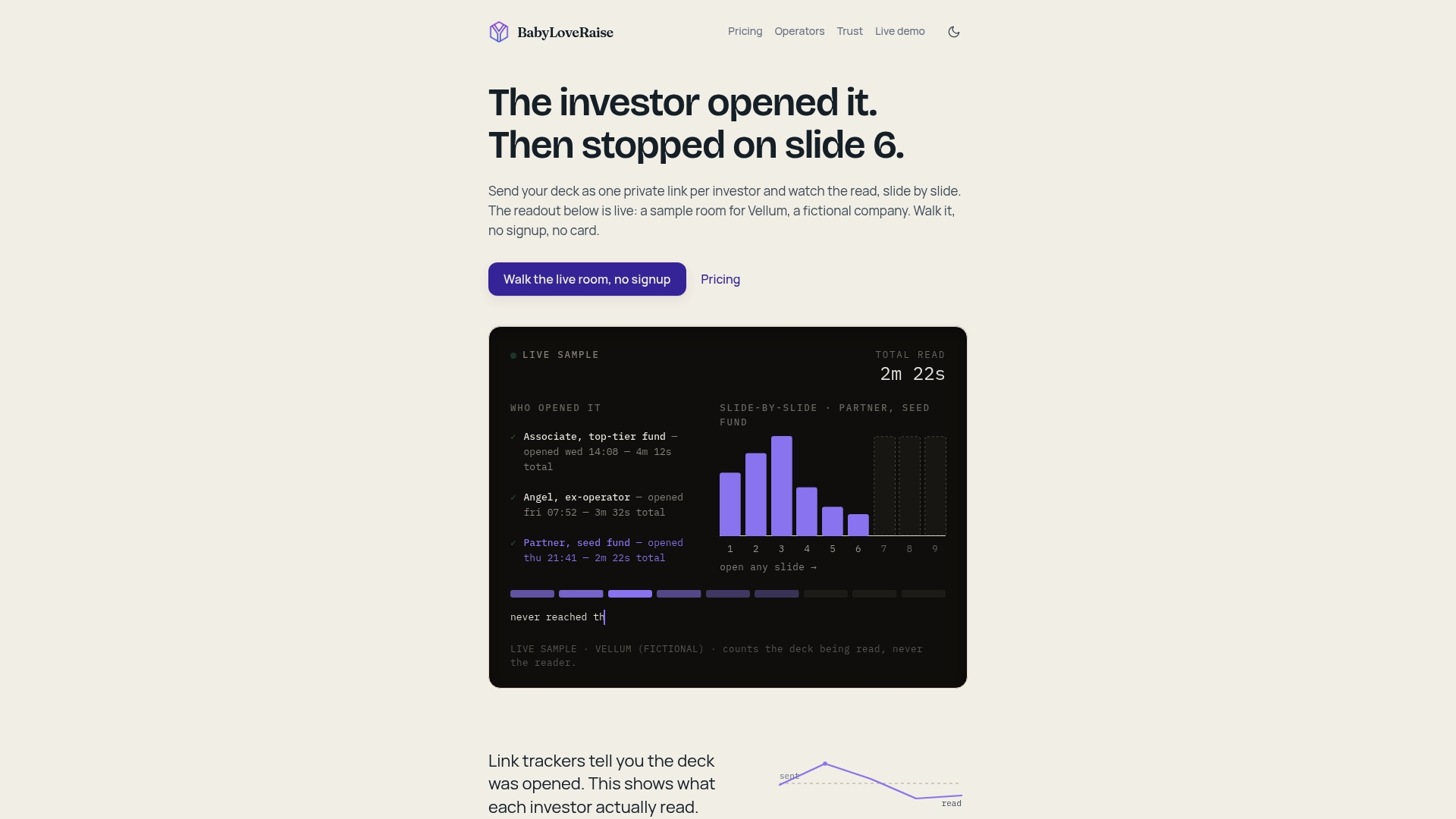
BabyLoveRaise is priced per raise, not per seat, which means adding 40 investors to your room does not change your bill. The platform includes per-slide engagement analytics, three share link types, optional watermarked downloads, and a free permanent archive when the raise closes. There are no archiving fees and no paywall at deal close. For fractional CFOs and advisory firms, the Operator tier runs firm-branded rooms across multiple client raises at a fraction of standard virtual data room pricing. See the full BabyLoveRaise pricing plans to find the right fit for your deal size and budget.
FAQ
What is a typical data room cost in 2026?
Virtual data room pricing in 2026 ranges from $2,400 per year for flat-rate single-room plans to over $30,000 for enterprise multi-room contracts. Per-page and per-user models can push total project costs significantly higher depending on deal complexity.
What hidden fees should I ask about before signing a VDR contract?
Ask specifically about setup fees, storage overage charges, additional user costs, post-close archiving fees, premium support tiers, and auto-renewal terms. Hidden fees routinely add 20% to 50% above the initial quoted price.
Is a free virtual data room a viable option for fundraising?
Free data room options exist but typically cap storage, limit users, and exclude analytics features. For a serious fundraising process where investor engagement data matters, a paid plan with per-slide tracking delivers more value than a free tier.
How do I compare data room fees across vendors accurately?
Request a fully itemized, project-complete quote from each vendor covering your expected user count, document volume, deal duration, and post-close archiving. Compare total projected cost across the full deal lifecycle, not monthly headline rates.
When does flat-rate pricing make more sense than per-user pricing?
Flat-rate pricing makes more sense when your deal involves more than 10 to 15 external parties or when your document volume is large and unpredictable. Per-user pricing only stays affordable when access is tightly controlled and the user list stays small throughout the deal.