
NDA for Startups: A 2026 Practical Guide for Founders
Discover the essential NDA for startup guide. Protect sensitive information and secure your business with this practical 2026 resource for founders.
July 21, 2026 · 13 min read

What is an NDA and why does your startup need one?
A startup confidentiality agreement, formally called a non-disclosure agreement, is a legally binding contract that restricts one or both parties from sharing sensitive business information with outside parties. For startups, that means your source code, financial projections, customer lists, and product roadmap stay protected when you bring in contractors, pitch investors, or negotiate partnerships. Without one, a conversation about your proprietary algorithm is just a conversation, with no legal recourse if the other party walks away and builds something similar.
NDAs for startups typically cover a defined set of recipients and a defined period. General business information usually carries a confidentiality term of two to five years, while trade secrets often receive indefinite protection. The people you will most commonly ask to sign one include:
- Contractors and freelancers who access your codebase, product specs, or internal systems
- Strategic partners exploring integrations, joint ventures, or co-marketing arrangements
- Investors during later-stage due diligence, when you share financials and cap table details
- Prospective employees who see proprietary product details before accepting an offer
Skipping an NDA in any of these situations does not just create legal exposure. It signals to the other party that your information is fair game. A founder who shares a detailed technical architecture with a contractor and has no signed agreement in place has very little standing in court if that contractor later builds a competing product.
How do you draft an effective NDA for your startup?

Drafting a startup NDA does not require a 20-page document. In fact, the opposite is true. Short, industry-standard NDAs of two to three pages get signed faster, generate less back-and-forth, and hold up just as well in court as longer versions, provided the key clauses are present and precise.
Here is what a well-drafted NDA for a startup needs to get right:
- Name the parties correctly. Use the legal entity names, not personal names, unless the individual is signing in their personal capacity. “Acme Technologies, Inc.” is not the same as “John Smith.”
- Define confidential information narrowly but completely. Overly broad definitions (“all information shared”) invite challenges. Name the categories: source code, financial data, customer information, product roadmaps, and any AI training data your startup uses.
- State the purpose of disclosure. The NDA should specify why the information is being shared, for example, “to evaluate a potential development contract.” This limits the receiving party’s use to that purpose only.
- Set realistic term lengths. Two to five years works for most general business information. Overly long terms, anything beyond five years for standard data, discourage counterparties from signing and can signal overreach.
- Include permitted disclosures. Allow the receiving party to share information with their legal counsel, accountants, or advisors who are themselves bound by confidentiality. Failing to include this clause creates friction with sophisticated counterparties.
- Specify governing law and jurisdiction. If your startup is in Delaware and your contractor is in Texas, you need to decide upfront which state’s courts will handle a dispute. Leaving this blank creates expensive ambiguity.
- Add return or destruction obligations. At the end of the relationship, the receiving party should be required to return or destroy confidential materials.
For deals with exposure over $50,000, get a lawyer to review the draft before you send it. A template works fine for routine contractor relationships, but a high-value partnership or a licensing deal with real IP at stake warrants professional review.
Pro Tip: Keep your standard NDA to two pages. A shorter document gets signed in hours rather than days, and in a fast-moving fundraise or hiring process, that speed matters more than you think.
When should you use an NDA in a startup context?

Knowing when to deploy a startup confidentiality agreement is as important as knowing how to draft one. Use it in the wrong situation and you slow down a deal or damage a relationship. Skip it when you should have used one and you lose legal standing.
Use an NDA in these situations:
- Hiring contractors and freelancers. Anyone who touches your codebase, product data, or internal systems should sign before they start. This is the most common and most straightforward use case.
- Negotiating partnerships and joint ventures. When two companies share proprietary information to explore a collaboration, a mutual NDA protects both sides before either commits.
- Vendor relationships involving sensitive data. If a vendor will access your customer database, financial systems, or proprietary processes, an NDA belongs in the contract package.
- Employee onboarding. Most employment agreements include confidentiality provisions that function as an NDA. If yours does not, add one.
- Later-stage investor due diligence. Once an investor moves past the initial pitch and starts requesting financials, cap table details, or technical documentation, an NDA is appropriate and expected.
Skip the NDA in these situations:
- Initial elevator pitches and early investor meetings. Many investors refuse to sign NDAs at this stage, and requesting one signals inexperience or distrust. VCs hear hundreds of pitches; they are not going to steal your idea and build it themselves.
- Public-facing conversations. If you are speaking at a conference or posting on LinkedIn, that information is already public. An NDA cannot retroactively protect it.
- Casual networking. A brief conversation about your general market thesis does not require a signed agreement.
The practical rule: share only what is necessary at each stage, and introduce the NDA when the conversation moves from “what do you do” to “here is how we actually built this.”
What types of NDAs do startups use?
The three primary NDA types are one-way, mutual, and multilateral. Each fits a different situation, and choosing the wrong one creates unnecessary friction.
-
One-way (unilateral) NDA. Only one party discloses confidential information, and only the receiving party is bound by confidentiality obligations. This is the right structure for contractor relationships, where your startup shares information but the contractor does not. It is also appropriate when you are sharing a pitch deck with a potential advisor who has nothing confidential to share in return.
-
Mutual (two-way) NDA. Both parties share confidential information and both are bound. This fits partnerships, joint ventures, and due diligence situations where the other company is also sharing proprietary data. Mutual NDAs tend to be easier to get signed during negotiations because neither party feels like the subordinate party. For partnerships and due diligence, mutual NDAs are generally the founder-friendly default.
-
Multilateral NDA. Three or more parties sign a single agreement. This works for complex collaborations, consortium arrangements, or multi-party licensing deals. The upside is one document instead of multiple bilateral agreements. The downside is that negotiating a single document that satisfies three or more parties takes longer and often requires legal support.
Most early-stage startups will spend the majority of their time with one-way NDAs for contractors and mutual NDAs for partnerships. Multilateral agreements appear less frequently but become relevant as the company scales into more complex commercial relationships.
What are the real limitations of NDAs?
An NDA is a deterrent, not a lock. Understanding what it cannot do is just as important as knowing what it can.
- NDAs do not protect public information. If your idea or method is already publicly known, an NDA cannot retroactively make it confidential. The receiving party can freely use anything they already knew before signing or anything they independently developed without using your data.
- NDAs do not prevent competition. NDAs only restrict disclosure and use of confidential information. They do not stop someone from starting a competing business, hiring your former employees, or building a similar product from scratch. That requires a separate non-compete agreement, and in states like California, non-competes are largely unenforceable anyway.
- NDAs do not assign ownership. A contractor who signs an NDA but not an IP assignment agreement may keep the code they wrote for you confidential and still legally own it. Always pair your NDA with an IP assignment clause or a separate IP assignment agreement.
- Overly broad terms backfire. Clauses that define confidential information as “everything shared in any format” or that impose confidentiality obligations lasting ten or more years tend to deter counterparties and may not hold up in court. Precision matters more than breadth.
- Requesting NDAs too early with investors can stall deals. Most VCs will not sign an NDA before an initial meeting, and pushing one signals that you do not understand how the fundraising process works.
- Enforcement requires documentation. If someone breaches your NDA, you need evidence: what was shared, when, and how the breach occurred. Without a paper trail, even a well-drafted agreement is difficult to enforce.
NDAs work best as one layer of a broader IP protection strategy, not as a standalone shield. Combine them with IP assignments, access controls, and careful information-sharing practices.
What should a standard startup NDA include?
A well-built NDA for a startup covers ten core elements. Miss any of them and you create gaps that a counterparty’s lawyer will find immediately.
- Precise party identification. Full legal names and entity types for both the disclosing party and the receiving party.
- Clear definition of confidential information. Name specific categories: source code, financial data, customer information, product roadmaps, personnel data, and any AI training datasets relevant to your business.
- Purpose of disclosure. State exactly why the information is being shared. This limits the receiving party to using it only for that stated purpose.
- Duration of confidentiality obligations. Two to five years for general business information; indefinite for trade secrets. State both explicitly.
- Permitted disclosures. Allow sharing with legal counsel, accountants, and advisors who are themselves bound by equivalent confidentiality obligations.
- Receiving party obligations. Specify the standard of care required, for example, the same level of protection the receiving party applies to its own confidential information, but no less than reasonable care.
- Exclusions from confidentiality. Carve out information that is already public, independently developed, or received from a third party without restriction. Courts expect these carve-outs; omitting them weakens the agreement.
- Remedies for breach. Include the right to seek injunctive relief (a court order to stop the breach) and monetary damages. Injunctions are particularly important because waiting for a damages trial while confidential information spreads is rarely a viable option.
- Governing law and jurisdiction. Name the state whose laws govern the agreement and where disputes will be resolved.
- Return or destruction of materials. Require the receiving party to return or certify destruction of confidential materials upon request or at the end of the relationship.
A residuals clause is worth considering for technology partnerships. It allows the receiving party to use information retained in unaided memory, which is a common ask from engineers and developers. Whether to include it depends on how sensitive your information is and how much negotiating leverage you have.
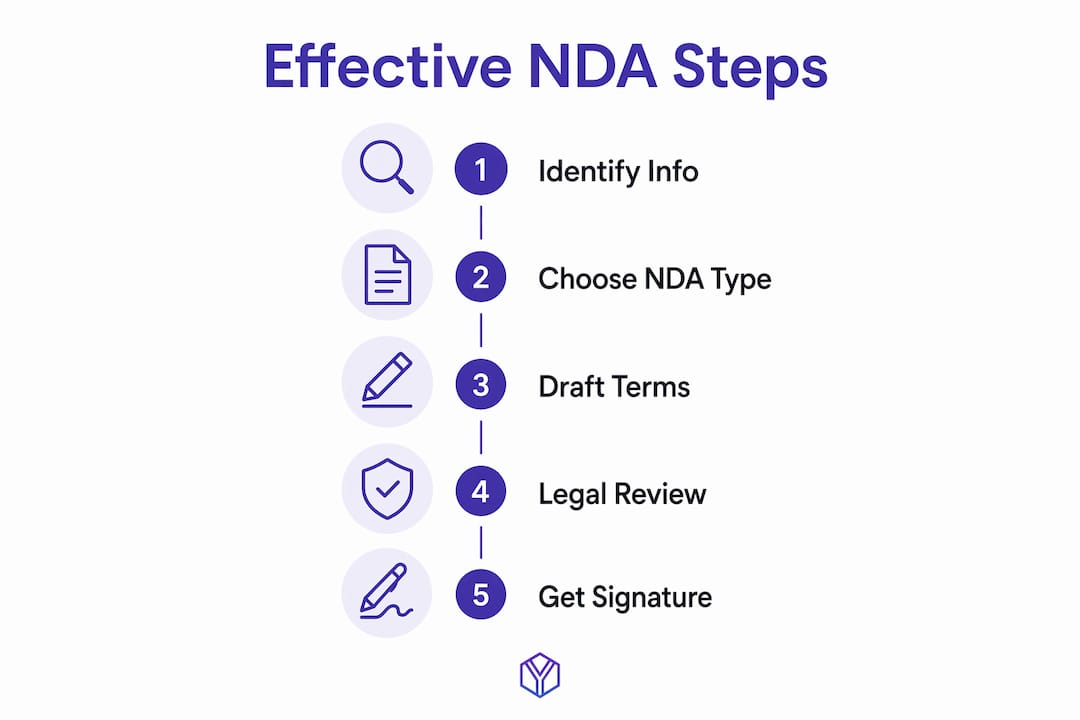
How do you get an NDA signed without slowing everything down?
The biggest practical problem with NDAs is not drafting them. It is getting the other party to sign quickly, especially when momentum in a negotiation matters.
Send the NDA before the meeting, not during it. Asking someone to read and sign a legal document on the spot creates pressure and often results in delays while they send it to their own counsel. Sending it a day or two in advance gives the other party time to review it without feeling rushed.
Use e-signature tools. Wet signatures on paper NDAs are a relic. Platforms like DocuSign or Adobe Acrobat Sign let both parties sign in minutes and create a timestamped audit trail that holds up in court. The contract approval process for a standard NDA should take hours, not days.
Keep the document short. A two-page NDA with plain language gets signed faster than a ten-page document with dense legal boilerplate. If the other party has to involve their legal team for a routine contractor NDA, you have made the document too complicated.
When a counterparty pushes back, ask why. A legitimate objection, like a confidentiality term that is too long or a definition that is too broad, is worth negotiating. A flat refusal to sign any NDA at all is a different signal, and it is worth pausing to consider what that tells you about the relationship.
Pro Tip: Create a standard NDA template for each common scenario: one for contractors, one for partnerships, one for due diligence. Having the right version ready to send immediately removes the delay of drafting from scratch every time.
How do you balance NDAs with trust in startup relationships?
Overusing NDAs creates friction. A founder who sends a five-page NDA before a first coffee meeting with a potential advisor is not protecting their business. They are signaling anxiety, and that signal travels.
The practical balance is to match the formality of the agreement to the depth of the information being shared. A general conversation about your market thesis does not need an NDA. A conversation where you share your technical architecture, your financial model, or your customer acquisition data does. The NDA is not a statement of distrust. It is a professional acknowledgment that both parties understand the stakes.
With investors, the calculus is different. Early-stage VCs hear hundreds of pitches and will not sign NDAs before initial meetings. Pushing one at that stage does not protect you. It just marks you as someone who does not understand how venture capital works. Save the NDA for the due diligence phase, when an investor is actively requesting sensitive documents and has a genuine reason to be bound.
With employees, the confidentiality obligation typically lives inside the employment agreement rather than as a standalone document. That framing matters psychologically. A new hire who signs an employment agreement with a confidentiality clause feels like a team member. A new hire who is handed a separate NDA on their first day sometimes feels like a suspect.
The goal is to protect what genuinely needs protecting without turning every relationship into a legal transaction. Share information in stages, use NDAs where the information is genuinely sensitive, and build the kind of operational security that makes the NDA a backstop rather than your first line of defense.
Fundraising document engagement: going beyond the NDA
An NDA protects your information legally, but it does not tell you what happens to your pitch deck after you send it. That gap is where founders lose visibility at the worst possible moment in a raise.
Secure data rooms for startups address this by combining controlled access with engagement analytics. Instead of emailing a PDF and waiting in silence, you share a single tracked link. You know when the document was first opened, which slides held attention, and which ones got skimmed past in seconds. That information changes how you follow up.
BabyLoveRaise is built specifically around this problem. The platform gives founders a hosted raise room where per-slide dwell time functions as a proxy for investor interest, the kind of read you would get from a cofounder sitting across the table but rarely get when you are fundraising solo. The owner dashboard separates “never opened” from “read everything and passed,” two states that look identical in your inbox but require completely different responses. Share links come in three registers: first send, forwardable, and private. Downloads can carry a watermark. When the raise closes, the room converts to a permanent archive rather than disappearing behind a paywall.
This approach layers on top of your NDA strategy rather than replacing it. The NDA establishes the legal obligation. The raise room establishes operational control: who has access, when they accessed it, and how deeply they engaged. Together, they give you both the legal standing and the practical visibility to manage your confidential fundraising documents with confidence.
For founders who want hands-on support, BabyLoveRaise also offers concierge services including pitch deck editorial passes and narrative Build Map artifacts, covering the document preparation side as well as the distribution and tracking side. Privacy-respecting investor tracking is built into the platform’s design: the system reports on the document, not on the person, which keeps the relationship with investors professional and trust-based.
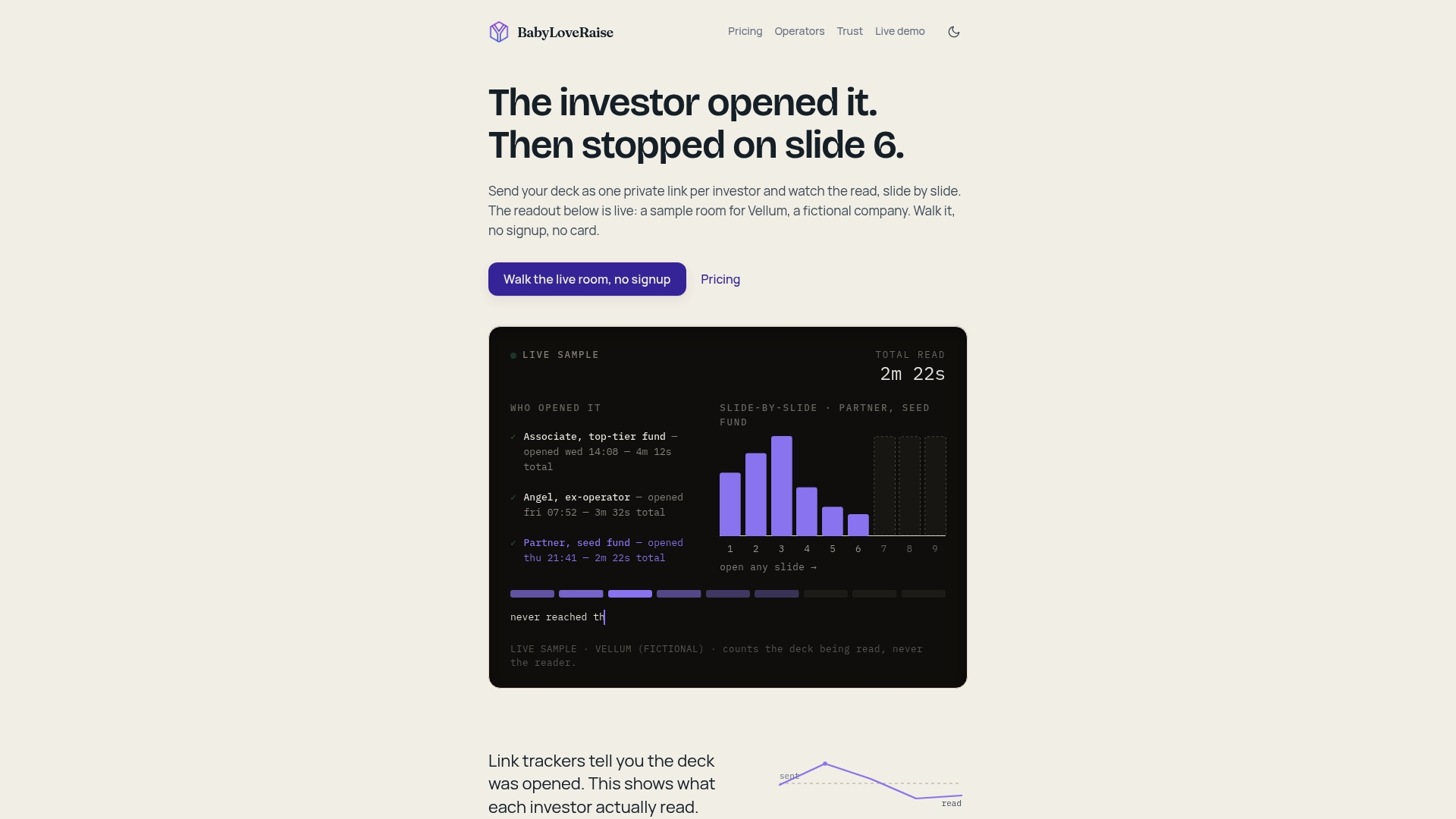
Protect your pitch deck and track real investor engagement with BabyLoveRaise. See exactly who read your deck, slide by slide, and follow up with the investors who actually finished it.
Key Takeaways
An NDA for a startup is a legal contract that protects confidential information, but it works only when paired with IP assignments, realistic term lengths, and controlled document sharing practices.
| Point | Details |
|---|---|
| NDA term lengths | Use two to five years for general business information and indefinite protection for trade secrets. |
| Avoid early investor NDAs | Most VCs will not sign before an initial meeting; save the NDA for due diligence when sensitive documents are actually being shared. |
| Pair NDAs with IP assignments | An NDA protects secrecy; an IP assignment agreement protects ownership. You need both. |
| Keep NDAs short | Two to three pages increases signing speed and reduces negotiation delays without weakening enforceability. |
| Layer your protection | Combine NDAs with controlled document access and engagement analytics to maintain both legal standing and operational visibility. |