
Venture Capital Terms Every Startup Founder Must Know
Master essential venture capital terms every startup founder must know. Learn how to negotiate and protect your company's future success.
July 20, 2026 · 9 min read

Venture capital terms are the specialized financial and legal phrases that define ownership, control, and payout in every startup investment deal. Founders who misread a liquidation preference or miss a protective provision clause can lose millions at exit, even from a successful company. The NVCA model documents set the baseline for most U.S. term sheets, and understanding the standard behind each clause gives you real negotiating power. This article breaks down the key terms in venture capital, explains what each one costs you, and shows you where to push back.
What is a venture capital term sheet and why does it matter?
A term sheet is a mostly non-binding summary of the proposed deal between a founder and an investor. It outlines the economic and control terms before lawyers draft the final legal agreements. Founders often treat signing a term sheet as closing the deal. That is a costly mistake. Signing a term sheet sets the baseline for legal documents, not the finish line.
The term sheet functions as a negotiation blueprint. Every clause you accept here shapes the definitive agreements that follow, including the Stock Purchase Agreement, Investor Rights Agreement, and Voting Agreement. Changing terms after the term sheet is signed damages trust and typically kills deals, according to experienced startup lawyers.

Two clauses in a standard term sheet are legally binding from the moment you sign: the confidentiality clause and the no-shop (exclusivity) clause. Every other clause is a negotiating position, not a final commitment. Knowing this distinction lets you treat the term sheet as a conversation, not a contract.
Common founder misconceptions include:
- Believing the valuation stated in the term sheet is the final number
- Assuming all clauses carry equal legal weight
- Thinking the deal is closed once the term sheet is signed
- Overlooking how downstream legal documents can reinterpret term sheet language
- Underestimating how long the process from term sheet to close actually takes (typically 60–90 days)
Key economic venture capital terms that affect your ownership
Pre-money valuation is the value assigned to your company before new investment comes in. Post-money valuation equals the pre-money valuation plus the new investment amount. If an investor puts $2M into a company valued at $8M pre-money, the post-money valuation is $10M, and the investor owns 20%. That math is simple. What founders miss is how the option pool affects it.
Option pools created pre-money dilute existing shareholders, including founders, before the investor’s money even arrives. Pool size typically runs 10–25% of post-money shares. A 15% option pool carved from a $10M post-money valuation effectively lowers your pre-money by $1.5M. Founders who do not model this before signing routinely give away more equity than they realize.
Liquidation preference determines who gets paid first when the company is sold or wound down. 98% of venture deals in Q4 2025 used a 1x non-participating liquidation preference, the founder-friendly market standard. That means investors get their money back first, then everyone shares the remaining proceeds based on ownership percentage. Participating preferred stock, by contrast, lets investors take their preference and then share in the remaining proceeds again. That structure can dramatically reduce founder payouts in mid-range exits.
Anti-dilution provisions protect investors if you raise a future round at a lower valuation (a down round). Broad-based weighted average anti-dilution is the current standard and is relatively founder-friendly. Full ratchet anti-dilution, which reprices all prior shares to the new lower price, has largely disappeared from standard deals because it can wipe out founder equity in a down round.
- Pre-money valuation: Negotiate this number, but model how the option pool carve-out changes your effective valuation before you agree.
- Liquidation preference: Accept 1x non-participating as the standard. Push back on any multiplier above 1x or any participating structure.
- Option pool size and timing: Request the pool be created post-money, or negotiate the smallest pre-money pool that satisfies the investor’s hiring plan.
- Anti-dilution: Broad-based weighted average is standard. Reject full ratchet provisions outright.
- Founder vesting: If your shares re-vest upon investment, negotiate credit for time served to avoid restarting your vesting clock from zero.
Pro Tip: Model three exit scenarios (low, mid, high) before signing any term sheet. Run the numbers with and without participating preferred, and with different liquidation multiples. The clause that looks minor at a $50M exit can cost you millions at a $30M exit.
What control and governance terms do to your company
Board composition determines who controls your company after the investment closes. A 2-1 board structure, two founder seats and one investor seat, is the recommended standard for early-stage rounds. It keeps founders in the majority. As you raise later rounds, investors typically push for additional seats or an independent director, which can shift control. Negotiate the composition and the process for selecting independent directors before you sign.
Protective provisions give investors veto rights over specific company actions. Over 90% of deals include these clauses. Common veto rights cover issuing new stock, selling the company, taking on debt above a threshold, and changing the certificate of incorporation. These provisions are not inherently bad. They become a problem when the list is too broad or when the threshold for triggering them is too low.
Control terms founders frequently overlook:
- Drag-along rights: Investors can force all shareholders to approve a sale if a majority agrees. This protects investors but can push founders into exits they do not want.
- Tag-along rights: Minority shareholders can join a sale on the same terms as the majority. This protects early investors and employees from being left out of a founder liquidity event.
- No-shop clause: Standard exclusivity runs 30–60 days. Anything longer freezes your ability to run a competitive process and should be negotiated down.
- Information rights: Investors receive regular financial reporting. Scope and frequency matter, especially if you have many investors.
Pro Tip: Founders who focus only on valuation during negotiations often concede board seats and protective provisions without realizing it. A higher valuation with a 2-2 board and broad veto rights is a worse deal than a lower valuation with a 2-1 board and a narrow protective provision list.
How to negotiate your term sheet during the fundraising process
The sequence from term sheet to close follows a predictable path. The investor delivers a term sheet, you negotiate and sign it, lawyers draft definitive documents, due diligence runs in parallel, and the deal closes when all conditions precedent are met. That process typically takes 60–90 days. Founders who treat the term sheet as the end of negotiations are unprepared for what comes next.
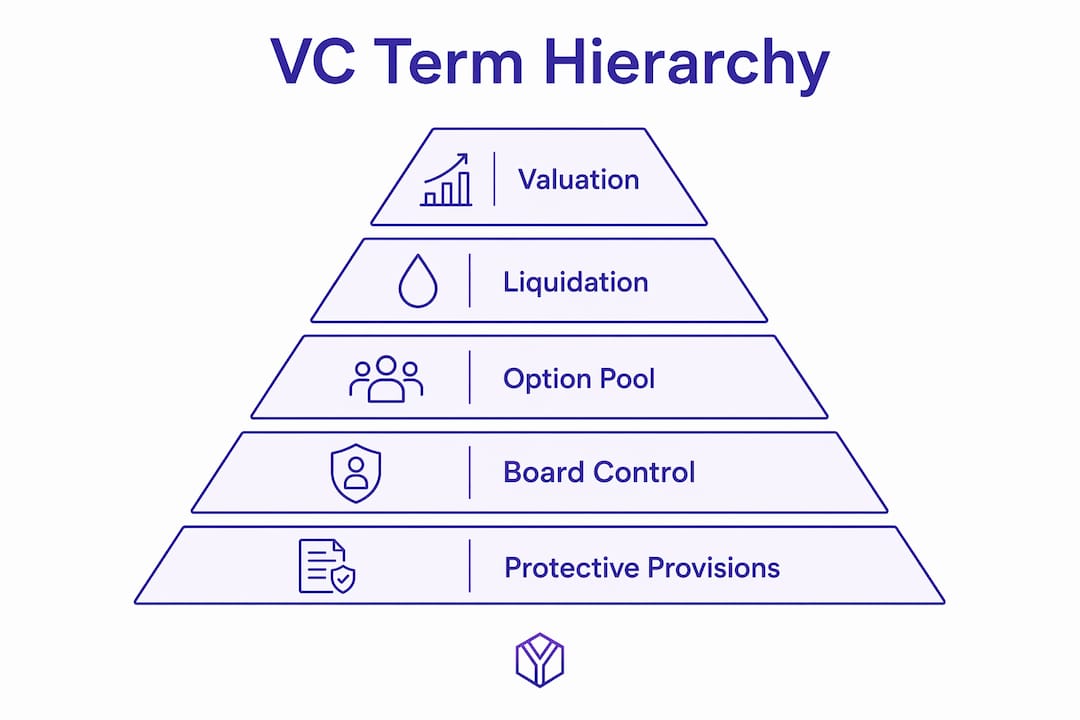
Most founder-friendly value comes from four clauses: liquidation preference, pre-money option pool, board composition, and anti-dilution. Concentrate your negotiating effort on these four. Other clauses, like IP assignment and standard vesting schedules, are largely non-negotiable and standardized across deals.
- Clarify binding vs. non-binding provisions first. Ask your lawyer to mark which clauses are legally binding before you respond to the term sheet. This prevents you from treating the entire document as final.
- Focus on exit-impacting terms. Model your payout under different exit scenarios before negotiating. You will know exactly which clauses cost you money.
- Negotiate the no-shop duration. Push for 30 days or less. A no-shop clause with no clear expiration can freeze your fundraising indefinitely.
- Do not renegotiate after signing. Experienced startup lawyers are clear: renegotiating after signing destroys trust and kills deals. Raise every concern before you sign.
- Hire a startup-specialized lawyer. General corporate counsel often lacks the pattern recognition to spot aggressive VC terms. A lawyer who reviews 50 term sheets a year will catch what a generalist misses.
Series B and C+ rounds grew from 26% of all term sheets in 2024 to 31% in 2025. That shift toward later-stage activity correlates with more founder-friendly terms and higher valuations across the market. Understanding the current market standard gives you a factual basis for pushing back on aggressive clauses. You can point to the 1x non-participating preference as the market norm, not just a preference.
Founders spend 80% of negotiation time on valuation but should focus more on liquidation preference and board control. Valuation affects your ownership percentage. Liquidation preference and board control affect whether you actually get paid and whether you stay in charge. Those are different problems with different stakes.
Key Takeaways
Understanding venture capital terms is the single most effective way founders can protect their ownership, control, and exit payout in any fundraising round.
| Point | Details |
|---|---|
| Term sheets are mostly non-binding | Only confidentiality and exclusivity clauses are legally binding before final documents are signed. |
| Four clauses drive most founder value | Liquidation preference, option pool timing, board composition, and anti-dilution determine your real outcome. |
| 1x non-participating is the market standard | 98% of Q4 2025 deals used this structure; reject participating preferred or multipliers above 1x. |
| Valuation is not the top priority | Founders who focus on valuation over control terms routinely lose leverage where it matters most. |
| Hire a startup-specialized lawyer | A lawyer who reviews VC term sheets regularly will catch aggressive clauses that generalists miss. |
Why I think most founders negotiate the wrong thing
Founders walk into term sheet negotiations fixated on the pre-money valuation number. I understand why. It is the most visible figure, the one you put in the press release, the one your co-founders and early employees ask about. But in my experience watching founders navigate fundraising, the valuation is rarely where deals go wrong.
The real damage happens quietly. A founder accepts participating preferred because the investor frames it as standard. They agree to a 20% pre-money option pool because they did not model the dilution. They concede a 2-2 board because they were grateful for the term sheet. None of these feel like big concessions in the moment. All of them show up painfully at exit.
The founders who come out of fundraising rounds with real leverage are the ones who read the investor relations guide before the first meeting, not after the term sheet arrives. They know what 1x non-participating means before an investor explains it to them. They have already modeled three exit scenarios. They know which clauses are standard and which are aggressive.
My honest advice: treat the term sheet as a financial model, not a legal document. Every clause has a dollar value at exit. Calculate it. Then negotiate the ones that cost you the most, and concede the ones that do not.
— Paul
BabyLoveRaise helps founders stay organized through the raise
Knowing your venture capital terms is one part of a successful raise. The other part is managing investor relationships without losing track of who has seen your deck, who engaged with it, and who went silent.

BabyLoveRaise gives founders a hosted raise room that tracks per-slide engagement, so you know exactly which investors read your deck and which slides lost their attention. Instead of sending a PDF into the void, you send one link and get real data back. When you are ready to follow up on a term sheet conversation, you already know who is engaged. See how it works at BabyLoveRaise pricing and check the trust and security page if you are sharing sensitive financial information with investors.
FAQ
What is a venture capital term sheet?
A term sheet is a mostly non-binding document that summarizes the proposed economic and control terms of a venture investment. It serves as the negotiating baseline before lawyers draft the final legal agreements.
Which venture capital terms matter most for founders?
The four terms with the greatest impact on founder outcomes are liquidation preference, option pool size and timing, board composition, and anti-dilution provisions. Negotiating these four clauses well protects both ownership and exit payout.
What does 1x non-participating liquidation preference mean?
It means investors receive their invested amount back first in a sale, then share remaining proceeds based on ownership percentage. This is the founder-friendly market standard, used in 98% of Q4 2025 venture deals.
How long does a no-shop clause last?
Standard no-shop clauses run 30–60 days. Any exclusivity period longer than 60 days is considered aggressive and should be negotiated down before signing.
Can you renegotiate a term sheet after signing?
Technically yes, but experienced startup lawyers warn that renegotiating after signing destroys investor trust and typically kills the deal. Raise all concerns and negotiate fully before you sign.