
What Is a DSR in Sales? Roles, Tools, and Strategy
Discover what a DSR in sales is. Learn about the Digital Sales Room and Daily Sales Report, and how they boost your sales strategy.
July 19, 2026 · 12 min read

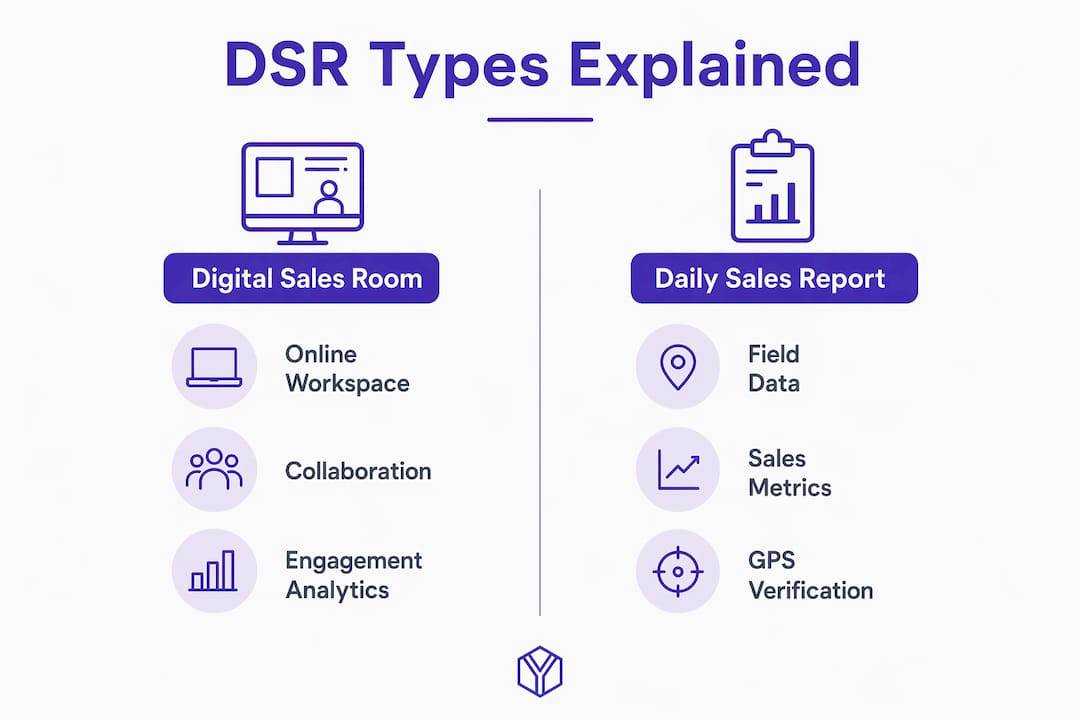
A DSR in sales refers to two distinct concepts: the Digital Sales Room, a secure online workspace for managing B2B deals, and the Daily Sales Report, a field intelligence log used in FMCG and retail operations. Both share the acronym, both drive sales performance, and both are increasingly central to how modern sales teams operate. Understanding the DSR meaning in sales, across both definitions, gives you a clearer picture of where deals are won and where field execution either holds or breaks down.
What is a DSR in sales? The two definitions you need to know
The term DSR carries two separate meanings depending on your sales context. In B2B and enterprise sales, DSR stands for Digital Sales Room. In FMCG, distribution, and retail field sales, DSR stands for Daily Sales Report. Neither definition is wrong. They simply describe different tools built for different stages and environments of the sales process.
Digital Sales Rooms centralize deal interactions to shorten sales cycles and boost win rates. That means a single shared workspace replaces the scattered email threads, forwarded PDFs, and Slack messages that typically fragment a complex deal. Daily Sales Reports, by contrast, improve field productivity by capturing granular, day-level data that managers can act on immediately rather than waiting for a monthly summary.
Both tools solve the same underlying problem: sales teams operating without reliable, real-time information make slower decisions and close fewer deals.
What is a Digital Sales Room and how does it transform B2B sales?
A Digital Sales Room is a branded, hosted online environment where buyers and sellers collaborate throughout a deal. It replaces the inbox as the primary deal workspace. Instead of hunting through email chains for the latest pricing sheet or contract draft, both sides access one shared room with a single link.
Digital Sales Rooms act as central hubs hosting demos, pricing documents, mutual action plans, and recorded presentations. That centralization matters because complex B2B deals often involve six to ten stakeholders on the buyer side, each needing access to different materials at different times. A well-structured Digital Sales Room gives every stakeholder what they need without requiring the rep to resend files manually.
Key features of a functional Digital Sales Room include:
- Engagement analytics that track page views, document dwell time, and repeated content views
- Mutual action plans (MAPs) that co-create clear next steps between buyer and seller
- CRM integration that syncs room activity directly into the sales pipeline
- Virtual meeting spaces embedded within the room for live calls and async video
- Controlled document sharing with permission settings for different stakeholder groups
Engagement analytics track page views and interaction to surface high-intent prospects and unblock stalled deals. That data tells a rep which slides a champion shared internally, which pricing page got reviewed three times, and which section the economic buyer never opened. That is intelligence no email thread can provide.
Pro Tip: Set up your Digital Sales Room before the first discovery call, not after. Sharing the room link in your meeting confirmation email signals professionalism and gives buyers a reason to engage before you even speak.
For sales teams evaluating platforms, the top Digital Sales Room alternatives in 2026 vary significantly in CRM depth, analytics granularity, and pricing structure.
What is a Daily Sales Report and why does it matter in FMCG and retail?
A Daily Sales Report is the structured record a field sales representative submits at the end of each working day. It captures every customer interaction, order, collection, and observation from that day’s route. In FMCG and distribution, the Daily Sales Report is the atomic unit of sales management.
The Daily Sales Report in FMCG captures chronological, quantitative, and qualitative field data including outlets visited, orders placed, collections made, and competitor activity observed. That last category is often overlooked. A rep who notes that a competitor ran a floor display promotion at three outlets on a Tuesday gives a sales manager intelligence that no CRM auto-fill can generate.
A standard Daily Sales Report typically records:
- Number of outlets visited versus planned
- Orders booked by SKU and volume
- Collections and outstanding payments
- Competitor pricing, promotions, and shelf activity
- Customer feedback and service issues
- Route deviations and reasons
| DSR Data Category | What It Measures | Why It Matters |
|---|---|---|
| Outlet visits | Actual vs. planned coverage | Identifies route gaps and low-performing territories |
| Order volume | Units and revenue per visit | Tracks daily sales progress against targets |
| Collections | Cash and credit recovered | Monitors receivables and cash flow health |
| Competitor activity | Promotions, pricing, new SKUs | Feeds tactical and pricing decisions |
| Customer remarks | Complaints, requests, feedback | Surfaces product and service improvement signals |
Digital DSR systems with GPS verification improve accuracy and can boost field productivity between 20–35%. GPS-stamped check-ins eliminate the guesswork around whether a rep actually visited an outlet, which protects both the rep and the manager from disputes over territory coverage.
Pro Tip: Treat the competitor remarks section of your Daily Sales Report as seriously as your order totals. A pattern of competitor promotions across five outlets in one week is a pricing signal your manager needs before the weekend, not at the next monthly review.
How does the role of a DSR shape customer relationships?
The third meaning of DSR in sales is the person: the Distributor Sales Representative or Direct Sales Representative. This is the field professional who executes the route, books the orders, and represents the brand at the point of sale. The role is common in FMCG, foodservice distribution, and consumer goods.

Distributor Sales Representatives typically visit 25–35 retail outlets daily, managing orders, inventory, and customer relations with FMCG experience and travel requirements. That volume means the average DSR has roughly 10–15 minutes per outlet. Every visit must count, which is why route planning and pre-call preparation are non-negotiable skills.
The core DSR responsibilities in a field role include:
- Executing a planned daily route with documented outlet visits
- Booking orders and upselling within approved product ranges
- Checking shelf placement, stock levels, and display compliance
- Collecting payments and resolving invoice disputes
- Reporting competitor activity and customer feedback
Successful Distributor Sales Representatives adapt from order-taker roles to trusted consultants offering product knowledge and business insights, especially to younger operators. This shift is not cosmetic. A DSR who walks into a restaurant and only takes an order is replaceable by an app. A DSR who notices the operator is running low on a high-margin item, suggests a bundle, and explains a promotional deal creates value that technology alone cannot replicate.
The role of Distributor Sales Representatives is evolving to meet younger operators’ needs, moving toward consultative solutions amid supply chain and market complexities. Sales teams that invest in training DSRs on consultative selling techniques see stronger retention rates at the customer level.
What are the key benefits and challenges of using DSR tools?
Digital Sales Rooms and Daily Sales Reports each deliver clear advantages, but neither works without deliberate implementation. The benefits are real. So are the failure modes.
Digital Sales Room benefits:
- Eliminates deal drift by keeping all stakeholders aligned in one place
- Surfaces buyer intent signals through engagement analytics
- Reduces time spent resending materials and chasing responses
- Creates a documented, searchable record of every deal interaction
Daily Sales Report benefits:
- Provides near real-time field visibility for managers and directors
- Captures competitive intelligence that no CRM auto-populates
- Enables tactical pivots before problems compound across a territory
- Holds reps accountable to planned routes and coverage targets
Digital Sales Rooms integrated with CRM systems prevent deal drift by ensuring buyer and seller activities are transparent, coordinated, and purposeful. Without that integration, a Digital Sales Room becomes just another document folder, which defeats the purpose entirely.
The challenges are equally predictable. Adoption resistance is the most common obstacle. Reps who have worked from email for a decade resist switching to a new workspace, especially if the tool adds steps rather than removing them. Data overload is the second trap. A Daily Sales Report that asks for 40 fields produces either incomplete data or copy-paste responses that tell managers nothing useful.
The best practice is to start with the minimum viable data set. For Digital Sales Rooms, that means one room per active deal, connected to your CRM, with a mutual action plan attached from day one. For Daily Sales Reports, that means five to seven core fields completed accurately rather than twenty fields completed carelessly.
How can sales teams use DSR data to close more deals?
DSR data is only valuable when it changes behavior. Collecting it without acting on it is administrative overhead. The teams that get the most from both Digital Sales Rooms and Daily Sales Reports treat the data as a decision input, not a compliance exercise.
For Digital Sales Rooms, the highest-value signal is repeated engagement. Tracking document dwell times and repeated content views pinpoints where buyer interest wanes or strengthens. A buyer who views the pricing page four times in two days is telling you something. Follow up on that specific page, not with a generic check-in email.
For Daily Sales Reports, the highest-value signal is pattern deviation. A rep who visits 30 outlets on Monday and 12 on Friday without explanation has a territory problem or a motivation problem. Managers who catch that deviation on Friday afternoon can address it before it becomes a weekly habit.
Practical DSR strategies for sales teams:
- Assign one Digital Sales Room per active deal, not per account
- Review engagement analytics before every follow-up call, not after
- Use mutual action plans to set buyer-owned next steps, not just seller tasks
- Flag Daily Sales Report anomalies within 24 hours, not at the weekly review
- Cross-reference competitor remarks from Daily Sales Reports with pricing decisions monthly
Pro Tip: Use your Digital Sales Room’s engagement data to decide who gets your next call, not your gut feeling. If a stakeholder you’ve never spoken to has viewed the technical spec sheet three times, they are your next conversation.
For founders and sales leaders who want to understand how engagement tracking applies beyond field sales, BabyLoveRaise’s approach to investor tracking software shows how the same per-slide dwell logic applies to pitch decks and fundraising rooms.
Key Takeaways
A DSR in sales covers three distinct concepts, and mastering all three gives sales teams a measurable edge over those who treat the acronym as a single idea.
| Point | Details |
|---|---|
| DSR has three meanings | Digital Sales Room, Daily Sales Report, and Distributor Sales Representative each serve different sales functions. |
| Digital Sales Rooms prevent deal drift | CRM-integrated rooms with mutual action plans keep complex B2B deals moving and buyers engaged. |
| Daily Sales Reports are intelligence tools | Competitor activity and route data captured daily enable tactical decisions that monthly reports miss entirely. |
| Field DSR roles are shifting | Distributor Sales Representatives who move from order-taking to consultative selling retain customers more effectively. |
| Engagement data drives follow-up | Repeated content views in a Digital Sales Room and route anomalies in a Daily Sales Report are the signals worth acting on first. |
DSRs are more powerful than most sales teams realize
The honest observation after watching sales teams adopt both Digital Sales Rooms and Daily Sales Reports is that most organizations use about 30% of what these tools can do. They set up a Digital Sales Room, drop a few documents in it, and call it done. They collect Daily Sales Reports, file them, and never cross-reference the competitor data against pricing decisions.
The teams that actually close faster are the ones treating engagement analytics as a conversation starter, not a vanity metric. When a buyer revisits your pricing page three times without responding to your last email, that is not silence. That is a buying signal wrapped in hesitation. The rep who calls that buyer and says “I noticed you had some questions about pricing, let me walk you through the options” wins more deals than the rep who sends a fourth follow-up asking if they had a chance to review.
Daily Sales Reports have the same untapped potential. The competitor intelligence buried in those reports, when aggregated across a territory over a quarter, tells a sales director exactly where a competitor is running a promotional push before it shows up in market share data. That is a genuine early warning system. Most companies treat it as a compliance form.
My advice: pick one signal from each tool and act on it this week. For your Digital Sales Room, identify the last deal where a stakeholder you hadn’t spoken to viewed materials more than twice. Reach out to that person directly. For your Daily Sales Reports, pull the last 30 days of competitor remarks from your field team and look for a pattern. You will find something worth a pricing or promotional response.
— Paul
How BabyLoveRaise approaches engagement tracking for high-stakes documents
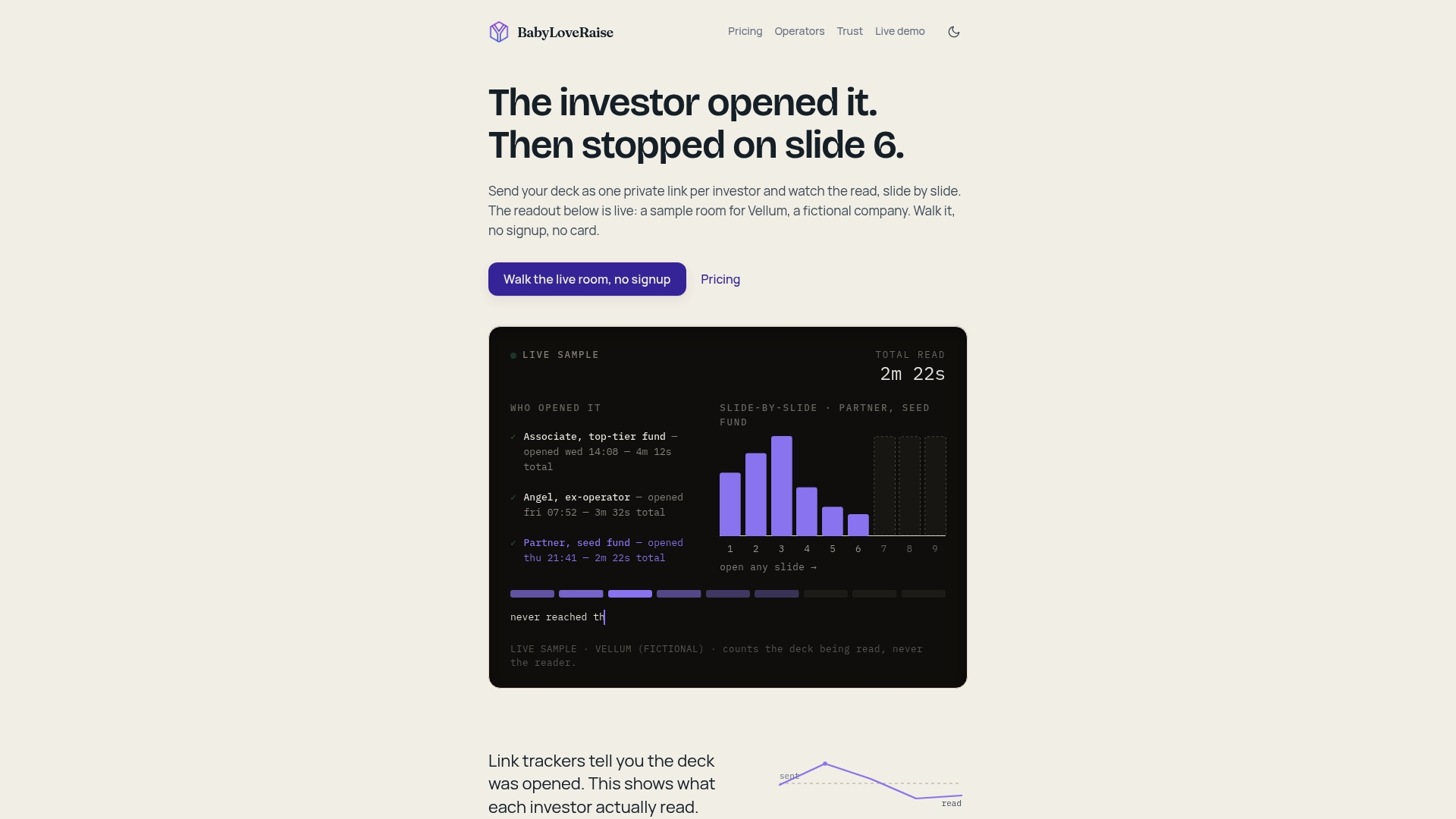
BabyLoveRaise applies the same engagement logic that makes Digital Sales Rooms effective to the fundraising context. Founders who share pitch decks through BabyLoveRaise get per-slide dwell data, first-read notifications, and a clear view of which investors read to the last slide versus who opened the deck and closed it after page two. That turns two identical silences, “never opened” and “read everything and passed,” into two different follow-up strategies.
For sales professionals who want to understand how document engagement tracking works at the infrastructure level, BabyLoveRaise’s pricing and plans show how per-raise pricing compares to per-seat models that charge you whether you’re actively raising or not. The raise room converts to a permanent archive when the raise closes, so you never lose your engagement history.
FAQ
What does DSR stand for in sales?
DSR in sales stands for Digital Sales Room, Daily Sales Report, or Distributor Sales Representative, depending on the industry context. B2B sales teams use DSR most often to mean Digital Sales Room, while FMCG and distribution teams use it for Daily Sales Report or the field rep role.
How does a Digital Sales Room work?
A Digital Sales Room is a shared online workspace where buyers and sellers access documents, mutual action plans, and meeting recordings through a single link. Engagement analytics within the room track which content buyers view and how often, giving reps real-time signals about buyer intent.
What data does a Daily Sales Report capture?
A Daily Sales Report captures outlets visited, orders booked, collections made, competitor activity, and customer feedback from a field rep’s daily route. Digital DSR systems with GPS verification add location-stamped check-ins that improve data accuracy and accountability.
What are the key responsibilities of a Distributor Sales Representative?
A Distributor Sales Representative visits 25–35 retail outlets daily, books orders, checks shelf compliance, collects payments, and reports competitor activity. The role increasingly requires consultative skills, not just order-taking, to meet the expectations of younger operators and changing market conditions.
How do Digital Sales Rooms prevent deal drift?
Co-created mutual action plans and engagement tracking keep both buyer and seller accountable to agreed next steps, reducing the gaps in communication that cause deals to stall. CRM integration ensures that room activity updates the pipeline automatically, so managers see deal momentum without waiting for rep updates.