What Should Be Included in a Pitch Deck: 2026 Guide
Learn what should be included in a pitch deck to attract investors. Cover all essential slides and secure your funding with confidence.
July 24, 2026 · 11 min read

What every pitch deck must include
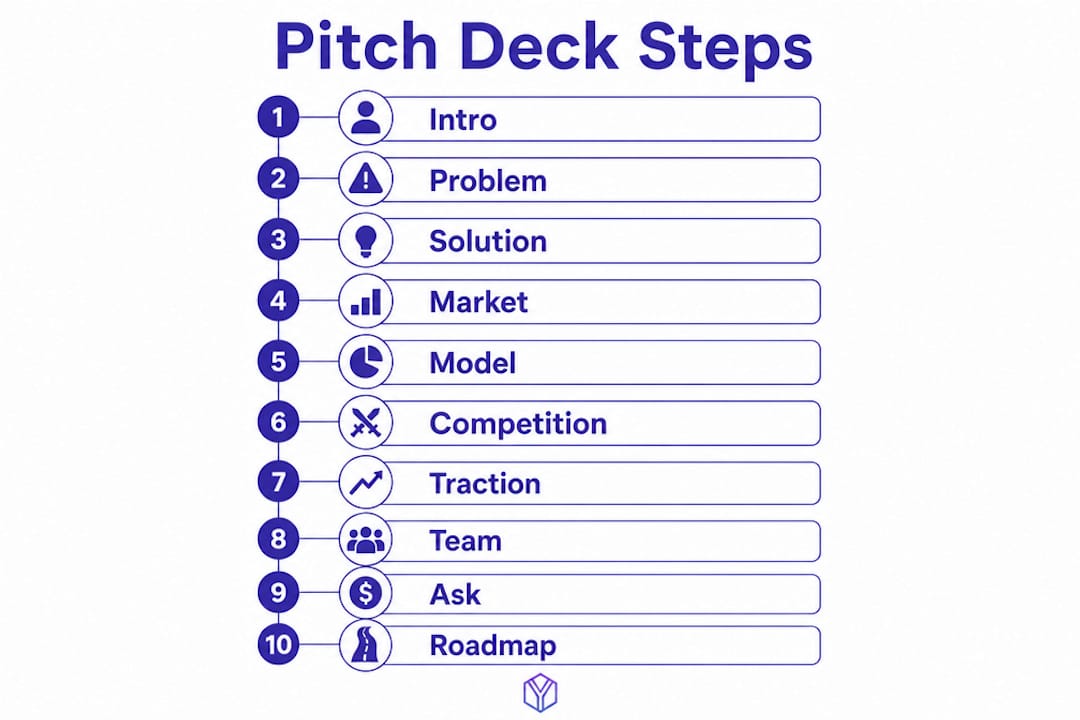
A pitch deck that raises money covers ten core components. Nail all ten and investors have everything they need to say yes to a meeting. Miss even two and the deck reads like a half-finished thought.
Here are the slides every deck needs:
- Company introduction — name, logo, one-sentence purpose, and contact info
- Problem — a specific, quantified pain point with a real human face
- Solution — what you built, how it works, and the value it creates
- Market opportunity — TAM, SAM, and SOM sized from the bottom up
- Business model — how you make money, pricing, and unit economics
- Competitive landscape — where you sit and why your position holds
- Traction — revenue, growth, retention, LOIs, or any proof of demand
- Team — founder-market fit and the experience that makes execution credible
- Funding ask — the amount, use of funds, and 12–18 month milestones
- Vision or roadmap — the bigger play beyond what you are building today
Investors scan these slides to answer one question: is this worth a second conversation? The deck’s job is to generate that meeting, not replace it. Treating a pitch deck as a full business plan is one of the most common errors early founders make.
Table of Contents
- How to build each section of your pitch deck
- What to avoid in your pitch deck
- How long should a pitch deck be?
- How to track and optimize your deck after you send it
- Exit strategy and potential returns
- Financial projections and key metrics
- Go-to-market strategy
- Key Takeaways
How to build each section of your pitch deck
Getting the component list right is step one. Knowing what actually belongs inside each slide is where most decks fall apart.
Company introduction
Open with a single declarative sentence that defines what your company does. Add your logo, a contact email, and optionally a tagline. The goal is instant orientation, not a history lesson. Investors read dozens of decks a week; they need to know within five seconds what category you are in.
Problem
Make the problem specific. “The market is outdated” is not a problem. “Mid-market logistics teams lose an average of 14 hours per week reconciling freight invoices manually” is a problem. Use real numbers, name the person who suffers, and explain why existing solutions fall short. If you cannot point to a specific person losing time or money, rethink whether the problem is real enough to build a company around.
Solution
Show the product, not a paragraph about the product. Screenshots, a short GIF, or a clean mockup work better than text-heavy descriptions. Keep the copy to two or three sentences and let the visual carry the weight. Every feature you mention should tie back to a pain point you named on the previous slide. Investors track that connection.

Market opportunity
Bottom-up market sizing builds far more credibility than pulling a Gartner TAM number and slapping it on a slide. Start with your ideal customer profile, multiply by realistic willingness to pay, and build up to your SAM and TAM from there. The math should show a clear path to a significant revenue level that justifies venture-scale returns; anything less makes a venture return hard to justify. Citing a massive top-down market without that path signals you have not done the customer math.
Business model
Spell out exactly how you make money: subscription, transaction fee, enterprise license, or marketplace take rate. Include current pricing if you have it. Even rough unit economics, what it costs to acquire a customer versus what they pay you over their lifetime, show investors you are thinking about the business and not just the product. This slide consistently draws some of the longest read times from investors at both pre-seed and seed stages.
Competitive landscape
Every startup has competition. Claiming otherwise is the fastest way to lose credibility in a room. A 2x2 matrix with axes that reflect real strategic trade-offs (say, ROI versus ease of use) works better than a feature tick-cross table, because features get copied. The slide’s real job is to show your defensible position and explain why your approach is fundamentally different, not just incrementally better.

Traction
This is the slide that separates real startups from ideas. Post-revenue companies should show growth trajectory, customer retention, and efficiency metrics like LTV/CAC. Pre-revenue companies can show letters of intent, a growing waitlist, pilot commitments, or customer interview data with willingness-to-pay signals. “Future traction” roadmaps do not count. Something on this slide must demonstrate that the market is already responding.
Team
Investors at the early stage bet on people first. Your team slide should highlight founder-market fit, relevant domain experience, and prior execution, not just job titles and alma maters. Quantified accomplishments beat pedigree every time. If you have notable advisors or angels already on board, include them. Keep the focus on the founding core; listing every hire dilutes the signal.
Funding ask
State the amount, the note terms or valuation range, and break the use of funds into three or four clear buckets: product development, hiring, go-to-market, and operations. Then tie those buckets to specific milestones. “This funding gets us to a key monthly recurring revenue milestone, which positions us for a strong Series A” is a real ask. “We need capital to grow” is not. A vague ask signals a lack of planning discipline.
Vision or roadmap
Do not skip this slide. Investors need to see the broader play beyond what you are building today. A scope evolution (“from B2B marketplace to healthcare supply chain OS”), a feature evolution timeline, or even a single visual that captures the long-term ambition all work. The vision slide is often the fewest words in the deck and the hardest to write well.
Pro Tip: For a deeper look at how winning decks structure these components visually, pitch deck examples from funded startups show the patterns in practice.
What to avoid in your pitch deck
Knowing what to leave out is just as important as knowing what to include. These are the mistakes that kill otherwise solid decks.
- Too many slides. A deck over 15 slides usually signals poor prioritization, not thoroughness.
- Inflated market sizing. Pulling a top-down TAM from a research report without bottom-up math reads as lazy thinking to experienced investors.
- Vague problem statements. “Customers need better solutions” is not a problem. Specificity is what makes investors nod.
- Feature-list solution slides. Investors want to see the value created, not a bulleted product spec sheet.
- Excessive financial detail. Detailed five-year models with yearly ROI, equity share, and profit share projections tend to hurt fundraising more than they help.
- Generic team bios. “10 years of experience in finance” tells an investor nothing. Tie each person’s background directly to why they are the right person to execute this specific business.
- Claiming no competition. It signals weak market thinking, not a unique opportunity.
- Using the deck as a business plan. The deck is a teaser designed to generate a meeting, not a comprehensive document meant to answer every question.
The most common structural mistake is treating the pitch deck as a document that must stand alone and answer every investor objection in advance. It cannot and should not. Put the deep detail, full financials, technical architecture, and product roadmap in an appendix that investors can explore after the meeting.
How long should a pitch deck be?
The industry standard is approximately 15 slides. Decks over 15 slides often signal poor prioritization; decks over 20 are almost universally discouraged. The 8–10 slide format can work for a visionary founder pitching live in the room, but it rarely survives being sent by email because the slides have to tell the story without you there to fill the gaps.
Investors spend under two minutes reviewing an initial deck and make a decision within the first four slides. That reality changes how you should think about slide order.
| Deck scenario | Recommended slide count | Opening slide |
|---|---|---|
| Email / cold send | 15 slides | Strongest signal: traction, team, or why-now |
| Live visionary pitch | 8–10 slides | Problem or vision |
| Stand-alone with appendix | 15 + appendix | Strongest signal |
| Series A and beyond | 15–18 slides | Traction or business model |
Structure the deck around your strongest signal, not a fixed sequence. If you have prior exits or recognizable logos, open with the team. If you have hockey-stick traction, put that headline number on the cover. Classic problem-solution is the last-resort opener, not the default.
A few structural principles that hold across all formats:
- Lead with your unfair advantage, then layer in problem, solution, market, competition, GTM, team, ask, and vision
- One clear point per slide; if a slide is trying to say three things, split it or cut two of them
- Put anything that requires deep reading in the appendix, not the main deck
- Use visuals over text wherever the product or data can speak for itself
Pro Tip: Pitch deck tracking without surveillance explains how to measure which slides investors actually read, so you know where to focus revisions.
How to track and optimize your deck after you send it
Building a great deck is only half the work. Once it leaves your hands, most founders go dark. They send a PDF, wait, and have no idea whether the investor opened it, skimmed slide three, or read every word. Those two silences look identical from the outside but require completely different responses.
Per-slide engagement data changes that. Tracking dwell time per slide tells you where investor attention drops, which is almost always more useful than knowing how many total views a deck received. A slide that gets skipped consistently is a signal to revise the narrative, not just the design.
BabyLoveRaise is built specifically for this problem. Instead of emailing a PDF and going dark, you send one room link. The platform notifies you on first read and records per-slide dwell time, so you can see exactly who read to the last slide and which slides lost attention. That distinction between “never opened it” and “read everything and passed” turns two identical silences into two different, actionable states.
Key features that matter during a raise:
- First-read notification so you know the moment an investor opens the deck
- Per-slide dwell time as a proxy for the cofounder read a solo founder does not have
- Three link registers (first send, forwardable, private) to control how the deck travels
- Watermarked downloads to track if the deck gets shared beyond the original recipient
- Permanent archive when the raise closes, with no paywall cliff
The practical workflow: send the deck, watch which slides get the most time, and revise the ones that get skipped. Founders who iterate based on engagement data rather than gut instinct tend to tighten their narrative faster and spend less time chasing investors who were never going to convert.
Exit strategy and potential returns
Investors think about exits from the first conversation. You should too. An exit strategy slide, or at minimum a clear signal within the vision section, shows that you understand how your investors will eventually realize a return.
The most common exit paths for venture-backed startups are acquisition by a strategic buyer, acquisition by a financial buyer, and IPO. At the early stage, you do not need a precise exit plan. What you do need is a credible answer to “who would buy this company and why?” Name the category of acquirer, explain the strategic logic, and give a rough sense of the multiples comparable companies have traded at. That framing tells investors you have thought about the full arc of the business, not just the next 18 months.
Financial projections and key metrics
Keep the financial slide high-level. A three-year forecast showing revenue, burn rate, and key milestones is enough for most early-stage decks. What investors are actually evaluating is whether you understand the levers of your business: how hiring, marketing spend, and product development translate into revenue growth.
The metrics that belong on this slide depend on your model. For SaaS companies, ARR, CAC, LTV, and churn are the core four. For marketplace businesses, GMV, take rate, and repeat purchase rate matter more. For pre-revenue companies, show estimated KPIs grounded in market research or analogies from comparable startups.
Avoid overly ambitious forecasts that are not supported by clear assumptions. A bottom-up model that starts from your ICP count and conversion rates is far more credible than a top-down percentage-of-market projection. Investors know these are estimates; what they are checking is whether your logic holds.
One rule worth taking seriously: detailed financials often hurt fundraising at the early stage. The classic failure pattern is a founder showing $2M in revenue over five years after raising $2M, which makes the math on a venture return obvious and bad. Keep the main deck focused on ARR, milestones, and expansion drivers. Put the full model in the appendix.
Go-to-market strategy
A go-to-market slide fails when it lists channels without logic. “We will use social media, influencers, and word of mouth” is a marketing wish list, not a strategy. What investors want to see is a specific acquisition path with unit economics attached.
The strongest GTM slides answer three questions: who is the exact first customer, how do you reach them, and what does it cost to acquire one? A concrete example works far better than a channel list. “We will partner with 50 dental offices in Miami through our founder’s existing network, converting at 30% based on our pilot” is a strategy. It names the ICP, the channel, the mechanism, and the evidence.
For sales team collaboration contexts, the GTM slide should also address whether you are using direct or indirect sales, why that approach fits your buyer, and how the channel scales beyond the beachhead market. Underestimating go-to-market complexity is one of the most common reasons early-stage startups stall after their first raise.
Key Takeaways
A pitch deck that raises money combines the right components with the right depth: concise, evidence-backed, and structured around your strongest signal rather than a fixed template.
| Point | Details |
|---|---|
| Ten core components | Every deck needs company intro, problem, solution, market, business model, competition, traction, team, ask, and vision. |
| Slide count target | Aim for approximately 15 slides; over 15 signals poor prioritization and under 10 rarely survives email. |
| Bottom-up market sizing | Build TAM/SAM/SOM from your ICP and willingness-to-pay data, not top-down research reports. |
| Financials stay high-level | Keep the main deck to ARR, milestones, and expansion drivers; detailed models belong in the appendix. |
| Track engagement after sending | Per-slide dwell time tells you which slides lose investors so you can revise the right content. |
Ready to see exactly which slides investors read and which ones they skip? BabyLoveRaise pricing is structured per raise, not per seat, so you pay for the fundraise you are running, not a subscription that outlasts it.