
Best Virtual Data Room Software for 2026: Expert Picks
Discover the best virtual data room software for 2026. Enhance security, access controls, and pricing, tailored for high-stakes deals.
July 23, 2026 · 14 min read

For high-stakes deals in 2026, the best virtual data room software combines ISO-certified security, granular access controls, and transparent pricing. Here are the top picks for US-based business professionals:
Top virtual data room providers at a glance:
- Ideals — Best for mid-market dealmaking; eight-level access controls, 24/7 support, usage-based pricing
- Intralinks — Best for large enterprise M&A and IPOs; AI-powered diligence tools, ISO 27701 certified
- Ansarada — Best for efficient due diligence workflows; six-level access control, advanced Q&A, AI insights
- Datasite — Best for complex, large-scale transactions; Sandbox feature, AI redaction, full lifecycle management
- SecureDocs — Best for cost-conscious SMBs; unlimited users and storage, flat-rate pricing, built-in e-signature
- Firmex — Best for legal and financial compliance; strong regulatory features, flexible deployment
- ShareVault — Best for private equity firms; dynamic permissioning, detailed reporting
- DealRoom — Best for mid-market M&A teams; cross-functional collaboration, flexible reporting
- Tresorit — Best for maximum encryption; zero-knowledge architecture, end-to-end encrypted sharing
- Digify — Best for IP-focused startups; dynamic watermarking, real-time document tracking
- EthosData — Best for cross-border deals; multilingual support, fast web-based setup
- Venue by DFIN — Best for regulated industries; AI contract analytics, multi-file redaction
- Box — Best for cross-industry document sharing; customer-managed encryption keys, AI automation
Every provider on this list holds at least one major security certification such as ISO 27001, ISO 27018, or ISO 27701. Generic file-sharing tools like Google Drive lack the granular permission hierarchies and audit trails that high-stakes deals require.
Best virtual data room software: in-depth provider profiles
The market has more than two dozen serious contenders. What separates them is not marketing copy but the specific combination of security architecture, workflow tools, and pricing structure each one offers. Here is a detailed look at every major provider.

| Provider | Security Certifications | Best For | Pricing Model | Ease of Use | Customer Support |
|---|---|---|---|---|---|
| Ideals | ISO 27001, ISO 27018 | Mid-market dealmaking | Usage-based | High | 24/7 chat, phone, email |
| Intralinks | ISO 27001, ISO 27701 | Large enterprise M&A, IPOs | Enterprise contract | Moderate | Dedicated team |
| Ansarada | ISO 27001, ISO 27018 | M&A, due diligence | Subscription tiers | High | 24/7 support |
| Datasite | ISO 27001 | Large one-off transactions | Custom enterprise | Moderate | Dedicated advisors |
| SecureDocs | SOC 2 Type II | SMB due diligence | Flat-rate | Very high | Business hours + email |
| DealRoom | SOC 2 | Mid-market M&A | Subscription | High | Chat and email |
| Box | ISO 27001, FedRAMP | Cross-industry sharing | Tiered subscription | High | 24/7 enterprise support |
| Citrix ShareFile | SOC 2, HIPAA | Compliance-focused businesses | Tiered subscription | High | Phone and chat |
| Firmex | ISO 27001 | Legal and financial deals | Subscription | High | 24/7 support |
| Onehub | SOC 2 | Secure content repositories | Tiered subscription | Very high | Email and chat |
| Digify | SOC 2 | IP-focused startups | Flat-rate | Very high | Email support |
| CapLinked | SOC 2 | Diverse deal types | Subscription | High | Email and chat |
| EthosData | ISO 27001 | Cross-border transactions | Custom | High | Dedicated onboarding |
| Venue by DFIN | SOC 2, ISO 27001 | Regulated industries | Custom enterprise | Moderate | Dedicated support |
| ShareVault | ISO 27001, SOC 2 | Private equity firms | Subscription | High | 24/7 support |
| FirmRoom | SOC 2 | Mid-sized dealmakers | Flat-rate | Very high | Chat and email |
| Fordata | ISO 27001 | Structured due diligence | Subscription | High | Dedicated support |
| Peony | ISO 27001, ISO 27018 | Cost-conscious compliance | Usage-based | High | Email and chat |
| Tresorit | ISO 27001, GDPR | Maximum encryption needs | Tiered subscription | High | Email and chat |
| Confiex Data Room | ISO 27001 | Secure file sharing | Custom | High | Responsive support |
| ShareFile | SOC 2, HIPAA | Enterprise compliance | Tiered subscription | High | Phone and chat |
| Drooms | ISO 27001 | AI-driven regulated deals | Custom enterprise | Moderate | Dedicated team |
| Google Drive | ISO 27001 | Non-confidential sharing | Freemium/subscription | Very high | Community + paid |
| V7 Go | SOC 2 | SMB document management | Subscription | Very high | Email support |
Ideals earns its reputation on two things: setup speed and support quality. The platform offers eight levels of access control, built-in redaction, and advanced Q&A workflows. Its usage-based pricing model means you pay for what you actually use, not a bloated enterprise seat count.
Intralinks is the platform most large investment banks reach for when a deal crosses $1 billion. Its AI-powered due diligence tools automate document classification and flag potential issues before reviewers ever open a file. ISO 27701 certification, which covers privacy information management, puts it ahead of most competitors on the compliance front.
Ansarada takes a different approach by building deal intelligence directly into the workflow. Its AI tools score deal readiness and surface gaps in document coverage, so advisors can prioritize where to focus. Six levels of granular access control and detailed audit logs make it a natural fit for complex M&A and post-merger integration.
Datasite is the platform for deals where the document volume is genuinely massive. Its Sandbox feature lets deal teams test workflows before going live, and its AI-powered redaction handles bulk document processing at a speed that manual review cannot match. The full lifecycle approach, from preparation through post-merger integration, is a real differentiator for one-off mega-transactions.
SecureDocs solves a problem most enterprise VDRs create: unpredictable cost. Flat-rate pricing covers unlimited users and unlimited storage, so a deal that expands in scope does not blow the budget. Built-in e-signature removes the need for a separate DocuSign subscription.
DealRoom is purpose-built for M&A teams that manage multiple deals simultaneously. Its cross-functional collaboration tools let buy-side and sell-side teams work in the same environment without stepping on each other, and its reporting features give deal managers a clear view of progress across workstreams.
Box is not a dedicated VDR, but its customer-managed encryption keys and FedRAMP authorization make it a credible option for organizations that need secure document sharing across industries without the overhead of a deal-specific platform. Automated index numbering and AI-powered services add structure to large document sets.
Citrix ShareFile offers multi-factor authentication, virus scanning, digital watermarks, auto-indexing, and built-in e-signature in a single package. New users get a 30-day free trial. It suits businesses that need a compliant file-sharing environment without the complexity of a full enterprise VDR.
Firmex has built its reputation in legal and financial services, where compliance requirements are non-negotiable. Its flexible deployment options and strong audit trail features make it a go-to for law firms managing regulatory filings and financial institutions running structured transactions.
Onehub keeps things straightforward. Its permission controls are customizable, its interface is clean, and its integration APIs let teams connect it to existing tools without custom development work. For businesses that need a secure content repository without deal-specific complexity, it delivers.
Digify focuses on what IP-heavy companies care about most: knowing exactly who has seen what and preventing unauthorized distribution. Dynamic watermarking and real-time document tracking give founders and legal teams a clear picture of document exposure at any moment.
CapLinked covers a wide range of deal types, from equity financings to strategic partnerships, and integrates with common business tools. Its audit-ready logs satisfy compliance requirements without requiring a dedicated compliance team to manage them.
EthosData stands out for cross-border transactions. Multilingual support and dedicated onboarding assistance reduce the friction that typically slows down international deals. Detailed activity tracking gives deal managers visibility across geographies and time zones.
Venue by DFIN targets regulated industries specifically. Multi-file redaction, AI contract analytics, automatic watermarking, and virus scanning are all built in. Healthcare, energy, and financial services teams use it for transactions where regulatory scrutiny is highest.
ShareVault is a strong fit for private equity firms running multiple portfolio transactions. Dynamic permissioning and detailed reporting give fund managers the control they need across a portfolio of deals without managing separate platforms for each one.
FirmRoom competes on price transparency and simplicity. Its flat-rate model and clean interface make it accessible for mid-sized deal teams that do not need the full feature set of an enterprise platform but still require solid security.
Fordata focuses on structured due diligence and asset management, with strong document control and collaboration features. It suits organizations running formal diligence processes where document organization and version control matter.
Peony is a newer entrant with a clear value proposition: enterprise-grade security at usage-based pricing. ISO 27001 and ISO 27018 certifications give it credibility, and its transparent pricing model appeals to cost-conscious teams.
Tresorit takes a zero-knowledge encryption approach, meaning even Tresorit itself cannot access your files. For organizations where data privacy is the primary concern, that architecture is a meaningful differentiator from platforms that hold encryption keys on your behalf.
Confiex Data Room focuses on security and customer service responsiveness. It suits businesses that prioritize strong encryption and want a support team that responds quickly when issues arise.
ShareFile (the Citrix platform) provides multi-factor authentication, HIPAA compliance, and built-in e-signature. It fits enterprise environments where compliance and collaboration need to coexist in a single tool.
Drooms uses AI to automate transaction workflows and document structuring. Fast setup and AI-driven organization make it useful for complex, regulated deals where time-to-close matters.
Google Drive is not a VDR. It lacks granular permission hierarchies, audit trails, and the access controls that regulated transactions require. It works for non-confidential team collaboration, but it should not be used for M&A due diligence or any deal involving sensitive documents.
V7 Go targets SMBs that need intuitive document management with solid security controls. Its user experience focus makes it accessible for teams without dedicated IT support.
How pricing, security, and features actually compare across providers
Pricing is the most opaque part of the VDR market, and it deserves real scrutiny before you sign anything. Three models dominate: per-page, per-user, and flat-rate.

Per-page pricing charges roughly $0.50 to $1.00 per page stored. On a document-heavy deal, that adds up fast and unpredictably. The per-page model is increasingly seen as a disadvantage precisely because it penalizes complexity, which is the opposite of what a deal team needs when a transaction expands in scope.
Per-user pricing scales with the number of reviewers. That sounds reasonable until the buy-side brings in three law firms and two financial advisors, each with their own teams. Costs can multiply quickly.
Flat-rate and usage-based pricing give deal teams predictable budgets. SecureDocs, FirmRoom, and Peony all use variants of this model. Ideals offers usage-based pricing that ties cost to actual activity rather than seat count.
On security, the ISO 27001, ISO 27018, and ISO 27701 certifications are the baseline for any provider handling regulated or cross-border transactions. ISO 27001 covers information security management. ISO 27018 adds protections for personally identifiable information in cloud environments. ISO 27701 extends that to privacy information management, which matters for deals touching EU data subjects or healthcare records.
SOC 2 Type II certification, held by SecureDocs, DealRoom, Onehub, Digify, and others, demonstrates that a provider’s security controls have been independently audited over time, not just at a single point. FedRAMP authorization, held by Box, is the standard for US federal government data.
Feature differentiation comes down to a few categories that actually move deals:
- AI automation: Intralinks, Ansarada, Datasite, and Drooms all offer AI-powered document classification, redaction, or deal readiness scoring. AI automation is now a baseline expectation for enterprise platforms, not a premium add-on.
- Q&A workflows: Ansarada, Datasite, Citrix ShareFile, and Venue by DFIN offer structured Q&A tools that route questions to the right experts and track response times. Unstructured email Q&A is a deal-team efficiency killer.
- Audit trails: Every serious VDR produces audit logs, but the depth varies. Ideals, Ansarada, and ShareVault produce granular logs that track document views, downloads, and time spent per page.
- Integration compatibility: Box, CapLinked, and Onehub offer APIs and native integrations with tools like Salesforce, Slack, and Microsoft 365. For teams already standardized on Microsoft 365, tenant-native VDR solutions that provision the data room inside your existing tenant can eliminate the duplicate governance overhead that comes with standing up a new external platform for each deal.
Pro Tip: Before requesting demos, map out your deal’s document volume, reviewer count, and expected duration. Run those numbers through each provider’s pricing model to get a realistic cost estimate. The platform that looks cheapest on the website often is not cheapest for your specific deal.
How to choose the right virtual data room for your business
The right platform is the one that fits the shape of your work, not just the next deal. Industry analysts consistently point out that the best VDR matches the pattern of an organization’s sensitive collaboration needs year-round, not just the requirements of a single transaction.
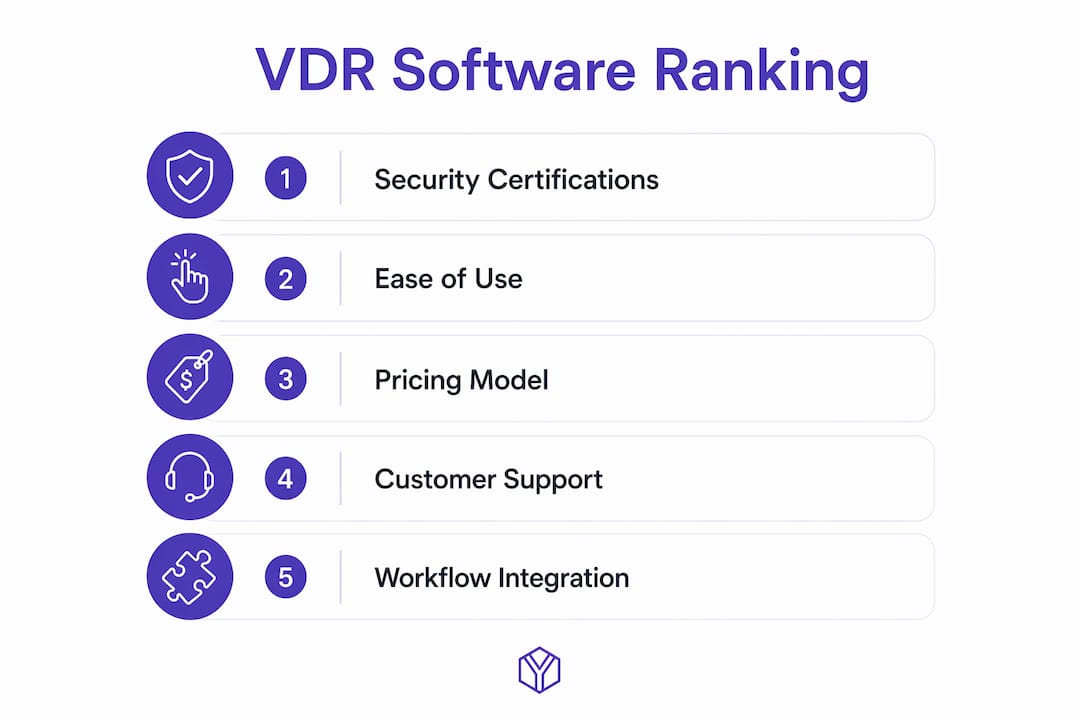
Start with security requirements. If your deal involves EU data subjects, healthcare records, or US federal contracts, your provider’s certifications are not optional. ISO 27001 is the floor. ISO 27018 and ISO 27701 matter for privacy-sensitive transactions. SOC 2 Type II is the standard for US-focused deals.
Evaluate total value, not just initial cost. Experts consistently recommend looking at security, efficiency, support quality, and impact on transaction outcomes together, rather than choosing the lowest headline price. A platform that saves your deal team ten hours per week on document management pays for itself quickly.
Match the platform to your workflow. A law firm running regulatory filings has different needs than a private equity fund managing portfolio transactions. Firmex and ShareVault are built for repeat dealmakers. Datasite and Intralinks are built for one-off mega-transactions. FirmRoom and SecureDocs are built for teams that want simplicity and cost predictability.
Check integration compatibility. If your team lives in Microsoft 365, a platform that integrates natively with your existing tenant removes a layer of governance complexity. If your CRM is Salesforce, a platform with a native Salesforce connector saves manual work on every deal.
Assess customer support before you need it. Deals close on tight timelines. A support team that responds in hours rather than minutes can cost you a deal. Ideals, Ansarada, and Firmex all offer 24/7 support. SecureDocs and FirmRoom offer business-hours support, which is fine for deals that do not cross time zones.
Evaluate free trials and demos carefully. Citrix ShareFile offers a 30-day free trial. Most enterprise platforms offer demos but not self-serve trials. Use demo time to test the specific workflows your team runs, not just the features on the marketing page.
Key criteria to evaluate before signing:
- Security certifications relevant to your industry and geography
- Pricing model and total cost for your expected deal size and duration
- Access control granularity and audit trail depth
- Q&A workflow tools and document organization features
- Integration with your existing tech stack
- Customer support hours and response time commitments
- Free trial or pilot availability
Understanding data room costs before you start evaluating vendors puts you in a much stronger negotiating position.
What experts say about virtual data room trends in 2026
The VDR market in 2026 is moving in three clear directions: AI automation as a baseline, pricing model reform, and workflow-native deployment.
AI-powered automation has moved from differentiator to baseline expectation. Platforms that cannot automate document indexing, classification, and redaction are losing ground to those that can. The practical effect is faster deal preparation and fewer errors in document organization, which matters most on large transactions where manual review is simply not feasible at scale.
Pricing model reform is accelerating. The per-page model, once standard across the industry, is now widely recognized as a liability for deal teams. Flat-rate and usage-based models give finance teams the budget predictability they need, and providers that have not moved away from per-page pricing are seeing it used against them in competitive evaluations.
The third trend is workflow-native deployment, particularly for organizations already standardized on Microsoft 365. Rather than copying documents to a third-party VDR for each deal, tenant-native solutions provision the data room inside the existing Microsoft 365 tenant. Files stay where they already live, identity and sensitivity labels carry over automatically, and the audit trail lands in the same compliance environment the security team already monitors. For enterprises running recurring sensitive workflows across M&A, board governance, and regulatory compliance, this approach removes the duplicate governance overhead that comes with standing up a new external platform for every program.
The total value framework for VDR evaluation, which weighs security, efficiency, support, and transaction outcomes together rather than just initial price, has become the standard recommendation from deal advisors. A platform that costs more per month but cuts deal preparation time significantly and reduces compliance risk delivers better value than a cheaper alternative that creates friction at every step.
Key takeaways
The single most important decision in choosing virtual data room software is matching the platform’s security architecture and workflow tools to your organization’s specific transaction type and ongoing collaboration patterns.
| Point | Details |
|---|---|
| Security certifications are the floor | ISO 27001, ISO 27018, and ISO 27701 are required for regulated and cross-border transactions; SOC 2 Type II is standard for US-focused deals. |
| Avoid per-page pricing | Per-page models create unpredictable costs on document-heavy deals; flat-rate and usage-based models give better budget control. |
| Evaluate total value | Security, efficiency, support quality, and transaction impact matter more than the lowest headline price. |
| Match platform to workflow | Ideals and ShareVault suit repeat dealmakers; Datasite and Intralinks fit large one-off transactions; SecureDocs and FirmRoom serve cost-conscious SMBs. |
| BabyLoveRaise for fundraising | Founders sharing pitch decks need per-slide engagement analytics and investor tracking, not a full VDR; BabyLoveRaise is built specifically for that use case. |
Pitch deck tracking built for founders, not deal teams
The platforms compared above are built for M&A due diligence, regulatory filings, and complex multi-party transactions. If you are a startup founder sharing a pitch deck with investors, that is a different problem entirely.
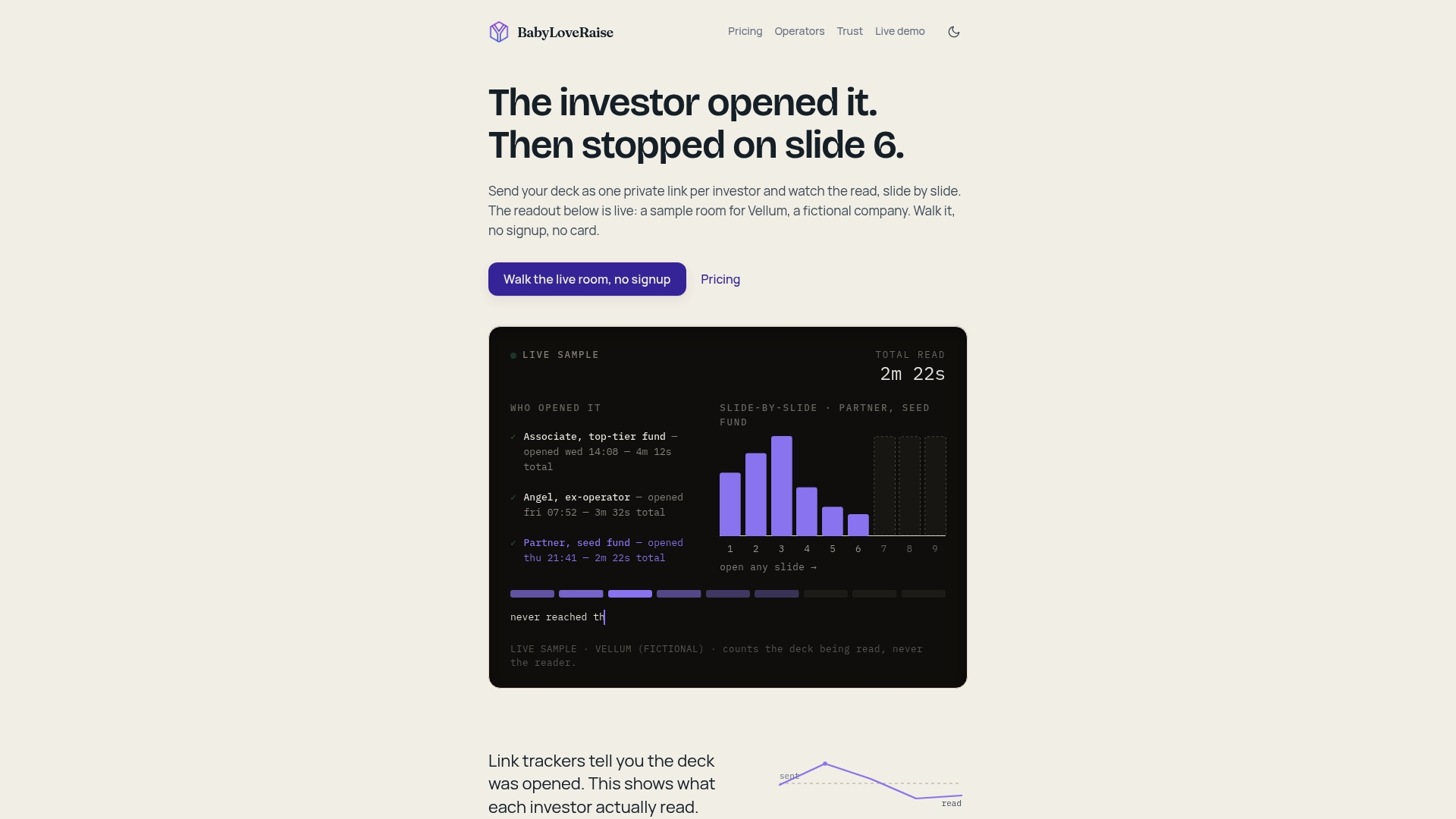
BabyLoveRaise is built around the fundraising raise itself, not generic document management. Send one room link instead of a PDF attachment, and know the moment an investor opens your deck. Per-slide engagement tracking shows which slides held attention and which got skimmed, so you know whether to follow up or revise. The dashboard turns “never opened it” and “read everything and passed” into two different, actionable states.
Key features for founders and fundraising advisors:
- Per-slide dwell tracking that shows exactly where investor attention dropped
- Three share link types (first send, forwardable, private) for different stages of outreach
- Watermarked downloads with a tracking register that reports on the document, not the person
- Permanent archive when the raise closes, with no paywall cliff
- White-label Operator tier for fractional CFOs and fundraising advisory firms running multiple client raises
Pricing is per raise, not per seat forever, which means the cost scales with your fundraising activity rather than your headcount. For advisory firms, the Operator tier lets you run firm-branded rooms across your entire client portfolio at a fraction of traditional VDR pricing. Optional concierge services, including pitch deck editorial passes and narrative Build Map artifacts, cover founders who want hands-on help beyond the platform itself. Learn more at babyloveraise.com.