
How to Build a Pitch Deck for Investors in 2026
Learn how to build a pitch deck for investors that captures attention in under 4 minutes. Discover essential slides to impress VCs.
July 26, 2026 · 8 min read

A great pitch deck is not a business plan in slide form. It is a concise slide argument for why your company is inevitable, structured to earn a meeting quickly. Venture capitalists spend an average of 3 minutes and 44 seconds on an initial review before deciding whether to respond. That window is your entire first impression. The slides that matter most in that window: financials, team, and traction, in that order of disproportionate reading time. Every other slide exists to make those three land harder.
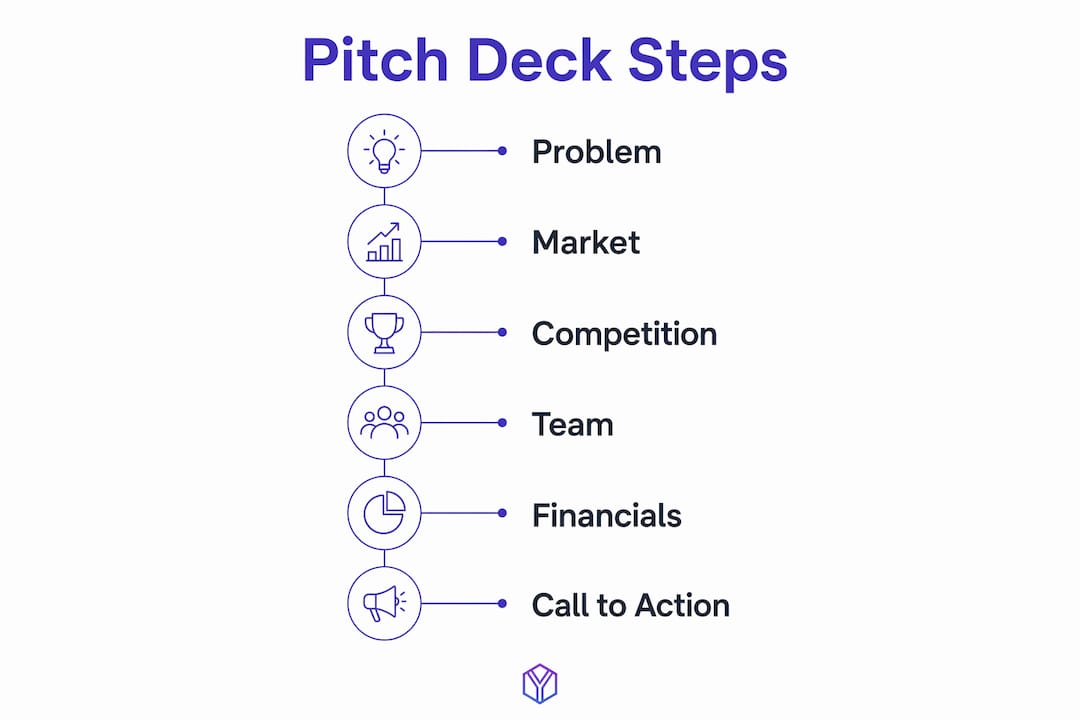
The core slides every funded deck includes:
- Cover: Company name, one-line description, contact details
- Problem: Specific pain, named customer, quantified cost
- Solution: What you do in 25 words or fewer
- Market size: TAM, SAM, SOM built from real assumptions
- Product: Screenshots or demo, not concept diagrams
- Business model: How you make money and your unit economics
- Traction: Revenue, growth trend, or validated demand signals
- Competition: Positioning matrix showing your differentiated advantage
- Team: Founder relevance to the problem, not advisor lists
- Financials: 3-year forecast with stated assumptions
- Ask: Amount, round type, and capital allocation
The deck’s job is to get a meeting, not close a deal. Y Combinator’s pitch philosophy frames every slide decision around one question: why is now the inevitable moment for this company?
Table of Contents
- How to build a pitch deck for investors, slide by slide
- How should you structure your deck for maximum investor attention?
- How BabyLoveRaise helps you track who actually reads your deck
- How to follow up and iterate after sending your deck
- Start tracking your deck with BabyLoveRaise
- Key Takeaways
How to build a pitch deck for investors, slide by slide
Each slide has one job. The moment a slide tries to do two things, it does neither well.
Open with a human story. Unusual Ventures recommends starting with a specific person experiencing the problem, not a market statistic. That story tells investors whether you found this problem honestly or reverse-engineered it from a trend report. Authenticity reads immediately.
Build market size from the bottom up. Y Combinator is direct on this: a bottom-up analysis, starting from the number of real buyers and working up to revenue potential, is far more credible than citing a third-party market report. “50,000 companies buy DevOps tools today” is an argument. “$47 billion global software market” is not.
Address competition head-on. JP Morgan’s startup banking guidance is clear: claiming no competitors signals either poor research or a market that does not exist. Use a 2×2 matrix or a Harvey Ball chart. Pick the two dimensions your buyers actually use when choosing, and show where you win.
| Slide | Investor’s core question | What to include |
|---|---|---|
| Problem | Is this pain real and urgent? | Named customer, specific cost, frequency |
| Market | Is the prize worth the fight? | TAM/SAM/SOM with sourced assumptions |
| Traction | Has anyone validated this? | Revenue trend, retention, or signed pilots |
| Team | Can this group actually win? | Founder-to-problem fit, prior relevant exits |
| Financials | Do the numbers make sense? | 3-year forecast, growth rate, churn assumptions |
| Ask | What do they get for saying yes? | Round size, type, capital allocation buckets |
For the team slide specifically, Y Combinator’s guidance is blunt: nobody cares about your advisors. What investors want to know is why you are the right person to solve this specific problem. Two to three lines per founder, focused on direct relevance, beats a full page of credentials every time.
Financial projections need assumptions, not just numbers. Show how many customers you expect, at what price, with what growth rate, and what churn you are modeling. An investor who can follow your logic will trust the output. One who cannot will discount the whole slide.
Pro Tip: End with a direct call to action, not a “Thank You” slide. Include your email, a calendar link, and a clear next step. Decks that close with a specific ask for a meeting generate more follow-up responses than those that fade out on a generic close.
How should you structure your deck for maximum investor attention?
Slide order is not arbitrary. Investors evaluate risk in a fixed sequence: first they need to believe the problem is real, then they check the solution, then they assess the market, then they look for proof the team can execute. A deck that front-loads the product demo before establishing the problem forces investors to hold context they do not yet have.

The first four slides receive the majority of investor attention on an initial read. Put your strongest material there. If your traction is exceptional, find a way to reference it early, even before the dedicated traction slide.
Design principles that actually matter:
- One idea per slide, no exceptions
- Visuals over text: screenshots beat diagrams, charts beat bullet lists
- Consistent font, color, and spacing throughout (a mismatched deck signals disorganization)
- No slide should require more than 15 seconds to understand
Tailoring for investor type matters more than most founders expect. A pre-seed angel wants to see founder conviction and a credible problem. A Series A fund wants repeatability: 8–10 delighted customers, a pipeline, and a sales motion that can scale. The same underlying deck can serve both audiences if you adjust the talk track, not the slides themselves. J.P. Morgan’s Lindsay Randall puts it plainly: “Stay true to yourself and the company you want to build” while adapting how you present to each investor’s specific thesis.
Common mistakes that kill decks before the third slide:
- Slides dense with text and jargon (investors stop reading, not skimming)
- Market sizing pulled from a generic report with no bottom-up logic
- Claiming no competition exists
- Financials with no stated assumptions
- A closing “Thank You” slide with no next step
- More than 14 slides for a live meeting
Keep a live meeting deck to 12–14 slides. For cold email outreach, 8–10 is the right ceiling. If you can present the full story in under 10 minutes, you leave room for the conversation that actually moves investors toward a yes. You can also review pitch deck examples that win funding to see how top-performing decks handle structure in practice.
How BabyLoveRaise helps you track who actually reads your deck
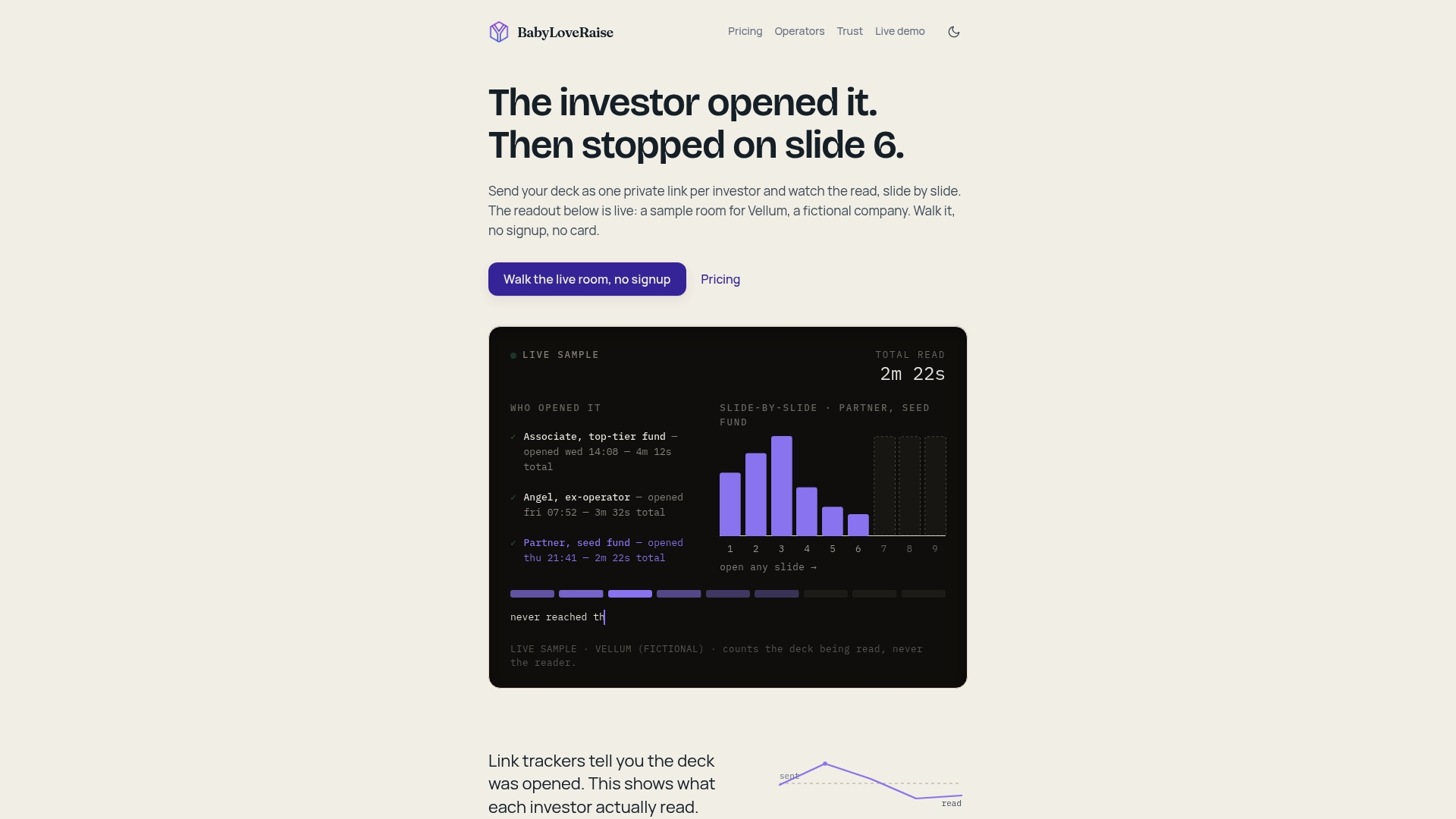
Sending a PDF or a Drive link and waiting is the worst version of fundraising. You cannot tell whether an investor never opened it or read every slide and passed. Those two outcomes require completely different responses, and without data, you treat them the same.
BabyLoveRaise gives founders a hosted raise room. You send one link. The room notifies you the moment an investor opens the deck and records per-slide engagement: how long each slide held attention, which slides got skimmed, and whether the investor read to the end. That per-slide dwell time functions as the second opinion a solo founder does not have.
| Engagement signal | What it tells you |
|---|---|
| Deck never opened | Follow up with a different subject line or warm intro |
| Opened, dropped at slide 3 | Problem or solution slide is not landing; revise it |
| Read to financials, then stopped | Projections may need stronger assumptions |
| Read all slides, no reply | High-interest investor; prioritize personal follow-up |
| Forwarded to a partner | Deal is being discussed internally; stay patient |
Share links come in three registers: first send, forwardable, and private. Downloads can carry a watermark. When the raise closes, the room converts to a permanent archive rather than disappearing behind a paywall. For ethical pitch deck tracking that reports on the document without surveilling the investor, that distinction matters.
Fundraising advisory firms and fractional CFOs can use the Operator tier to run firm-branded rooms across multiple client raises. Optional editorial passes and narrative “Build Map” artifacts are available for founders who want hands-on help shaping the deck before it goes out. If you want to see how BabyLoveRaise compares to general document-tracking tools, the investor tracking software guide covers the landscape in detail.
How to follow up and iterate after sending your deck
Engagement data changes how you follow up. An investor who read every slide two days ago and has not replied is a warm lead. An investor who never opened it is a cold one. Treating them identically wastes both your time and theirs.
Follow-up best practices grounded in engagement data:
- Wait 48–72 hours after confirmed open before following up; same-day follow-up reads as anxious
- Reference something specific in your message: “I noticed you spent time on the financials slide — happy to walk through the assumptions”
- Limit follow-ups to two or three before moving on; persistence past that point damages your reputation
- Track which slides investors exit on and use that pattern to prioritize deck revisions
- Update the deck between batches, not between individual sends; constant changes make it impossible to isolate what is working
Iteration should be systematic. If three investors in a row drop at the market sizing slide, that slide has a problem, not those investors. Fix the bottom-up logic, restate the SAM with a clearer assumption, and test the revision with the next batch. For founders refining their narrative arc, tools like Spark Concept’s Idea Checker can help pressure-test whether your core thesis holds before you send another round.
Investor feedback, even informal objections raised in a first call, belongs in the deck. If five investors ask the same question about your go-to-market, that question should be answered on the relevant slide before the sixth conversation. The deck is a living document during the raise, not a finished artifact.
Start tracking your deck with BabyLoveRaise
A strong deck gets you in the room. Knowing who read it, how far they got, and where they stopped is what gets you to a close. BabyLoveRaise is priced per raise, not per seat forever, so you pay for the fundraise you are running, not a subscription that outlasts it. Set up your raise room, send your first link, and stop guessing.
Key Takeaways
A pitch deck built around the “why now” narrative, structured for a 3-minute-44-second review window, and tracked with per-slide engagement data gives founders the clearest path to a funded raise.
| Point | Details |
|---|---|
| Investor review time is short | Venture capitalists spend an average of 3 minutes and 44 seconds on an initial deck review. |
| Slide order follows investor logic | Structure slides to match how investors evaluate risk: problem, solution, market, traction, team. |
| Market sizing needs bottom-up logic | Build TAM/SAM/SOM from real buyer counts and assumptions, not generic market reports. |
| Team slide beats advisor lists | Investors want to see founder-to-problem fit in two to three focused lines per founder. |
| Engagement data sharpens follow-up | Per-slide tracking distinguishes investors who never opened from those who read and passed. |