
Intralinks Alternatives for Founders: Per-Raise Analytics
Discover the best Intralinks alternatives for founders. Explore top fundraising tools that enhance pitch-deck tracking and offer better pricing.
August 1, 2026 · 9 min read

For startup pitch-deck tracking, fundraising-focused raise rooms beat legacy enterprise VDRs on every dimension that matters to a founder: per-slide engagement, predictable pricing, and privacy controls built around the raise itself. BabyLoveRaise is the recommended option for pre-seed and seed founders; Ideals fits advisors who need a polished VDR interface; Datasite and Firmex serve regulated transactions where deep compliance is non-negotiable.
Three quick matches:
- Rapid investor read-tracking and deck analytics: A fundraising raise room with first-read notifications and per-slide dwell data
- Transparent per-raise pricing and advisor tiers: BabyLoveRaise’s Operator console or a modern VDR with flat-fee options
- Enterprise-grade compliance (M&A, regulated deals): Datasite or Firmex, both SOC 2 certified with full audit trails
The comparison table below breaks down each category across the dimensions that actually affect your raise.
Table of Contents
- What are the best Intralinks alternatives for startup fundraising?
- What features actually matter when you replace Intralinks?
- How do you choose the right Intralinks alternative for your raise?
- Why BabyLoveRaise fits startup pitch-deck tracking
- Key Takeaways
- What founders actually learn from engagement analytics
- BabyLoveRaise: see the raise room in action
- Research sources and useful references
What are the best Intralinks alternatives for startup fundraising?
G2’s alternatives list flags fundraising-focused platforms as the preferred replacements for enterprise tools when founders need deck engagement analytics and transparent pricing. The market has split into five distinct categories, and the right pick depends almost entirely on deal complexity and what you need to measure.
| Category | Best for | Per-slide analytics | Pricing model | White-label/operator |
|---|---|---|---|---|
| Fundraising raise rooms | Pre-seed/seed founders, solo advisors | Yes, first-read + dwell | Per-raise | Yes (BabyLoveRaise Operator tier) |
| Lightweight share/track tools | Quick deck shares, small teams | Limited | Per-seat or subscription | Rarely |
| Modern VDRs | Advisors running multiple deal types | Partial | Per-seat or flat fee | Sometimes |
| Enterprise VDRs (Datasite, Firmex) | Regulated M&A, large cap deals | No | Opaque enterprise billing | No |
| Branded client portals | Advisory firms, law firms | No | Subscription | Yes |
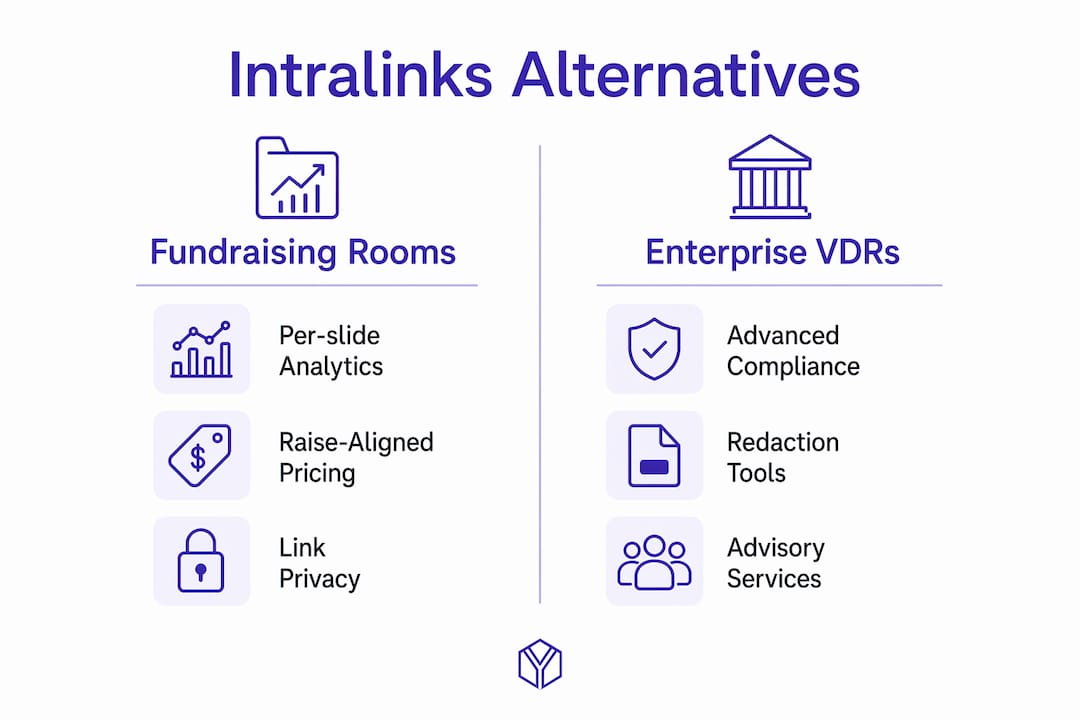
The pricing gap is real. Industry write-ups consistently flag legacy providers for opaque billing, while newer platforms offer predictable, raise-aligned fees. For a founder running a 90-day seed round, paying per-seat for a year makes no financial sense.
Fundraising raise rooms (BabyLoveRaise) are the strongest fit for pre-seed and seed founders. You get per-slide dwell, first-read notifications, and tiered link privacy without paying for M&A compliance features you will never use.
Modern VDRs like Ideals work well for advisors managing multiple deal types simultaneously. The interface is cleaner than legacy tools, and market guides recommend them for deals that need more structure than a raise room but less overhead than an enterprise platform.
Enterprise VDRs (Datasite, Firmex) still win on advanced compliance, redaction tools, and advisory services. If your deal involves regulatory filings or institutional due diligence, that overhead is justified. For a seed round, it almost certainly is not.
What features actually matter when you replace Intralinks?
Most founders switching away from Intralinks are not looking for a feature-equivalent replacement. They want something that tells them which investors read the deck and where attention dropped off. That is a different product category entirely.
Per-slide engagement and first-read notifications
Prioritize per-slide dwell and first-read notifications above everything else. A tool that tells you “the deck was opened” is nearly useless for follow-up decisions. You need to know which slides held attention and which got skipped, because that tells you whether to follow up with a pitch refinement or a meeting request.

General document platforms rarely carry per-slide or investor identity analytics. They treat a fundraise like any file share, which means you lose the signal that makes follow-up precise.
Pro Tip: When a slide shows dwell time well below the deck average, that is your revision target, not a reason to follow up. Save your follow-up energy for investors who reached the financial slide.
Privacy controls and link types
Forwardable links are a liability during a raise. A deck forwarded without your knowledge means you lose the identity signal on every subsequent read. Look for tools that offer at least three link registers: a first-send link (tracked to a named investor), a forwardable link (tracked but anonymous on forward), and a private link (no forwarding, password-protected). BabyLoveRaise’s pitch deck tracking approach covers this distinction in detail.
Download handling and watermarks
Measured watermarks on downloads serve two purposes: they deter unauthorized sharing and they create a paper trail if a deck surfaces somewhere it should not. Not every tool offers this. Ask vendors specifically whether watermarks are applied automatically or require manual configuration per link.
Pricing model transparency
Founders and fractional CFOs consistently prefer predictable, raise-aligned pricing because fundraising is time-boxed. A per-raise fee aligns cost to the actual duration of your raise. Per-seat or storage-based billing punishes you for inviting more investors to review the deck.
CRM integrations and data export
Engagement data that lives only inside the deck tool is only half useful. The other half is getting that data into your fundraising CRM so follow-up tasks are triggered automatically. Ask vendors whether raw event data (opens, slide views, time stamps) is exportable as CSV or via API, and whether they integrate with tools like HubSpot or Notion.
Post-raise archive policy
This one gets overlooked until it matters. Some tools lock your data behind a paywall the moment your subscription lapses. A permanent archive means your engagement history, investor list, and deck versions stay accessible after the raise closes, without a monthly fee.
Security basics
SOC 2 Type II certification and AES-256 encryption are the floor, not a differentiator. Any tool you consider for investor-facing document sharing should carry both. If a vendor cannot produce a SOC 2 report on request, that is a disqualifying signal.
How do you choose the right Intralinks alternative for your raise?
Pick the option that gives you the per-raise metrics you rely on and pricing that matches your raise timeline, not a vendor’s billing cycle.
Evaluation checklist for a 20–30 minute demo:
- Ask to see a sample engagement report with per-slide dwell data for a real or demo deck
- Confirm first-read notifications fire in real time (not batched daily)
- Request proof of SOC 2 Type II certification
- Test a link across mobile and desktop to verify the investor experience
- Ask whether raw event data exports as CSV or connects via API
- Demo the CRM sync with your actual tool (HubSpot, Airtable, or equivalent)
- Confirm the archive policy: what happens to your data after the raise closes?
Questions to ask vendors directly:
- How long is analytics data retained after a raise ends?
- Can I export the full event log (timestamps, slide views, IP signals) as raw data?
- What identity signals do you capture on link opens?
- Is watermarking automatic or manual per link?
- What is the support SLA for a founder mid-raise at 9 PM?
Red flags that should end the conversation:
- Pricing is “custom” with no published ranges or per-raise option
- No trial or demo available before purchase
- No per-slide granularity, only total open counts
- Downloads cannot be watermarked
- No clear data retention or archive policy post-raise
Investor tracking software guides cover these evaluation criteria in more depth for founders who want a full framework.
Why BabyLoveRaise fits startup pitch-deck tracking
BabyLoveRaise is built specifically for startup raises, not adapted from an M&A compliance tool. That distinction shows up in every feature decision.
The raise room sends a first-read notification the moment an investor opens the deck, then records per-slide dwell for the full session. You see who read to the financial slide, who dropped off at the team page, and who opened the deck three times without responding. Those are three different follow-up conversations.
Link privacy works in three tiers: a named first-send link for your initial outreach, a forwardable link for warm intros where you expect the deck to travel, and a private link for sensitive conversations. Downloads carry a measured watermark automatically. When the raise closes, the room converts to a permanent archive at no additional cost, which is a meaningful contrast to tools that gate your own data behind a continued subscription.
For advisors and fractional CFOs, the Operator console runs firm-branded rooms across multiple client raises from a single dashboard. That is a different product than a per-seat VDR license, and the pricing reflects it.
Pro Tip: Use the per-slide dwell data after your first 10 investor sends to identify the one or two slides where attention consistently drops. Revise those before the next cohort, not after the round closes.
Optional concierge services, including pitch deck editorial passes and narrative “Build Map” artifacts, are available for founders who want hands-on support beyond the analytics.
Key Takeaways
For startup fundraising, the right Intralinks alternative is a fundraising-specific raise room with per-slide analytics and per-raise pricing. BabyLoveRaise is the strongest fit for pre-seed and seed founders who need investor engagement data without enterprise VDR overhead.
| Point | Details |
|---|---|
| Match tool to deal type | Fundraising raise rooms fit seed rounds; enterprise VDRs fit regulated M&A. |
| Per-slide dwell is the key metric | Open counts alone cannot tell you which investors engaged or where to revise. |
| Pricing model matters | Per-raise fees align cost to your raise timeline; per-seat billing does not. |
| Archive policy is often overlooked | Confirm post-raise data access before signing up, not after the round closes. |
| BabyLoveRaise for startup raises | Per-slide analytics, tiered link privacy, Operator console, and permanent archive in one raise room. |
What founders actually learn from engagement analytics
The single most underrated shift in fundraising is moving from “I sent the deck” to “I know exactly who read it and how far they got.” Per-slide dwell data consistently reveals that investor silence after a send is almost never uniform: some investors never opened the link, some read three slides and stopped, and a few read everything twice. Those are not the same situation, and they require different responses. First-read notifications change follow-up timing from guesswork to precision, and slide-level drop-off data turns deck revision from intuition into a testable hypothesis. The founders who use this data well stop chasing cold leads and start having better conversations with warm ones.
BabyLoveRaise: see the raise room in action
If per-slide investor engagement and predictable pricing are what your raise needs, BabyLoveRaise is worth a 20-minute look. A demo covers the full engagement dashboard (per-slide dwell, first-read notifications, link privacy controls), the Operator console for advisor teams, and the archive policy so you know how your data is handled after the round closes.
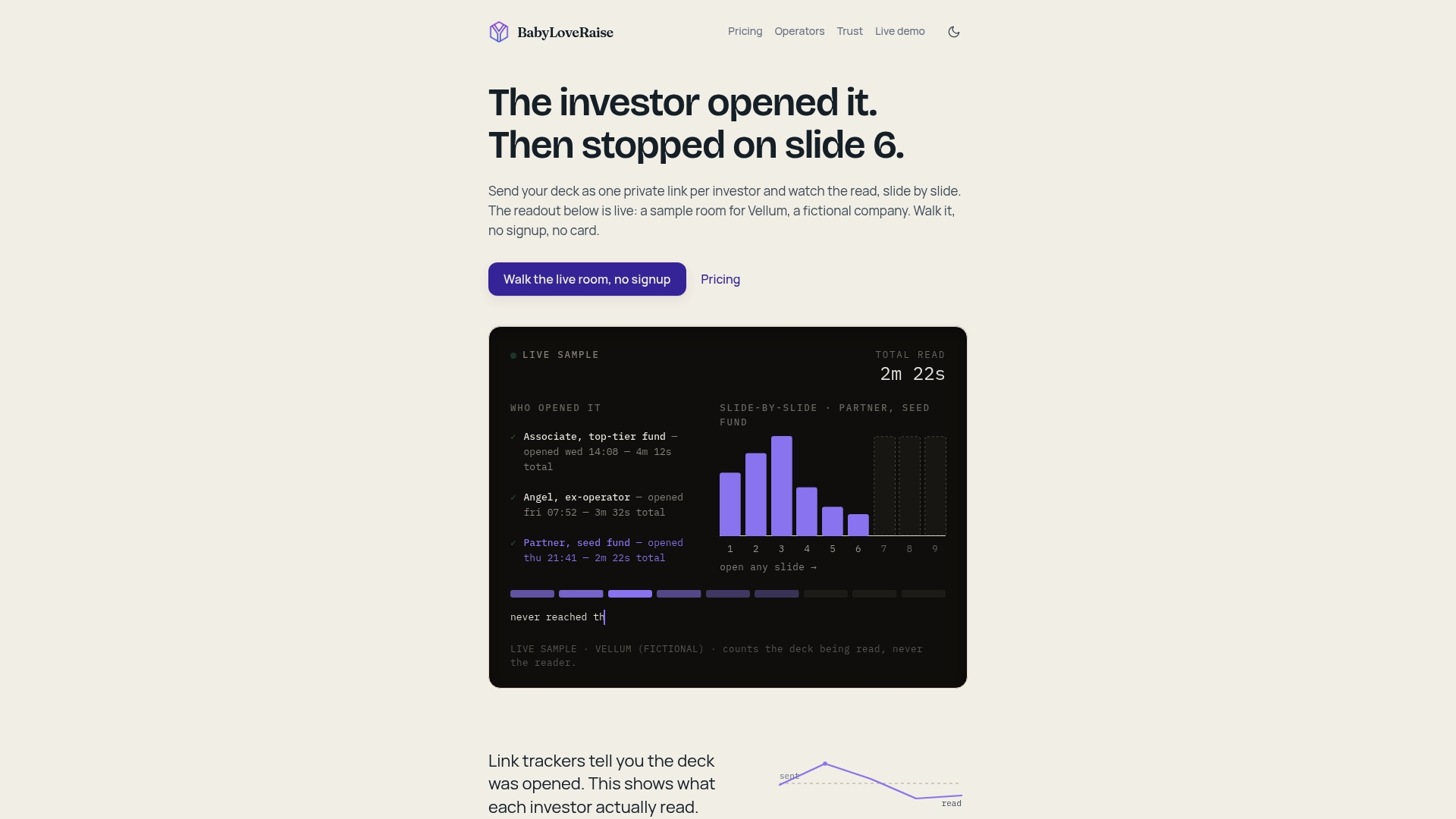
View transparent per-raise pricing or explore the Operator console if you run multiple client raises. Trials and pilot options are available on request during the demo. Book directly at babyloveraise.com.
Understanding what a profitability path signals to investors is worth reading alongside your engagement data — knowing which slides investors dwell on tells you where your financial narrative is landing.
Research sources and useful references
- Intralinks VDRPro alternatives (G2)
- Top Intralinks Competitors (datarooms.org)
- Top Intralinks Competitors: Find the Best Alternatives (data-rooms.org)
- Top 10 Intralinks Competitors for M&A and Due Diligence (dataroom-providers.org)
- The 10 Best Intralinks Competitors and Alternatives (PandaDoc)
- Intralinks alternatives and competitors (SaaSHub)
- BabyLoveRaise product and features
- BabyLoveRaise pricing and Operator plans
- Secure data rooms for startups (BabyLoveRaise blog)
- Investor tracking software guide for founders (BabyLoveRaise blog)