
15 Minute Investor Update Template With Engagement Tracking for Intros
Copy a frozen, metrics first investor update template you can fill in 15 minutes. Send monthly, track deck engagement, and turn updates into warm intros.
September 22, 2026 · 15 min read

Use a metrics-first template: TL;DR, then metrics, wins, lowlights, priorities, asks, round status, sent monthly on the same day. Keep it between 300 and 800 words, freeze the format for at least six months, and never skip the lowlights section, since honesty there is what separates an update investors trust from one they skim and archive. Send it to current investors, people who passed, and advisors alike.
TL;DR:
- Monthly investor updates should include only 3-5 core metrics, showing both current and prior periods, to enable clear month-over-month comparisons.
- Honest lowlights with root causes and fixes are essential, as they foster long-term trust and prevent an overly promotional narrative.
- Specific asks linked to named individuals or companies outperform vague requests and increase the likelihood of actionable responses.
- A consistent format and regular timing, preferably within the first few days of each month, reinforce credibility and build investor familiarity over time.
- Tracking engagement through tools like per-slide analytics helps tailor follow-ups and improves the effectiveness of subsequent investor interactions.
BabyLoveRaiseSee Who Engaged With Your DeckShare one raise room link and see who opened, finished, or skimmed each slide, so follow-ups reflect real investor engagement.Explore BabyLoveRaise
Table of Contents
- The Investor Update Template You Can Copy Right Now
- Why Monthly Beats Quarterly (and How Long Is Too Long)
- What Goes in Each Section of the Update
- The 15-Minute Ritual That Keeps You Consistent
- Who Should Be on Your Update List
- How Tracking Investor Engagement Sharpens Your Follow-Up
- Legal and Compliance Considerations for Investor Updates
- Common Mistakes That Undermine an Otherwise Good Update
- Formatting an Update So It Reads Well on a Phone
- Adjusting Your Update for Angels vs. Venture Capital Firms
- What a Genuinely Effective Update Looks Like in Practice
- A Founder’s Honest Take on the Discipline
- Make Every Update Count with a Raise Room
- A Few Templates and Guides Worth Bookmarking
- Sources
- FAQ
The Investor Update Template You Can Copy Right Now
Three versions of this template cover almost every founder’s situation: a quick email for month one, a fuller structure for months two through twelve, and a table format for founders who track more than five metrics. Pick one, freeze it, and stop redesigning your update every quarter.
1. The 2-minute email (early-stage, first few updates)
Subject: [Company] update — March 2026
Headline: MRR grew compared to the prior month.

Cash on hand, net burn, runway, and signups improved compared to last month.

Win: Closed our first $15K annual contract.
Hard thing: Churn ticked up to [6%](https://www.reddit.com/r/Entrepreneurs/comments/1spuy2j/18_of_our_customers_were_churning_in_the_first_90/) — we're rebuilding onboarding.
Ask: Intro to a fintech-focused seed investor for our next round.
That is the entire email. No PDF, no deck link, no scrolling required.
2. The 10-minute monthly template
TL;DR: [One sentence: headline metric + direction]

METRICS (this month vs. last month)
- MRR/ARR: $X (prior: $X)
- Cash on hand: $X
- Net burn: $X/mo
- Runway: X months
- North star metric: X (prior: X)

WINS
- [2–4 bullets with evidence, not adjectives]

LOWLIGHTS / CHALLENGES
- [1–3 honest items, each with root cause and fix]

PRIORITIES (next 30 days)
- [2–3 items]

ASKS
- [1–3 specific, bounded asks]

ROUND STATUS: [One line, always present]
3. The variable table version (for founders tracking 6+ metrics)
Drop metrics into a table instead of a bullet stack, and delete rows that don’t apply to your business. A marketplace founder needs GMV and take rate; a SaaS founder needs net revenue retention. Never keep a row just because a template had it. If a metric doesn’t move the story, cut it rather than padding the report.
Why Monthly Beats Quarterly (and How Long Is Too Long)
Monthly is the industry standard for pre-seed through Series A companies; quarterly belongs to Series B+ companies running formal board cycles with audited numbers. The gap matters because early-stage investors decide who to introduce you to based on recent signal, not last quarter’s story.
Send in the first three to five business days of the month, while last month’s numbers are fresh and before your own memory of “what actually happened” fades. The specific weekday matters less than never missing a month.
- 300 to 800 words is the target length, scannable on a phone screen in under two minutes.
- Consistency in when you send outranks polish in how you write it.
- Consistent sending to investors who passed can convert a prior “no” into a “yes” over 6 to 12 months.
One caveat: if you have nothing new to report in a given month, send a shorter version anyway. A skipped month reads as trouble even when there isn’t any.
What Goes in Each Section of the Update
Each section has a job. Skip the job, and the section becomes filler.
| Section | What to include | What to leave out |
|---|---|---|
| TL;DR | One sentence: headline number + direction | Context, caveats, backstory |
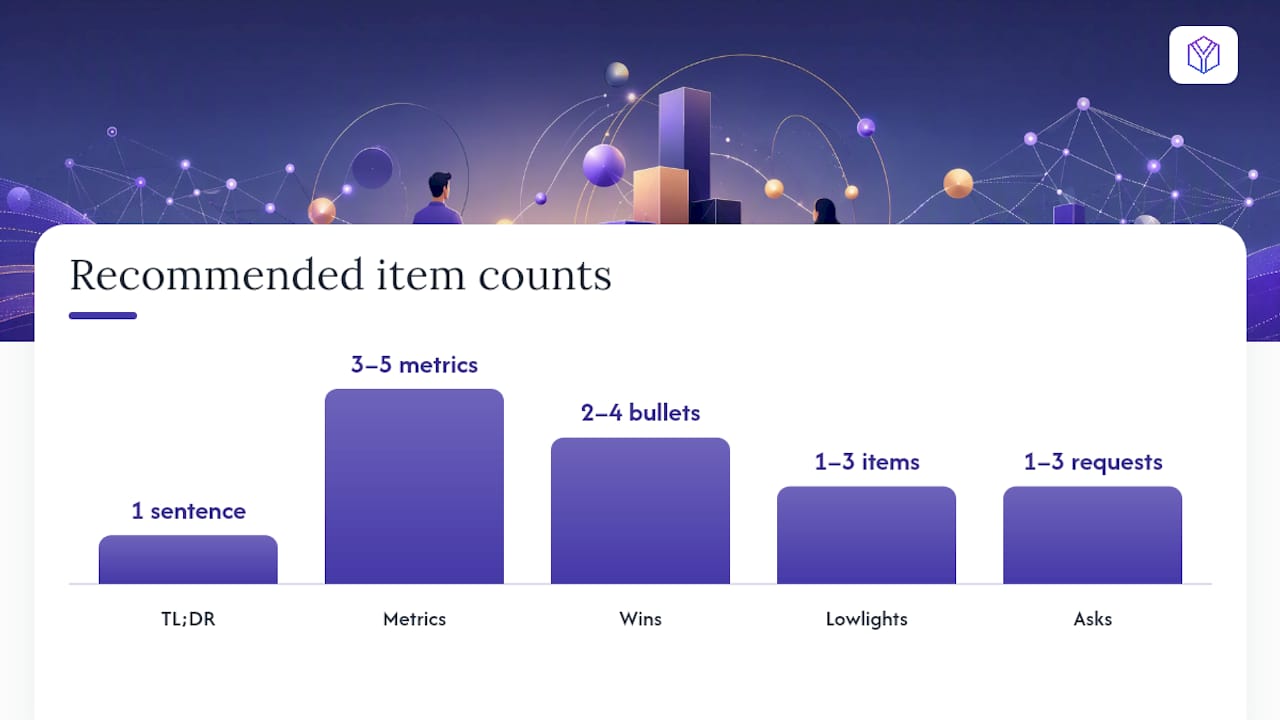
| Metrics | 3–5 frozen metrics, current vs. prior period | Vanity metrics that change monthly |
| Wins | 2–4 bullets with evidence | Adjectives without proof |
| Lowlights | 1–3 honest items with root cause and fix | Vague admissions with no plan |
| Priorities | Next 30 days only | Long-term roadmap |
| Asks | 1–3 specific, bounded requests | “Any intros welcome” |
| Round status | One line, every single month | Silence when nothing has changed |
The metrics section is where most updates fall apart. Pick three to five hard-to-game numbers: MRR or ARR, cash on hand, net burn, runway, and one north-star metric specific to your business. Show the prior period beside the current one every time. Swap metrics month to month and investors lose the ability to compare, which defeats the entire purpose of a recurring update.
Lowlights are non-negotiable. Founders who include an honest “hard things” section tend to see stronger long-term investor engagement than those who only report wins, because an update with zero problems reads as marketing copy, not a status report.
Asks need a name attached. “Intro to a Series A lead investor who has written checks in vertical SaaS” beats “any intros appreciated” every time, and specific asks can generate warm intros within days while vague ones typically generate nothing.
The 15-Minute Ritual That Keeps You Consistent
Once your template is frozen, the update stops being a writing project and becomes a fill-in-the-blanks exercise. Here’s the breakdown:
- Minutes 1 to 4: Pull your frozen metrics from whatever source of truth you use (Stripe, your bank, your CRM). Don’t recalculate definitions. Don’t add a new metric because it looks good this month.
- Minutes 5 to 6: Write the one-line headline. This is the sentence people will remember.
- Minutes 7 to 9: Fill in “what changed” and the metrics table.
- Minutes 10 to 12: Write your wins and lowlights. Lowlights first, if you’re being honest with yourself. They’re harder to write and easier to skip.
- Minutes 13 to 14: Write your asks and close with round status.
- Minute 15: Run the pre-send checklist and hit send.
A frozen template plus a short, timeboxed ritual is what makes monthly cadence sustainable past month three, when the novelty wears off and the discipline has to carry it.
Pro Tip: If you ever change how you calculate a metric (say, switching from gross to net MRR), disclose it explicitly in “what changed” that same month. A silent definition change is the fastest way to make your numbers look manipulated later.
Who Should Be on Your Update List
Your list should include more than the people who wrote checks. Current investors are obvious. Add people who passed, your advisors, and, if it makes sense for your business, a separate sanitized version for customers or design partners who don’t need your burn rate.
Subject lines should follow one pattern every month: [Company] update — [Month Year]. Some founders add the headline number directly in the subject line for extra scanability, like Acme update — March 2026 (MRR: $42K).
A few mailing mechanics matter more than people expect:
- Always BCC the full list. Never use “To” or “CC” for an investor update.
- Send plain text in the email body. No PDF attachment, no link to a Google Doc that requires a click and a login.
- Reply within 24 to 48 hours to any investor who responds. A fast reply is often worth more than the update itself.
- Archive every update somewhere you can pull up 12 months of history in one click. That archive becomes credibility in itself when a new investor asks for track record.
Sending to people who passed converts prior “no” decisions over time, largely because their read on your business shifts as they watch consistent, dated progress accumulate in their inbox.
How Tracking Investor Engagement Sharpens Your Follow-Up
An update that goes out to 40 people generates 40 different reactions, and email alone tells you almost none of them. Per-slide engagement tracking on your pitch deck changes that: you can see who opened the update, who clicked through to the deck, and who read to the last slide versus who skimmed and stopped.
- Never opened and read everything, then went quiet look identical in a normal inbox. They require completely different follow-ups.
- Investors who read the whole deck are your highest-probability responders for a specific ask, so send them the ask that matches what they lingered on.
- Pairing a monthly update with raise-room analytics shows exactly which investors opened the update and which asks actually generated replies, so next month’s ask gets sharper instead of staying generic.
Legal and Compliance Considerations for Investor Updates
Investor updates aren’t formal disclosure documents, but they still carry real legal weight, especially once your company has multiple investors and an active cap table.
Be precise about numbers. If you report MRR, cash, or runway, make sure those figures reconcile with what your bank statements and accounting records actually show. Investors compare updates against diligence materials during a future round, and inconsistency between what you reported monthly and what shows up in a data room raises real questions.
Avoid forward-looking language that reads as a guarantee. “We expect to close our Series A by Q3” is a projection; phrase it that way rather than stating it as fact. Regulatory frameworks around securities communications vary, and founders raising under Regulation D or similar exemptions should keep updates factual and avoid language that could be read as a general solicitation outside the bounds of their offering.
If you named a customer, a revenue figure tied to a specific deal, or a partnership in an update, get permission first, especially if that customer has a nondisclosure agreement with your company. A leaked or misattributed detail in an update that gets forwarded around a fund can create a problem that has nothing to do with fundraising and everything to do with a broken confidentiality agreement.
When in doubt on a specific disclosure question, a quick check with counsel costs less than an angry email from a customer or a co-investor later.
Common Mistakes That Undermine an Otherwise Good Update
The most common failure is inconsistency. A founder sends three great updates, then goes quiet for four months during a hard stretch, which is exactly when investors most want to hear from them. Silence during a rough patch reads far worse than an honest lowlight ever would.
The second failure is changing the format every time. If your metrics section has different numbers in different orders each month, investors can’t compare month over month, which defeats the entire point of a recurring cadence.
Other recurring mistakes:
- Burying the headline. If the reader has to scroll to find out what happened this month, the TL;DR has failed its one job.
- Vague asks. “Always looking for great people” gets ignored. Name the role, the stage, or the specific investor profile you need.
- Skipping lowlights entirely. An update with only good news reads as a pitch, not a report, and erodes trust faster than one honest miss ever would.
- Attaching a PDF or deck link instead of writing plain text. It adds friction, and busy investors skip anything that requires a second click.
- Sending only to people who already wrote a check. That leaves out the passed investors and advisors most likely to warm back up to you over time.
Formatting an Update So It Reads Well on a Phone
Most investors read updates on a phone between meetings, which means formatting decisions matter almost as much as content decisions.
Skip charts unless a trend genuinely needs a visual to land. A simple line showing MRR over six months earns its place; a pie chart of expense categories usually doesn’t. If you do include a chart, keep it to one, keep the axis labels legible at thumbnail size, and never rely on color alone to distinguish two lines, since a meaningful share of readers will view it in dark mode or grayscale preview.
Tables work well for metrics because they let a reader scan current versus prior period in one glance. Keep tables to five rows or fewer. A ten-row metrics table stops being scannable and starts feeling like a spreadsheet dump.
Use bold sparingly, on the one or two numbers you actually want remembered. Bolding every metric defeats the purpose, since nothing stands out when everything is emphasized. Skip colored text and background highlighting entirely. Many email clients render them inconsistently, and a red “burn increased” callout can look alarming in a way that undercuts an otherwise calm, factual tone.
Plain text, one clear headline number, a scannable metrics section, and short paragraphs beat a beautifully designed one-pager almost every time, mostly because the designed version usually requires a click to open.
Adjusting Your Update for Angels vs. Venture Capital Firms
Angel investors and venture capital firms read the same update differently, and a little customization goes a long way without requiring two separate documents.
Angels, especially ones without a fund behind them, often care more about the human story and the specific milestone that changes their personal financial exposure. They’re less likely to ask for detailed cohort data and more likely to respond to a clear, honest lowlight, since many angels have been operators themselves and recognize candor when they see it.
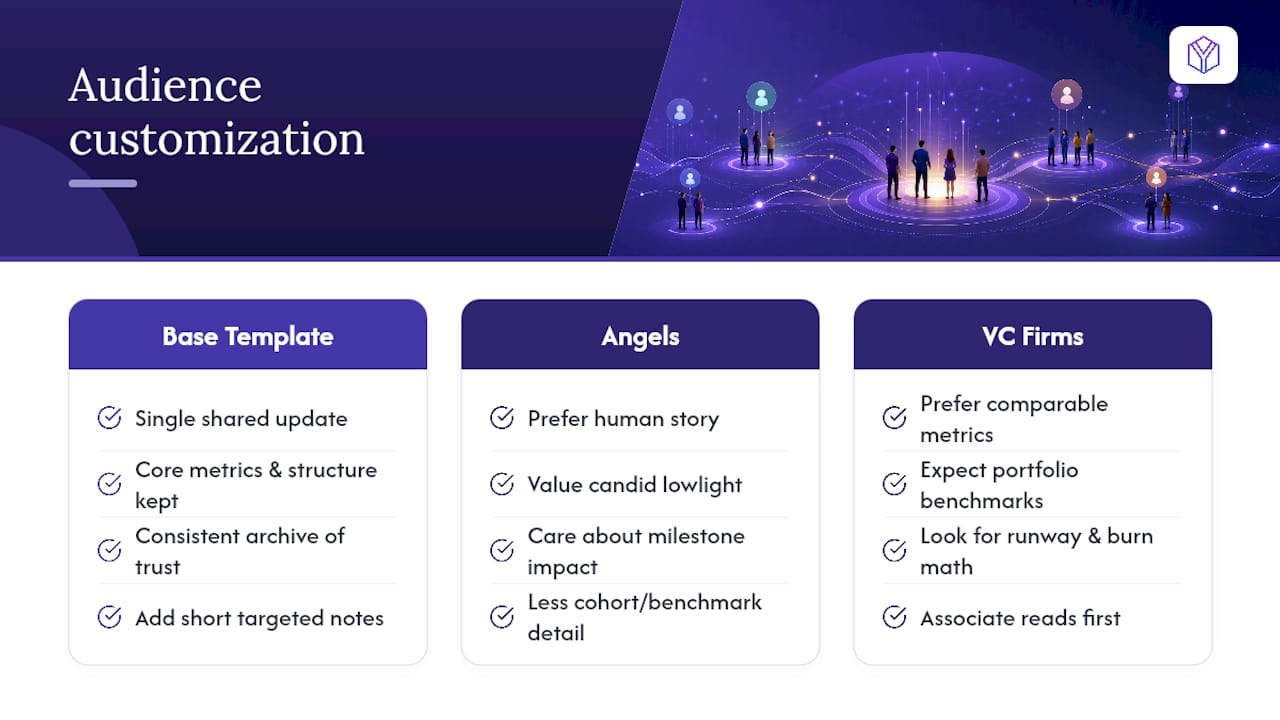
Venture capital firms, particularly at the seed and Series A level, want metrics they can compare against their own portfolio benchmarks: net revenue retention, gross margin, CAC payback, and runway math that ties directly to their internal model of your burn multiple. A VC associate is often the first reader, and they’re building a case to bring to a partner meeting, so specific, bounded asks that tie to that internal process (an intro to a portfolio company, a warm lead to a later-stage fund) land better than general requests.
The fix isn’t two templates. It’s one base template with a short, targeted note added to specific investors when an ask or context applies only to them. Keep the core metrics and structure identical across your whole list. Consistency is what builds the archive of trust in the first place, and fragmenting the format defeats that.
What a Genuinely Effective Update Looks Like in Practice
The updates that get replies share a few traits, regardless of industry. The headline number appears in the first sentence, not the third paragraph. The lowlight is specific enough that a reader believes it (a churn number, a delayed hire, a slipped launch date) rather than a soft, deflected admission. The ask names a person, a company type, or a specific kind of intro, not a general appeal for help.
Compare two ask lines side by side: “Would love any intros to investors” versus “Looking for a warm intro to a seed fund that’s led rounds in vertical marketplaces, ideally $500K to $1M check size.” The second gets forwarded. The first gets skimmed and forgotten, because the reader has no idea who to think of.
The best updates also read the same way in month eleven as they did in month one. That repetition is the point: a reader who has seen ten consistent updates trusts the eleventh without having to reread your whole pitch, because the format has already done the work of proving you’re organized and honest about your numbers.
A Founder’s Honest Take on the Discipline
Polish fades fast; discipline compounds. A plain, honest update sent on the same day every month for a year builds more investor trust than any single beautifully designed one-pager ever will. Give it six to twelve months and watch what happens to your intro flow.
— Paul
Make Every Update Count with a Raise Room
Writing a tight monthly update solves half the problem. Knowing whether anyone actually read it solves the other half, and that’s the gap BabyLoveRaise’s raise room closes. Instead of guessing whether an investor opened your latest email, you get a first-read alert and per-slide engagement data showing who reached the last slide of your deck and who stalled out on slide four.
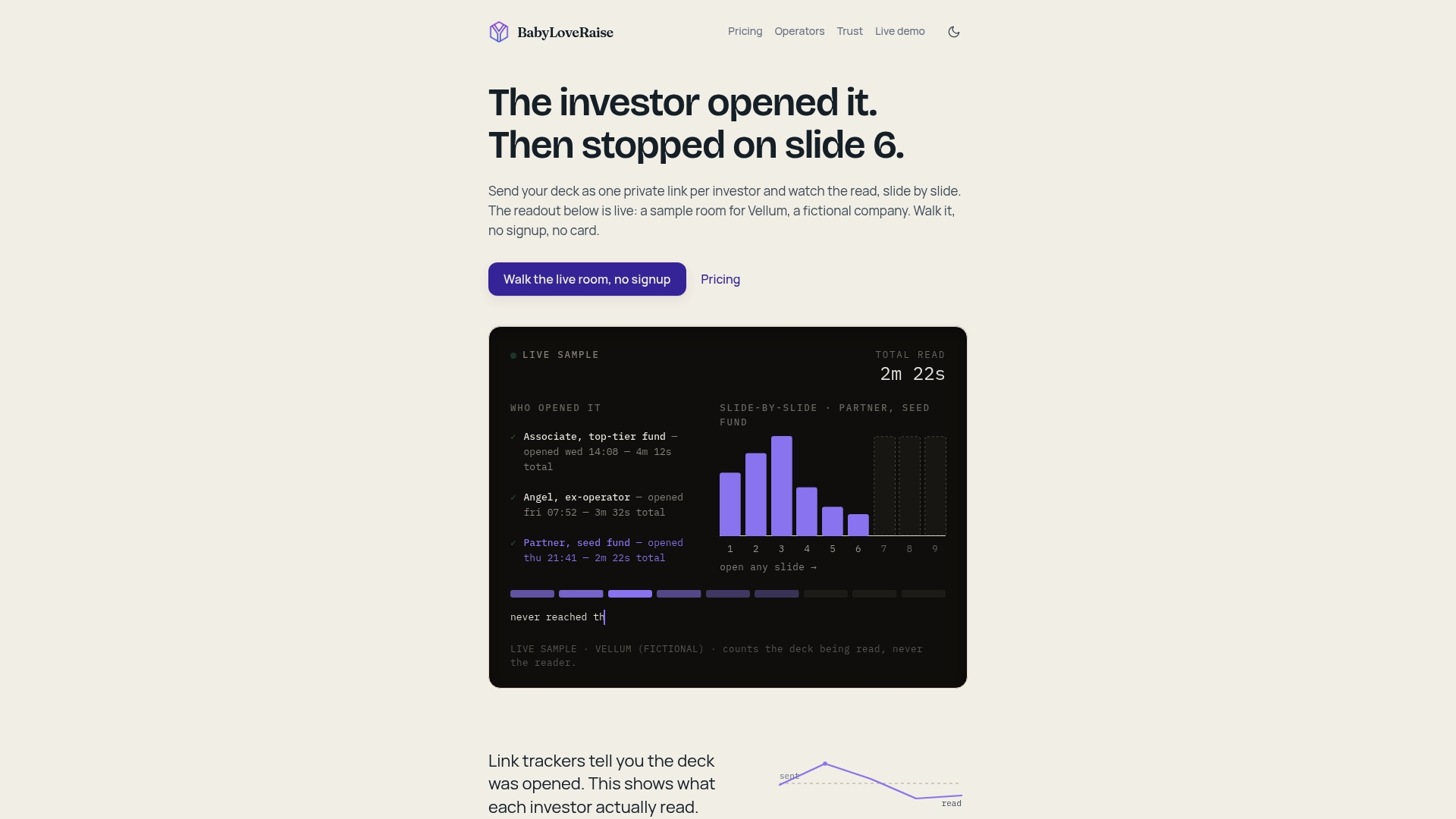
That distinction between “never opened it” and “read everything and went quiet” changes how you follow up: the deck link inside your monthly update becomes a live signal, not a static attachment. Pair it with an editorial pass if you want a second set of eyes on the narrative itself, and once your round closes, the room converts into a free permanent archive instead of disappearing behind a paywall. Advisory firms and fractional CFOs managing several client raises at once can run all of them through a white-label Operator seat. Check current plans, including the raise room at $149 per month or $399 per quarter, and see whether a tracked raise room fits your next update cycle.
A Few Templates and Guides Worth Bookmarking
- Investor update lexicon and format guidance for cadence and structure basics.
- Investor update cadence guide covering asks and audience strategy.
- Follow-up strategy for seed founders to pair with your monthly send.
- Using data to drive growth decisions for quantifying wins.
Sources
- Startups
- Investor update cadence (StartupFundraising)
- Monthly investor update (Vectig)
- The Investor Update Playbook (Gupta Deepak)
FAQ
How Long Should an Investor Update Be?
Aim for 300 to 800 words, short enough to read fully on a phone in under two minutes. If you consistently need more, you’re likely including detail that belongs in a follow-up call instead of the update itself.
Should I Send Updates Monthly or Quarterly?
Monthly is the standard for pre-seed through Series A companies; quarterly generally fits Series B and later, once you have a formal board reporting cycle. Monthly cadence also gives you more chances to convert investors who previously passed.
What Should I Do If I Have Bad News to Report?
Report it anyway, with the root cause and your fix, in a dedicated lowlights section. Honest lowlights build more long-term trust than an update that only shows wins, and skipping a month to avoid bad news reads worse than the bad news itself.
Who Should Receive My Monthly Investor Update?
Send it to current investors, advisors, and people who previously passed on investing. Consistent updates to passed investors can convert a prior “no” into a “yes” over 6 to 12 months, which makes them worth keeping on the list.
How Can I Tell Which Investors Are Actually Reading My Updates?
Standard email tools show opens at best, not depth of engagement. A raise room with per-slide tracking shows exactly who opened your deck, who read to the last slide, and which slides lost attention, so your follow-up goes to the right people first.