
Investor Follow-Up Strategy for Seed Founders in 2026
Master your investor follow up strategy for 2026. Learn to engage effectively with investors using proven techniques to secure funding.
July 31, 2026 · 11 min read

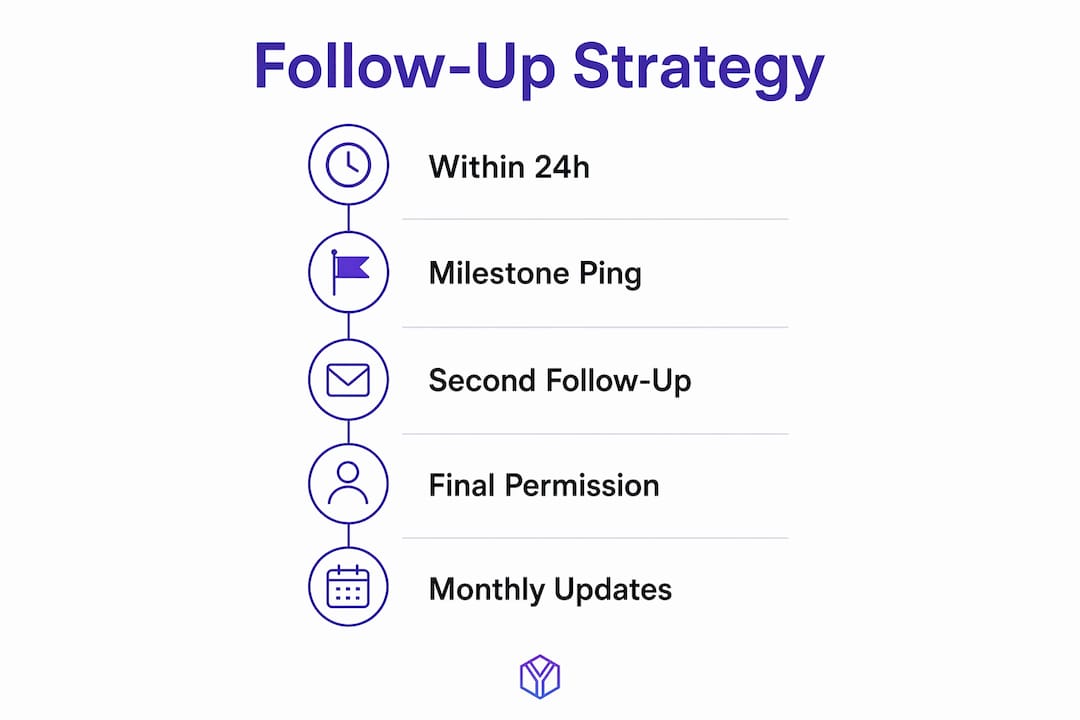
Send your first follow-up within 24–48 hours of any meeting or deck open: a short thank-you that recaps what you discussed, links only the materials you promised, and ends with one low-friction ask. From there, your investor follow-up strategy runs on a simple spine: milestone ping at day 7–10, a permission ask at day 14, one final value-add nudge, then monthly updates for everyone who hasn’t said no.
Your first 48 hours:
- Send the thank-you email with promised materials (deck link, model, one-pager — whatever you committed to) within 24–48 hours
- Log who you sent it to and note any engagement signal you already have
- Set a calendar reminder for day 7 to check who opened the deck
One-line BLUF you can paste right now:
“Hi [Name], great talking today — attached is the [deck/model] we discussed. Would a 15-minute call next week to walk through our traction numbers work for you?”
Pro Tip: Don’t re-attach the deck as a PDF. Send a tracked room link instead. You’ll know the moment they open it and which slides they actually read — that data shapes every message you send after this one.
Table of Contents
- Why a disciplined follow-up wins more deals than persistence alone
- What to send in the first 24 hours after a meeting or deck open
- How many follow-ups should you send, and when do you stop?
- How to segment investors and tailor your messages
- What every investor update should contain
- How to use deck engagement signals to prioritize follow-ups
- Three copy-paste templates for every stage of the raise
- Red flags, mistakes to avoid, and privacy considerations
- Key Takeaways
- Why engagement data changed how I think about follow-up
- BabyLoveRaise turns your follow-up plan into a live dashboard
- Useful sources and further reading
Why a disciplined follow-up wins more deals than persistence alone
Most founders lose investor threads not because of an active “no” but because they fail to create urgency or add value between touches. Silence usually means the investor is busy, not that they’ve passed. The fix is treating fundraising as a pipeline with milestone-based updates, not a one-shot pitch.

Verabro’s research puts it plainly: 2–3 meaningful, milestone-based follow-ups over a 6–8 week window is the right ceiling before treating silence as a soft pass. The founders who stay in the game longest are the ones who give investors a reason to re-engage each time, not just a reminder that they exist.
Common mistakes that kill threads:
- Sending “just checking in” with no new information
- Re-attaching the same deck in every email
- Following up on multiple channels simultaneously before getting a reply
- Sending a long update when a three-sentence ping would do
What to send in the first 24 hours after a meeting or deck open
Send within 24–48 hours of any meeting or first deck open. The goal is simple: document what happened, deliver what you promised, and make the next step obvious.
Your 24-hour follow-up checklist:
- Subject line that references the meeting specifically (not “Following up”)
- One sentence that names something specific from the conversation
- Link to promised materials (deck room link, not a PDF attachment)
- One low-effort CTA — a yes/no question or a specific time offer
Subject line options:
- “Quick follow-up: [Company] deck + [specific topic you discussed]”
- “[Name], materials from today + one question”
Template:
Hi [Name],
Really enjoyed our conversation about [specific topic]. As promised, here’s the deck: [room link].
One quick question: would a 15-minute call Thursday or Friday work to walk through our revenue model?
[Your name]
Keep it under 100 words. Investors read these on their phones between meetings. A link, not an attachment, lets you see exactly when they open it and how far they read.
How many follow-ups should you send, and when do you stop?
A practical cadence keeps momentum without burning goodwill. NUVC’s guidance and Verabro’s framework both converge on the same window: 2–3 meaningful touches over 6–8 weeks, then shift to monthly updates.
| Day | Action |
|---|---|
| Day 0 | Send thank-you + promised materials + CTA |
| Day 7–10 | Milestone ping: one new data point (customer win, metric, hire) |
| Day 14 | Permission ask: “Can I keep you on monthly updates?” |
| Day 21 | Final value-add nudge if no reply |
| — | Monthly update to full list; no individual chasing |
Stop rules: After three meaningful touches with no reply, stop individual follow-ups. Move the investor to your monthly update list. If they re-engage on an update, that’s a warm signal worth acting on.
Cross-channel note: Email first, always. A single LinkedIn message is acceptable only after two unanswered emails, and only if you have a genuine connection. Never ping the same investor on three channels in the same week.
How to segment investors and tailor your messages
Segment first, message second. A sector-focused partner at a Series A fund needs a different message than an angel scout who met you at a demo day. Sending the same email to both wastes both of your time.
Four practical segments for seed and pre-seed:
- Active lead partners: High-fit VCs who attended a full meeting or read the deck end-to-end. Send milestone pings every 7–10 days. CTA: “Can we schedule a partner intro call this week?”
- Sector specialists: Investors with a clear thesis match but no meeting yet. Send one sharp, thesis-aligned note. CTA: “Would a 10-minute call to discuss [specific market angle] be useful?”
- Angels and scouts: Faster decisions, smaller checks, often great for intros. Keep updates brief. CTA: “Know anyone in your network who focuses on [sector]?”
- Non-responders: Two touches, no reply. Move to monthly update list. CTA: “Can I keep you posted as we hit milestones?”
Tag each investor in your raise room or CRM with their segment on day one. That tag determines which template you pull and how often you reach out. For founders managing a large outbound list, cold email automation tools can help schedule and track sequenced outreach without manual reminders.
What every investor update should contain
Every update should be concise and lead with concrete progress, not vague sentiment. The structure that works: three wins, one challenge, one ask. Under 200 words total.
Repeatable update template:
- Win 1: “Signed [X] new customers this month, bringing MRR to [$Y].”
- Win 2: “Closed [key hire or partnership].”
- Win 3: “Hit [product milestone].”
- Challenge: “Still working through [specific obstacle] — open to intros to anyone who’s solved this.”
- Ask: “If you know a [specific role/investor type], an intro would mean a lot right now.”
Subject line examples for updates:
- “[$Company] — MRR up 40%, one ask”
- “Quick update: new customer + a question for you”
- “[$Company] milestone + intro request”
Low-friction CTAs that get replies:
- “Yes/no: would an intro to [name] make sense?”
- “15 minutes this week to walk through the new numbers?”
- “Can I keep you on monthly updates while we build?”
Sharing a challenge alongside the wins builds trust faster than a polished-but-vague update. Investors know startups have problems. Naming one shows you’re self-aware.
How to use deck engagement signals to prioritize follow-ups
Let engagement data dictate priority. An investor who never opened your deck needs a different message than one who spent eight minutes on your financial model slide. Treating both the same wastes a follow-up and misses the signal.
Engagement signals and what they mean:
- Unopened: The subject line didn’t land, or it got buried. Try a new subject line on a fresh send, not a “bumping this” reply.
- Opened, skimmed (under 2 minutes): Something didn’t hook them. Add a new anchor — a metric, a customer name, a market data point — in your next message.
- Full read, stopped at one slide: That slide has a problem. Fix it, then send a note: “Updated the deck with new traction data — worth another look?”
- Full read, multiple sessions: They’re doing diligence. This is your warmest lead. Ask for a partner intro or a deeper call.
| Signal | Next action |
|---|---|
| Unopened | New subject line, resend after 5 days |
| Skimmed | Add one new data point, reference the slide they stopped on |
| Full read | Ask for partner intro or deep-dive call |
| Repeat reader | Treat as active interest; move to top of follow-up queue |
Pro Tip: Use the engagement data to craft the one new piece of value you add each follow-up. If they spent the most time on your market size slide, your next email leads with a new market data point. That’s not coincidence to them — it’s relevance.
For a deeper look at how slide-level analytics change prioritization decisions, BabyLoveRaise’s tracking guide covers the mechanics in detail.
Three copy-paste templates for every stage of the raise
These follow the rule from Causo’s template research: one new data point per message, one low-effort CTA, readable in under 60 seconds on mobile.
Template 1 — Post-meeting thank-you (Day 0)
Hi [Name], great talking today. Here’s the deck: [link]. Since we spoke, we just signed [customer/milestone]. Would a 15-minute call Thursday work?
Template 2 — Milestone ping (Day 7–10)
Hi [Name], quick update: we hit [specific metric] this week. Thought it was relevant given what you mentioned about [topic from meeting]. Still happy to answer any questions — or I can keep you on monthly updates if that’s easier.
Template 3 — Permission/close (Day 14–21)
Hi [Name], I don’t want to crowd your inbox. If the timing isn’t right, totally fine — can I just keep you posted with a monthly update? No pressure either way.
Subject line pairings:
- Template 1: “Materials from today + one question” / “[Company] deck — [specific topic]”
- Template 2: “New traction since we last spoke” / “[Company] — [metric] update”
- Template 3: “Quick question before I stop bugging you” / “Should I keep you posted?”
Red flags, mistakes to avoid, and privacy considerations
Avoid low-value “bumping” messages and cross-channel pressure. Both signal poor judgment, and investors talk to each other.
Do-not list:
- Never send “just bumping this” with no new content
- Never follow up on email, LinkedIn, and Twitter in the same week
- Never re-attach the same deck version you already sent
- Never mention that you tracked their opens (“I saw you viewed the deck”)
- Never send more than three individual follow-ups before shifting to monthly updates
Privacy note: Engagement tracking should inform your decisions, not become a surveillance log you reference in messages. Platforms like BabyLoveRaise report on document engagement, not individual behavior — the distinction matters. Use the data to decide when and what to send; never use it to pressure or corner an investor.
Pro Tip: Log opt-outs in your raise room or CRM the day they happen. If an investor says “please remove me from updates,” mark it immediately. One ignored opt-out can close a door permanently.
For more on privacy-preserving tracking, BabyLoveRaise’s approach keeps the analytics on the document side, not the person.
Key Takeaways
A disciplined investor follow-up strategy built on engagement signals, milestone-based updates, and clear stop rules consistently outperforms generic persistence.
| Point | Details |
|---|---|
| Send within 24–48 hours | First follow-up goes out within 24–48 hours with promised materials and one specific CTA. |
| Cap at 2–3 meaningful touches | Verabro recommends a 6–8 week window before treating silence as a soft pass. |
| Segment before you message | Active lead partners, sector specialists, angels, and non-responders each need a different cadence and CTA. |
| Let engagement data lead | Unopened, skimmed, and fully read decks each signal a different next action — treat them differently. |
| BabyLoveRaise raise room | Tracks per-slide engagement and distinguishes unread from fully read decks, so every follow-up targets an actual reader. |
Why engagement data changed how I think about follow-up
The conventional wisdom on investor follow-up is all about persistence: keep showing up, keep adding value, and eventually someone says yes. That framing isn’t wrong, but it misses the more interesting problem. Most founders aren’t failing because they give up too early. They’re failing because they can’t tell the difference between an investor who never opened the deck and one who read every slide and quietly decided to pass. Those two situations look identical in a Gmail thread. They require completely different responses.
When you can see that an investor spent four minutes on your traction slide and two minutes on your team page, you stop guessing. You know what they care about. Your next message leads with a new customer win, not a generic update. That’s not a small improvement in efficiency — it’s a fundamentally different conversation.
The other thing worth saying: the permission ask at day 14 is underused and underrated. Asking “can I keep you on monthly updates?” converts a silent thread into an opt-in relationship. Six months later, when your MRR doubles, that investor is still on your list. Several of the best seed rounds I’ve seen closed with investors who passed early and re-engaged on a monthly update eight weeks later. The pipeline mindset wins over the long game.
BabyLoveRaise turns your follow-up plan into a live dashboard
Knowing the right cadence is one thing. Knowing which investor to call tomorrow morning is another. BabyLoveRaise gives you a raise room that tracks first opens, per-slide dwell time, and repeat reads — so the triage decisions this article describes happen automatically, not from memory.
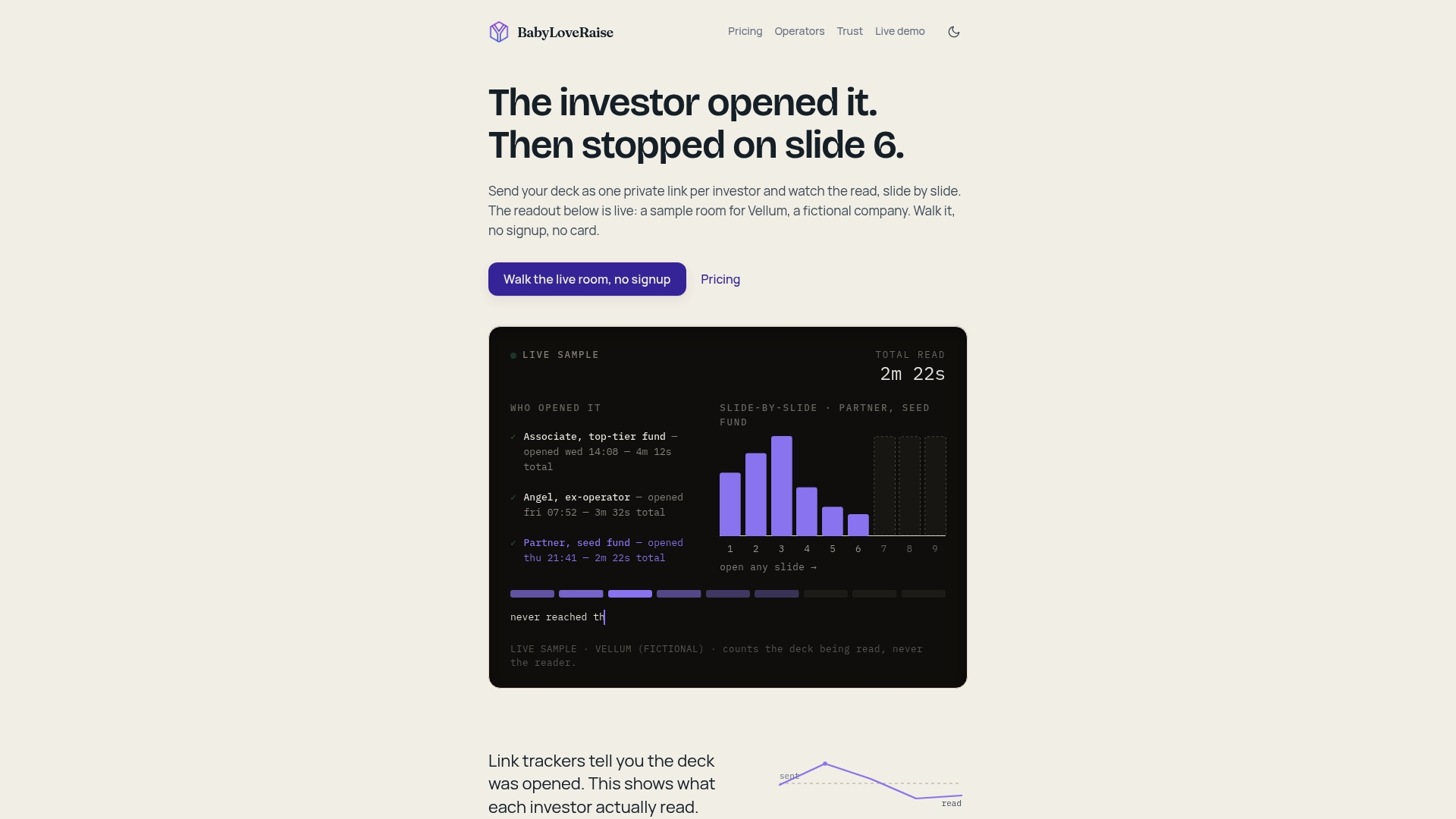
Three features map directly to the workflow above: the unread-vs-full-read dashboard separates your warmest leads from cold threads in one view; share links in three access registers (first send, forwardable, private) let you control what each investor sees and when; and when the raise closes, the room converts to a free permanent archive instead of disappearing behind a paywall. For advisory firms running multiple client raises, the Operator tier adds firm-branded rooms and concierge deck editing across every client at once.
If you’re ready to stop guessing which investors actually read your deck, see how BabyLoveRaise is priced and set up your raise room today.
Useful sources and further reading
Short reading list for founders building their follow-up workflow:
- NUVC: How to Follow Up With Investors Without Getting a Restraining Order — Best source for permission-ask flow, opt-in list strategy, and the “one new data point” rule. Contains templates.
- Verabro: The Investor Follow-Up Strategy Most Founders Get Wrong — Covers cadence timing, stop rules, and soft-pass interpretation. Read this before you send your third follow-up.
- Causo Hub: VC Follow-Up Templates for 2026 — Four scenario-specific templates (24-hour nudge, silent-thread revive, milestone ping, six-month re-engage). Copy-paste ready.
- Qubit Capital: Investor Follow-Up Email Tips and Templates — Timing guidance, post-meeting structure, and subject-line advice. Good for founders preparing their first institutional outreach.
- BabyLoveRaise Blog — Ongoing posts on raise-room workflows, investor relations, and deck analytics for seed and pre-seed founders.
Keep this list short. One read-through of each source before your next pitch send is enough to tighten your follow-up workflow considerably.