
Six Teaser Email Templates for Investors That Track Opens, Founders
Six ready teaser-email scripts for founders: subject lines, 1–5 slide tracked teasers, and follow-up timing so you know who opened, who finished, and who...
August 29, 2026 · 12 min read

A teaser email’s only job is to get a meeting. Send a one-line pitch, a single proof point, and a tracked 1 to 5 slide teaser link, not a 20-slide attachment. Skip the company history, skip the market-sizing slide, and skip anything that asks an investor to commit before they have even opened your email.
TL;DR:
- Sending a teaser email with a tracked link provides detailed engagement data, enabling targeted follow-up based on investor activity.
- A one to five-slide teaser deck should clearly define your offering, traction, team, and funding ask without attachments.
- Specific, researched subject lines and openers that reference an investor’s recent activity increase reply rates compared to generic phrases.
- Prioritize follow-ups within 24 to 72 hours only if the investor opens or completes the deck, and cease after one unresponsive bump.
- Using a hosted raise room with engagement tracking turns static outreach into a real-time signal source, boosting response efficiency.
Table of Contents
- What Is a Teaser Email to Investors?
- What to Send: The Teaser Deck and Hosting Choice
- Subject Lines and Openers That Actually Get Opened
- Email Anatomy and Six Templates You Can Adapt
- Writing a “Why This Investor” Line That Converts
- How to Prioritize Follow-Ups Using Engagement Signals
- Common Mistakes and a Pre-Send Checklist
- What Switching to Tracked Teasers Actually Changes
- Turn Your Teaser Outreach Into a Trackable Workflow
- Sources
What Is a Teaser Email to Investors?
A teaser email is a short, cold or lightly-warmed message that gives an investor just enough to decide whether a fuller conversation is worth their time. It is not a pitch deck compressed into text, and it is not a substitute for a data room. Think of it as the trailer, not the movie.
Investors screen inboxes in seconds, not minutes. Most partners at active funds see dozens of unsolicited pitches a week, and the ones that get a reply tend to be short, specific, and easy to act on. Visible’s guide to cold emailing investors makes the same point from the investor side: targeted, concise messages consistently outperform long ones, even when the long ones have better substance buried inside them.
Teaser emails work best in three situations:
- Cold outreach, when you have no warm connection and need to earn five minutes of attention.
- Early follow-up after an intro, when a mutual contact has already flagged you but you still need to make the ask concrete.
- Conference or event follow-up, when you met briefly and need to convert a business card into a calendar hold.
In every case, the format is the same: short enough to read on a phone between meetings, specific enough to prove you’re worth 15 minutes.
What to Send: The Teaser Deck and Hosting Choice
The asset behind your email matters as much as the email itself. A full pitch deck, sent cold, signals that you don’t understand how investors triage inboxes. A teaser deck of one to five slides respects the screening process and earns you the right to send the full deck later, when someone actually asks for it.
A tight teaser deck usually covers:
- One-line description of what you do and for whom
- The problem and your solution, in plain language
- One or two traction numbers that matter (revenue, users, retention, waitlist size)
- The team, in one line each
- The ask: how much you’re raising and on what terms
Attachments are the wrong delivery mechanism for cold outreach. A tracked link, whether a simple document-sharing tool or a purpose-built raise room, lets you see who opened it, how far they read, and whether they came back a second time. TiniDrop’s breakdown of teaser links versus deck dumps argues this directly: a tracked link turns a one-way pitch into a data source you can act on.
There’s an ethics line here worth drawing clearly. Good tracking tells you about the document, not the person. It reports opens, per-slide dwell time, and completion, never location data, device fingerprinting, or anything that feels like surveillance. If you’re evaluating tools, our post on ethical pitch deck tracking covers where that line sits in practice.
Pro Tip: Set your teaser link to expire after 30 to 45 days. An investor who needs to reopen a stale link months later is a signal you want to catch, not a courtesy you owe them indefinitely.
Subject Lines and Openers That Actually Get Opened
Your subject line has one job: prove you’re worth 1.5 seconds of consideration. The best ones lead with signal, not enthusiasm. A number, a mutual name, or a specific stage beats a clever phrase every time.
Strong subject line patterns include:
- “[Metric] in [timeframe] — raising a [stage] round”
- “[Mutual contact] suggested I reach out”
- “Following up from [conference name]”
- “[Company] — [category] for [specific customer type]”
- “Quick intro: [one-line differentiator]”
- “Re: your [portfolio company] investment”
That last one only works if it’s true. Pitchkit’s research on cold email templates is blunt about this: openers that reference a specific portfolio company, a recent public check, or a thesis quote the investor actually wrote beat generic flattery every single time. “I’ve long admired your work” tells an investor nothing. “Your note on vertical SaaS margins in October matches exactly what we’re building” tells them you did the reading.
The opener formula that works across almost every scenario:
- Reference something real and specific about the investor’s activity or thesis.
- State what you do in one sentence, no jargon.
- Give one proof point that would make a skeptical person pause.
Six adaptable openers:
- “Saw your check into [portfolio company] last quarter. We’re building [what you do] for [audience].”
- “Your post on [topic] mirrors what we’re seeing at [company].”
- “[Mutual contact] mentioned you’re looking at [category] deals right now.”
- “We just crossed [metric], and your thesis on [space] made me think of you first.”
- “Following up after [conference] — wanted to send the deck you asked about.”
- “Noticed [fund] led the last round for [comparable company]. We’re a few steps behind them on a similar path.”
Vague openers get skimmed. Specific ones get replies, because they prove effort the investor doesn’t have to reciprocate blind.
Email Anatomy and Six Templates You Can Adapt
The whole email should run under roughly 150 words. Six pieces, in order: subject line, opener, one-line pitch, one proof point, a small specific ask, and a signature with a link. Nothing else earns its place. Pitchkit’s data on short-format cold emails shows this structure consistently outperforms longer, more “complete” pitches, because investors are scanning for a reason to say yes to a meeting, not a reason to fund you on the spot.
Here are six templates for common situations. Swap the bracketed details, but keep the shape.
- Pre-seed with traction: Open with the metric (“$12K MRR in four months, 40% month-over-month growth”), state what you do in one line, name the round size, close with a link to your teaser and a two-line-availability ask.
- Pre-seed without traction: Lead with the team’s relevant background or a striking early signal (waitlist size, LOIs, pilot commitments) instead of revenue, since you have no revenue number to open with.
- Warm intro follow-up: Reference the person who connected you in the first sentence, thank them briefly, then move straight into the one-line pitch and ask, since the warm-up work is already done.
- Accelerator follow-up: Mention the program by name and cohort, cite what changed since demo day, and ask for a short call before the batch’s investor deadline.
- Re-engagement: Reference the exact date of your last email, state what’s changed (new metric, new hire, closed part of the round), and repeat the ask without apologizing for following up.
- Conference follow-up: Open with where you met, restate what you told them in one sentence, and attach the teaser link you promised.
Personalize the proof point every time. A metric that impresses a growth-stage generalist fund may mean nothing to a pre-seed specialist looking at team background instead.
Writing a “Why This Investor” Line That Converts
Generic openers get generic silence. The single highest-leverage line in your email connects a real, specific fact about the investor’s portfolio or public thesis to your own company’s angle, according to Capitaly’s breakdown of the perfect teaser email. It takes five minutes of research and it’s the difference between a reply and a delete.
Fast research tactics that take under five minutes:
- Scan the fund’s portfolio page for a comparable or adjacent company.
- Search the partner’s name plus “thesis” or “investing in” for recent public writing.
- Check Crunchbase or the fund’s own site for deals closed in the last two quarters.
Weak: “I love what you’re doing at [fund] and think we’d be a great fit.” Strong: “You led [company]'s seed round on the thesis that vertical AI tools beat horizontal ones. We’re the vertical play in [industry], six months behind them on the same curve.”
Before you hit send, run a five-minute audit: confirm the fund invests at your stage, confirm the check size matches your round, confirm the “why this investor” line references something true and recent, and confirm your teaser link actually opens on mobile.
Pro Tip: Keep a running note of every fund’s most recent public deal. Five minutes of research now saves you from sending a generic line that any of fifty other founders could have written.
How to Prioritize Follow-Ups Using Engagement Signals
Engagement data solves a problem that used to be invisible: the difference between “never opened it” and “read the whole thing and passed.” Those two outcomes look identical from a founder’s side, a silent inbox, but they call for completely different responses.

If an investor opens your teaser and reads to the last slide, that’s your highest-priority follow-up. TiniDrop’s guidance on signal-driven sequencing recommends following up within 24 to 72 hours of a completed read, referencing the read directly and offering a specific 15 to 20 minute window rather than an open-ended “let me know if you’re free.”
A practical cadence:
- Immediate reply window: if you get a notification the deck was opened and finished, follow up within a day while it’s still fresh.
- 48 to 72 hour rule: a second open of the same link is a stronger signal than the first. Treat it as a nudge to reach out.
- One-week bump: if there’s been no open at all after a week, send one short, polite bump and nothing more.
- Stop after one follow-up: if that bump gets no engagement either, move on. Repeated unread emails just erode your sender reputation.
Raise-room style analytics report exactly these states, first read, per-slide dwell, and completion, so you can tell instantly whether a silent investor never saw your pitch or saw every slide and passed, an approach BabyLoveRaise built its entire tracking model around. Features like expiring links and download watermarking, covered in our guide to pitch deck access control, let you extend trust without losing visibility into who’s actually engaging.
Timing matters beyond the week-to-week cadence too. Investor responsiveness tends to dip in December and August, when fund activity slows around holidays and travel. If you can choose your send window, avoid those months for your first cold touch.
Common Mistakes and a Pre-Send Checklist
Most teaser emails fail before the pitch itself gets read, because of formatting and targeting errors that have nothing to do with the company’s quality.
The recurring mistakes:
- Attaching the full 20-slide deck instead of a trimmed teaser or link
- Opening with generic flattery instead of a specific, researched line
- Writing a subject line with no signal, no number, no name
- Making a vague ask (“let me know your thoughts”) instead of a specific one (“15 minutes Thursday or Friday”)
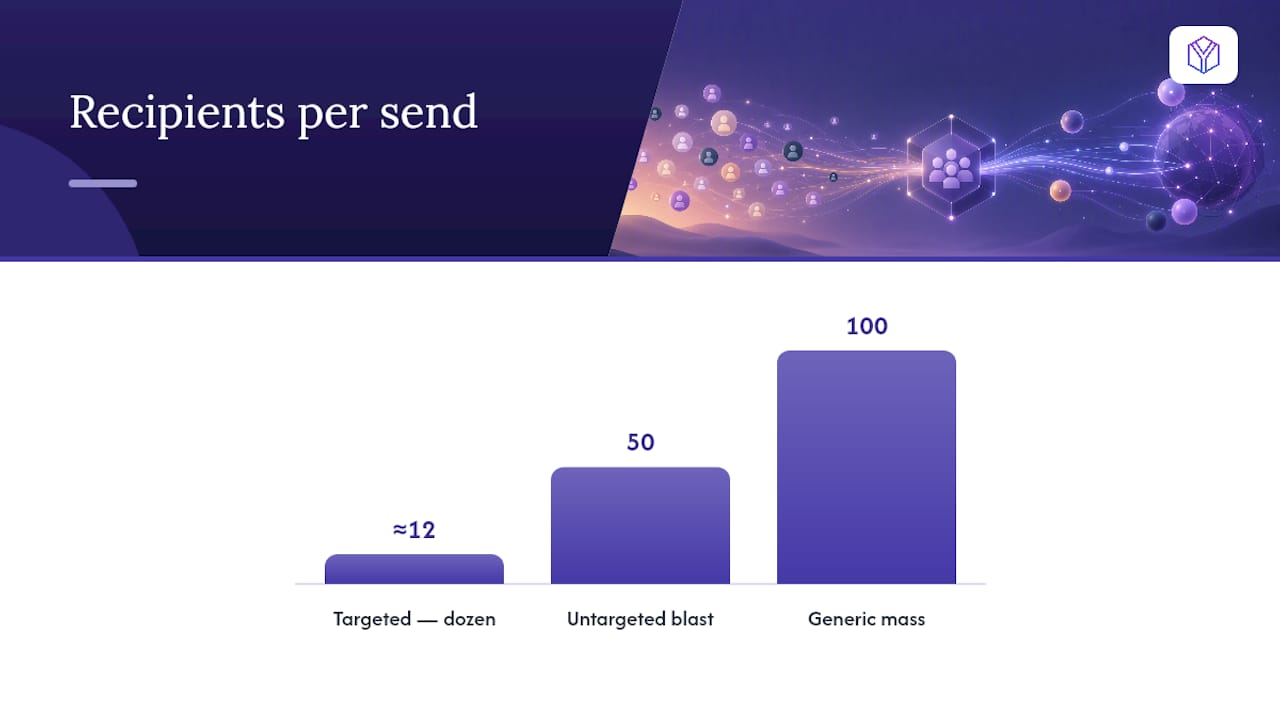
- Blasting the same unpersonalized email to a large, untargeted list
That last one deserves a specific warning. Batching identical emails to fifty investors with no stage or sector filter tanks your reply rate and, over time, your sender reputation. A dozen well-targeted, personalized emails beat a hundred generic ones almost every time.
| Checklist item | What to verify |
|---|---|
| Personalization | “Why this investor” line is specific and true |
| Length | Full email under 150 words |
| Asset | Teaser link, not full-deck attachment |
| Link settings | Expiry date and permission level set correctly |
| Ask | One specific, small, schedulable request |
| Targeting | Stage, sector, and check size actually match |
Run through this list before every send, not just the first one. It takes ninety seconds and catches most of the errors that kill reply rates.
What Switching to Tracked Teasers Actually Changes
A founder pattern worth watching for: sending the same PDF pitch deck to forty investors and hearing back from three. It’s a common story precisely because it exposes a blind spot most founders don’t realize they have. There’s no way to tell who opened it, who forwarded it internally, or who read three slides and closed the tab.
Switching to a tracked teaser link changes the entire follow-up calculus. Instead of guessing who to nudge, you follow up with the investors who actually opened the deck and skip the ones who never did. That single shift, from blind follow-up to signal-driven follow-up, tends to be the biggest efficiency gain in the whole outreach process, bigger than a better subject line or a sharper one-liner.
The lesson generalizes past any one platform: the fastest way to raise your reply rate is not writing a better sentence. It’s replacing an email you can’t see the results of with one you can.
— Paul
Turn Your Teaser Outreach Into a Trackable Workflow
Every tactic in this guide, the tight teaser deck, the tracked link, the signal-driven follow-up, depends on actually being able to see what happens after you hit send. That’s the specific gap BabyLoveRaise closes: a hosted raise room that turns a static teaser deck into a live signal source, without asking investors to create accounts or click through gated forms.
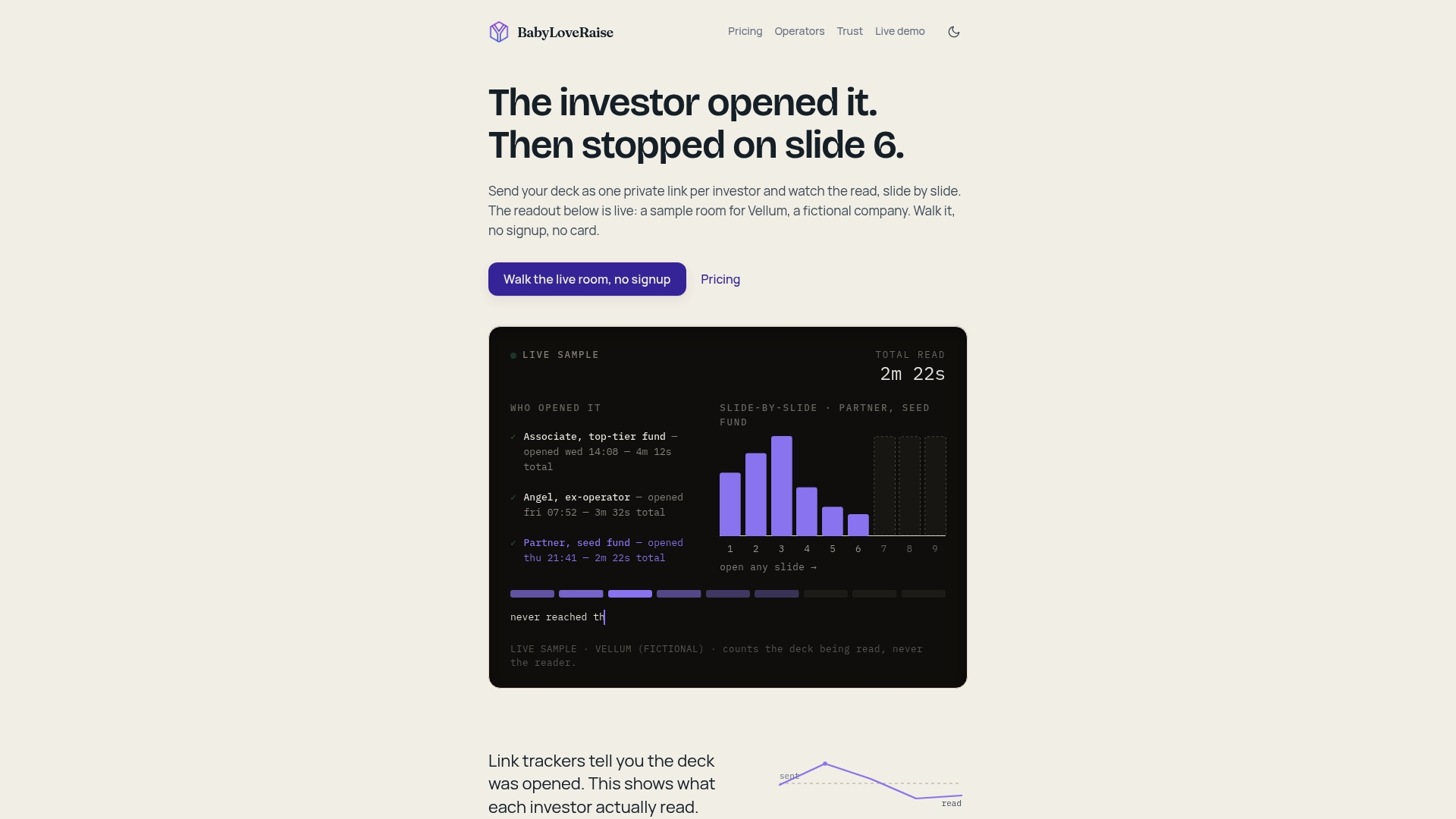
Set up a raise room, generate a unique share link for each investor, and watch opens land in your dashboard in real time. Per-slide engagement data shows exactly where attention holds and where it drops, so revisions target the slides that actually lose readers instead of the ones you assume are weak. Share links come in three registers, first send, forwardable, and private, so you can extend a link to a partner’s associate without losing track of who’s reading. Downloads can carry a measured watermark, and when your round closes, the room converts to a free permanent archive instead of disappearing behind a paywall.
Fold it into your outreach the way this guide describes: create one link per investor, prioritize follow-ups by who finished the deck, and stop guessing which silence means “not interested” and which means “hasn’t opened it yet.” Start a raise room at BabyLoveRaise and send your next teaser with a link you can actually act on.
Sources
The templates and timing rules in this guide draw on Pitchkit’s cold email research for anatomy and reply-rate data, Visible’s cold outreach guide for targeting discipline, and TiniDrop’s teaser-link workflow for follow-up sequencing. Founders building their email cadence around a broader list should also read this partner guide on crowdfunding email strategy for list-segmentation notes that apply well beyond crowdfunding.
- Investor cold email templates that actually get replies | Pitchkit
- How to Cold Email Investors in 2026 (Templates + Tips) | Visible
- Teaser deck vs pitch deck vs executive summary: what to actually send investors - Pitch Deck Guide