
Founders: Redact Investor Documents With Raise Room Controls, Not NDAs
For founders: what to redact in investor documents, when to open diligence, and how watermarks and per slide tracking plus staged disclosure protect trade...
September 28, 2026 · 8 min read

Redact anything that lets a competitor rebuild your product or steal your customers: core architecture, exact pricing, individual customer names, and granular financials. Share summary metrics that sell the story instead, and gate the rest for diligence. Most VCs will not sign an NDA before that stage, so marking materials confidential and controlling access matter more than a signature. A raise room handles that access layer without slowing down the pitch.
TL;DR:
- Redact detailed architecture, proprietary algorithms, and granular customer or financial data, while sharing high-level metrics like total ARR and overall growth.
- Use staged disclosure: start with a teaser deck, then provide a guarded version with ranges and anonymized data, and reserve full details for diligence-only access.
- Implement strict access controls, watermarks, and version tracking to trace leaks and enforce confidentiality during different fundraising stages.
- Most early-stage investors will not sign NDAs; focus on marking sensitive materials as confidential, limiting access, and maintaining logs to protect trade secrets legally.
- Over-redacting standard business metrics can erode trust and slow funding attempts; balance protection with transparency to foster investor confidence.
BabyLoveRaiseShare Sensitive Details With More ControlBabyLoveRaise gives founders a hosted raise room with measured downloads, share-link controls, and per-slide engagement for investor decks.Explore BabyLoveRaise
Table of Contents
- What to redact: specific categories and slide examples
- How to redact practically: staged disclosure and raise-room controls
- Trade secrets, NDAs, and the legal boundary founders must respect
- Quick redaction checklist founders can copy into their raise-room workflow
- Balancing protection and investor trust
- How BabyLoveRaise supports these redaction workflows
- Primary sources and references
- Sources
- FAQ
What to redact: specific categories and slide examples
The rule of thumb is simple: if a slide’s details could help a competitor copy your product or steal a customer relationship, mask it. If a slide’s details help an investor decide whether to take a first meeting, keep it visible.
Technical slides are the riskiest. Architectural diagrams, algorithms, and code snippets belong in diligence, not in a first-round deck. Show that the system works and what it enables, not how it is built.
Customer slides need the same treatment. Naming clients by logo can be tempting, but full contracts, pricing terms, or personally identifiable information should never appear in a shared deck. Aggregate the data instead: “A dozen enterprise retail customers, with an average contract value in the tens of thousands of dollars” tells the story without exposing a single relationship.
Financial slides are where founders often overshare. Customer-level revenue and margins reveal exactly how you price and who pays what. High-level ARR, growth rate, and burn rate give investors what they need to evaluate the business without handing over the pricing playbook.
A few concrete examples by slide type:
- Product architecture: redact system diagrams, proprietary algorithms, and code, keep the outcome and differentiation.
- Customers: redact contract terms and PII, keep logos (with permission) and aggregate usage stats.
- Financials: redact per-customer revenue and margin detail, keep ARR, growth rate, and runway.
- Go-to-market: redact supplier cost breakdowns and exact pricing schedules, keep channel strategy and unit economics ranges.
Legal and contract language deserves its own caution. Draft agreements, negotiation terms, or anything that could create liability if disclosed should stay out of any shared deck entirely.
How to redact practically: staged disclosure and raise-room controls
Redaction is not a one-time edit. It is a sequence tied to how far along a conversation with a given investor has progressed.
- Build a teaser deck. This is the public-facing summary: problem, market, traction highlights, team. No proprietary detail lives here.
- Build a guarded deck. This version goes to investors who have taken a meeting. It includes more context, ranges instead of exact figures, and placeholders like “Customer A, enterprise retail partner” instead of names.
- Reserve a diligence room. Full financials, contracts, and technical detail unlock only after a term sheet or signed NDA, and only for the deal team actually doing the work.
Redaction techniques that work at each stage include replacing tables with ranges, blurring or annotating diagrams so the shape is visible but the mechanism is not, and cutting nonessential appendix slides entirely rather than trying to redact them line by line.
Before you send anything, set the controls that make staged disclosure enforceable. Choose between a first-send link, a forwardable link, and a private link depending on how much control you need over redistribution. Add a viewer allowlist, an expiration date, and a measured watermark on downloads so a leaked file traces back to its source. Disable copy and paste where the tool allows it, and turn on per-slide tracking so you know which pages actually held attention.
Version control matters just as much as access control. Stamp every deck with a version number, a date, and reviewer notes, and keep a log of who accessed which version and when. That log is not just good hygiene, it is the kind of record that supports a trade-secret claim later if something goes wrong.

Put one person in charge of approving redactions before a deck goes out, and route every follow-up decision through the engagement data rather than gut feel.
Pro Tip: Use per-slide engagement signals to decide who earns the guarded deck and who advances to diligence, rather than sending your most detailed version to everyone who asks.
Trade secrets, NDAs, and the legal boundary founders must respect
Trade secret protection in the United States depends on three things: the information has independent economic value, it is not generally known, and the owner takes reasonable efforts to keep it secret. That last part is where most founders lose protection without realizing it.
The USPTO trade secret toolkit lays out what “reasonable efforts” looks like in practice, and skipping them can forfeit trade secret status entirely regardless of how sensitive the information actually is.
- Mark confidential materials clearly, on every page or slide that qualifies.
- Limit access to a defined list of reviewers on a need-to-know basis.
- Use signed employee confidentiality agreements as a baseline.
- Apply digital access controls so distribution is tracked, not just assumed.
Almost no venture capital firm will sign an NDA before a first pitch meeting, according to Cooley GO guidance, which advises founders to strip sensitive technical and confidential detail from early decks rather than ask investors for a signature they will refuse anyway. NDAs make more sense in narrow situations: late-stage conversations, strategic partnership discussions, or deals involving unpatented IP where the company has no other way to protect the disclosure, according to Cooley GO’s guidance on NDAs. Even then, the agreement should be scoped narrowly and reviewed by counsel.
This is where documented access logs and marked materials earn their keep. If a dispute ever arises, a record showing exactly who saw which version, when, and under what confidentiality marking is evidence that you took the information seriously. Bring in counsel early when the disclosure involves high-value, unpatented innovation or a strategic partner who could become a competitor.
Quick redaction checklist founders can copy into their raise-room workflow
Turn the rules above into a repeatable pass before every send.
- Run a slide-by-slide redaction review: catches details that snuck in since the last version.
- Mark confidential slides explicitly: supports a trade-secret claim if it is ever tested.
- Set the link permission tier and expiration: limits who can open the deck and for how long.
- Enable a measured watermark on downloads: traces a leaked copy back to its source.
- Record the viewer allowlist: keeps distribution deliberate instead of accidental.
- Lock older versions: prevents an outdated, oversharing draft from resurfacing.
- Plan follow-ups around who read which slides: turns engagement data into next steps.
| Checklist step | Raise-room control |
|---|---|
| Redaction review | Slide-by-slide edit before each send |
| Confidentiality marking | Watermark and labeled slides |
| Access limits | Viewer allowlist and link expiration |
| Leak tracing | Measured watermark on downloads |
| Version hygiene | Locked older versions, dated stamps |
Balancing protection and investor trust
Over-redacting is its own risk. Practitioners have noted that stripping out standard business metrics can read as a lack of confidence or trust, according to commentary in Forbes, and it can slow down conversations you are trying to speed up. The goal is not maximum secrecy, it is proportionate secrecy: protect what a competitor could exploit, share what an investor needs to say yes to a meeting. Let engagement signals, not blanket caution, tell you who has earned the next layer of access.
— Paul
How BabyLoveRaise supports these redaction workflows
A raise room builds the access layer this whole approach depends on: first-send, forwardable, and private link tiers map directly to teaser, guarded, and diligence-stage sharing, and a measured watermark on downloads traces any leaked copy.
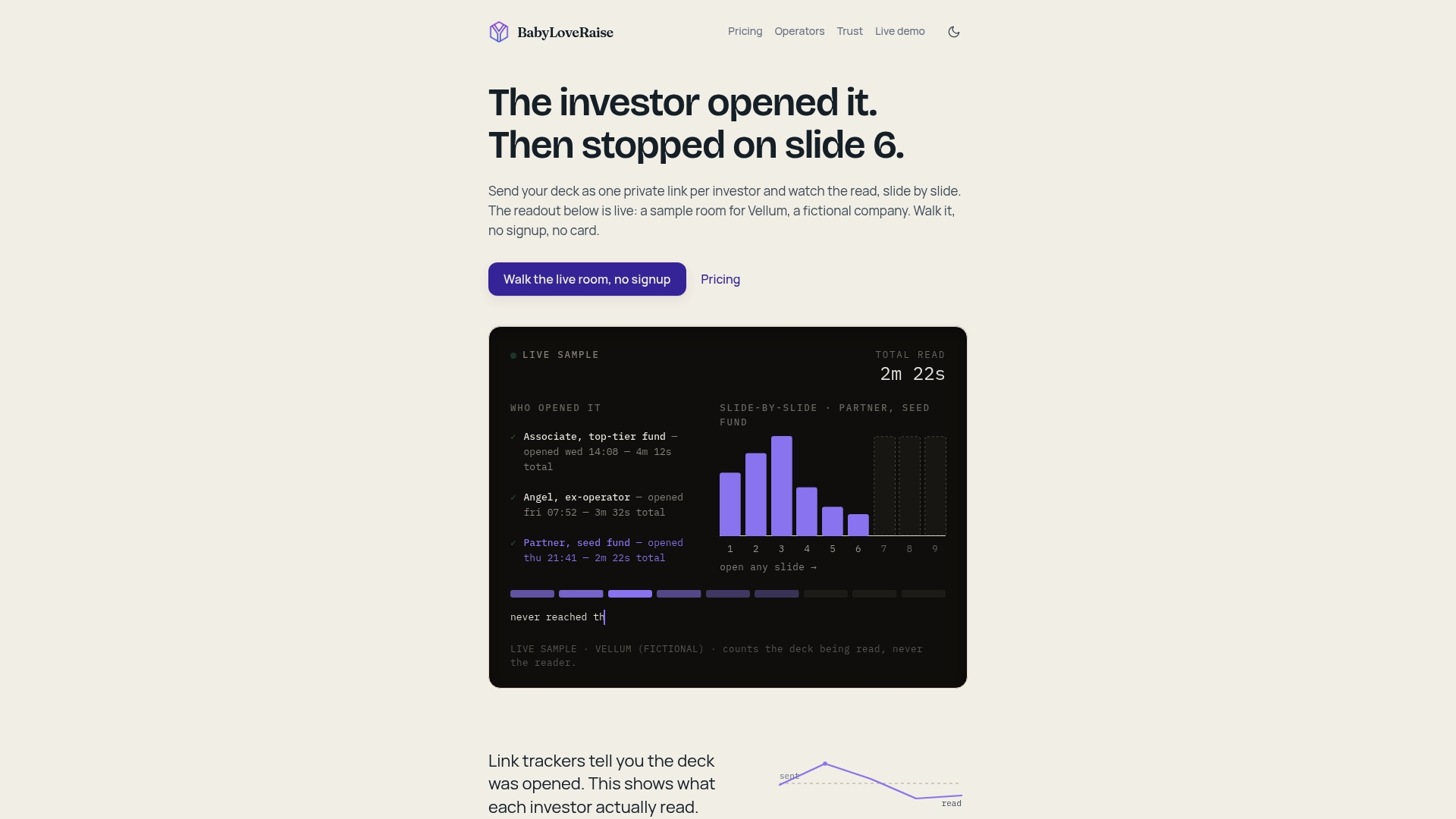
Per-slide engagement analytics show exactly which investors read to the end, so follow-ups and access upgrades go to the right people instead of everyone who clicked. Plans run per raise rather than as a permanent per-seat license, and advisory firms running multiple client raises can use a white-label Operator seat instead.
Primary sources and references
- USPTO trade-secret toolkit: criteria and reasonable-efforts examples.
- FTC in-camera treatment filing: example of confidential deck treatment in a legal filing.
- Cooley GO guidance and Cooley GO on NDAs: fundraising NDA norms.
- Forbes commentary: risks of over-redaction.
Sources
- Cooley GO guidance
- USPTO trade-secret toolkit
- FTC — Everlane motion for in-camera treatment (public)
- Cooley GO — What you need to know about the NDA
- Forbes — Why you shouldn’t ask investors to sign an NDA
FAQ
What should founders always redact from a pitch deck?
Redact core technical architecture, individual customer contracts and PII, and granular per-customer financials. Replace them with aggregate metrics like overall ARR and growth rate that still tell the story.
Will investors sign an NDA before reviewing a deck?
Almost never at the early stage. Cooley GO’s guidance advises founders to remove sensitive detail from initial decks instead of asking VCs to sign anything, and to reserve NDAs for narrow, late-stage, or special-IP situations.
How do you protect trade secrets without an NDA?
Mark materials confidential, limit access to a defined viewer list, and keep a log of who saw which version. The USPTO toolkit treats these steps as the “reasonable efforts” that preserve trade-secret status even without a signed agreement.
Can over-redacting hurt a fundraise?
Yes. Stripping out standard business metrics can read as a lack of trust or preparation, according to Forbes, so aim for proportionate redaction rather than blanket secrecy.
What raise-room controls support safe deck sharing?
Look for tiered link permissions, viewer allowlists, expiration dates, measured watermark downloads, and per-slide engagement tracking. BabyLoveRaise builds these directly into its raise room plans.