
Fundraising Documents for Founders: Live Raise Checklist
Ensure your live raise is successful with essential fundraising documents like pitch decks and financial models. Get your checklist now!
July 29, 2026 · 10 min read

If you are running a live raise right now, here is what investors will want to see: a pitch deck, one-page executive summary, financial model with projections, current and pro forma cap tables, company formation documents, key contracts, IP summary, team bios, product roadmap, and a data-room index. Get all of these sharable before your next investor call.
Your raise-ready document checklist:
- Pitch deck (10–15 slides, ask on slide 2 or 3)
- One-page executive summary
- Financial model and projections (at least 3 years for pre-seed, 5 years for seed)
- Current cap table and pro forma cap table
- Company formation documents (certificate of incorporation, bylaws, EIN)
- Material contracts (customer, vendor, partnership agreements)
- IP summary and assignment agreements
- Team bios and org chart
- Product and technology roadmap
- Data-room index (folder map for investors)
Table of Contents
- What documents you need at each funding stage
- How investors run due diligence: six categories to map your data room
- How to prepare each key document without wasting investor time
- How to share and control documents during a live raise
- Folder structure and file-naming conventions you can copy now
- Common mistakes founders make with fundraising documents
- Raise timeline checklist: what to do now, this week, and before signing
- Key Takeaways
- Why engagement analytics change how you run a raise
- BabyLoveRaise gives you a raise room built for this
- Useful sources and further reading
What documents you need at each funding stage
Stage determines depth, not just length. Over-preparing at pre-seed wastes time; under-preparing at Series A kills deals.
| Document | Pre-seed | Seed | Series A |
|---|---|---|---|
| Pitch deck | Required | Required | Required |
| Executive summary | 1 page | 1 page | 1–2 pages |
| Financial projections | at least 3 years | 5 years minimum | 5 years plus monthly detail |
| Cap table | Current only | Current + pro forma | Full dilution model |
| Formation docs | Certificate + bylaws | Full package | Full package |
| Legal agreements | SAFEs or convertible notes | SAFEs or priced round | NVCA model docs (Charter, IRA, SPA, Voting Agreement, ROFR/Co-Sale) |
| IP assignments | Summary | Full assignments | Full assignments + freedom-to-operate memo |
Stage callout: Pre-seed investors primarily want to see the idea, the team, and a plausible market. Seed investors want to see traction and a financial model with 5 years of projections and real assumptions. By Series A, the NVCA model legal documents define the standard package: an Amended and Restated Certificate of Incorporation, Investors’ Rights Agreement, Stock Purchase Agreement, Voting Agreement, and Right of First Refusal and Co-Sale Agreement. Budget for lead-investor legal fees, which typically run $25,000–$50,000 in priced rounds.
How investors run due diligence: six categories to map your data room
Investors triage documents fast. They scan for red flags first, then go deep on the categories that match their thesis. A well-organized data room speeds that process and signals operational maturity.

| Category | Top 3 documents | What the investor looks for |
|---|---|---|
| Financial records | P&L, balance sheet, projections | Revenue growth, burn rate, runway |
| Formation docs | Certificate of incorporation, bylaws, cap table | Clean ownership, no hidden liabilities |
| Intellectual property | IP assignments, patent filings, trademark registrations | Clear ownership, no founder-to-company gaps |
| Material contracts | Customer agreements, vendor contracts, LOIs | Revenue quality, concentration risk, obligations |
| Team / employees | Bios, offer letters, equity grants, advisor agreements | Key-person risk, vesting schedules |
| Product / tech roadmap | Roadmap deck, architecture summary, demo | Build progress, defensibility, timeline realism |
Start with decision-relevant documents only and add depth as investor interest grows. Uploading everything on day one creates noise and exposes sensitive information before trust is established.
How to prepare each key document without wasting investor time
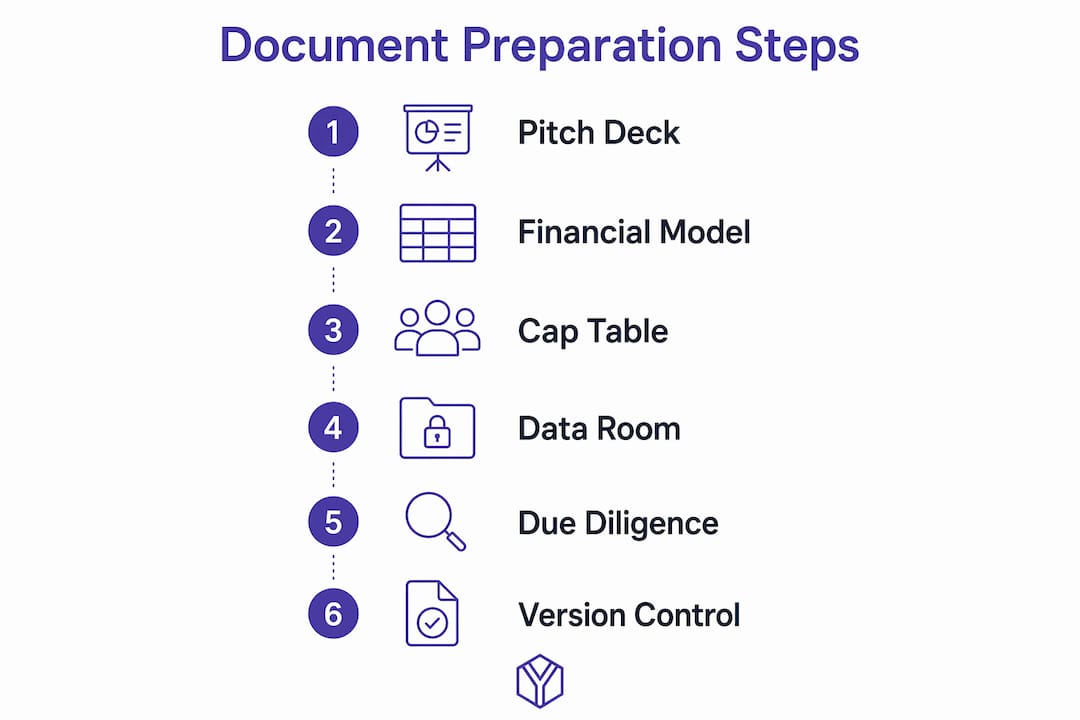
Pitch deck. Keep it to 10–15 slides. Put the ask on slide 2 or 3, not the last slide. The one-line ask formula: “We are raising $[amount] in a [round type] to [specific use of proceeds] over [timeline].” Funders consistently flag buried asks as a reason to pass without replying, so state the ask up front and connect it directly to the investor’s thesis.
Financial model. Include revenue by segment, unit economics, a clear assumptions tab, and a summary dashboard. Pre-seed models need at least 3 years; seed models need 5 years. Every number in the model must match the deck exactly. Inconsistencies between your deck and your model are the single fastest way to lose credibility.
Cap table. Provide both current and pro forma versions. The pro forma should show post-round dilution, option pool expansion, and any convertible note conversion. Keep it in a standard format. A messy cap table with unexplained entries signals legal risk.
Legal documents. At pre-seed and seed, a summary of your SAFE or convertible note terms is enough for the data room. Full legal packages belong behind a second-access tier, available after an NDA or when a lead investor signals serious interest. For guidance on when and how to gate access, the NDA considerations for startups are worth reviewing before you set permissions.
Dos and don’ts:
- Reconcile every number across deck, model, and cap table before uploading
- Avoid jargon in the executive summary; write for a generalist partner, not a technical co-investor
- Never upload unredacted employee salaries or customer names in early-stage rooms
- Include a one-page “numbers at a glance” PDF that surfaces key metrics without requiring the full model
Pro Tip: Create a single-page “numbers at a glance” PDF: ARR or MRR, burn rate, runway, headcount, and last-round valuation. Attach it to the executive summary folder. Investors who open the room on a phone will thank you, and it reduces back-and-forth before a first call.
How to share and control documents during a live raise
Version control, rapid file replacement, and activity tracking are what separate a professional raise room from a shared Drive folder. Here is how to use each lever.
Permission tiers:
- First-send link: sent directly to a named investor; tracks that specific person’s engagement
- Forwardable link: used when an investor wants to share with a partner; still tracks all readers
- Private link: for sensitive follow-on documents; requires identity confirmation before access
Security features to enable before you go live:
- Watermarks on downloadable PDFs (include viewer name and date)
- Download controls (view-only for early-stage; download enabled for confirmed leads)
- Time-limited access for documents shared before an NDA is signed
- E-signature compliance for any documents requiring countersignature
Engagement metrics that matter:
- First-read moment (did they open it within 24 hours of receiving the link?)
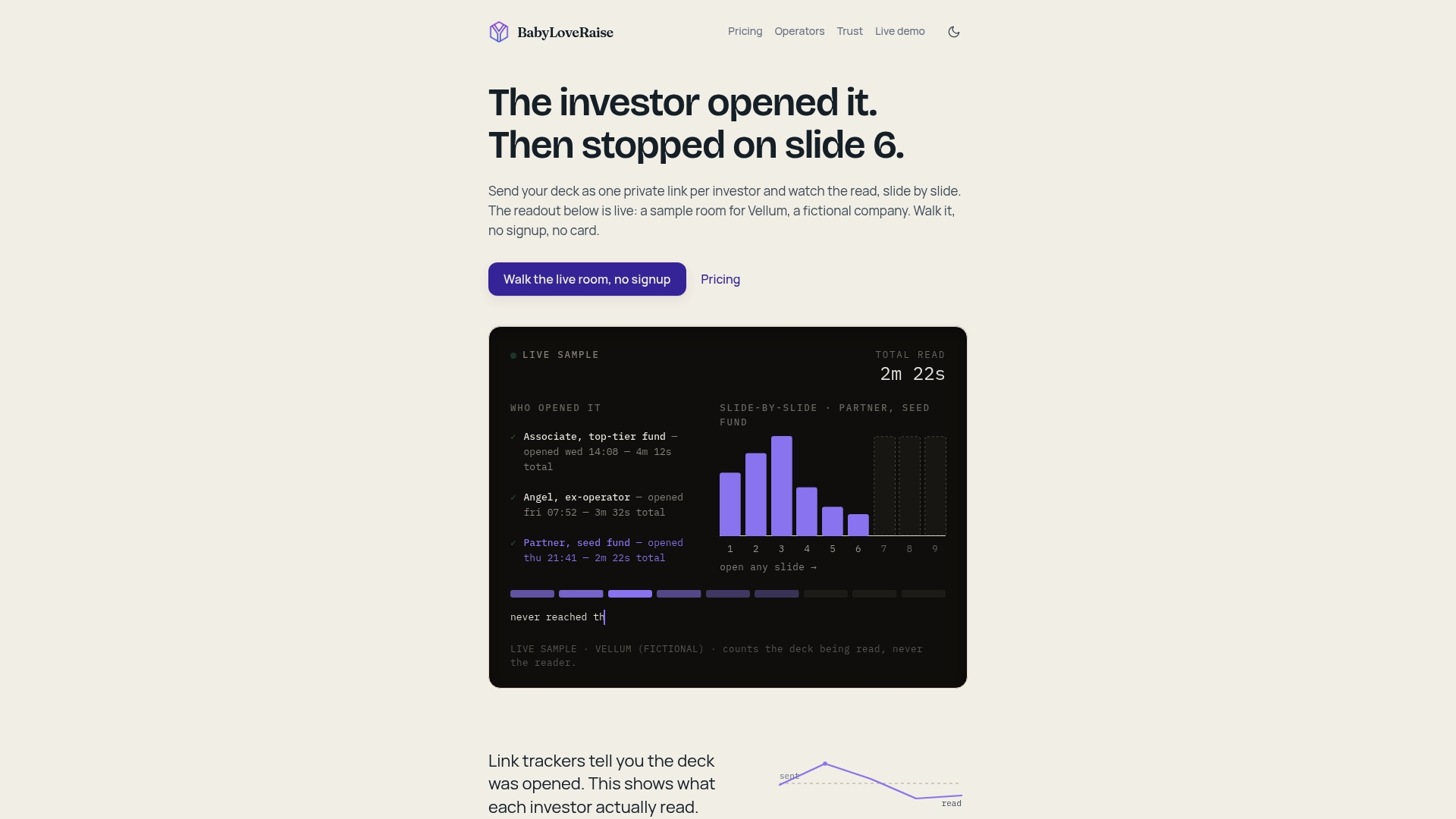
- Slide-level dwell time (which slides held attention, which got skipped?)
- Completion rate (did they read to the last slide?)
- Return visits (did they come back, and which section did they return to?)
Pro Tip: If an investor opened your deck and spent 4 minutes on the financials slide but never returned, that is a buying signal, not a pass. Follow up within 48 hours with a short note offering a model walkthrough. Investors who skipped the deck entirely get a different message: a re-send with a sharper subject line.
Folder structure and file-naming conventions you can copy now
A hierarchical folder structure that mirrors an investor’s diligence checklist reduces friction. A flat file dump does the opposite.
Folder template:
01 - Executive(exec summary, one-pager, pitch deck)02 - Financials(model, P&L, balance sheet, projections)03 - Legal(formation docs, SAFEs, cap table, agreements)04 - IP(assignments, patent filings, trademark registrations)05 - Team(bios, org chart, advisor agreements)06 - Tech(roadmap, architecture summary, demo link)
File-naming rules:
- Short folder prefix + document type + version + date
- Example:
02-Financials_Model_v2_2026-04-15.xlsx - Use
_FINALonly when the document is signed or board-approved; use_ForReviewfor drafts - Never use spaces in filenames; use underscores
A data-room index is the table of contents investors read before they open a single file. Drop a one-page index PDF into the root folder that lists every document, its folder location, and a one-line description. Investors who run structured due diligence processes will use it to navigate directly to what they need.
Common mistakes founders make with fundraising documents
Inconsistent numbers. The deck says $2.1M ARR; the model says $1.9M. Investors notice immediately. Reconcile every figure before uploading anything.
Messy cap table. Unexplained entries, missing vesting schedules, or a cap table that does not match the formation docs are red flags that suggest legal cleanup ahead. Publish a pro forma with clear assumptions.
Burying the ask. Putting the funding request on the last slide or the last paragraph of a proposal is one of the most common and most costly mistakes founders make. State the ask clearly and early, and connect it to the investor’s stated thesis.
Jargon-heavy language. A proposal full of buzzwords sounds like every other proposal. Write plainly. What does your product do, for whom, and why now?
No version control. Sending “Deck_FINAL_v3_REALLYFINAL.pdf” is a signal that your operations are not raise-ready. Use a raise room with built-in version management.
Raise timeline checklist: what to do now, this week, and before signing
Right now (before your next investor meeting):
- One-page executive summary, clean and current
- Pitch deck with ask on slide 2 or 3
- Up-to-date cap table (current version)
- Basic financial model with at least 3-year projections (pre-seed) or 5-year projections (seed)
- Data-room skeleton with folder structure in place
Within 1–4 weeks:
- Complete financial model with assumptions tab and unit economics
- Upload key contracts (customer agreements, vendor, partnership)
- Prepare IP assignment summary and confirm all assignments are signed
- Add team bios and advisor agreements to the Team folder
- Build reference list (customers, advisors, prior investors willing to speak)
Before signing a term sheet:
- Full legal package ready for lead investor review (Series A: NVCA model docs)
- Audited or reviewed financials if requested by the lead
- Finalized pro forma cap table showing post-round dilution
- Confirm budget for lead-investor legal fees ($25,000–$50,000 in priced rounds)
- All sensitive documents behind second-tier access with NDA confirmation
Key Takeaways
The most important thing a founder can do during a live raise is have the right documents ready, organized, and shareable before the first investor meeting, not after.
| Point | Details |
|---|---|
| Stage determines depth | Pre-seed needs at least 3-year projections; seed needs 5-year projections with unit economics. |
| Six diligence categories | Map your data room to financials, formation, IP, contracts, team, and product roadmap. |
| Put the ask up front | State the amount, round type, and use of proceeds on slide 2 or 3, not the last slide. |
| Version control matters | Use a raise room with built-in version management and per-slide engagement tracking. |
| BabyLoveRaise raise room | BabyLoveRaise gives founders per-slide analytics, watermarked downloads, and tiered share-link permissions priced per raise, not per seat. |
Why engagement analytics change how you run a raise
Most founders treat document sharing as a one-way transmission. You send the deck, then wait. The problem is that silence tells you nothing. An investor who never opened your deck and an investor who read every slide and forwarded it to two partners look identical in your inbox.
Engagement analytics break that symmetry. When you know which slides held attention and which got skipped, you have something to act on. A founder who sees that three investors spent significant time on the financials slide but none returned for a second look knows exactly what the follow-up conversation should address. That is a different kind of preparation than sending a generic check-in email five days later.
The other shift is prioritization. During a live raise, you are managing 20–40 investor relationships simultaneously. Tracking first-read moments and completion rates lets you rank that list by actual engagement, not by who replied most recently to an email. The investors who finished the deck get a different follow-up than the ones who opened it once for 30 seconds.
BabyLoveRaise gives you a raise room built for this
Every problem described in this guide, from version control to engagement blind spots to permission management, is what BabyLoveRaise was built to solve. You send one room link instead of a PDF attachment. The room tracks who opened the deck, which slides they read, and whether they came back. Downloads carry a measured watermark. Share links come in three tiers: first-send, forwardable, and private. When the raise closes, the room converts to a permanent archive at no extra cost.
For advisory firms and fractional CFOs running multiple client raises, the Operator tier provides firm-branded rooms across all clients at a fraction of traditional virtual data-room pricing. Founders who need hands-on help can add concierge services: an editorial pass on the pitch deck or a narrative Build Map artifact that structures the raise story before a single document goes live.
See raise-room pricing and get your documents in front of the right investors, with the analytics to know who is actually reading them.
Useful sources and further reading
- NVCA Model Legal Documents — The standard legal templates for U.S. priced equity rounds, including the Charter, IRA, SPA, Voting Agreement, and ROFR/Co-Sale Agreement. Use these as the baseline for Series A document prep.
- Marquee Equity — Fundraising Documents Guide — Practical guidance on projection horizons by stage (3 years pre-seed, 5 years seed) and document prioritization.
- Varnum — Early-Stage Equity Term Sheets — Covers lead-investor legal fee norms ($25,000–$50,000 cap) and term sheet mechanics for priced rounds.
- Candid — Think Like a Funder — Funder perspective on what makes a strong fundraising proposal, including the case for a clear, early ask.
- Perivan — Data Room Checklist — Guidance on limiting early data-room contents to decision-relevant documents and expanding as investor interest deepens.
- BabyLoveRaise Blog — Ongoing founder resources on raise rooms, secure sharing, and fundraising operations.
- BeeSign — E-Signature Compliance Checklist — Practical guidance on e-signature legal compliance and identity verification for documents requiring countersignature.
This article is general information for founders and does not constitute legal or financial advice. Confirm document requirements and legal terms with qualified counsel for your specific round.