
Skip the NDA: Three Tier Investor Deck Confidentiality for Founders
A playbook for founders to protect investor deck confidentiality: use three-tier disclosure, per-slide tracking, and strict data-room controls. Skip NDAs...
September 7, 2026 · 9 min read

Skip the NDA request for cold outreach and early meetings. Send a tiered deck instead, teaser first, main deck second, through a tracked, permissioned link, and save real confidentiality measures (NDAs, clean rooms, restricted data access) for post-term-sheet diligence or strategic-partner talks where the stakes and relationship actually justify them. That single sequencing decision protects more than any signature on a boilerplate NDA.
TL;DR:
- Sending a tiered deck through tracked links with restricted access is more protective than requesting NDAs early in the fundraising process.
- Using a three-tier disclosure strategy—teaser, main deck, and data room—limits sensitive detail until it is genuinely required during diligence.
- Tracking engagement and setting permissions on content access helps founders identify serious investors and prevent leaks without unnecessary friction.
- NDAs are generally ineffective for early-stage pitches, except in cases involving technical secrets, strategic negotiations, or specific corporate interests.
- Maintaining detailed records of disclosures, access logs, and signed agreements strengthens a founder’s legal position if disputes arise later.
BabyLoveRaiseTrack Investor Deck EngagementShare one raise room link, see who opened and finished your deck, and focus follow-ups on investors who actually read it.Explore the raise room
Table of Contents
- What Is Investor Deck Confidentiality, Really?
- Building a Tiered Deck Strategy: Teaser, Main, Data Room
- How Do You Share a Deck Securely Without Scaring Off Investors?
- When Do NDAs Actually Make Sense in Fundraising?
- Keeping Records That Actually Hold Up Later
- How a Raise Room Puts This Playbook Into Practice
- What Founders Consistently Get Wrong About This
- Protect Your Raise Without Slowing It Down
- Sources
What Is Investor Deck Confidentiality, Really?
Investor deck confidentiality isn’t a legal contract you get someone to sign before your first call. It’s a system of staged disclosure, access controls, and documentation that limits what any single investor sees, tracks what they did with it, and preserves your ability to claim trade-secret protection later if something goes wrong. Founders who treat it as a single NDA moment misunderstand the problem. Founders who treat it as an ongoing process, one that scales with how serious a conversation gets, protect both their fundraising momentum and their intellectual property.
The mechanics matter more than the paperwork. A tiered disclosure strategy that limits early-stage sharing to non-sensitive material, paired with secure tracked links, does more real protective work than a one-page NDA an investor will likely decline anyway.
Building a Tiered Deck Strategy: Teaser, Main, Data Room
Almost every leaked or misused pitch deck traces back to one mistake: sending the wrong level of detail to the wrong stage of conversation. A 40-slide “everything deck” sent cold is a liability, not a pitch. Structure disclosure in three tiers instead.
Teaser deck (5 to 7 slides). This is your cold-outreach and first-meeting artifact. Cover the market size, the problem, a high-level solution description, and traction indicators like revenue trend or user growth. Leave out proprietary technical detail, granular financials, and anything that identifies specific customers by name.
Main deck (for active meetings). Once an investor is engaged, expand to include summarized unit economics, a compact financial snapshot, and more specific go-to-market detail. Still no raw financial models, no source code, and no customer lists that could be cross-referenced or poached.
Data room (post-term-sheet diligence only). This is where the sensitive material lives: detailed financial models, cap tables, contracts, source code excerpts, and customer lists. Gate it behind a formal data room with logged access, not a shared drive link.
Before migrating any slide up a tier, run it through a short checklist:
- Does this slide name a specific customer, partner, or supplier?
- Does it expose a formula, algorithm, or technical process a competitor could copy?
- Would removing it change an investor’s decision to move forward?
- Is there a summarized version that conveys the same signal with less exposure?
If a slide fails that last question, it stays behind until diligence actually requires it. Most decks lose almost nothing by holding detail back until it’s asked for.
How Do You Share a Deck Securely Without Scaring Off Investors?
The delivery method matters as much as the content. A password-protected PDF emailed as an attachment gives you zero visibility and zero control once it leaves your inbox. It can be forwarded, screenshotted, or sitting in a stranger’s downloads folder within minutes.
A tracked raise-room link or a virtual data room with granular permissions solves that. Investors click a link, you get a notification the moment it opens, and the platform records what happened after that: which slides they lingered on, whether they reached the last page, and whether they came back a second time.
Practical controls worth setting up from day one:
- Use expiring links so a teaser sent in January isn’t still circulating in June.
- Require a quick registration step (name and email) before granting access, rather than leaving a link open to anyone who has it.
- Disable downloads where you can, and apply a measured watermark when downloads are unavoidable, so a leaked copy can be traced to its source.
- Watch engagement data, not just replies: a deck opened but abandoned after two slides tells you something different than one read start to finish with no response.
Pro Tip: Don’t over-gate the teaser stage. Requiring a login, an NDA, or a phone call before an investor can even see your market slide kills momentum faster than any leak risk you’re trying to prevent. Save the friction for the data room, where it belongs.
Balance matters here. Every extra click or permission screen you add is a small tax on investor patience, and early-stage investors have plenty of decks competing for their attention. Reserve the friction for the stage where the content actually deserves it.
When Do NDAs Actually Make Sense in Fundraising?
Most venture investors will not sign an NDA to look at a pitch deck, and asking usually backfires. It signals unfamiliarity with how fundraising norms work, and it can quietly block an investor from syndicating the deal to co-investors, since an NDA restricts who else they can loop in. For a founder trying to build momentum across a dozen investor conversations, that friction works against you, not for you.
There are real exceptions, and knowing the difference matters:
- Corporate or strategic investors. When a corporate venture arm or a potential acquirer is evaluating a deal that overlaps with their own product line, a narrowly scoped NDA covering specific technical disclosures is a reasonable ask.
- Deep technical diligence. If an investor’s technical team wants to review architecture or algorithms beyond what a data room summary shows, a limited-scope NDA or a clean-team arrangement, where only designated reviewers see the sensitive material, keeps exposure contained as explained in The Role of Delegation in Startup Growth.
- Partnership negotiations. Talks that combine investment with a commercial relationship (distribution, licensing, co-development) justify tighter terms than a standard equity round.
Outside those cases, lean on reasonable measures instead of a signature: label sensitive documents with confidentiality legends, log who accessed what and when, limit data-room access to need-to-know reviewers, and make sure every employee and contractor who touched the underlying IP signed an assignment and confidentiality agreement before you started fundraising. State trade-secret law generally protects information only when the owner took reasonable steps to keep it secret. A founder who never asked for an NDA but can show a documented, access-controlled disclosure process is often in a stronger legal position than one who got a signature on a form nobody read.
Keeping Records That Actually Hold Up Later
If a dispute ever surfaces, the paperwork you kept matters more than the paperwork you asked investors to sign. Build the habit of preserving evidence as you go, not reconstructing it after something has already gone wrong.
- Export platform access logs periodically rather than trusting they’ll still exist months later if a login expires or a vendor changes plans.
- Note who attended each meeting, what version of the deck was shown, and which slide numbers covered sensitive material.
- Keep the actual transmission emails, especially ones carrying a confidentiality legend or an ownership statement on the attached file.
- Confirm every employee and contractor signed an IP assignment and confidentiality agreement before they touched anything you’d later call proprietary.
None of this is exciting work. It’s also the difference between a founder who can point to a documented disclosure trail and one who has to rely on memory.
How a Raise Room Puts This Playbook Into Practice
A raise room built specifically for fundraising, like BabyLoveRaise, operationalizes most of this checklist without adding manual overhead. The core problem it solves is a subtle one: “never opened the deck” and “read every slide and passed” look identical in a founder’s inbox. Per-slide engagement analytics turn those two silences into two different, actionable signals, so a follow-up email goes to someone who actually engaged, not someone who never clicked the link.
- Share links come in three registers, first send, forwardable, and private, so you control who can pass a link along and who can’t.
- Downloads can carry a measured watermark, discouraging casual leaks without blocking legitimate diligence.
- Pricing runs per raise rather than per seat indefinitely, which matters for a founder who fundraises occasionally, not continuously.
- An operator console lets fractional CFOs and advisory firms run branded rooms across multiple client raises at a fraction of typical data-room pricing.
When a raise closes, the room converts to a free permanent archive instead of vanishing behind a paywall, which matters more than it sounds like once you need to reference old materials for a future round.
What Founders Consistently Get Wrong About This
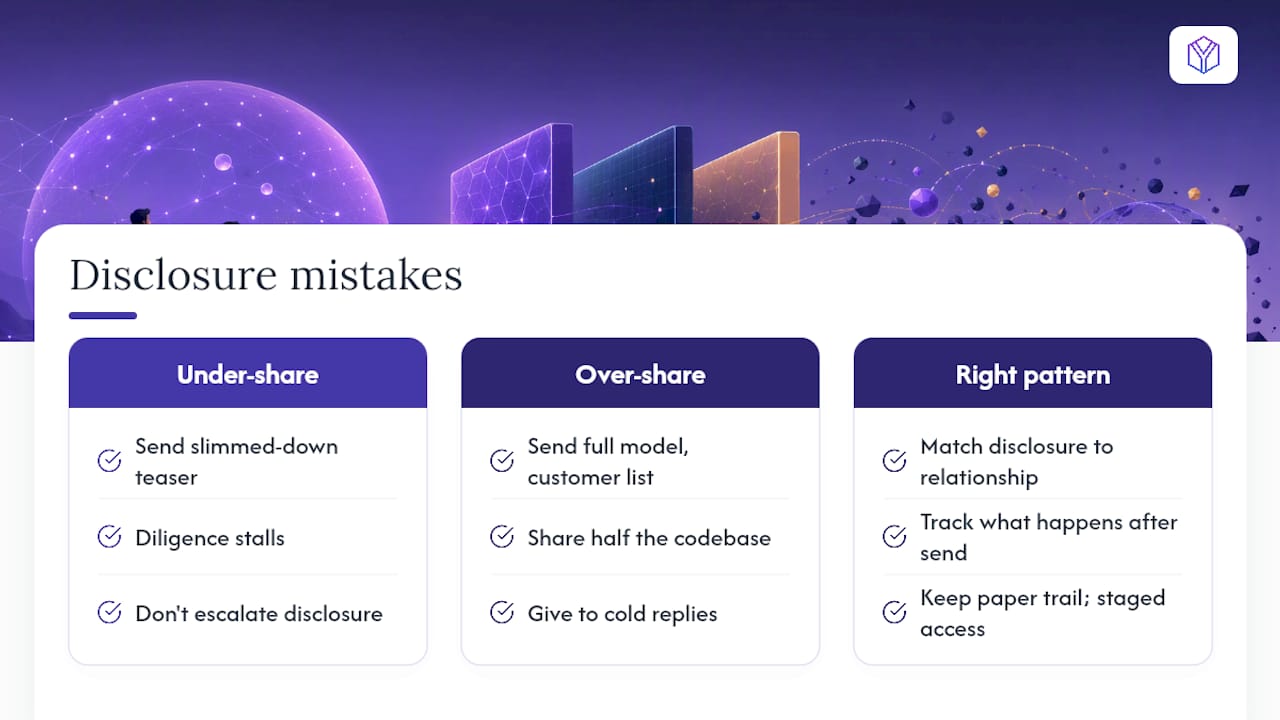
Founders overcorrect in one of two directions. Some send a slimmed-down teaser to a serious lead investor for three rounds of meetings and wonder why diligence stalls, because they never escalated the disclosure tier as the relationship deepened. Others send the full model, the customer list, and half the codebase to anyone who replies to a cold email, then act surprised when a competitor seems to know their numbers.
The pattern that actually works is boring: match disclosure to relationship depth, track what happens after you hit send, and keep the paper trail even when nothing feels wrong yet. NDAs rarely fix a trust problem. Staged access and good records do.
— Paul
Protect Your Raise Without Slowing It Down
There are practical alternatives to guessing whether an investor actually read your deck or just let it sit unopened. Instead of a static PDF attachment or a Drive link you lose visibility the moment it’s sent, you can get a raise-room link that tracks per-slide engagement, notifies you on first read, and offers features like watermarked downloads and different link permissions depending on who’s asking.
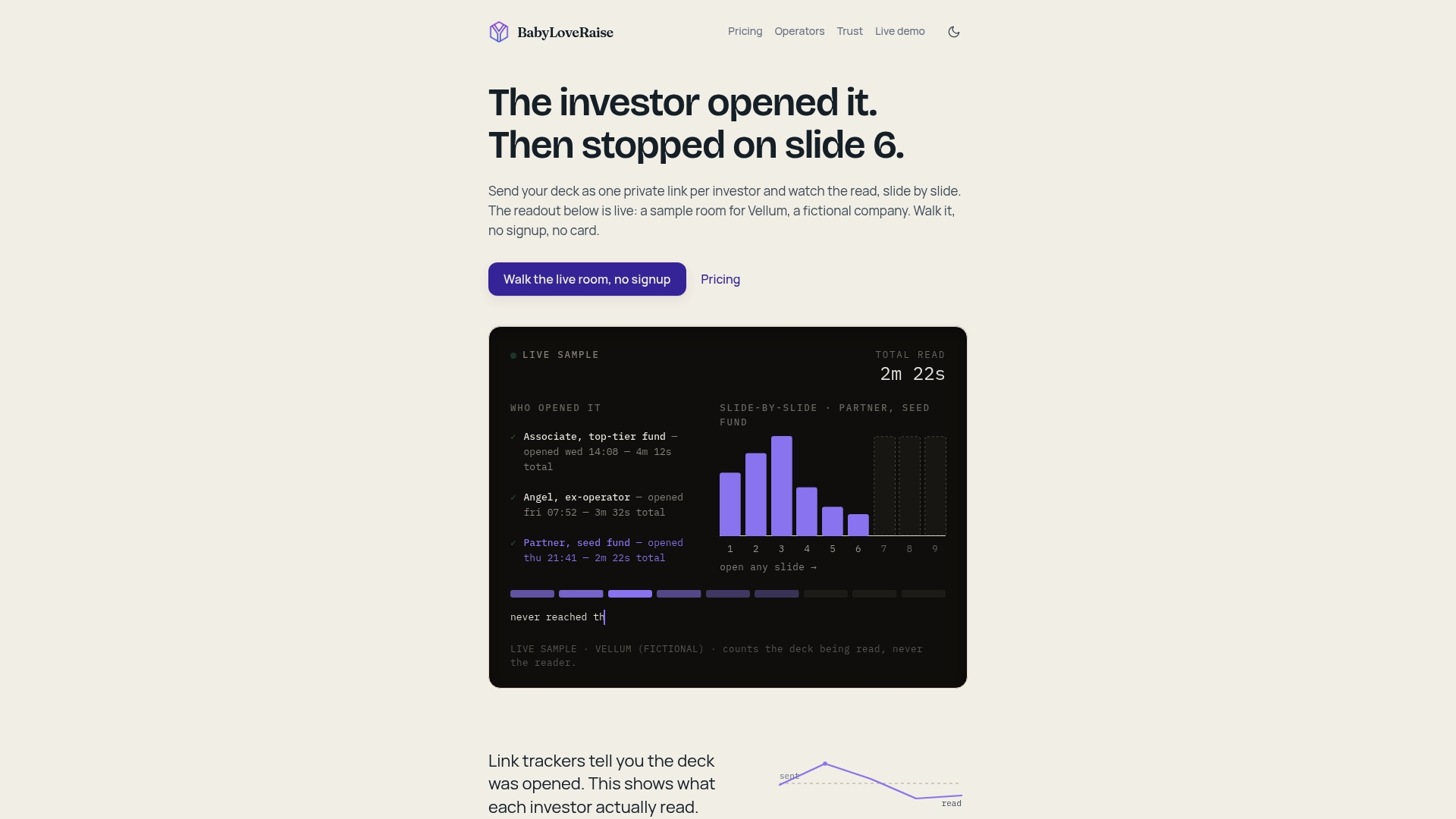
Per-slide data can serve to identify which part of the story is losing people. For advisors and fractional CFOs juggling several client raises at once, the operator console offers white-labeled rooms and per-raise pricing instead of a permanent per-seat cost. Set up a raise room, send a tracked link, and get insights on who is reading before sending follow-up emails.
Sources
The legal and practical guidance here draws on trade-secret protection strategies for tech employers, investor NDA norms, and secure data room practices. For setup help, see BabyLoveRaise’s guides on preventing deck screenshots and building a secure data room.
This article is general information, not a substitute for advice from a qualified lawyer. Consult a qualified legal professional about your own circumstances before acting on anything here.
- 6 steps tech employers can take to strengthen trade secret protections in 2026
- Secure Due Diligence: How to Share Info With Investors