
Demo Day: Follow Up in 48 Hours with Deck Data for Founders
Founders: a tactical demo day follow-up playbook for the first 48 hours — what to send, a four-touch cadence, and how deck engagement data prioritizes...
September 30, 2026 · 11 min read

After demo day, send a brief, personalized recap within the same day, ideally within two hours, and follow a four-touch cadence that prioritizes 15 to 20 high-fit investors. Move the top five into active conversation first, then roll the rest out in waves. Every message you send in this window should end with one clear next step, not a general “let me know what you think.”
TL;DR:
- Investors who show specific signals, like raising their hand or asking targeted questions, should be prioritized for immediate follow-up within hours.
- Sending a personalized video on Day 0 and clear next steps in subsequent messages increases response rates compared to generic email follow-ups.
- Focus on the top 20 high-fit investors, ranking them by stage fit, signals, and existing relationships, and contact the first five without delay.
- Back-to-back scheduling of short, 20 to 30-minute meetings with top investors maximizes momentum and minimizes context-switching.
- Avoid overwhelming investors with full decks or vague calls to action, instead providing concise, targeted information and specific meeting proposals.
BabyLoveRaiseSee Which Investors Read Your DeckBabyLoveRaise shows who opened your pitch, who reached the final slide, and where attention dropped during your raise.Track your raise
Table of Contents
- Timing and cadence: the ideal follow-up window and touch sequence
- Prioritizing investors: who to reach first after demo day
- Channels and formats that work
- Follow-up message structure: what to say in each touch
- Concrete cadence and example templates
- Scheduling logistics after demo day
- What founders should avoid in post-demo follow-up
- How deck engagement analytics change follow-up prioritization
- The follow-up is the real demo
- Another option worth knowing about
- Sources
- FAQ
Timing and cadence: the ideal follow-up window and touch sequence
Demo days exist to generate meetings, not term sheets, and the Techstars pitch toolkit makes that distinction directly: the event’s job is to secure the follow-up conversation. YC’s Investor Day data showed companies averaged about fourteen meetings each after Demo Day. Momentum from that stage moment fades fast, which is why the recap has to land the same day.
About fourteen meetings is the average a company generated per founder after YC’s Investor Day, a reminder that most of your round gets built in the days after the pitch, not during it.
A same-day recap paired with touches over the following ten days is an effective structure, according to Sendspark’s research on post-demo follow-up:
- Day 0: a short recap, sent within two hours when possible, video optional.
- Day 2: one proof point or case study that addresses a specific concern raised.
- Day 5: a direct ask for a meeting or next step.
- Day 10: a brief re-engagement or polite close if there has been no response.
Some investors will tell you upfront that they run a one to two week review cycle. When that happens, a quick acknowledgment on Day 0 is enough, and you push the direct ask to align with their stated timeline instead of forcing Day 5.
Prioritizing investors: who to reach first after demo day
Not every investor in the room deserves the same speed of follow-up. Spend the first 30 to 60 minutes after your pitch ranking your list before you write a single message.
- Score stage and sector fit first. An investor whose fund writes checks at your stage and sector is worth more than one who simply attended.
- Weight direct signals from the room. A raised hand, a specific question about your model, or a lingering conversation afterward outranks a polite nod.
- Check existing relationships. A warm intro or prior conversation moves someone up the list regardless of how they reacted on stage.
- Build the “next 20.” Techstars mentors recommend focusing on a manageable list of 20 high-fit prospects rather than spraying outreach across hundreds of names.
- Send the first five immediately. The same guidance emphasizes motion over polish: get five messages out the door, then iterate based on what comes back before touching the rest of the list.
A simple spreadsheet with columns for fit score, signal strength, and last contact date is enough to track this. You do not need dedicated software to run the triage, just discipline in updating it after every reply.
Channels and formats that work
The channel you choose for each touch matters almost as much as the timing. A 60-second personalized video works well for Day 0 because it recreates the human connection your onstage moment already built, while a short email carries less friction for a quick Day 2 or Day 5 nudge.
- Use a personalized video when you have a specific reaction or question to reference from the room.
- Use a short email when the message is a status update, proof point, or scheduling ask.
- Use a LinkedIn note only as a light-touch supplement, never as the primary channel for a serious ask.
- Use a calendar link the moment an investor signals genuine interest, to convert momentum into a booked slot before it cools.
Keep the Day 0 message under roughly 150 words. A long recap reads like a pitch memo, not a thank you, and investors skim these between meetings. According to Sendspark’s data, personalized video follow-ups can drive two to three times more replies than plain text alone, which makes video worth the extra ten minutes of setup on your highest-priority names.
Templates help you scale without losing authenticity. Build one skeleton per touch, swap in two or three variables per investor (their question, their fund’s focus, a mutual connection), and resist the urge to rewrite from scratch each time.
Pro Tip: Record one short video the day of your pitch while your energy and specifics are still fresh, then reuse the framing across your top ten investors with small tweaks.

Follow-up message structure: what to say in each touch
Structure matters more than length. Each message should do one job well rather than cover everything you wish you had said on stage.
- Open with one line of context. Reference the specific moment from your pitch or their question, not a generic “great meeting you.”
- Add three short takeaways. Cover traction, the ask, and one differentiator, each in a single sentence.
- Close with one explicit call to action. Propose two or three specific dates and times rather than asking them to suggest their own.
Skip the full deck attachment on Day 0. If they ask for more detail, send the one slide or datapoint that answers their specific question rather than the whole document, a practice NetHunt’s post-demo guidance recommends to avoid overwhelming a reader who is still deciding whether to engage further.
A subject line like “Quick follow-up: [your company] + the metric you asked about” outperforms a vague “Following up from demo day” because it tells the investor exactly why the email is worth opening, reflecting email marketing guide to cost-effective growth best practices. Founders can adapt ready-made structures from teaser email templates built for investor outreach rather than starting from a blank page.

Concrete cadence and example templates
A clear timeline removes the guesswork of what to send and when. Each touch has a distinct objective, and the phrasing skeleton stays short enough to personalize in under five minutes per investor.
| Touch | Timing | Channel | Objective |
|---|---|---|---|
| Touch 1 | Day 0, within 2 hours | Email or short video | Recap and warm the relationship |
| Touch 2 | Day 2 | Add proof point tied to their question | |
| Touch 3 | Day 5 | Email or call | Make a direct ask for a meeting |
| Touch 4 | Day 10 | Re-engage or close politely |
For each touch, keep the skeleton to one or two lines of context, one supporting proof point or link, and one explicit next step with a proposed date. When an investor responds positively, move fast: propose two to three specific time slots in your next message and confirm time zones before they have to ask.
- Touch 1 should feel personal, referencing their specific reaction from the room.
- Touch 2 should answer the one objection or question they raised, not introduce new ones.
- Touch 3 should ask directly for a 20 to 30 minute call, dated and time-boxed.
- Touch 4 should offer a genuine update, not a guilt-driven nudge.
Scheduling logistics after demo day
When several investors ask for time in the same 48-hour window, clustering meetings works better than spreading them out. Back-to-back conversations create visible deal heat and cut down on context-switching between pitches.
- Limit first meetings to 20 or 30 minutes each, long enough to gauge real interest without over-committing your week.
- Propose two or three specific slots in your initial scheduling message instead of asking investors to pick their own.
- Prioritize depth with your top five over breadth across twenty scattered calls in week one.
Founders should expect scheduling race conditions once multiple investors want time at once, and Techstars’ guidance on the investor process recommends building defined meeting windows rather than letting requests overrun your calendar. An assistant or an operator console can help manage this volume, though handing off scheduling trades some personal control for speed.
What founders should avoid in post-demo follow-up
Most follow-up failures come from a handful of repeatable mistakes.
- Avoid the info dump. Sending the full deck and every appendix on Day 0 buries the one datapoint an investor actually cares about.
- Avoid delayed follow-up. Waiting several days after demo day lets the moment go cold before you have even started.
- Avoid a vague CTA. “Let me know if you’re interested” gives the investor nothing to act on.
- Avoid mistaking silence for rejection. A one to two week review cycle is normal, and a polite check-in with new material after that window is the right move, not a repeat of the same ask.
- Watch for real red flags. Repeated unanswered CTAs or the same objection surfacing across multiple touches, often around pricing or integration, are signs to escalate or address head-on rather than send another generic nudge.
How deck engagement analytics change follow-up prioritization
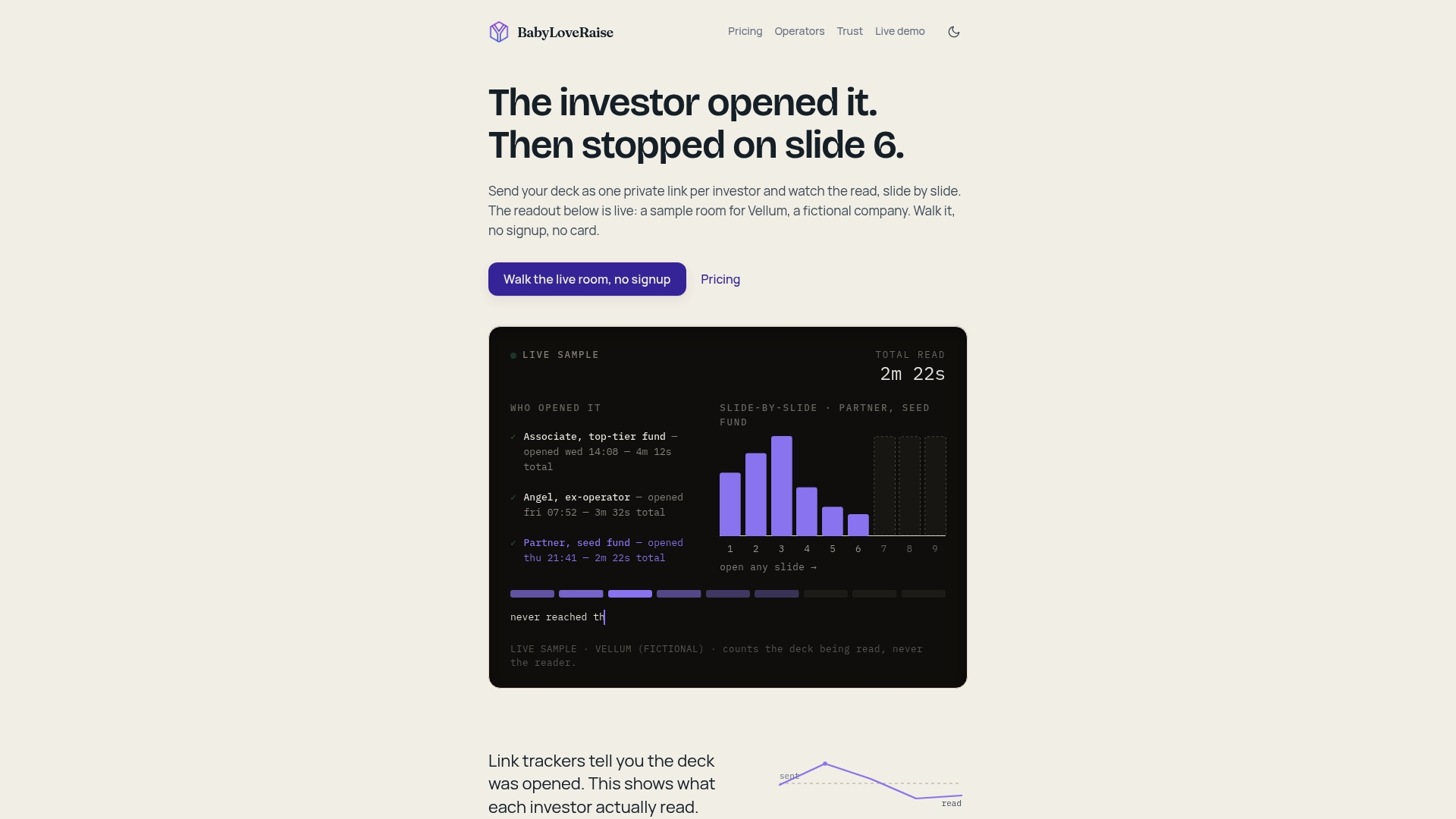
A follow-up list built only on gut feel from the room misses half the picture. Per-slide engagement tracking, the kind BabyLoveRaise’s raise room provides, shows who opened the deck, who read to the last slide, and which slides held attention versus got skimmed. That turns two silences that used to look identical, never opened it and read everything and passed, into two different signals worth two different messages.
- An investor who never opened the deck needs a short, curiosity-driving subject line and a quick check-in, not a detailed pitch.
- An investor who read the full deck and went quiet needs a targeted rebuttal or new evidence aimed at their likely objection.
- An investor who stalled on a specific slide needs a follow-up that addresses that exact page directly.
Pro Tip: Check which slide loses the most attention across your list. If it’s the same slide for most readers, fix the slide before your next batch of outreach, not just the follow-up message.
The follow-up is the real demo
Demo day gives you a room full of attention for a few minutes. What you do with the next 48 hours decides whether that attention turns into a term sheet or a forgotten name in someone’s inbox. Plan your cadence, your top 20, and your templates before you ever step on stage.
— Paul
Another option worth knowing about
Ranking investors by gut feel works until your list hits twenty names and three of them stop responding. A raise room gives you the read-state data to fix that: per-slide engagement tracking shows who finished the deck and who never opened it, and follow-ups go out based on what actually happened, not a guess.
- The raise room runs at published prices per quarter or per month, priced per raise rather than per seat.
- An editorial pass adds a human review of your deck for founders who want a second opinion before it goes out.
- Fundraising advisory firms running multiple client raises can use the white-label Operator seat, priced at published rates per month or per year per seat.
Check current plans on the BabyLoveRaise pricing page and set up your raise room before your next round of outreach goes out.
Sources
- Master your pitch (Techstars toolkit)
- How to build an investor list from scratch in 30 days (Techstars blog)
- Post-Demo Follow-Up Templates That Close Deals (Sendspark blog)
- 5 Post-Demo Strategies That Win Buyers Over (NetHunt CRM)
FAQ
What does demo day mean?
Demo day is an event, usually run by an accelerator program, where startup founders pitch their company to a room of investors in a short, timed presentation. Its main purpose is to generate follow-up meetings rather than close funding on the spot, as noted in the Techstars pitch toolkit.
What is demo day in construction?
In construction, a demo day generally refers to a demolition day, when a structure or site is torn down as part of a build or renovation project. This is a different use of the term from the startup and investor context this article covers.
What is a demo meeting?
A demo meeting is a shorter, one-on-one or small-group session where a founder shows their product or pitch to a specific investor or prospect, typically scheduled after an initial introduction. It differs from demo day, which is a larger, timed event in front of many investors at once.
Can anyone attend YC demo day?
Y Combinator’s demo day and Investor Day events are generally invite-only for vetted investors, not open to the general public. Founders in the batch present to that curated investor audience, and scheduling for those meetings has been run through structured systems in the past, as described in Y Combinator’s own writeup of its Investor Day format.
How soon should I follow up after demo day?
Send your first follow-up the same day, ideally within two hours of your pitch, while your presentation is still fresh in the investor’s mind. From there, a four-touch cadence across the following ten days keeps the conversation moving without overwhelming your list.