
Track Pitch Deck Opens, Then Follow Up After a Second Visit (Founders)
Track who opens your pitch deck, when, and which slides held attention. Use second visit and slide level signals to time a follow up and protect investor...
September 15, 2026 · 10 min read

Yes: send your deck as a tracked link instead of a PDF attachment, and you can see who opened it, when, and which slides held their attention. That data turns into your follow-up plan. The immediate move is simple: export your deck to PDF, upload it to a raise room or deck-tracking tool, turn on email capture or unique per-investor links, and switch on first-read notifications before sending anything out.
TL;DR:
- Tracking tools with per-slide analytics and first-read alerts help identify genuine investor interest through multiple visits or extended engagement on key slides.
- Using unique links per investor and controlling access with passwords or CRM integrations ensures accurate attribution and protects sensitive data.
- Behavioral signals such as return visits, long dwell times on financial slides, and multiple sessions over a week are stronger indicators of interest than single opens or brief views.
- Relying on dwell time alone is unreliable, as it does not reveal why an investor stayed or left, making qualitative follow-up more important.
- Founders should prioritize ethical tracking that reports on deck interactions rather than individual profiling to maintain investor trust.
BabyLoveRaiseSee Who Engaged With Your DeckBabyLoveRaise gives founders a raise room with first-read alerts and per-slide engagement, so follow-ups reflect real investor reading.Explore BabyLoveRaise
Table of Contents
- How to Track Pitch Deck Opens: What It Actually Measures
- What a Good Pitch Deck Tracker Should Show You
- How to Set Up Tracked Sharing for Your Deck
- Reading the Signals: When and How to Follow Up
- Tracking Without Turning Investors Into Surveillance Targets
- How BabyLoveRaise Handles This for Founders
- Where Deck Tracking Falls Short
- What I’ve Learned Running Raises on Signal, Not Guesswork
- Start a Raise Room With BabyLoveRaise
- Sources
- FAQ
How to Track Pitch Deck Opens: What It Actually Measures
Tracking a pitch deck means hosting it behind a link instead of mailing a PDF. The file lives on a server, a viewer opens the link in their browser, and the platform logs everything that happens between click and close. An attachment tells you nothing once it leaves your outbox. A tracked link lets you see who opened it and which slides they spent time on, which is the entire point of switching formats.
Standard platforms report a consistent set of signals:
- Open timestamp, so you know exactly when someone clicked
- Total time spent in the deck, session by session
- Per-slide dwell time, showing which pages got real attention
- Number of separate visits, which flags a repeat look
- Download events, if the viewer pulled a copy
- Forwarding detection on some tools, showing when a link gets passed to a second reader
You’ll also choose how you identify viewers, either through an email gate before they see slide one, or a unique link assigned to each recipient with no gate at all. Version control matters here too: one master link means every investor sees your latest deck, not a stale copy sitting in an old email thread.
What a Good Pitch Deck Tracker Should Show You
Not every deck-tracking setup gives you the same depth. Before you commit to a workflow, check for these five capabilities.
- Per-viewer timeline and slide heatmap. You should see exactly how long each person spent on each slide, not just an aggregate “5 minutes total” number.
- First-read alerts and return-visit detection. Return visit detection and open timestamps are standard features on serious analytics platforms, and a second visit a few days later is worth noticing.
- Flexible viewer identity. Some tools force an email gate, others let you send a unique link per person and skip the gate entirely, and some just report anonymous session data.
- Single-source link with version control. One link, one current version, no risk of an investor reading a deck you already revised three times.
- Access controls and CRM sync. Password protection, disabled downloads, measured watermarking, and the ability to map each sent link back to a contact record.
Buyer guides that compare tracking software converge on roughly this same shortlist, and G2 reviewers consistently flag per-slide analytics and notifications as the features that separate a useful tool from a glorified file host. If a platform is missing more than one of these, keep looking.
How to Set Up Tracked Sharing for Your Deck
Getting tracking live takes less time than writing the outreach email you’re about to send. Here’s the sequence:
- Export your deck as a PDF. Whether you built it in PowerPoint, Keynote, or Google Slides, export to PDF before uploading. This gives you consistent slide rendering across every device the investor might open it on.
- Upload to a raise room or tracking tool and turn on per-view analytics. Setup guidance across founder how-to posts is consistent: upload once, enable tracking, and everything downstream flows from that single file.
- Choose your identity capture method. An email gate is the blunt option. A unique link per investor is the sharper one, since it identifies the viewer without asking them to hand over anything, and it lets you attribute every open to a specific person with zero friction on their end.
- Lock down access and map links to your CRM. Set a password or domain restriction if the deal is sensitive, enable first-read notifications, turn on a measured watermark for any downloadable copy, and log which link went to which investor in your CRM or a tracking sheet.
- Test the link yourself, then send one link per investor with a short note. Open it from a personal email first to confirm the notification fires. Then send.
Pro Tip: Never reuse the same link across multiple investors if you want clean attribution. A shared link tells you “someone opened this deck three times,” not who — and that ambiguity kills your ability to time a good follow-up.
Reading the Signals: When and How to Follow Up
Not all opens mean the same thing, and treating them identically wastes your best openings. A few behaviors carry real weight:
- A repeat visit within a few days of the first open, especially from the same link or email
- Extended dwell time on your traction or financials slides specifically, not just total time in the deck
- Multiple sessions logged against one investor’s unique link over the course of a week
A second visit within a short window often signals that the deck is being discussed internally, not just skimmed by one person on a train. That’s the moment to reach out, and doing it while the conversation is still fresh matters more than doing it perfectly. A follow-up sent soon after a second visit tends to land while the deck is still top of mind for whoever’s reading it.
Reference what they actually looked at. “I noticed you spent time on our traction slide, happy to walk through the numbers behind it” reads as attentive, not stalkerish, because it’s specific. A tool like an AI follow-up email generator can help draft that kind of slide-specific nudge quickly without sounding scripted.
Low-signal behavior looks different: one open, under a minute total, no return visit after a week. That’s not necessarily a rejection, but it’s not worth a same-day follow-up either. Log every open, every dwell pattern, and every outcome in your CRM. Over a full raise, that log tells you which slides consistently hold attention and which parts of your pitch deck’s per-slide performance are quietly costing you interest.
Tracking Without Turning Investors Into Surveillance Targets
The line between useful analytics and creepy tracking is thinner than most founders assume, and crossing it damages trust before a term sheet ever gets discussed. A few rules keep you on the right side of it.
- Track the document, not the person. Report on what happened to the deck, not a running profile of an individual’s behavior across unrelated files.
- Be upfront if an email gate is required to view. Hiding that requirement erodes trust the moment someone notices.
- Use visible controls, like measured watermarks on downloads, instead of hidden trackers an investor never agreed to.
- Skip automated drip sequences triggered by opens. A notification should route to you, a human, who then decides whether and how to reach out.
- Honor any request to remove access immediately, no exceptions.
Pro Tip: If you wouldn’t be comfortable explaining exactly what you’re tracking to the investor’s face, don’t track it that way. This single filter catches almost every overreach before it happens.
Document-level signals, not investor profiling, is the standard worth holding yourself to throughout a raise.
How BabyLoveRaise Handles This for Founders
BabyLoveRaise is built around exactly this problem: turning two identical silences, “never opened it” and “read the whole thing and passed,” into two different, actionable signals. Founders get:
- A hosted raise room instead of a bare PDF link, with one master link that updates automatically when the deck changes
- Per-slide analytics showing who finished the deck and which slides got skimmed versus studied
- First-read alerts the moment an investor opens the room for the first time
- Three share-link registers (first send, forwardable, private) so you control exactly how a link can travel
- Measured watermarking on downloads and a free permanent archive once the raise closes, instead of a paywall cliff
The dashboard reports on the deck, not a dossier on the investor. That distinction shapes these features.
Where Deck Tracking Falls Short
Tracking tools solve a real blind spot, but they don’t solve everything, and treating the data as gospel leads to bad calls.
A dwell number can’t tell you why someone lingered on a slide. Ten minutes on your financials could mean deep interest, or it could mean they got a phone call and left the tab open. Treat long dwell times as a prompt to reach out, not proof of intent.
Forwarding detection is spotty across the industry. If an associate forwards your link to a partner internally, most tools log that as a second session on the same link rather than a new named viewer, which muddies your attribution unless you’re using unique per-investor links from the start.
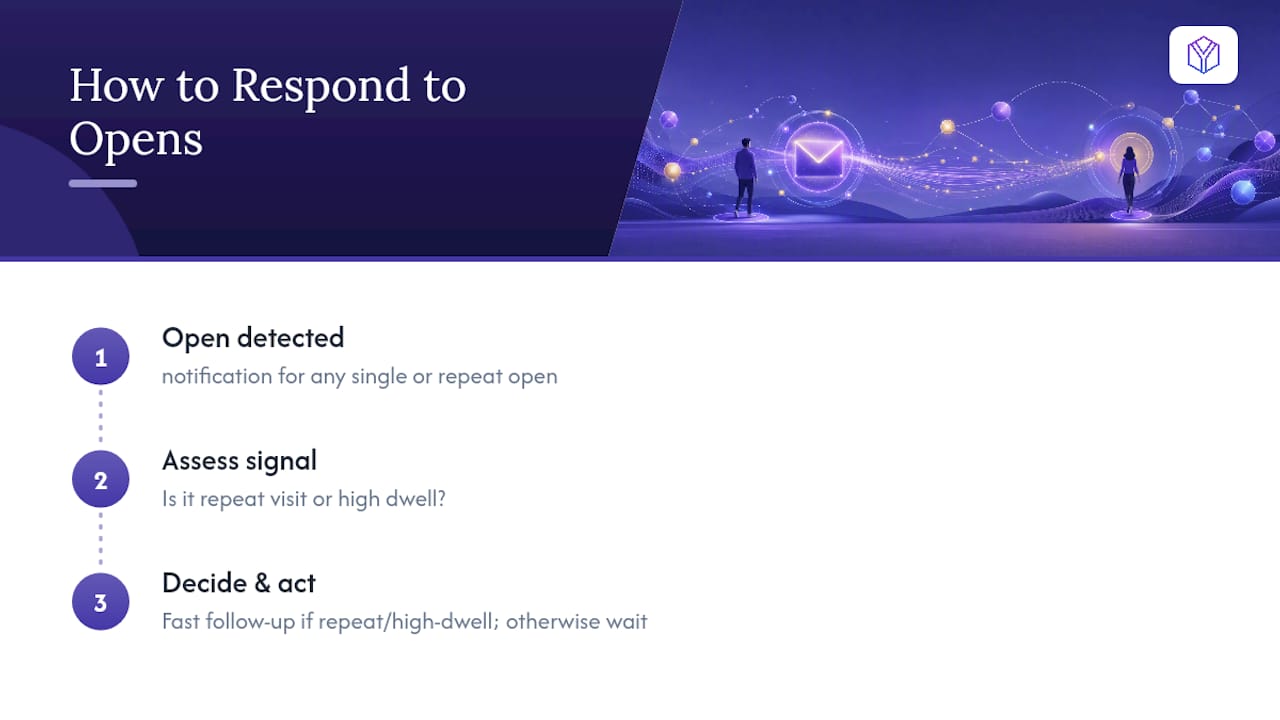
Notifications can also train you to over-respond. Not every open deserves same-day outreach, and firing off a message after every single ping reads as needy fast. Save the fast follow-up for genuine repeat-visit or high-dwell signals, and let single, brief opens pass without comment.
Finally, no tracker fixes a weak deck. If the data shows people opening your deck and leaving within 30 seconds, the fix is the deck itself, not a better dashboard.
What I’ve Learned Running Raises on Signal, Not Guesswork
The founders who get the most out of tracked decks aren’t the ones checking the dashboard obsessively. They’re the ones who wait for a real signal, a second visit, a long look at the numbers slide, and then send one sharp, specific note. That single habit turns a cold follow-up into a warm one more often than any amount of general persistence.
— Paul
Start a Raise Room With BabyLoveRaise
The fundraising-specific version of these features includes first-read alerts, per-slide dwell tracking, and a single room link that replaces the scattered PDF-and-Drive-link approach most founders default to.
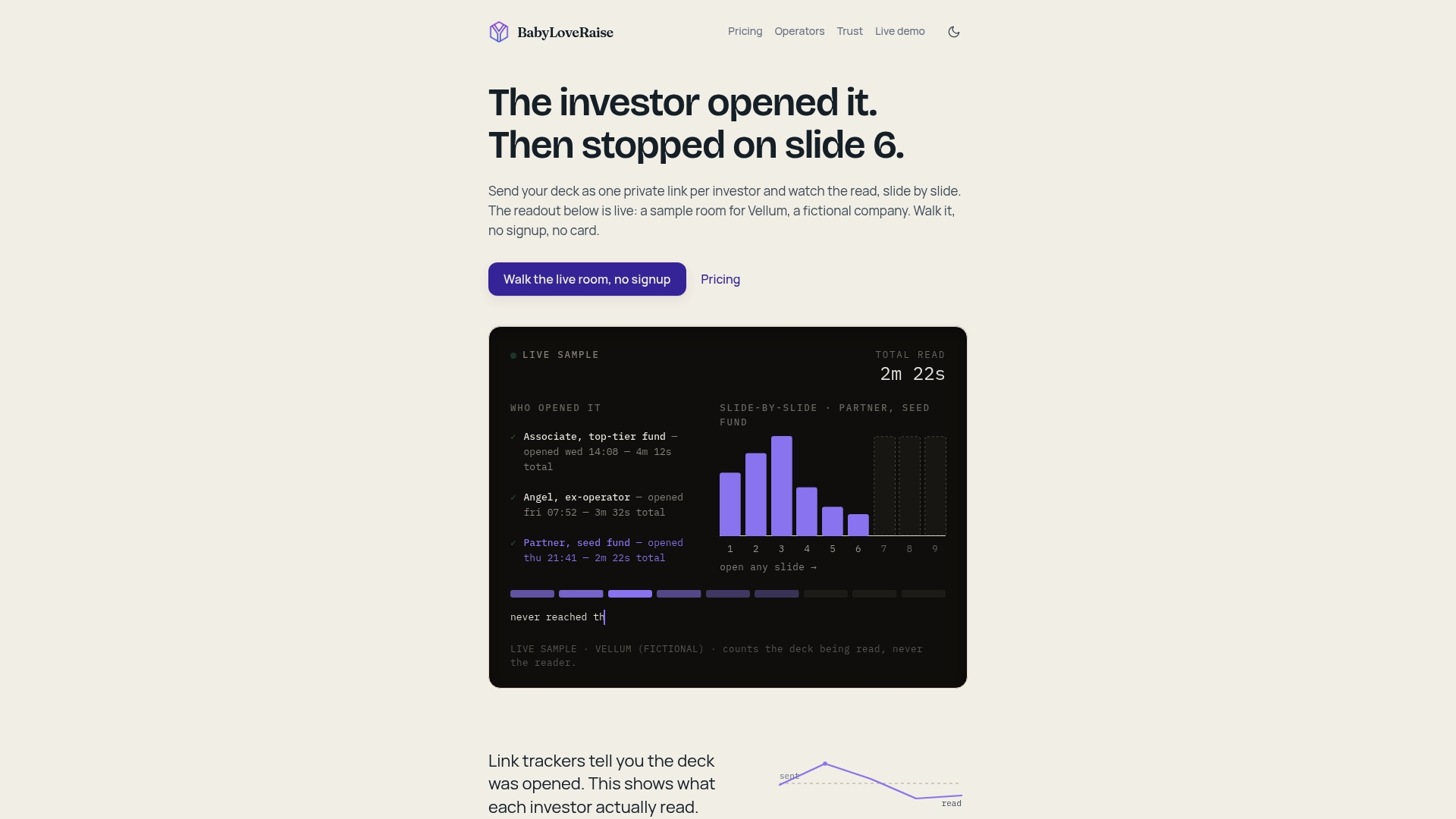
If you’re running a solo raise, per-slide engagement data works as a stand-in for the cofounder gut-check you don’t have in the room. If you’re a fractional CFO or fundraising advisor juggling several client raises at once, the white-label Operator tier lets you run firm-branded rooms across every client without paying data-room pricing for each one. Concierge options, including editorial passes on the deck itself and narrative Build Map artifacts, cover founders who want more hands-on help shaping the story before it goes out. Head to BabyLoveRaise to start a raise room or get a walkthrough of how the dashboard flags first reads and dead slides before your next investor call.
Sources
FAQ
What Is the 10/20/30 Rule for Pitch Decks?
The 10/20/30 rule suggests keeping a pitch deck lean and concise, with a focus on clear, readable content. It’s a guideline for keeping decks streamlined, not a strict requirement, and plenty of funded decks run longer when the content demands it.
What Mistakes Should You Avoid in a Pitch Deck?
The most common mistakes are burying the ask, overcrowding slides with text instead of visuals, and skipping the traction or financials slide investors specifically look for. A close second is sending the deck as a dead-end attachment with no way to know if it was ever opened.
Does a Pitch Deck Get Investor Attention?
A tracked pitch deck gets more useful attention than an emailed PDF, because it tells you when interest happens instead of leaving you guessing. Signals like a second open within a few days or extended time on your traction slide are strong indicators that someone is discussing the opportunity internally.
What Are Three Components of a Pitch Deck?
Most decks build around the problem being solved, the solution and product, and the traction or business model that proves it works. A fourth component, the team, often decides whether investors take the first three seriously at all.