
Advisors: Firm Branded Fundraising Portal To Turn Opens Into Meetings
Operator-focused guide for advisory firms and fractional CFOs on firm branded fundraising portals: use slide-level analytics, per-raise pricing, and a...
September 16, 2026 · 13 min read

A firm-branded fundraising portal, often called a white-label raise room, gives advisory firms and founders a single branded link that replaces the emailed PDF and tracks who actually reads the deck. The immediate payoff is simple: instead of guessing why an investor went quiet, you get slide-level data showing whether they opened it, finished it, or forwarded it to a partner. Evaluate a vendor on analytics depth, share-link controls, and per-raise pricing before anything else.
TL;DR:
- A branded raise room provides slide-level analytics, viewer attribution, and multiple share-link options, which improve investor engagement tracking.
- It offers security features like expiring links and audit logs, along with permanent archived access once the raise closes, unlike general file sharing tools.
- Per-raise pricing is more aligned with fundraising activity, avoiding the costs of unused seats typical of per-seat subscription models.
- Effective deployment requires integrating analytics signals into a clear follow-up workflow and ensuring internal staff use the branded links consistently.
- Advisory firms benefit from multi-client dashboards, custom branding, and a structured process that shortens fundraising cycles.
BabyLoveRaisebabyloveraise.comTurn Deck Opens Into Better Follow-UpsBabyLoveRaise gives advisory firms branded raise rooms with per-slide engagement data, helping teams distinguish readers from untouched decks.Explore BabyLoveRaise
Table of Contents
- What a White-Label Raise Room Does That a PDF Can’t
- What to Require Before You Pick a Portal
- How to Turn Deck Analytics Into a Follow-Up Workflow
- What Advisory Firms and Fractional CFOs Should Expect From an Operator Tier
- Security, Archive Behavior, and Pricing Traps to Watch
- Case Studies: What Successful Implementation Actually Looks Like
- Legal and Compliance Considerations for Branded Fundraising Portals
- How a Branded Portal Compares to Generic Sharing Tools
- Common Adoption Challenges and How Firms Work Through Them
- How Firms Should Actually Roll This Out With Clients
- Get a Branded Raise Room Running for Your Next Client
- Sources
- FAQ
What a White-Label Raise Room Does That a PDF Can’t
Emailing a pitch deck as an attachment is a dead end. Once it leaves your outbox, you have no idea if it was opened, skimmed, or deleted. You can’t fix a typo, swap a slide, or see which investor forwarded it to their partner before a decision.
A firm-branded raise room solves that by putting the deck behind one link that updates live and reports back. Every open, reread, and forward gets logged against a specific viewer or a specific link, which means the silence after a “looks great, let me review” email stops being a mystery.
The signals that actually matter include:
- First-read notifications the moment a link opens
- Reopens and multiple sessions, which outperform a single read as a signal of real interest
- Forwarded views from people outside your original send list
- Slide-by-slide dwell time showing exactly where attention drops
Branding matters here beyond aesthetics. When an advisory firm sends every client’s raise through the same generic file-sharing link, investors see no consistency and firms get no credit for the process. A firm-branded portal makes every client raise look like it runs through the same disciplined operation, which is the entire pitch of hiring an advisor or fractional CFO in the first place.
What to Require Before You Pick a Portal
Not every deck-sharing tool built for general business documents will hold up under fundraising-specific demands. Before you commit a client roster to one platform, run the feature list against what a raise actually needs.
- Slide-level analytics with viewer attribution. You need to know which named investor stalled on the traction slide, not just an aggregate view count.
- Completion metrics, not just opens. A deck that gets opened but abandoned at slide three is a different lead than one read start to finish.
- Three share-link registers. First-send links for cold outreach, forwardable links for warm intros, and private non-forwardable links for sensitive terms sheets or cap table detail.
- Measured watermark downloads with audit logs. If someone downloads a PDF copy, you want a timestamped record of who and when, not just a static watermark image.
- Operator-level white-labeling. Custom domains, firm logos, and a multi-client console so an advisory firm runs every client raise under its own brand, as explained in Sell Your Software Business With Captyx - Top Way to Sell a Business | Captyx.
- CRM and webhook support. Engagement events should push into whatever pipeline tool your firm already runs, not sit trapped in a separate dashboard.
Pro Tip: Ask any vendor demo to show you a “read but didn’t finish” investor next to a “reopened three times” investor side by side. If the dashboard can’t visually separate those two states in ten seconds, the analytics aren’t granular enough to change your follow-up behavior.
Recent guidance on investor behavior backs this up directly: slide-by-slide analytics and single-link sharing are what convert a read into a scheduled meeting, not just proof that a file was opened.
How to Turn Deck Analytics Into a Follow-Up Workflow
Analytics without a process behind them are just a dashboard nobody checks. Here’s a workflow that treats engagement data as a task list rather than a curiosity.
- Send one link per firm or per investor, never a mass PDF blast. Attribution breaks the moment two people share one generic link.
- Watch for first-read notifications on day one. Anyone who hasn’t opened the link within 48 hours becomes a “reminder” task, not a “cold” one.
- Rank reopeners and long readers above single first-time viewers. A finding based on 358,672 investor views across 24,541 decks shows 26.5% of genuinely interested investors reopen the deck and only 4.2% ever download it, which means a reopen carries far more weight than a download request.
- Send timed follow-ups matched to the signal. A completed read gets a direct ask for a call. A partial read at the same slide across multiple investors gets a deck revision, not a nudge.
- Fix the slide where attention consistently drops, then push the revised link back through the same room rather than starting a new thread.
- Route every event into your CRM or tracker so a partner picks up outreach without re-checking a separate dashboard.
The most useful combination isn’t a single metric. It’s pairing a first-read notification with a later completion flag: an investor who reads slowly over several sessions before finishing is often a stronger prospect than one who blazes through once and disappears. Deck design matters too. DocSend-derived research has long pointed to a short, roughly three-minute read as the target, since that’s closer to how investors actually triage decks than a full meeting-length walkthrough.
What Advisory Firms and Fractional CFOs Should Expect From an Operator Tier
Running raise rooms across a client roster is a different job than running one for a single founder. An Operator tier needs to handle multiple simultaneous raises without letting one client’s data bleed into another’s dashboard.
- Custom domains and consistent branding across every client room, so the firm’s name, not a vendor’s, is what investors see.
- Per-raise billing rather than per-seat subscriptions, since a firm running four active raises a quarter shouldn’t pay for twelve unused seats the rest of the year.
- Segregated admin roles so a junior associate can manage day-to-day link sends without touching another client’s investor list.
- Client-facing templates that let a firm spin up a new branded room in minutes instead of rebuilding a page from scratch for every engagement.
- Concierge services as a line item, not a freebie. Editorial passes on the deck itself and narrative “Build Map” style artifacts are billable work that firms can package alongside the room subscription.
Fractional CFOs already carry responsibility for building fundraise-ready data rooms, and firms that run a structured process tend to move through diligence faster than those improvising folder structures in Google Drive. A white-label Operator console just formalizes that responsibility into something billable and repeatable across every client on the roster.
Security, Archive Behavior, and Pricing Traps to Watch
A raise room holds sensitive competitive information, so access control isn’t optional. Expiring links, optional passwords, and a private non-forwardable link tier for cap table or terms-sheet detail should all be standard, not premium add-ons.
- Require audit logs that timestamp every download, not just every view, since diligence requests often hinge on proving who saw what and when.
- Confirm watermarked downloads are actually measured and logged, not just cosmetically stamped.
- Ask what happens to the room after the raise closes. A permanent, free archive conversion means your deck history doesn’t vanish or get walled behind a paywall the moment the deal is done.
- Watch for hidden per-download fees that appear after a free trial, and be wary of per-seat pricing structures when your actual usage pattern is per-raise: four raises a year with three team members each is a very different cost shape than a dozen seats billed year-round.
Pricing structure is often the clearest tell of how a vendor thinks about this market. A tool built for general document sharing will almost always default to per-seat billing, because that’s how it prices every other use case. A raise room built specifically for fundraising should default to per-raise economics instead.
Case Studies: What Successful Implementation Actually Looks Like
The clearest pattern in successful rollouts isn’t a single dramatic result. It’s a firm that stops treating deck sharing as an afterthought and starts treating it as the front door of its process.
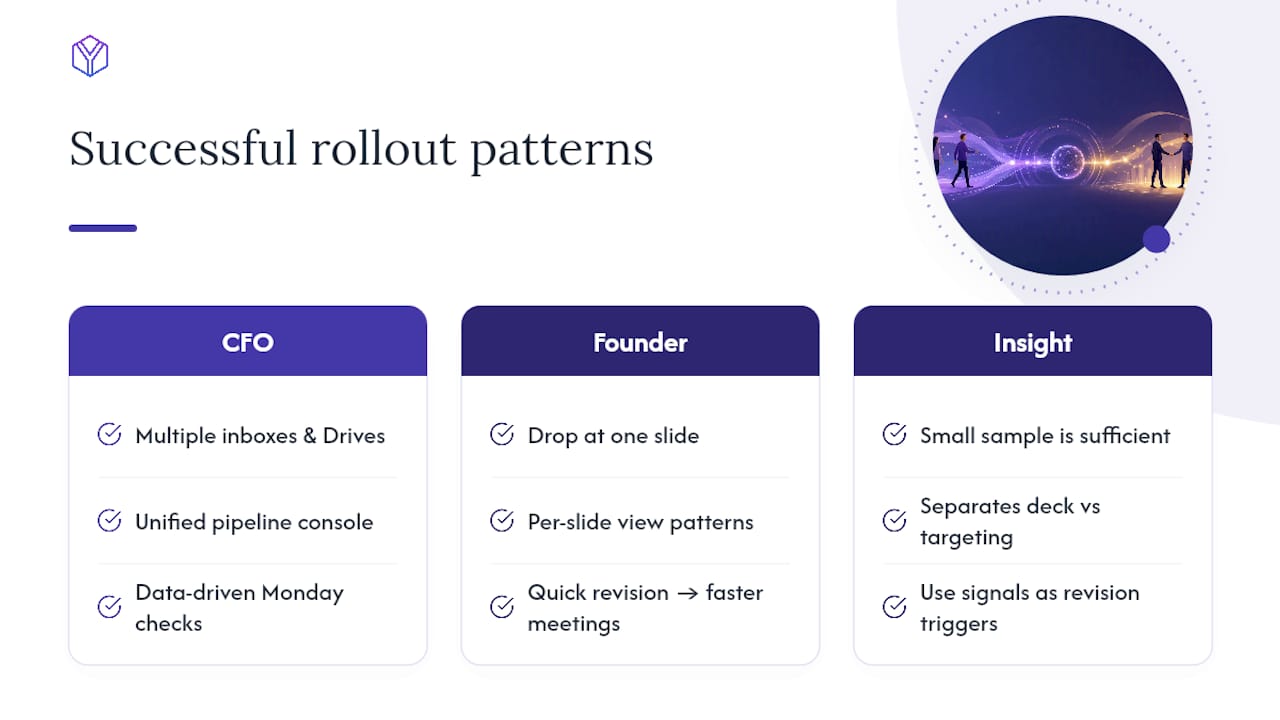
A fractional CFO running three concurrent client raises, for example, gains the most value not from any single dashboard number but from being able to triage all three pipelines from one console instead of three separate email threads and three separate Drive folders. The firm stops asking “Did they open it?” as a rhetorical question and starts answering it with data, which changes what a Monday morning check-in actually looks like.
For a solo founder, the more common success story is subtler: a deck that looked fine on paper turns out to lose every investor at the same slide, usually the market-size or go-to-market slide. Once that pattern shows up in the per-slide data across five or six viewers, the fix is obvious and fast. Founders and advisory firms who treat that kind of slide-level signal as a revision trigger, rather than noise, tend to shorten the gap between first send and second meeting.
None of this requires a large sample. Even a handful of tracked opens is usually enough to separate a deck problem from a targeting problem, which is the distinction that actually changes what a firm does next.
Legal and Compliance Considerations for Branded Fundraising Portals
A raise room carries the same confidentiality obligations as any other channel used to share cap tables, financials, or forward-looking projections to prospective investors. Access controls, expiring links, and audit trails aren’t just security features. They’re also the paper trail a firm may need to show who had access to sensitive information and when, which matters if a dispute over confidentiality or selective disclosure ever comes up.
Watermarking measured downloads serves a similar dual purpose: it deters casual redistribution and gives the firm a record to point to if a deck surfaces somewhere it shouldn’t. None of this substitutes for a proper NDA or the securities counsel every seed raise should already have reviewing solicitation materials. Firms should treat the portal as an operational and evidentiary layer on top of, not instead of, standard legal practice around private offerings. The portal doesn’t change securities law; it just makes the firm’s own conduct easier to document.
How a Branded Portal Compares to Generic Sharing Tools
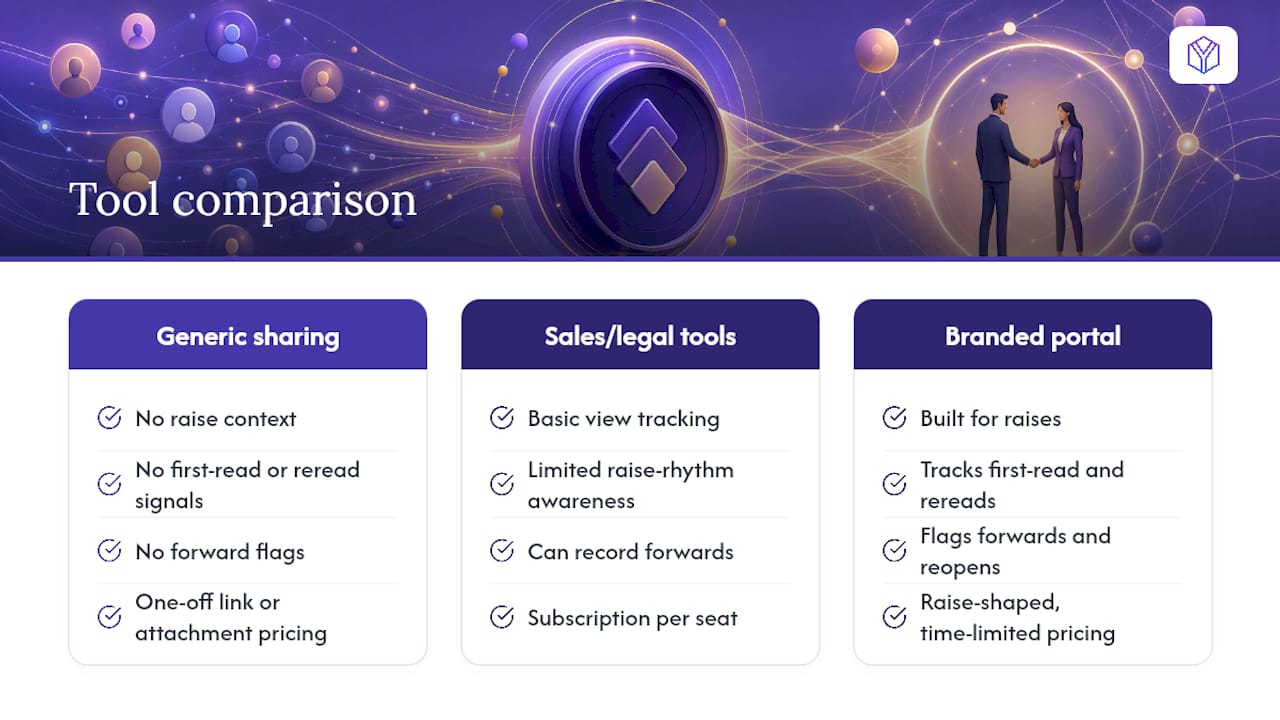
A generic file-sharing link, whether that’s a Drive folder or an email attachment, treats a pitch deck like any other document. It has no concept of a raise, no distinction between a cold send and a warm forward, and no way to flag that one specific investor just reopened the deck for the third time this week.
Third-party document-tracking tools built for sales or legal use cases fare better on basic view tracking but usually stop there. They weren’t built around the specific rhythm of a raise: the first-read spike, the reread pattern days later, the forward to a partner who wasn’t on the original send list. A firm-branded, fundraising-specific portal is built around that rhythm from the ground up, with pricing that reflects a raise’s actual shape (a few months of intense activity, then a close) rather than a permanent per-seat subscription designed for ongoing document collaboration.
Common Adoption Challenges and How Firms Work Through Them
The most common friction point is internal, not technical: getting every associate at a firm to actually send raise room links instead of falling back on old habits and emailing a PDF because it feels faster in the moment. That gets fixed by making the branded link the default template in outreach sequences, so sending it takes the same two clicks as attaching a file.
The second challenge is investor pushback, particularly from investors used to receiving a straightforward attachment who find a link mildly odd at first. That friction fades quickly once a firm frames the room correctly, framing it as a live, always-current version of the deck rather than a gatekeeping mechanism.
The third is analytics overload. A dashboard with too many raw numbers and no clear priority order gets ignored. Firms that succeed pick two or three signals, reopens, completions, and forwards, and build their follow-up cadence entirely around those, ignoring the rest of the dashboard until a specific question calls for it.
How Firms Should Actually Roll This Out With Clients
I’d require a branded room the moment a client has a real target list, not before. Rolling it out too early on a founder still shaping the narrative just generates noisy data nobody acts on.
A short onboarding checklist works better than a long one: confirm the branded domain and template look right, load the current deck version, set link types for cold versus warm sends, and walk the client through what a reopen actually means before the first send goes out.
On packaging, treat the room subscription as the base fee and bundle editorial passes or narrative mapping as separate line items. Clients pay for the process discipline, not just the software.
— Paul
Get a Branded Raise Room Running for Your Next Client
One solution built around exactly the checklist above offers per-slide analytics with viewer attribution, three share-link registers for first sends and warm forwards, measured watermark downloads, and a white-label Operator tier for firms running multiple client raises at once.
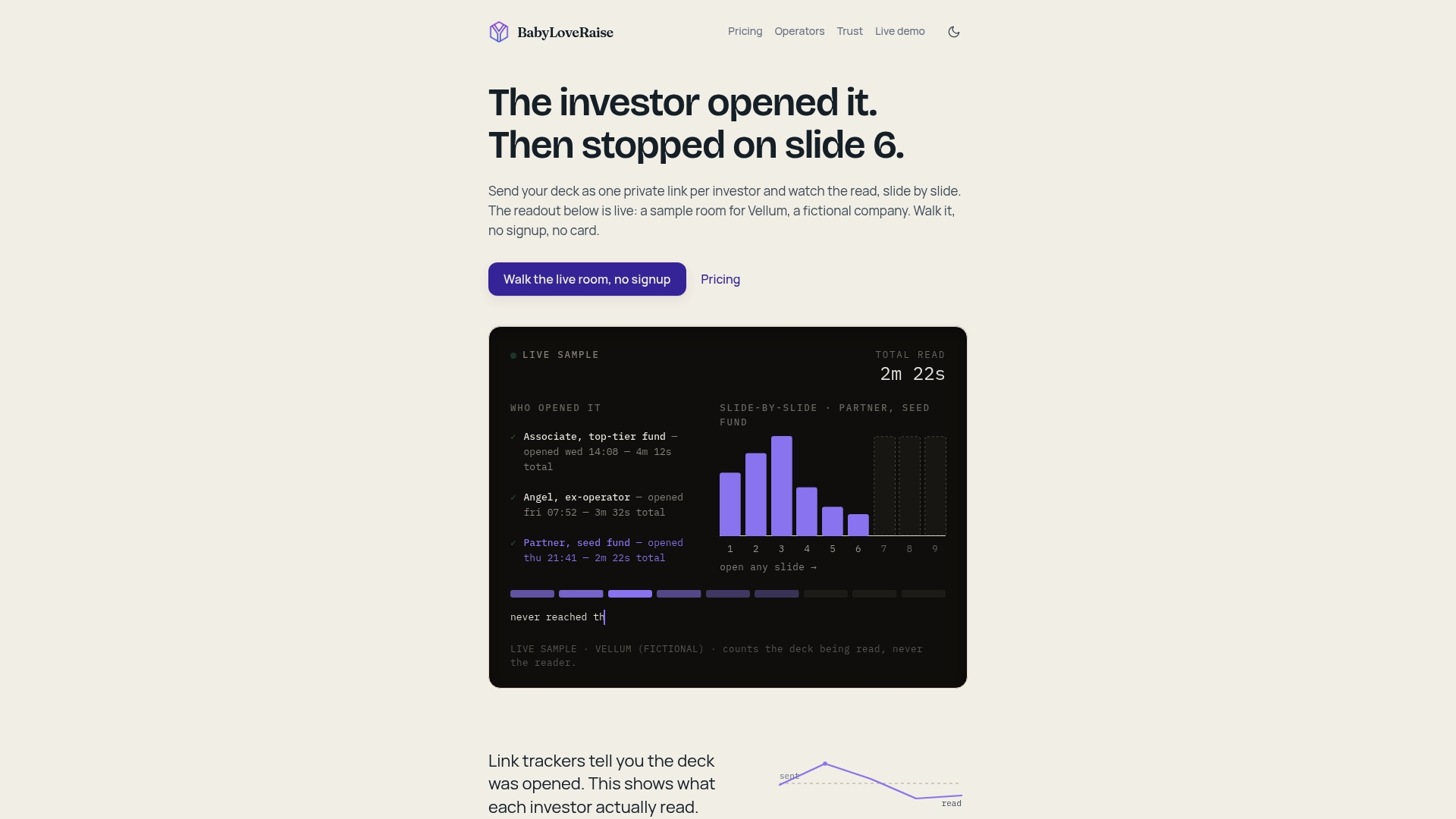
Pricing runs per-raise rather than locking a firm into a permanent per-seat plan, and every room converts to a free permanent archive once the raise closes, instead of hitting a paywall the moment you need old data again. Advisory firms and fractional CFOs get custom branding and a multi-client console; solo founders get the same first-read notifications and per-slide dwell tracking. If your current process still runs on emailed PDFs and a guess about why an investor went quiet, start a raise room on BabyLoveRaise and send your next deck as a tracked link instead.
Sources
For deeper data on investor reading behavior, see the pitch deck analysis of 24,541 decks and DocSend-derived research on deck attention. For product specifics, read BabyLoveRaise’s guide on tracking deck completion.
- How Investors Read Pitch Decks — Data from 24,541 Decks
- What Investors Actually Read in Your Pitch Deck (DocSend Data) - PitchGrade
- What Does a Fractional CFO Do? | StartupCFO
FAQ
What Is a Firm-Branded Fundraising Portal?
It’s a white-label raise room, a hosted, custom-branded page where a firm or founder shares a pitch deck under one tracked link instead of an email attachment, with built-in slide-level analytics.
How Is This Different From Emailing a PDF?
A PDF attachment gives you no data once it’s sent; a branded raise room logs opens, reopens, forwards, and per-slide dwell time against a specific viewer or link.
What Share Link Types Should a Portal Support?
Look for at least three registers: a first-send link for cold outreach, a forwardable link for warm intros, and a private non-forwardable link for sensitive detail like cap tables.
Is Per-Raise Pricing Better Than Per-Seat for a Seed Raise?
For most pre-seed and seed raises, yes. Per-raise pricing matches the actual usage pattern (a few active months, then a close), while per-seat plans charge for capacity you’re not using year-round.
What Happens to the Room After the Raise Closes?
A well-built portal converts the room into a permanent, free archive rather than cutting off access or moving the deck behind a paywall, so the engagement history stays available.