
How to Track Deck Completion During a Fundraise
Learn how to track your pitch deck's completion rates effectively. Gain insights with BabyLoveRaise's tools to engage investors better.
August 15, 2026 · 9 min read

Host your pitch deck as a trackable raise-room link, measure slide-level completion rate in real time, and act on re-open signals the same day. That’s the workflow. BabyLoveRaise implements it out of the box: first-read alerts arrive within minutes, and per-slide dwell data is available the same day you send.
Key Takeaways
Tracking deck completion works when you combine slide-level completion rate, per-slide dwell time, and re-open signals into a single, signal-driven follow-up workflow.
| Point | Details |
|---|---|
| Completion rate benchmark | Decks of 15–20 slides reach roughly 65% completion with institutional investors. |
| Deliver as a link, not a file | Web-based raise-room links capture slide-level events; PDF attachments capture nothing after send. |
| Re-open is your best trigger | A re-open within 48 hours is the highest-conversion follow-up signal; act on it the same day. |
| Privacy comes first | Track the document, not the person; use link registers and measured watermarks, not individual profiling. |
| BabyLoveRaise | Implements per-raise pricing, per-slide analytics, three share-link types, and real-time alerts in one hosted raise room. |
Table of Contents
- What metrics actually tell you if an investor finished your deck
- How to capture these metrics reliably
- How to interpret signals and act on them
- Investor privacy and etiquette you should follow
- A 7-step checklist to start tracking deck completion today
- How BabyLoveRaise maps to this workflow
- What fundraising-first deck analytics typically costs
- Why every send deserves its own signal read
- BabyLoveRaise gives you the raise room to act on this now
- Sources
What metrics actually tell you if an investor finished your deck
Raw open counts are nearly useless. An investor who opened your deck on a phone while boarding a flight looks identical to one who read every slide twice. The metrics that actually answer “did they finish?” are:
- Deck completion rate: viewers who reached the final slide divided by unique viewers. Decks of 15–20 slides hit roughly 65% completion with institutional investors, while decks over 25 slides drop below 41%.
- Per-slide dwell time: seconds spent on each slide. A spike on your financials slide means genuine scrutiny; a flat line across all slides means a skim.
- Drop-off point: the exact slide where most viewers exit. This is your revision target.
- Re-opens and forwards: a second session from the same viewer, or a new viewer from a forwarded link, signals a buying committee forming.
- Measured downloads: tracked PDF exports that carry a watermark, so you know which version circulated.
- Share-link register: a log of every link sent, to whom, and with what permissions.
Slide-level view-through, dwell time, drop-off, re-opens, and forwards are the signals that reveal what actually resonates, not total view counts.
Pro Tip: Compare completion rates by cohort: cold outreach vs. warm intro. Warm intros typically finish at a higher rate, so a cold-outreach completion rate above your warm baseline is a strong signal worth acting on immediately.
How to capture these metrics reliably
The method you use to deliver your deck determines what you can measure. Here’s how the main approaches compare:
- Hosted raise-room link: captures slide-level events, forwards, and re-opens automatically. Best accuracy, best privacy control. Requires the viewer to open a URL rather than a file.
- Web-based slide hosting (generic): similar capture capability but lacks fundraising-specific features like share-link registers or per-raise pricing.
- PDF/PowerPoint attachment with measured watermark: captures who downloaded and which version, but provides zero slide-level data after the file leaves your outbox.
- Manual reporting: no automation, no real-time alerts, and no per-slide granularity. Useful only as a fallback.
Static files go dark the moment you hit send. Delivering decks as web links is the practical prerequisite to capturing slide-level interactions and forwards automatically.
Time-to-insight by method: hosted raise-room links return open alerts within minutes and slide-level summaries the same day. Processing-based platforms can take a few hours, similar to how visual-intelligence field tools return percent-complete reports within hours of upload. Static attachments return nothing.
Configure three share-link types from the start: a first-send link (single viewer, no forwarding), a forwardable link (tracks new viewers), and a private link (for board members or advisors). This preserves analytics without collapsing all traffic into one anonymous stream.
Pro Tip: Never send a forwardable link to your first cold outreach. Use a first-send link so you know exactly who opened it before a forward multiplies the audience.
How to interpret signals and act on them
Raw data without a decision rule is just noise. Here’s a triage workflow:
- High completion + re-open within 48 hours: send a personalized follow-up within 24 hours. This is your hottest signal.
- High completion, no re-open: follow up within 48–72 hours with a specific question tied to a slide they spent time on.
- New viewer from a forwarded link: identify the new viewer’s firm and route to a partner intro if possible.
- Drop-off before slide 8 on a 15-slide deck: the problem is in your opening narrative. Revise slides 1–5 before the next send.
- Low completion across a cohort: run an A/B test. Send a revised version of slides 3–6 to the next 10 investors and compare completion rates.
Per-slide dwell time tells you which slides to rework. Pricing and financials slides that get skimmed signal a credibility gap; a team slide with low dwell suggests the narrative isn’t landing. For practical guidance on slide-level edits, refining your startup presentation covers A/B testing approaches worth applying here.
Pro Tip: A re-open within 48 hours is the single highest-conversion follow-up trigger. Set your CRM to create a task automatically when that alert fires.

Investor privacy and etiquette you should follow
Tracking is a tool for better timing and better content, not for building profiles on individual investors. The distinction matters, both ethically and practically.
- Track the document, not the person. Measure which slides held attention, not who the individual is beyond what they’ve voluntarily shared.
- Disclose measured downloads or watermarking when appropriate. If a download carries a watermark, investors should know that.
- Avoid per-person surveillance. Link-level registers that show “this link was opened twice” are appropriate; keystroke-level behavioral profiling is not.
- Prefer share-link registers over user-profiling systems. A log of which links were sent and opened is transparent and auditable.
Deck analytics should answer two questions: did this investor engage, and which part of the deck needs work? The moment tracking shifts from improving your outreach to profiling an individual’s behavior, it crosses a line that damages trust and relationships. Use the data to get better at fundraising, not to surveil the people you’re trying to impress.
For a deeper look at privacy-forward tracking design, BabyLoveRaise’s approach to pitch deck tracking without surveillance explains the document-focused model in detail. On the legal side: U.S. privacy rules around tracking vary by context; consult counsel for specific compliance questions before deploying any analytics tool.
A 7-step checklist to start tracking deck completion today
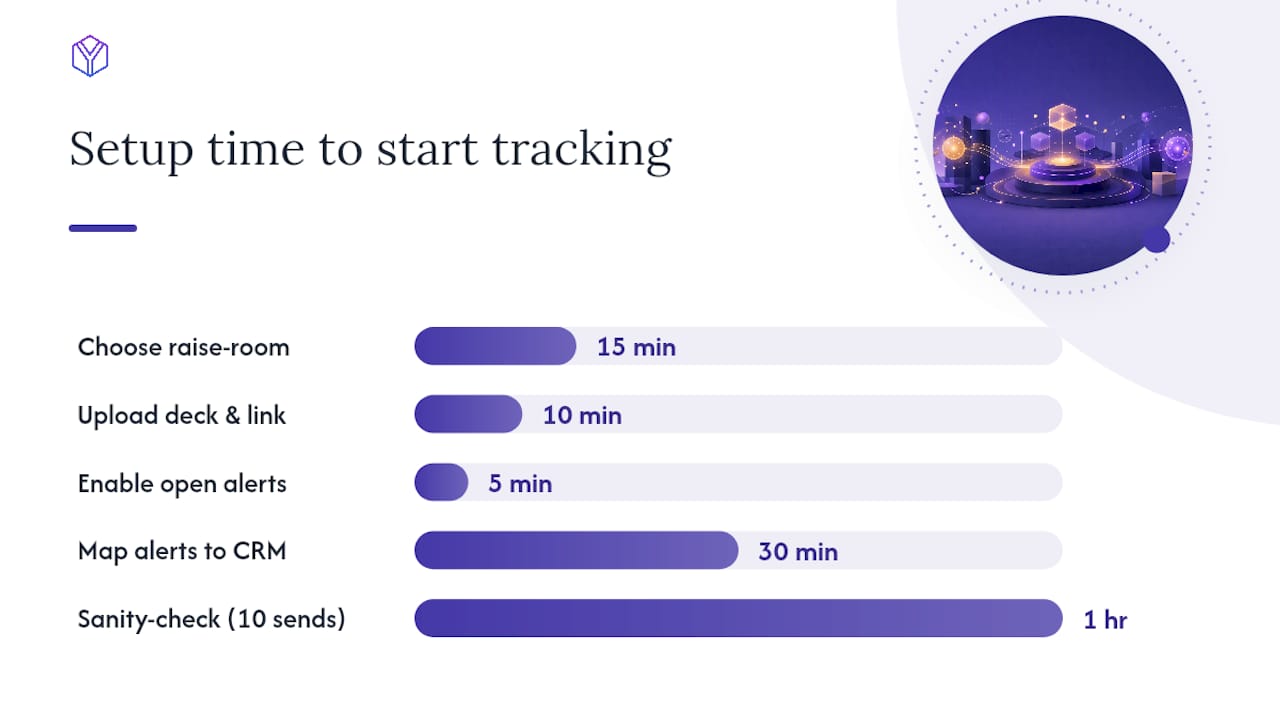
- Choose a raise-room platform (15 minutes): select a tool built for fundraising, not generic file sharing.
- Upload your deck and generate a raise-room link (10 minutes): use the hosted link, not a PDF attachment.
- Configure share-link types (10 minutes): set up first-send, forwardable, and private link registers before your first send.
- Enable real-time open alerts (5 minutes): connect alerts to email or Slack so you catch first reads immediately.
- Map alerts to CRM tasks (30 minutes): every open alert should auto-create a follow-up task in your fundraising CRM.
- Send your first 10 links and log the cohort (ongoing): note whether each send was cold outreach or warm intro for cohort comparison.
- Sanity-check after 10 sends (1 hour): verify that completion rates, dwell times, and drop-off points are being recorded accurately before scaling outreach.
A two-deck strategy helps here: send a 5–8 slide teaser for cold outreach and the full 15–20 slide deck for meetings. Track each version separately so completion rates stay comparable within each cohort.
Pro Tip: After your first 10 sends, check whether any slide shows zero dwell time across all viewers. That’s a rendering or load issue, not a content problem. Fix it before send 11.
How BabyLoveRaise maps to this workflow
| Dimension | BabyLoveRaise |
|---|---|
| What it measures | Deck completion rate, per-slide dwell time, drop-off point, re-opens, forwards, new viewers |
| Share link types | First-send, forwardable, private — each tracked separately in a link register |
| Privacy model | Document-focused tracking; measured watermarks on downloads; no individual profiling |
| Time-to-insight | Real-time open alerts; same-day per-slide summary |
| Pricing model | Per-raise subscription (quarterly or monthly); Operator console for advisory firms |
| Export and CRM | Dashboard export; alert-to-CRM task mapping; permanent archive after raise closes |
Use cases where this maps directly:
- Cold outreach: send a first-send link, get an open alert within minutes, follow up while interest is fresh.
- Partner meeting follow-up: send a forwardable link post-meeting, track when the partner shares it internally, and identify the buying committee.
- Board reporting after a raise session: the raise room converts to a free permanent archive, so historical engagement data stays accessible without a recurring paywall.
Per-slide analytics and follow-up prioritization are covered in detail on the BabyLoveRaise blog for founders who want to go deeper on the methodology.
What fundraising-first deck analytics typically costs
Pricing models in this category fall into three buckets:
- Per-raise: one fee for the duration of a single raise. Best for founders running one round at a time. Avoids paying a per-seat fee during the months between raises.
- Per-seat (annual): common for general document-tracking tools. Costs more over a single raise cycle but may suit teams tracking multiple document types year-round.
- Operator console: a multi-client tier for fractional CFOs and advisory firms running several raises simultaneously, typically at a fraction of virtual-data-room pricing.
Operational costs to plan for beyond the platform fee: onboarding time (usually under an hour for a hosted raise room), optional editorial passes if you want a concierge review of your deck narrative, and CRM integration setup (30–60 minutes for most tools).
Pro Tip: Per-raise pricing almost always beats per-seat pricing for a single-raise founder. Run the math: if your raise takes three months, a per-raise fee is typically cheaper than three months of a per-seat annual plan prorated. Check BabyLoveRaise pricing for current plan details.
Why every send deserves its own signal read
Most founders treat outreach as a sequence: send, wait, follow up on day three, repeat. The problem is that sequence ignores the actual data sitting in your raise room. An investor who re-opened your deck at 11 PM on a Tuesday is not the same as one who opened it once for 40 seconds. Treating them identically wastes your best opportunities.
Small instrumentation changes produce outsized returns in follow-up efficiency. Replacing a blind three-day cadence with a signal-triggered workflow means your best follow-up email goes out when an investor is actively thinking about your company, not when a calendar reminder fires. One caution: opens alone are not enough. A completion rate without re-open context tells you someone finished the deck but nothing about their intent. Both signals together are what drive the decision.
BabyLoveRaise gives you the raise room to act on this now
Per-raise pricing, per-slide analytics, privacy-first share registers, and real-time alerts: BabyLoveRaise packages the entire workflow described here into a single hosted raise room. Setup takes under an hour. Upload your deck, configure your link types, connect your alerts to your CRM, and your first send is instrumented. When the raise closes, the room becomes a permanent archive at no extra cost.
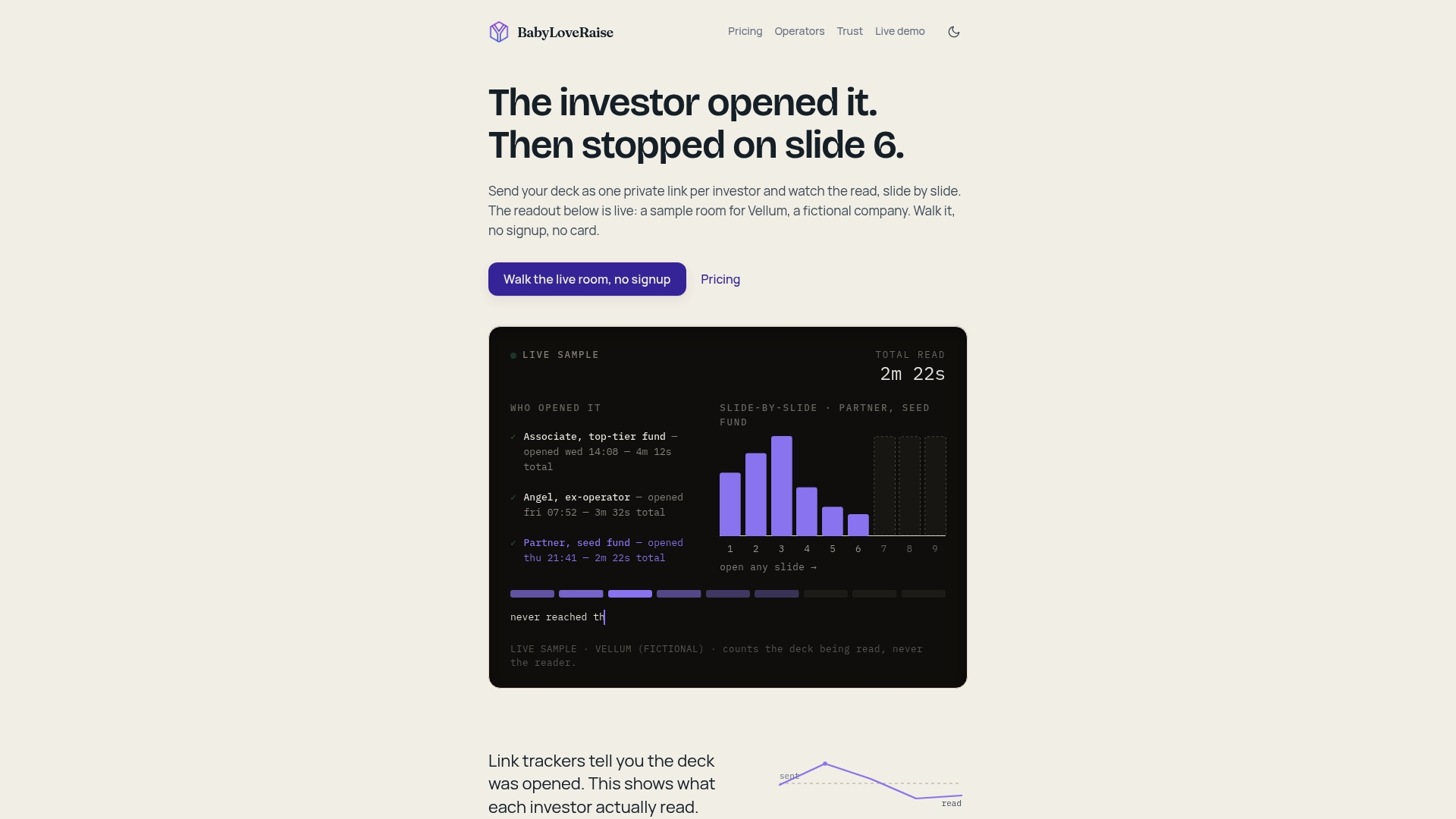
Founders who want to implement this workflow today can get started at BabyLoveRaise. Set up a raise room, send your first tracked link, and have slide-level data before end of day.
Sources
- What Pitch Deck Length Converts Best
- How to Measure Sales Deck Engagement in 2026
- Progress AI — DroneDeploy