
Founder Toolkit: Investor Outreach Email Templates With Tracked Decks
Founders get copy ready investor outreach email templates, tracked deck tactics, and follow up cadences tied to per slide engagement to prioritize replies...
September 29, 2026 · 13 min read

The fastest path to a reply is a short cold email with one specific traction signal, two supporting bullets, and a direct scheduling link, paired with a tracked deck instead of a blind attachment. It works because investors screen for fit in seconds, and specificity plus low friction beats a polished but generic pitch. Send it today with a raise-room link and an open Calendly slot attached.
TL;DR:
- Using a tracked link instead of a PDF attachment helps identify whether investors opened and read your deck, guiding targeted follow-ups.
- Sending three personalized, highly targeted emails over three to four weeks maximizes response rates, with each message introducing new information.
- A well-crafted, one-line value statement with traction data and a clear ask in the first email allows investors to self-screen instantly.
- Building familiarity through engagement, referencing mutual contacts, or specific portfolio companies increases cold outreach success.
- Keep outreach concise, tailored, and focused on your company’s core metrics, avoiding detailed deal terms until a direct conversation occurs.
BabyLoveRaiseKnow Which Investors Read Your DeckSend one raise room link and see who opened, reached the final slide, or stopped paying attention along the way.Explore BabyLoveRaise
Table of Contents
- Which outreach template should you send first?
- What subject lines and openers get emails opened?
- What should the first email actually contain?
- How often should you follow up, and with what?
- How do you write a forwardable blurb connectors will send?
- How many outreach emails should you send per day, and why does tracking matter?
- Copy-ready templates for cold, warm, and follow-up emails
- Pre-send checklist and quick best practices
- How tracked delivery changes your follow-up script
- What legal and compliance rules apply to investor outreach?
- What sending three hundred emails taught me about discipline
- A simpler way to send decks and know who’s actually reading
- Where to read more on outreach and fundraising tactics
- Sources
- FAQ
Which outreach template should you send first?
Most founders default to one template and wonder why replies dry up. The right choice depends on how warm the relationship already is, not how polished your deck looks.
- Cold short intro: a one-line value proposition, two bullets on traction and stage, and a scheduling call to action. Use this for investors you have never spoken with who invest in your sector.
- Warm outreach: reference the prior interaction (an event, a comment on a post, a mutual contact), add one line of fresh progress, and ask for fifteen minutes. Use this when there is any real history to point to.
- Permission or update emails: short, recurring notes to investors who asked to stay in the loop but are not ready to meet. Use this to keep a list warm without asking for time every message.
- Signal-based outreach: triggered by a concrete event such as a new hire, a customer win, or press coverage. Use this when you have news that changes an investor’s read on your traction.
Cold outreach converts better when founders build familiarity before the ask lands. Techstars notes that engaging with an investor’s content first, or asking for a quick perspective on a strategic problem, turns a cold email into something closer to a natural conversation. That single move, asking for input instead of a meeting, often gets a faster reply because it costs the investor almost nothing to answer.
What subject lines and openers get emails opened?
A subject line has one job: tell the investor in five words whether this fits their thesis. HubSpot recommends a formula that packs sector, signal, and stage into a single line, something like “B2B SaaS, lead secured, seed.”
- Formula: [Sector], [Key signal], [Stage or ask]. Example: “Climate fintech, $40k MRR, raising seed.”
- Opener 1: mention a specific portfolio company and why your traction resembles it.
- Opener 2: name the mutual contact in the first sentence, not buried in paragraph two.
- Opener 3: lead with the metric that moved most recently, not a mission statement.
Openers that reference actual research, a fund’s stated thesis, a recent portfolio addition, a specific blog post, read as effort rather than a template. Vague flattery reads as neither.
Pro Tip: Write the subject line last, after the body is done. You will pick a sharper signal once you know what the email actually proves.
What should the first email actually contain?
Investors decide fit in the first few sentences, so the first email should let them self-screen without needing a call. Sequoia points out that investors prioritize a handful of concrete data points early: founding date, team size, stage, and traction, before deciding whether a deeper look is worth their time.
- Open with one sentence describing what the company does and the problem it solves, in plain language a non-expert would understand.
- State founding date, team size, and stage so the investor can place you against their thesis instantly.
- Include one traction metric: MRR, ARR, active users, or a growth percentage, whichever is strongest and honest.
- Make the ask explicit: how much you are raising and what you want from this specific investor, a meeting, feedback, or an intro.
- Attach a one-pager or link a tracked raise-room rather than a full deck. A full deck sent cold gets skimmed once and forgotten; a link you can revisit tells you who actually engaged.
Keep the full deck out of the first message unless it was explicitly requested. A one-pager or a short room link respects the investor’s time and gives you a signal (opened, ignored, read to the end) that a static PDF never will.
How often should you follow up, and with what?
A single email rarely closes a meeting. The fix is not more urgency, it is a follow-up cadence with new information at each step.
- Day 5 to 7: a short reminder that adds one new detail, a metric update, a customer signed, or simply confirmed availability for a call.
- Day 12 to 14: a second nudge with a different signal than the first, since repeating the same line reads as a form email.
- Week 3 to 4: a final, low-pressure note that either proposes a specific time or asks permission to add them to a periodic update list.
Each message should keep the ask simple: one question, one link, one time window. When an investor never opens any of the three emails, stop asking for meetings and shift them into your update list instead, a lower-friction relationship that keeps the door open without repeated cold asks.
Pro Tip: If a tracked link shows the deck was opened but abandoned after the second slide, your next email should address that slide directly instead of repeating the general pitch.

How do you write a forwardable blurb connectors will send?
Asking “can you introduce me?” puts work on the connector. A forwardable blurb removes that work entirely: the connector copies, pastes, and hits send. Techstars recommends giving connectors an explicit blurb with a subject line, a short description, traction, and a clear ask, since a message the connector can paste without editing is far more likely to go out the same day.
- Subject line the connector can reuse as-is, written from their voice, not yours.
- One line of context: what the company does and why it is relevant to this particular investor.
- One line of traction: the single strongest metric or milestone to date.
- Explicit ask and suggested cadence: a fifteen or twenty-minute call, with a few proposed windows.
Prefer a warm intro whenever a real connector exists. Reserve cold outreach for investors with no path through your network, where a sharp, targeted email is the only option.
How many outreach emails should you send per day, and why does tracking matter?
Volume without personalization burns a list fast. A better default is quality over quantity.
- Batch three to five highly personalized emails per day rather than blasting a long list at once.
- Customize at least one sentence per email, tied to the investor’s portfolio, thesis, or recent public comment.
- Use tracked links to separate “never opened” from “read to the end.” Those are two different problems that need two different follow-ups, not the same reminder.
- Let per-slide dwell time guide the next message. An investor who lingered on the traction slide gets a data-forward follow-up; one who dropped off early gets a shorter, sharper reframe of the opening pitch.
Tracked links turn silence into information. Without one, a founder cannot tell whether an investor ignored the email entirely or read the whole deck and quietly passed, and those two outcomes call for opposite next moves.
Copy-ready templates for cold, warm, and follow-up emails
Replace the bracketed language with your own details before sending; nothing below should go out verbatim.
-
Cold outreach template. Subject: [Sector], [key metric], [stage]. Body: one line on what you do and the problem solved, two bullets (traction metric, stage and round size), one line naming why this investor’s thesis fits, and a closing line with a scheduling link. Personalization and brevity matter most here: Y Combinator advises keeping cold emails short, researched, and relevant to the specific investor’s portfolio rather than sending a generic version to a long list.
-
Warm outreach template. Subject: reference the shared context directly, for example “Following up from [event/mutual contact].” Body: one line recalling the connection, one line of fresh progress since then, and a direct request for fifteen minutes with two or three proposed times.
-
First follow-up template. Subject: reuse the original subject with “following up” appended. Body: two sentences, a reminder of the ask plus one new data point (a metric change, a hire, a customer), and the same scheduling link repeated.
-
Permission or update template. Subject: “[Company] update, [month/year].” Body: three or four sentences covering the headline metric, one qualitative win, and a one-line reminder that you’re raising or planning to raise, closed with an offer to keep them posted at a set cadence. Keep a private update list rather than a visible BCC line; a visible group of external addresses reads as sloppy and can expose contacts to each other without consent.
A teaser email pack built around tracked links pairs naturally with all four templates above, since it lets you see which version is actually landing before you scale outreach further.
Pre-send checklist and quick best practices
Run this before every send, not just the first one.
- Personalize one sentence minimum, tied to something specific about the recipient.
- Verify thesis fit: check the fund’s stage and sector focus before sending, not after.
- Test every link, especially the scheduling link and the deck link, on a second device.
- Include a scheduling call to action such as a Calendly slot so booking a call takes one click.
- Decide attach versus link in advance, and default to a tracked link over a raw attachment.
- Never mass-BCC investors into a shared thread; each outreach email should look individually sent.
- Log every send in a simple CRM (a spreadsheet works) and A/B test subject lines across batches.
Pro Tip: Track reply rate by subject-line formula, not just by investor, so you learn what signal actually earns opens over time.
How tracked delivery changes your follow-up script
A static PDF gives you one signal: sent. A tracked link gives you three: never opened, opened but skimmed, and read to the end, and each deserves a different message. An investor who never opened the link gets a short, re-angled subject line, not a longer email. One who skimmed the first few slides and stopped gets a follow-up that addresses the slide where attention likely dropped. One who read to the last slide gets a direct scheduling ask, since they’ve already done the work of evaluating the pitch.

Platforms like BabyLoveRaise build this distinction into a raise room: per-slide dwell time replaces guesswork about where a deck lost the reader, and per-raise pricing means the tracking exists specifically for the outreach window rather than as a permanent per-seat tool. The practical effect is a shorter list of real prioritization, follow up with readers first, and revise the slide that lost everyone else.
What legal and compliance rules apply to investor outreach?
Investor outreach itself, sending emails describing your company and asking for a meeting, is standard practice and not a regulated activity. The line to watch is what you say about the raise once you move from conversation to an actual investment offer. In the United States, offering securities publicly without an exemption can trigger registration requirements, and language that reads as a general solicitation before you have confirmed accredited-investor status can create problems under securities rules. Most early founders avoid this by keeping outreach emails focused on the company and the ask for a conversation, and saving specific deal terms, valuation, and instrument details for direct conversations with each investor rather than a broadcast email.
Respect unsubscribe requests immediately and avoid scraping contact lists without consent, since both create reputational and, in some cases, legal exposure. When a raise involves a formal offering document or a SAFE with specific terms, it is worth having a startup attorney review the outreach language once, before it goes to a long list, rather than after a fund flags it.
What sending three hundred emails taught me about discipline
Templates only work when you send them consistently, not when they feel perfect. The founders who get replies are the ones who follow up on day 6 even when day 1 felt awkward, and who treat a template as a starting draft, not a script to recite. One personalized line, sent on schedule, beats a flawless email that never goes out.
— Paul
A simpler way to send decks and know who’s actually reading
Templates get the email opened, but what happens after the click still matters. Some fundraising platforms replace the blind PDF attachment with a single raise-room link that tracks who opened it, who read to the last slide, and which slides lost attention, enabling targeted follow-up rather than a generic nudge to everyone.
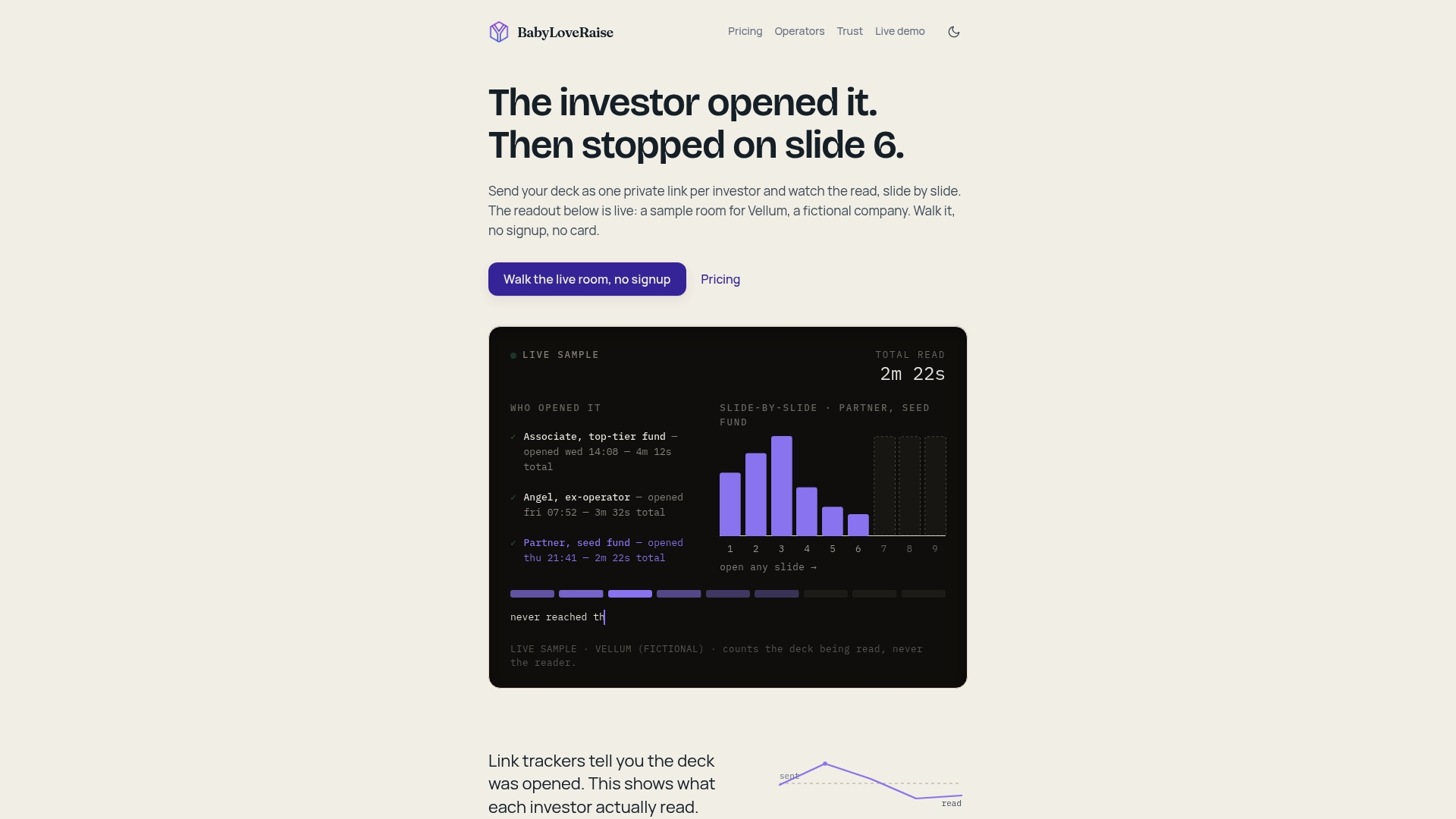
- Tracked links in three registers: first-send, forwardable, and private, so warm intros and cold outreach both stay measurable.
- Per-slide dwell data shows exactly where a deck loses readers, which turns a vague “any feedback?” follow-up into a specific fix.
- Per-raise pricing, starting at a modest monthly or quarterly rate, instead of a permanent per-seat tool you keep paying for after the round closes.
- A free permanent archive once the raise ends, rather than a paywall that locks your own deck away.
Advisory firms and fractional CFOs running multiple client raises can look at the operator console for a white-label version of the same tracking. Check the pricing page to see which room fits your current raise.
Where to read more on outreach and fundraising tactics
- Sequoia on what data points investors scan for first.
- Y Combinator on keeping cold emails short and personal.
- HubSpot on subject-line structure and scheduling links.
- BabyLoveRaise’s pitch deck strategy guide for what to highlight before you hit send.
- For testing subject lines at scale, this email marketing guide covers structure and A/B testing basics that carry over from marketing lists to investor lists.
Sources
- How to present to investors | Sequoia
- How to approach investors | Techstars
- 6 Tips On Writing a Killer Outreach Email to Investors | HubSpot
- How to cold email investors | Y Combinator
FAQ
Should you attach the deck or send a tracked link?
Send a tracked link rather than a raw attachment for the first email. A link lets you see whether the investor opened it and how far they read, information a static PDF never gives you, and it keeps the initial email lighter.
How many follow-up emails is too many?
Three follow-ups spread over three to four weeks is a reasonable ceiling before shifting an unresponsive investor into a periodic update list instead of continued direct asks. Each follow-up should add a new detail rather than repeat the same request.
What should a forwardable intro blurb include?
A forwardable blurb needs a ready-to-use subject line, one line of context on the company, one line of traction, and an explicit ask with suggested meeting times, written so the connector can paste and send it without editing. This removes the extra work that often stops a warm intro from ever going out.
How long should an investor outreach email be?
Keep it to a few short paragraphs: one line on the problem, two bullets on traction and stage, and a direct ask with a scheduling link. Brevity and specific research on the investor matter more than length or polish.
Is it legal to email investors directly about a raise?
Yes, reaching out to describe your company and request a conversation is standard and not itself a regulated act. The compliance questions arise later, when you discuss specific offering terms, so it is worth confirming with a startup attorney how your jurisdiction treats solicitation once real deal terms enter the conversation.