
No Response After Sending Your Deck? Here's What to Do
Not hearing back after sending your deck? Learn how to follow up effectively with tailored strategies that improve your chances.
August 12, 2026 · 13 min read

Getting no response after sending a deck doesn’t mean the answer is no. Send one short follow-up email within 3–5 business days of your initial send, reference something specific from your pitch, and end with a single, narrow ask.
- If you sent cold: wait 3–5 business days, then send one short nudge with a new signal (a metric, a customer win, a press mention).
- If you had a meeting first: follow up within 24–48 hours with a brief recap of what the investor cared about, any promised materials, and one clear next-step question with a specific time window.
- If you’re past day 10 with no open: the problem is likely the hook or deliverability, rather than the deck itself.
Pro Tip: Never open a follow-up with “Just checking in.” It signals you have nothing new to say. Lead with the update, then ask.
Key Takeaways
Getting no response after sending a deck is almost always fixable with a short, signal-driven follow-up cadence and the right diagnostic data before you send anything.
| Point | Details |
|---|---|
| Follow up within 3–5 days | Cold sends need a first follow-up by day 4–5; post-meeting recaps should go within 24–48 hours. |
| Follow-ups drive 44% of replies | In a 53M-email dataset, follow-ups produced roughly 44% of positive replies; the first follow-up alone generated about 26%. |
| Diagnose before you resend | No opens means a hook or deliverability problem; opened with short dwell means a slide-specific proof point is missing. |
| Stop at three cold touches | Two follow-ups plus the initial send is the ceiling for cold outreach; close the loop and re-enter at 60–90 days with a real milestone. |
| BabyLoveRaise separates the two silences | The raise room shows who opened, per-slide attention, and first-read timing so every follow-up targets the right problem. |
Table of Contents
- Run this checklist before you send any follow-up
- Why you probably didn’t hear back: diagnosing the silence
- When to follow up and templates you can send right now
- If email fails: other channels and how to escalate
- When to stop chasing and what to do next
- How tracking and per-slide engagement changes your follow-ups
- How to warm up the conversation before you send the deck
- The part of fundraising silence nobody talks about
- What BabyLoveRaise shows you when silence is ambiguous
- Sources
Run this checklist before you send any follow-up
Wasted follow-ups are worse than no follow-up. A message that bounces, lands in spam, or goes to the wrong person costs you credibility you can’t easily recover. Before you hit send, work through these checks.
Recipient and role
- Confirm you emailed the right person. A general partner at a fund reads differently than an associate. If you sent to an associate, consider whether a GP introduction is possible.
- Check that the email address is current. People move firms. A quick LinkedIn search takes 30 seconds.
- Verify the thread: does your follow-up reply to the original send, or are you starting a fresh thread? Replying keeps context visible.
Technical checks
- Open your deck link on a phone, a tablet, and a desktop browser. A broken link on mobile is invisible to you and fatal to the recipient.
- If you sent an attachment, confirm the file size is under 10 MB. Larger files often trigger spam filters or get silently dropped.
- Check your domain’s email authentication: SPF, DKIM, and DMARC records should all pass. Gmail and other major providers deprioritize unauthenticated senders, and a failed record can route your message to spam before anyone sees it.
Personalization check
- Does the email reference something specific to this recipient? A fund thesis, a portfolio company, a shared connection?
- Is your ask clear? “Let me know your thoughts” is not an ask. “Are you open to a 20-minute call this week or next?” is.
Pro Tip: Paste your deck link into a private browser window and open it on a different device before every send. You’ll catch broken links, login walls, and permission errors that you’d otherwise never see.
Why you probably didn’t hear back: diagnosing the silence
Silence after a deck submission usually has one of six causes. Knowing which one applies changes everything about your next move.
The most common causes
- Wrong recipient or wrong timing. The email reached someone who doesn’t make decisions, or it landed during a blackout period (end of quarter, a fund’s close, a holiday week).
- Spam or deliverability failure. Your message never reached the inbox. No open, no reply, no signal.
- Inbox overload. The email was seen, mentally flagged as “respond later,” and buried. This is the most common cause for warm contacts.
- Low perceived relevance. The subject line or first sentence didn’t connect the pitch to what the investor actually cares about.
- Unclear ask. The deck was interesting but the email ended without a specific next step, so the recipient had no obvious action to take.
- Internal deprioritization. If the meeting or call ended without a clear next step, the opportunity quietly slides down the priority list. Investors rarely give direct feedback; silence often means they didn’t reach internal conviction, not that your team performed poorly.
Reading the signals
The signal you have (or don’t have) tells you which cause is most likely:
- No opens at all: suspect deliverability, wrong recipient, or a hook that failed before the email was opened.
- Opened once, very briefly: the subject line worked but the first paragraph didn’t. The recipient moved on in under 30 seconds.
- Opened multiple times or forwarded: genuine interest, but something stalled internally. This is the case where a follow-up is most likely to convert.
Pro Tip: If your deck link is a plain Google Drive or Dropbox URL, you have no signal at all. You’re flying blind on every follow-up. A tracked link changes that entirely.
When to follow up and templates you can send right now
Follow-up emails account for roughly 44% of positive replies in large cold-email datasets, with the first follow-up alone generating about 26% of replies. That number is the clearest argument for a disciplined cadence over a single send.
Recommended cadence
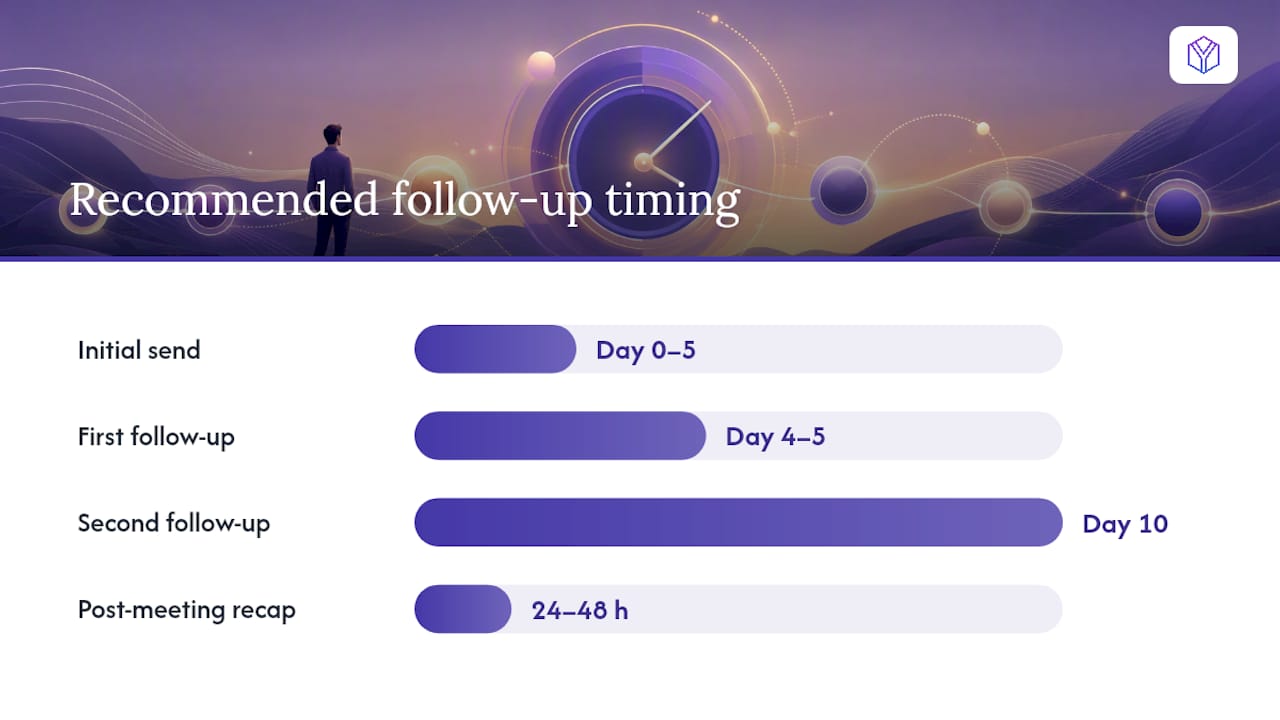
| Touch | Timing | Intent | What to include |
|---|---|---|---|
| Initial send | Day 0–5 | Introduce and pitch | Hook, deck link, one clear ask |
| First follow-up | Day 4–5 | Nudge with new signal | One sentence update, restate ask |
| Second follow-up | Day 10 | Final nudge | Brief, direct, close-the-loop option |
| Post-meeting recap | Within 24–48 hours | Confirm momentum | Recap, deliverables, narrow next step |
Templates
Cold follow-up (first nudge)
Subject: [Company] — quick follow-up
Hi [Name], I sent over our deck last week and wanted to follow up briefly. Since then, we’ve [new signal: signed X customer / hit $Y ARR / closed Z in commitments]. Happy to share the deck if you haven’t had a chance to pull it up. Would a 20-minute call this week work?
Post-meeting recap
Subject: Great talking — next steps
Hi [Name], thanks for the time today. You mentioned [specific thing they cared about] — I’ve attached [promised material]. One question: would it make sense to schedule a follow-up call in the next two weeks to go deeper on [specific topic]?
Value-add update
Subject: [Company] update — [metric or milestone]
Hi [Name], wanted to share a quick update: [one concrete milestone]. Given what you said about [their thesis or concern], I thought this was worth flagging. Still happy to connect if the timing works.
Close-the-loop (no response after two follow-ups)
Subject: Closing the loop on [Company]
Hi [Name], I’ll stop following up after this one. If the timing or fit changes, I’d love to reconnect. Either way, I appreciate you taking a look.
Subject-line options that tend to get opens:
- “[Company] — one quick update”
- “Following up: [specific metric]”
- “Quick question about [Company]”
- “Re: [Company] deck”
Effective follow-ups provide context, remind the recipient of value, and end with a clear CTA. Generic nudges do none of those three things.
Pro Tip: Don’t send a full deck to investors who haven’t replied to your initial email. Offer it on request instead: “Happy to share the deck if helpful.” Attaching unsolicited materials reads as pressure, not confidence.
If email fails: other channels and how to escalate
Two follow-ups with no reply is a signal, not a verdict. Before you move on, try one alternative channel. The key word is one.
Channel decision guide
- LinkedIn: best for cold contacts where you have no mutual connection. Keep the message under 75 words. Reference the email you sent, add one new signal, and ask a yes/no question.
- Warm intro: the highest-conversion channel at any stage. If you have a mutual connection who knows the investor well, a brief, specific intro request (“Could you forward a note to [Name]? We just hit [milestone] and I think it’s a fit for their thesis”) is worth more than three cold follow-ups.
- Voicemail: rarely used, which is exactly why it works occasionally. Keep it under 25 seconds. State your name, company, one sentence on why you’re calling, and a specific callback window.
- Different contact at the same firm: if the associate went quiet, a brief note to the GP (or vice versa) can restart the thread. Frame it as a check-in, not a complaint.
Sample LinkedIn message
Hi [Name], I sent an email last week about [Company] and wanted to follow up here in case it got buried. We just [new signal]. Would a quick call make sense? Happy to keep it to 15 minutes.
Voicemail script
Rules for warm intros
- Ask your connector to make the intro only if they genuinely know the investor and can speak to your work.
- Write the intro email for them. Make it easy to forward.
- Follow up with your connector, not the investor, if you don’t hear back within a week.
Pro Tip: Never use two channels simultaneously on the same contact. Send the LinkedIn message only after the email follow-up has gone unanswered for at least 5 business days. Parallel outreach reads as desperation.
When to stop chasing and what to do next
Three touches is the standard ceiling for cold outreach: the initial send, one follow-up with a new signal, and one close-the-loop message. For warm contacts or post-meeting situations, you can extend to four touches over a 3–4 week window before stopping.
After that, stop. Not because the relationship is over, but because continued chasing actively damages it.
How to structure the close-the-loop message
Keep it short, warm, and free of passive aggression. The goal is to leave the door open, not to guilt the recipient into replying. The template in the previous section works for most situations.
Nurture schedule for long-term re-entry
- 60 days out: send one brief update tied to a real milestone (revenue, a new customer, a press mention). No ask required.
- 90 days out: if the milestone is significant, make a narrow ask again. “We’ve grown X since we last spoke. Would it make sense to reconnect?”
- Ongoing: log the contact in your fundraising CRM with a note on what they cared about, what you promised, and when to re-engage.
What to log in your CRM
- Date of each touch and channel used
- Whether the deck was opened and how far they read
- Any specific objection or question they raised
- The next scheduled re-engagement date
How tracking and per-slide engagement changes your follow-ups
The two silences that look identical from your inbox, “never opened it” and “read everything and passed,” require completely different responses. Treating them the same is one of the most common follow-up mistakes founders make.
The action map
- Never opened: the problem is the hook, the subject line, or deliverability. Don’t resend the same email. Rewrite the first sentence, add a new signal, and consider a different send time (Tuesday through Thursday, 8–10 AM in the recipient’s time zone tends to outperform Monday and Friday sends).
- Opened, short dwell (under 60 seconds): they saw the deck but something in the first few slides didn’t hold attention. Your follow-up should lead with the specific proof that addresses the most likely objection on those early slides: a customer name, a revenue figure, a market size reference.
- Opened, long dwell or multiple sessions: genuine interest stalled somewhere. Your follow-up should make the next step as easy as possible. A narrow ask (“15-minute call this week?”) converts better than a broad one (“let me know if you’d like to chat”).
- Opened and forwarded: someone else inside the firm is looking. Mention in your follow-up that you’re happy to speak with the broader team.
Per-slide dwell data tells you which part of the deck lost the investor, so you can target your follow-up to the exact slide where attention dropped rather than guessing.
Privacy and trust

Tracking that a link was opened is standard and widely accepted. Tracking per-slide attention is more granular. You don’t need to disclose it, but you should never weaponize it (“I can see you spent 45 seconds on slide 7”). Use the data to write a better follow-up, not to make the recipient feel surveilled.
Pro Tip: Set a simple rule: if the deck wasn’t opened within 5 business days, treat it as a deliverability or hook problem and fix both before resending. If it was opened but produced no reply within 3 business days, send the follow-up with a slide-specific proof point.
How to warm up the conversation before you send the deck
The best follow-up strategy starts before the deck goes out. Founders who send a cold deck with no prior contact are starting at the lowest possible conversion point.
Teasers and pre-deck outreach
Send a one-paragraph email before the deck. State the problem you solve, one proof point, and ask if they’d like to see the deck. This creates permission and primes the recipient to open the link when it arrives. It also filters out non-responders before you’ve invested in a full send.
Personalized outreach prior to the deck
Research the investor’s recent portfolio, public statements, or fund thesis. Reference something specific in your first message. “I saw your post on [topic] and it maps directly to what we’re building” converts at a higher rate than a generic intro because it signals you did the work.
Warm-up tactics that work
- Engage with the investor’s LinkedIn content (a genuine comment, not a like) two or three weeks before outreach.
- Get a mutual connection to mention your name in conversation before you email.
- Share a relevant article or data point with no ask attached, then follow up a week later with the pitch.
A well-structured pitch deck still needs a warm entry point. The deck converts the interest; the pre-outreach creates it.
The part of fundraising silence nobody talks about
Silence after sending a deck is treated as a follow-up problem. Most of the advice you’ll find focuses on timing, templates, and cadence. That advice is correct, and it’s also incomplete.
The deeper issue is that most decks are built to inform rather than to create motion. They answer “what do you do?” but not “what happens next?” A deck that ends without a clear ask, a specific round size, and a concrete use of funds gives the investor nothing to act on. Silence is the rational response to a document that doesn’t ask for anything.
Silence is the default for cold outreach; the founders who convert it are usually the ones who sent a second concise follow-up with a new, concrete signal. But the founders who convert at the highest rate are the ones who built motion into the deck itself: a clear ask on the last slide, a specific next step in the cover email, and a follow-up cadence that treats the raise like a sales pipeline.
Three rules worth keeping:
- Treat every send as the start of a sequence, not a single event.
- A follow-up without a new signal is noise. Add one or don’t send it.
- The goal of every touch is one narrow next step, not general interest.
One founder I’ve seen described in fundraising circles changed nothing about their deck but shifted from a single send to a three-touch cadence with milestone updates. Their reply rate on cold outreach roughly doubled. The deck didn’t change. The motion did.
What BabyLoveRaise shows you when silence is ambiguous
The hardest part of getting no reply after sending a deck is not knowing whether the silence means “never saw it” or “saw it and passed.” Those two situations call for completely different responses, and without data, you’re guessing.
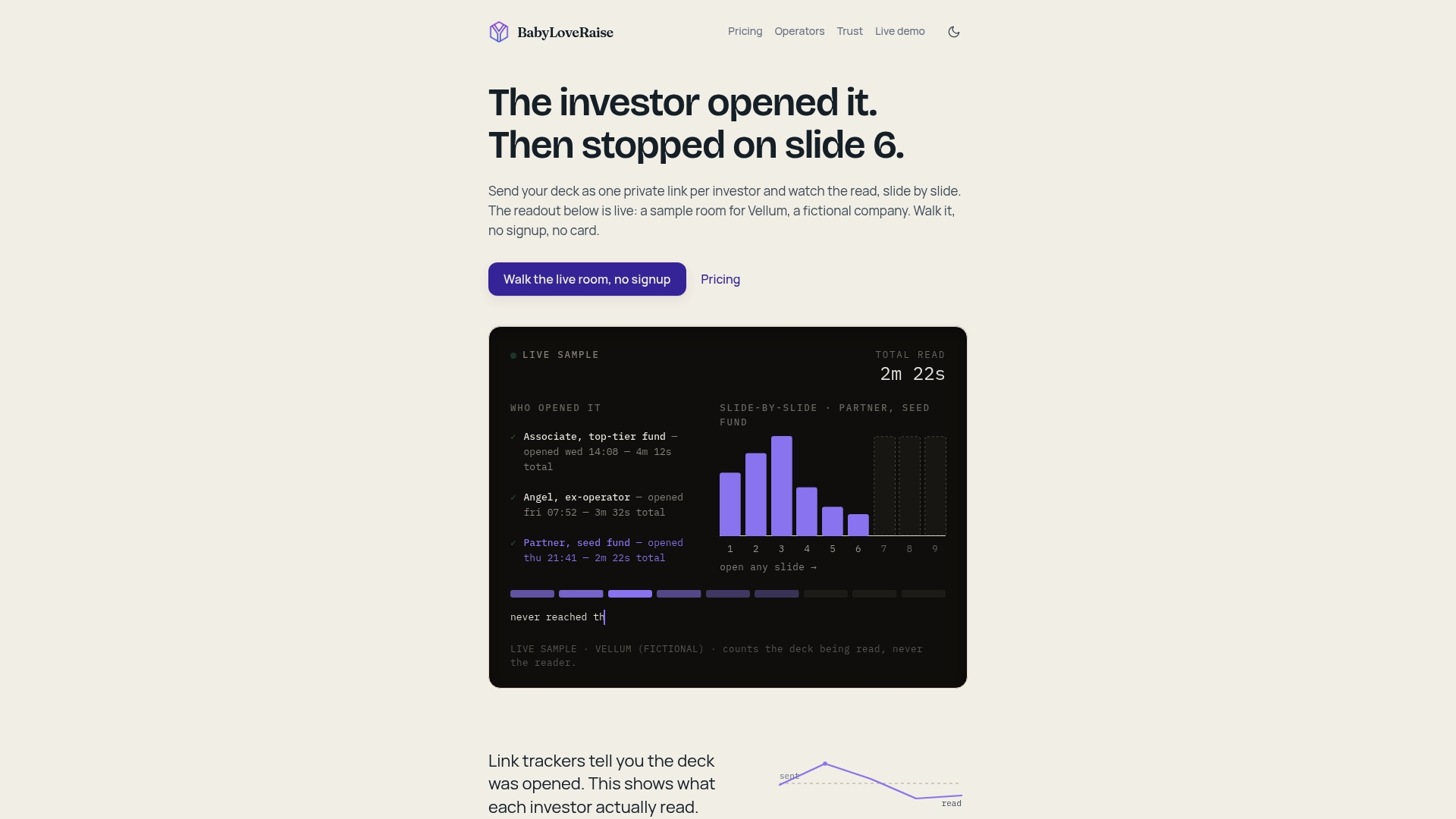
BabyLoveRaise gives founders a hosted raise room that resolves that ambiguity. When you send the room link instead of a PDF or Drive URL, you get a real-time notification on first open, per-slide dwell data showing exactly where attention held and where it dropped, and a dashboard that separates “never opened” from “read to the last slide.” That distinction alone changes which follow-up you send and when.
The platform is priced per raise, not per seat, which means you pay for the raise you’re running, not a recurring subscription that outlasts it. Pre-seed and seed founders get the core tracking and share controls. Fundraising advisory firms and fractional CFOs can run firm-branded rooms across multiple client raises through the Operator tier. For founders who want hands-on help with deck messaging, concierge editorial passes are available.
To see how the raise room works and set up tracking before your next send, visit BabyLoveRaise or read the investor follow-up strategy guide for a deeper walkthrough of cadence and re-engagement tactics.
Sources
- Why Investors Stop Responding After Your Pitch Deck
- Should I Send a Deck to Investors Who Haven’t Responded to My Email?
- ISP deliverability guide: Gmail | Bento