
Founders: One Pager vs Deck, Send One Pager First and Track Slides
Lead with a one pager of about 300 words, send a 9–15 slide deck only after an ask, and use per slide tracking to turn opens into meetings.
September 23, 2026 · 9 min read

Send a one-pager to open the door; save the pitch deck for the meeting it earns. A one-pager runs about 300 words and gets scanned in under two minutes. A deck runs 9 to 15 slides and gets walked through live. Cold outreach gets the one-pager. The deck goes out only after an investor asks for it.
TL;DR:
- Sending a one-pager cold minimizes the risk of overwhelming investors with details, increasing reply rates compared to full decks.
- A one-pager should highlight a strong traction number near the top to catch interest within the first few seconds of scanning.
- Full pitch decks are best reserved for follow-up meetings after initial interest, not for cold outreach, to avoid giving too much surface area for rejection.
- Trackable raise-room links provide insights into whether investors open and read the full deck, guiding more targeted follow-ups.
- Using a simple, inline message with key metrics and a clear ask in the subject line boosts the likelihood of securing a response.
BabyLoveRaisebabyloveraise.comSee Which Slides Hold AttentionShare your raise deck in one room, then see who opened it, reached the last slide, and where attention dropped.Explore BabyLoveRaise
Table of Contents
- One Pager vs Deck: What Job Does Each One Do?
- When Should You Send a One-Pager vs a Deck?
- What Goes in a One-Pager (and in What Order)?
- How Should a Short Pitch Deck Be Structured?
- What Outreach and Formatting Rules Actually Move Reply Rates?
- What Do Per-Slide Analytics Actually Tell You About a Raise?
- The Discipline Behind the Sequence
- How BabyLoveRaise Supports the One-Pager to Deck Sequence
- Sources
- FAQ
One Pager vs Deck: What Job Does Each One Do?
The confusion around one pager vs deck mostly comes from treating them as the same document at different lengths. They’re not. A one-pager is built to survive a 90-second scan and earn a reply. A pitch deck is built to guide a live conversation and hold up when a partner forwards it to the rest of the firm.
Founders who compress a full deck into one page usually end up with dense, unscannable copy that buries the traction. Founders who stretch a one-pager into fifteen slides usually end up with padded, redundant content that says less with more words. Treating them as separate cognitive instruments, not different sizes of the same file, is the correct mental model.
- Job: One-pager earns attention. Deck earns conviction.
- Format: One-pager is a single scannable page, often inline in an email. Deck is a slide sequence meant to be presented or skimmed slide by slide.
- Reading time: One-pager, under two minutes. Deck, roughly 5 to 8 minutes read alone, longer live.
- Main risk: Sending a full deck cold gives an investor too much surface area to find a reason to pass; sending an overstuffed one-pager buries the one number that would have gotten a reply.
When Should You Send a One-Pager vs a Deck?
Match the document to the moment, not to how much material you’ve built.
- Cold outreach, demo day, or a conference handout. Lead with a one-pager or teaser. It’s the fastest way for a stranger to size up your company before deciding whether a meeting is worth their time.
- An investor replies or a meeting gets scheduled. Switch to the short pitch deck. This is the format built for narration, objections, and follow-up questions in real time.
- Diligence and term-sheet conversations. Now the full deck plus a data room or written memo comes into play, with financial models, cap table detail, and reference material the short deck deliberately leaves out.
Sequencing this way isn’t just tidier. Full decks sent cold tend to convert to meetings at a much lower rate than a sharp one-pager does, because a deck cold shows every weakness at once instead of earning the right to explain them.
What Goes in a One-Pager (and in What Order)?
Open with a one-line category and differentiator, then your strongest traction number, before the reader’s eyes drift anywhere else. Everything after that is supporting evidence for a decision the reader is already halfway toward making.
A one-pager that works usually hits seven sections in this order:
- Headline: what you do, in one sentence, plus your category.
- Problem: the pain, stated plainly, no industry jargon.
- Solution: how you solve it, in two or three lines.
- Traction: revenue, growth rate, users, or pilot results. This is the section investors scan first, so put a dominant number near the top, not buried at the bottom.
- Market: size and why now.
- Team: why you three or four are the right people.
- Ask: how much you’re raising and what for.
Keep the whole thing to roughly 300 to 800 words, with generous white space and one or two bold numbers up top that a reader catches without hunting. Skip the PDF attachment on the first email. Put the highlights directly in the message body.
Pro Tip: Templates that lead with a single “kill shot” metric, your best traction number, consistently outperform narrative-first one-pagers in cold outreach. Investors screen for proof before story.
How Should a Short Pitch Deck Be Structured?
A meeting-ready deck runs 9 to 15 slides, paced at roughly 20 to 30 seconds per slide when you’re presenting it live. Anything longer starts fighting the clock instead of the room.
- Cover: company name, one-line pitch.
- Problem: the pain in concrete terms.
- Solution: your product, in plain language.
- Product or demo: a screenshot, a flow, or a short walkthrough.
- Market: size, segment, timing.
- Business model: how you make money.
- Traction: growth, revenue, retention, or pipeline.
- Team: backgrounds that matter to this specific business.
- Financials and ask: burn, runway, raise amount, use of funds.
- Appendix: cap table, detailed financials, customer logos, references, anything a partner might ask about after the meeting.
The appendix and a light data room are where diligence-level detail belongs, not the core narrative slides. Keep the main deck lean; let the appendix do the heavy lifting when someone digs deeper.
Send the deck only once an investor asks for it, and send it as a trackable link rather than a flat PDF. That single choice is the difference between guessing whether anyone read it and knowing exactly which slide lost them.

Pro Tip: If you don’t know your slide order yet, a tested investor-focused slide sequence is a faster starting point than building from scratch.
What Outreach and Formatting Rules Actually Move Reply Rates?
Small formatting choices decide whether your one-pager gets read or archived unopened.
- Put the one-pager text inline in the email body. Attachments add a click, and every extra click loses readers, especially on mobile.
- If you attach anything, keep the file small and PDF-formatted, avoiding formats that require extra permissions requests.
- When an investor says “send the deck,” respond with a trackable raise-room link instead of an untracked attachment, so you can see what actually happens after you hit send.
- Test two or three subject lines that state the traction number or the category directly, rather than a vague “quick intro.”
- Follow up once after 4 to 5 business days. If the message shows as read but unanswered, reference something specific in the deck rather than a generic “just checking in.”
What Do Per-Slide Analytics Actually Tell You About a Raise?
“They didn’t reply” hides three completely different situations: never opened it, opened and dropped off, or read straight through and passed anyway. Each one calls for a different follow-up, and right now most founders can’t tell which they’re dealing with.
- Never opened: the subject line or timing failed, so rework the outreach, not the deck.
- Opened, dropped early: the problem or solution slide isn’t landing, so that’s where you revise first.
- Read through, no reply: the pitch worked; the fit or timing probably didn’t, so a lighter, no-pressure follow-up beats a hard push.
Per-slide engagement analytics turn those three silences into three distinct signals founders can act on, showing which slide holds attention and which one loses it. That’s a sharper diagnostic than gut feeling, and it pairs well with broader content engagement analytics practices used across other high-stakes outreach. A practical flow: send the one-pager, an investor asks for more, you share a tracked raise-room link, then use the engagement data to decide which slide needs an editorial pass before the next send. One courtesy worth keeping in mind: tracking should tell you about the document’s performance, never feel like surveillance of the person reading it.
The Discipline Behind the Sequence
The sequence matters more than either document alone. A one-pager forces you to name your single strongest proof point before you’re allowed to explain anything else, and that constraint makes the deck better too, because by the time you build it you already know what actually persuades a stranger in ninety seconds. Most founders skip this step and go straight to fifty slides. Test the one-pager first. Get it rejected a few times. Then build the deck around whatever line got a reply.
— Paul
How BabyLoveRaise Supports the One-Pager to Deck Sequence
Some services turn your deck send into something you can actually act on instead of a file that disappears into silence. Once an investor asks for the deck, you share a hosted raise room instead of a flat PDF: it notifies you the moment someone opens it and records per-slide engagement, so you know who read to the last slide and which slide lost the room.
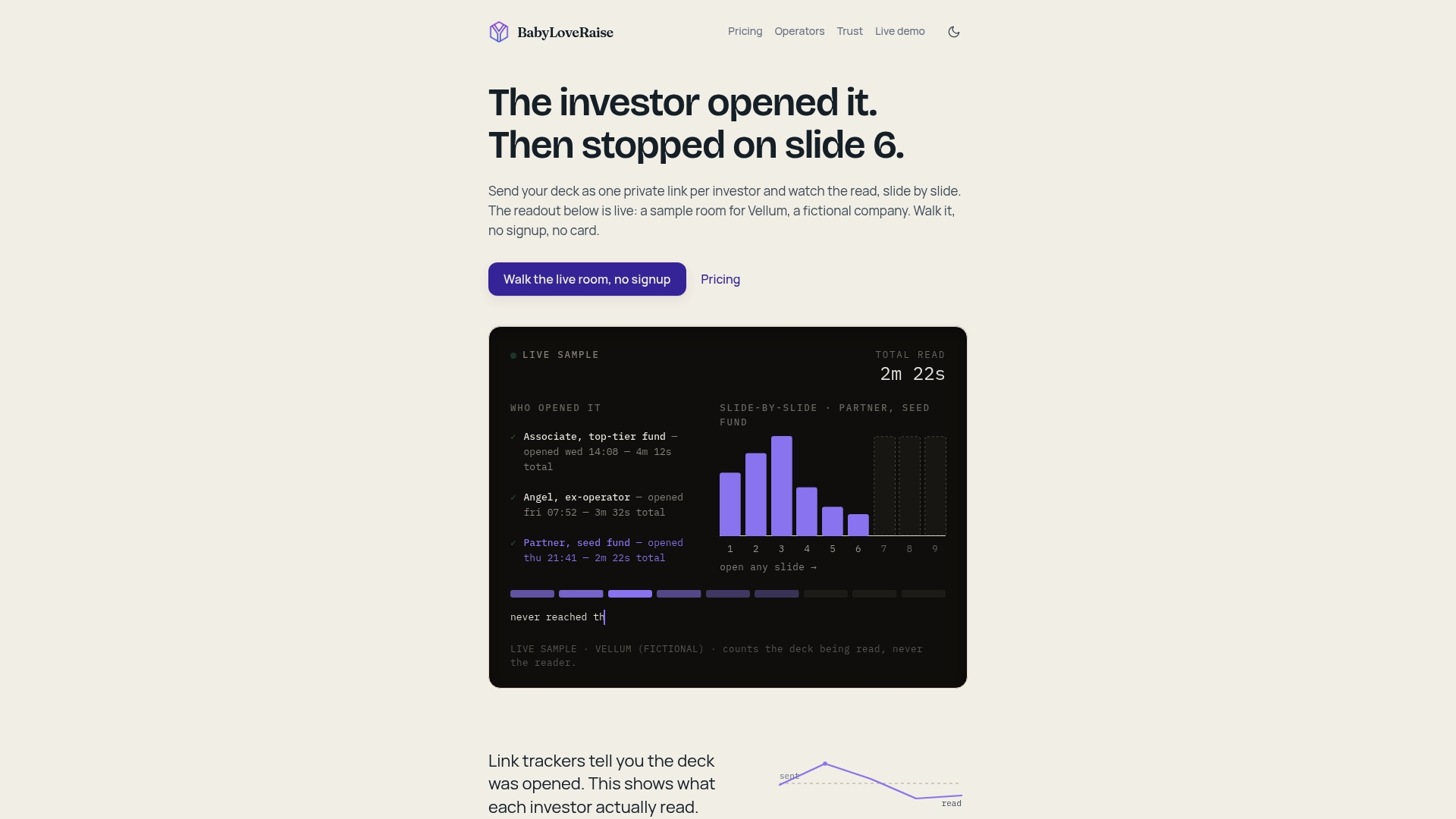
That distinction, between someone who never opened it and someone who read everything and passed, is exactly what generic file sharing can’t tell you, and it’s what turns a guess into a targeted follow-up or a specific slide revision. The raise room is priced per raise, not as a forever per-seat subscription, and when the round closes it converts to a free permanent archive instead of vanishing behind a paywall. Founders who want hands-on help tightening the slides an investor stalled on can add an editorial pass, and advisory firms running multiple client raises can look at the Operator seat for a white-label console across every deck they manage. Check current pricing and start with the raise room for your next send.
Sources
The one-pager length and section guidance in this article draws on the Startups.com Lexicon definition of the format, along with sequencing and practitioner experience from Start-Wise’s investor one-pager template. The comparative framing between opening and persuading documents comes from VentureMage’s breakdown of what investors actually want to see first, and slide-count pacing follows the teaser vs. pitch deck guide referenced above.
- Startups
- Investor one-pager template · Start-Wise
- Pitch Deck One Pager: What Investors Want · VentureMage
FAQ
What Is an Example of a One-Pager?
A typical investor one-pager is a single page with a company headline, a problem and solution summary, a traction metric near the top, market size, team credentials, and a funding ask. It’s built to be scanned in under two minutes, not read like a report.
What Is Another Name for a One-Pager?
It’s often called an executive summary, a teaser, or a one-page investor summary. All three describe the same job: a short, scannable document meant to earn a first meeting rather than close a round.
What Is the 10/20/30 Rule for Pitch Decks?
It’s a well-known shorthand suggesting no more than 10 slides, a 20-minute presentation, and 30-point font. The core idea, keeping a deck short enough to hold live attention, lines up with the 9 to 15 slide range recommended for a meeting-focused deck.
What Does the Term “One-Pager” Mean?
A one-pager is a single-page summary of a startup meant for fast investor screening, distinct from a pitch deck used during live meetings. Its job is to earn a short meeting, not to explain every detail of the business.
How Much Does BabyLoveRaise Cost?
Current plan details and pricing are listed on the BabyLoveRaise pricing page.