
What Is a One Time View Link for Investor Decks?
A one time view link transforms investor decks, providing real-time insights on engagement and ensuring you never guess on follow-ups again.
August 28, 2026 · 8 min read

A one time view link, in the context of fundraising, is a hosted deck link that notifies you the instant an investor opens it and records exactly how they read it, slide by slide. Instead of guessing whether that PDF you emailed last Tuesday vanished into a dead inbox, you know who opened it, whether they finished it, and where their attention dropped. For any founder running a pre-seed or seed raise, that single change, from silence to signal, is worth adopting immediately.
TL;DR:
- Repeat opens, especially on financial or ask slides, are strong signals of investor diligence and potential interest.
- Tracking time spent to the end of the deck indicates deeper engagement, which predicts a higher chance of future conversation.
- Using personalized, non-gated, first-send links with clear next steps maximizes open rates and timely follow-up actions.
- Closing the raise and archiving engagement data ensures future reference and continuous improvement in outreach strategies.
- Maintaining document-focused privacy practices builds trust while allowing effective tracking of investor engagement.
Table of Contents
- How Do One Time View Links Work Inside a Raise Room?
- Which Engagement Signals Actually Predict Investor Momentum?
- How Do You Create and Send a One Time View Link?
- How Do You Interpret Engagement Signals and Follow Up Effectively?
- What Privacy Practices Should You Follow With Investor Tracking?
- Why BabyLoveRaise Is Built for This Exact Workflow
- A Founder’s Take: Why Signal Beats Guesswork Every Time
- Turn Every Deck Send Into a Working Signal With BabyLoveRaise
- Sources
How Do One Time View Links Work Inside a Raise Room?
A hosted link behaves nothing like a PDF attachment. Once a deck lives in a raise room instead of an inbox, every open becomes a data point instead of a guess, and that persistence is the whole game: the link survives across sessions, so a second look three days later shows up as a second look, not a mystery.
The mechanics break down into a few distinct layers:
- First-read notification: the moment an investor opens the link for the first time, you get an alert, which is the trigger for warm follow-up rather than a cold check-in later.
- Per-slide dwell tracking: the room logs time spent per slide and flags the last slide read, so a stall on slide 4 (usually the team slide) reads very differently from finishing all 14.
- Three link registers: a first-send link tied to one recipient, a forwardable link built for syndication, and a private link for advisors reviewing before it goes external, each with its own tracking guarantee.
- Measured watermarking and download controls: downloads can carry a visible, timestamped watermark, which discourages casual leaks without forcing a login wall on the initial view.
Presentation-tracking tools generally confirm this pattern: tracking data on opens, repeat views, and per-slide time is what turns a static send into something you can actually act on.
Which Engagement Signals Actually Predict Investor Momentum?
Not every open means the same thing, and treating them equally is how founders waste follow-up energy on the wrong investors. A single open with no return visit usually means “filed for later.” A second open, especially one that lands on the financials or the ask slide, means someone is actually deciding.
Three signals matter more than the rest:
- Repeat opens. An investor who comes back a second time is doing internal diligence, often before a partner meeting.
- Read-to-end. Finishing the deck correlates far more with genuine interest than a quick three-slide skim ever does.
- Dwell on financials or the ask. Time spent there beats time spent anywhere else as a predictor of a real conversation coming next.
Per-investor identification beats a generic view counter because it tells you who, not just how many. Tracked links tied to an investor database close that loop; a raw hit counter never will. Keep the link frictionless, too. Gated logins on a first send tend to suppress opens before an investor has any reason to trust you yet.
Pro Tip: Treat a first read as a 48 to 72 hour warm window. If nothing happens by then, the deck probably needs a rewrite before it needs a reminder email.
How Do You Create and Send a One Time View Link?
A raise room only produces useful signal when you set it up with intent, not as an afterthought. The workflow below is what most founders should follow from first upload to post-raise archive.
- Upload a teaser deck, not your full financial model. The standard fundraising sequence runs teaser deck → full deck → financial model → data room for diligence, and a teaser deck of around a dozen slides is the right weight for a first send.
- Choose the right register. Mint a unique first-send link for each investor you’re contacting directly; use a forwardable link only when you expect (and want) a partner to circulate it inside their firm.
- Add a clear next step on the link page itself, usually a meeting scheduler, so a warm read converts into a booked call without an extra email round-trip.
- Log every send in your CRM and connect first-read alerts to a follow-up rule, so a notification triggers action instead of sitting in a Slack channel unread.
- Archive the room once the raise closes. BabyLoveRaise converts a closed raise into a permanent free archive rather than cutting access off behind a paywall, so your engagement history stays intact.
A few practical notes worth keeping in mind:
- Private links for internal or advisor review should never go external. Mixing that register with your outreach links muddies your data.
- Watermarked downloads matter more once you’re past first contact and sharing with a partner’s team.
- Don’t skip the CRM step. Real-time open notifications only pay off when someone is watching for them and acts fast.
How Do You Interpret Engagement Signals and Follow Up Effectively?
Raw engagement data is useless without a rule that turns it into an action. Build a simple triage matrix: cross opens, recency, dwell time, and forwards, and let that combination tell you who gets a message today versus who waits.
A workable prioritization looks like this:
- First read, no repeat, under 60 seconds total: log it, wait. Don’t message yet.
- Second read within a week, or read-to-end on the first pass: send a short, specific note referencing the slide they lingered on.
- Forwarded to a new viewer: treat that as a warm introduction opportunity, not just a metric.
- No open at all after 5 to 7 days: the problem is likely targeting or subject line, not the deck itself.
That last point matters more than founders give it credit for: a deck that never gets opened isn’t a content problem yet, it’s an outreach problem. Fix the intro or to send, then worry about slide 9.
Keep follow-up messages short and tied to the actual signal from shared documents. “Saw you spent time on our unit economics slide, happy to walk through the model if useful” reads as attentive, not desperate, because it references something real.
Pro Tip: Set the exact rule in advance: first read triggers a 48 to 72 hour wait, a second read or read-to-end triggers a same-day meeting request. Deciding this before the raise starts keeps you from second-guessing every ping.
Advisors running several client raises at once should aggregate this across the portfolio rather than per founder, watching which decks and which slides underperform across multiple companies to spot patterns in messaging, not just in individual investor behavior.
What Privacy Practices Should You Follow With Investor Tracking?
Engagement tracking works because it stays document-focused, not person-focused. Recording opens, dwell time, and forwards on a deck is fundamentally different from building a profile of an individual investor’s browsing habits, and blurring that line erodes trust fast.
A few rules worth setting from day one:
- Skip login gates on the first send; save gating for diligence-stage materials, not the teaser.
- Use watermarking to deter casual leaks, not as a surveillance tool.
- Track the document, never the person, and say so if an investor asks.
- Archive engagement history after the raise closes rather than deleting it, since it’s useful context for future rounds.
Why BabyLoveRaise Is Built for This Exact Workflow
BabyLoveRaise runs the entire pattern above natively instead of bolting tracking onto a generic file share. Its raise rooms send first-read notifications, log per-slide attention, and support all three link registers, first send, forwardable, and private, out of the box. Downloads carry a measured watermark, and when a raise closes the room becomes a permanent, free archive instead of hitting a paywall.
The Track Google Slides Views guide walks through the mechanics of per-slide attention data in practice, and the platform’s Demo Day Deck Analytics extend the same logic to cohort-wide investor tracking. Fractional CFOs and advisory firms running several client raises can use the Operator tier for white-labeled, firm-branded rooms, with optional editorial passes for founders who want help tightening the deck itself before it ever reaches an inbox.
A Founder’s Take: Why Signal Beats Guesswork Every Time
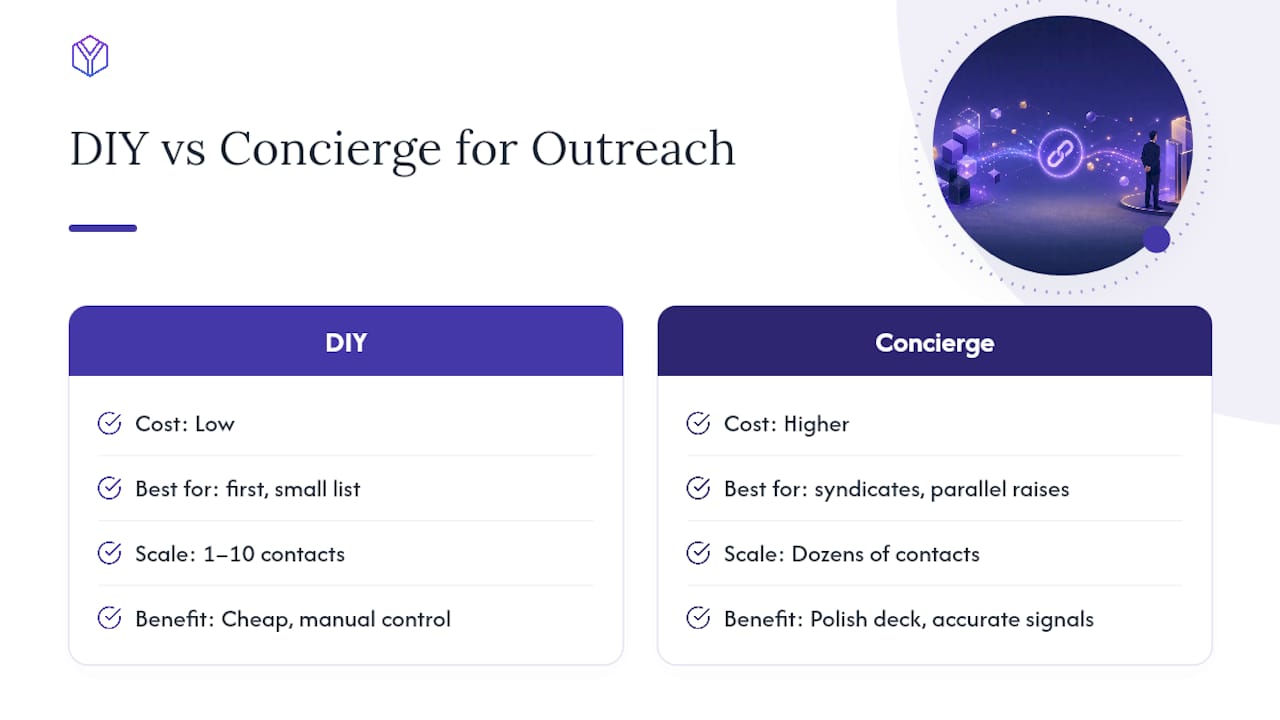
Most founders spend fundraising energy on the wrong problem: writing more follow-up emails instead of writing fewer, better-targeted ones. Signal-driven outreach flips that. When you know a partner read to the last slide twice, your third email writes itself, and you stop wasting time chasing investors who never opened the deck at all.
The DIY route works fine for a first raise with a short investor list. Once you’re running parallel client raises or a syndicate with dozens of contacts, the concierge and editorial options earn their cost fast, mostly by keeping the deck itself sharp enough that the analytics have something worth measuring.
— Paul
Turn Every Deck Send Into a Working Signal With BabyLoveRaise
BabyLoveRaise replaces the guessing game of emailed PDFs with a raise room built specifically for fundraising: first-read alerts, per-slide dwell tracking, and three link registers that match how you actually work with investors, from a cold first send to a forwarded intro inside a fund.
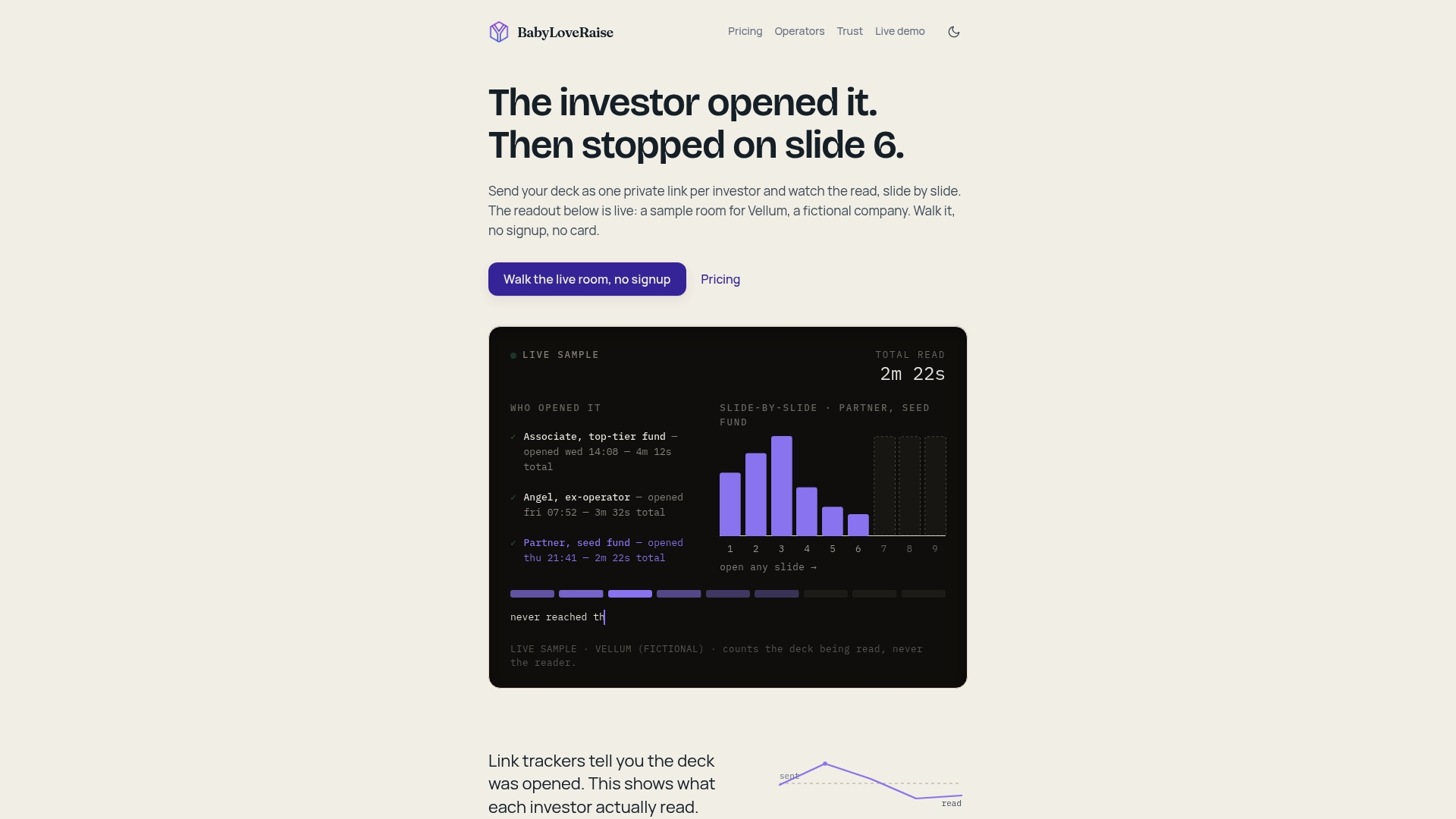
For fundraising advisors and fractional CFOs juggling several client raises at once, the Operator tier gives you firm-branded rooms across every client without paying for a full enterprise data room license. And unlike tools that cut off access the moment your round closes, BabyLoveRaise converts a finished raise into a permanent archive at no cost, so the engagement history you built stays useful for your next round too. Start your raise room and send your first tracked link at BabyLoveRaise.
Sources
- How to Share and Track Fundraising Materials With Investors
- Best Data Room & Pitch Deck Tools for Fundraising (2026) | Round Funded
- How to Know If Someone Opened Your Pitch Deck: Presentation Tracking Tools — PitchBoost