
Founders: Set Per Slide Privacy Friendly Deck Analytics in 48 Hours
Founders: set per raise, per slide privacy friendly deck analytics in 48 hours to meet FTC and NIST guidance and protect investor data.
September 24, 2026 · 9 min read

Use a privacy-preserving, per-raise room that reports per-slide engagement without building long-lived recipient profiles. That’s the approach that satisfies both sides of the problem: founders get a real signal on who opened the deck, who finished it, and where attention dropped, while investors never get tracked, retargeted, or logged into some cross-deal profile. BabyLoveRaise is built around exactly that model, and it’s the standard the rest of this guide measures against.
TL;DR:
- Privacy-friendly analytics should log only document-specific engagement, such as slides viewed and time spent, without building cross-raise profiles on investors.
- Using pseudonymized tokens and automated data deletion helps prevent surveillance and ensures data cannot be reconnected to individual identities after the raise.
- Vendors must be evaluated based on privacy controls like data minimization, transparency, and scope limits before choosing a platform for fundraise analytics.
- Clear, simple disclosures are essential to meet FTC expectations, with no hidden trackers or vague privacy notices, especially in confidential or regulated contexts.
- The recommended raise room costs $149 monthly, supports multiple link types and watermarking, and offers special pricing for firms managing several client raises.
BabyLoveRaiseSee Where Your Deck Holds AttentionBabyLoveRaise gives founders a privacy-friendly raise room with first-read alerts and per-slide engagement analytics for investor follow-ups.Explore BabyLoveRaise
Table of Contents
- What Counts as Privacy Friendly Analytics in a Fundraise?
- How Do Privacy-Preserving Metrics Avoid Surveillance?
- Which Vendor Checks Matter Before You Send a Deck?
- What Should You Do in the Next 48 Hours?
- A Founder’s Case for Privacy-First Deck Analytics
- Get a Raise Room That Actually Respects Both Sides
- Sources
- FAQ
What Counts as Privacy Friendly Analytics in a Fundraise?
Privacy friendly analytics, in a fundraising context, means the sender learns document-level engagement, not the recipient’s identity or behavior outside the deck. This is a different problem than privacy friendly web analytics tools like cookie-less site trackers. Nobody sending a pitch deck cares about page views on a marketing site. They care about whether Slide 9 (the one with the go-to-market numbers) is where every investor stops reading.
Three technical patterns show up across the market, and each one trades granularity for privacy risk differently.
Per-raise first-party tracking. The raise room itself, not a third-party pixel, logs the events: first open, time on each slide, last slide reached. Because the room only exists for this raise, there’s no cross-deal history being built. Outputs look like “opened Tuesday at 4:12 PM, read to Slide 11, spent 40 seconds on the market-size slide.” That’s the pattern BabyLoveRaise’s per-slide analytics runs on.
Firms managing a broad angel list sometimes prefer this for early, wide-net sends.
Consent-first tracking. In more sensitive fundraising contexts, such as regulated industries or raises involving personal financial disclosures, the sender asks for affirmative agreement before any tracking starts. This is the safest legal posture but adds friction to the send.
The trade-off is straightforward: per-raise first-party tracking gives you the most actionable, individual-level signal with the lowest legal exposure, provided it stays document-scoped and disclosed. Aggregated metrics are safer still but weaker for follow-up. Consent-first tracking is the right call whenever the deck touches anything an investor would reasonably expect to stay confidential beyond just “did you read this.”

How Do Privacy-Preserving Metrics Avoid Surveillance?
The distinction between “analytics” and “surveillance” comes down to scope and retention, not the presence of tracking itself. A raise room that logs an open event is not surveilling anyone. A tool that feeds that same open event into an ad network, or keeps building a profile on that investor across every deck they’ve ever viewed from any client, is doing something categorically different. The NIST Privacy Framework calls the fix data minimization and disassociated processing. Collect only what the raise needs, and structure the system so that data can’t easily be recombined into a person-level profile once the raise is over.
Here’s what that actually looks like in a document-sharing product:
- Pseudonymized or ephemeral tokens. The room assigns a link-specific identifier rather than tying engagement to an email address or a persistent cookie, so “opened” and “finished” events report on the document, not a tracked individual across other contexts.
- Retention limits with automated deletion. Engagement logs expire or get purged on a schedule instead of living forever in a vendor’s database, which is the same retention principle the NIST framework treats as a baseline control.
- Share-link registers. A first-send link, a forwardable link, and a private link each carry different tracking behavior, so the sender knows exactly what’s being measured before it goes out.
- Measured watermarking. A visible or embedded watermark on downloads deters leakage without adding any additional tracking layer to the recipient’s device.
Pro Tip: Ask any vendor point-blank what happens to engagement data 90 days after your raise closes. If they can’t give you a retention answer, assume the data lives forever, which is the opposite of data minimization.
These controls map directly onto what the FTC has flagged as risky: third-party pixels and general-purpose analytics alternatives that quietly ship confidential engagement data to ad-tech vendors. A first-party raise room never has that pipe to begin with.
Which Vendor Checks Matter Before You Send a Deck?
Before sending a single link, run the provider through five categories. This isn’t paranoia. It’s the same logic NIST recommends: convert privacy outcomes into a checklist you can actually score a vendor against, rather than trusting a marketing page.
- Privacy engineering. Does the system minimize data collection, pseudonymize identifiers, and enforce a retention window with automatic deletion?
- Use limitation. Is engagement data used strictly for this raise, or does the vendor reserve rights to use it for advertising, benchmarking, or resale?
- Transparency. Is there a plain-language disclosure the recipient sees before opening the deck, and is consent affirmative rather than buried in a terms page?
- Controls. Can you choose between first-send, forwardable, and private link types, and does the platform support measured watermarking on downloads?
- Commercial fit. Does pricing scale with a single raise, or are you locked into a perpetual per-seat contract that outlives the fundraise itself?
The FTC’s guidance on confidential contexts is blunt about the transparency piece: hidden trackers that contradict a stated privacy promise are exactly the kind of behind-the-scenes behavior that draws enforcement attention. A vendor that can’t articulate its disclosure language in one sentence probably hasn’t thought about this hard enough.
On commercial fit, advisory firms running multiple client raises have a specific problem general document tools don’t solve well. Per-raise pricing and white-label Operator tiers exist because a fractional CFO managing five client raises simultaneously needs a cost structure tied to the deliverable, a closed raise, not five separate perpetual licenses.
What Should You Do in the Next 48 Hours?
Turn the checklist above into action before your next send. Here’s the sequence that actually works:
- Pick your link type per recipient tier. First-send links for your primary target list, forwardable links for warm intros you expect to get passed along, private links for anyone getting a one-off, non-reusable send.
- Set your watermark and retention window. Decide now whether downloads get a measured watermark and how long engagement logs persist after the raise closes.
- Write a one-line disclosure. Something as simple as “We track when this deck is opened and read to help us prioritize follow-ups” covers the affirmative-consent bar the FTC has emphasized in confidential-context cases.
- Build your follow-up trigger rules. First-read notification with no finish after 48 hours means a light nudge. A finished-flag with heavy dwell on the financials slide means a warm call, not an email.
- Document opt-out requests. If a recipient asks you to stop tracking or delete their engagement data, honor it and keep a simple record that you did. This is the paper trail that matters if anyone ever asks.
- Archive the summary, not the surveillance. When the raise closes, keep anonymized aggregate learnings (which slides worked) rather than an identifiable log of who did what.
Pro Tip: The “never opened it” and “read everything and passed” outcomes look identical from a founder’s inbox. A raise room that distinguishes them, the way BabyLoveRaise’s per-slide tracking does, turns two dead ends into two different next actions.
A Founder’s Case for Privacy-First Deck Analytics

Investors talk to each other. A founder who tracks opens responsibly, discloses it plainly, and never repurposes the data builds a reputation that outlasts any single raise. One who runs a hidden pixel and gets caught loses more than a meeting, they lose the intro chain behind it.
The mistake I see founders make most often isn’t under-tracking, it’s vague disclosure paired with over-collection: grabbing IP addresses, device fingerprints, or browsing history nobody asked for, while burying the fact in fine print nobody reads. That combination is precisely what FTC enforcement around confidential-context tracking targets. The fix isn’t to stop measuring. It’s to measure only what changes your next move: did they finish, and where did they stall. A dwell spike on your competition slide tells you to rewrite that slide. A stall right after your ask tells you the number itself needs work. Everything else is noise dressed up as insight.
— Paul
Get a Raise Room That Actually Respects Both Sides
One alternative to blind emailing a PDF or a Drive link and hoping for a reply uses one link to indicate who’s actually reading, without turning your investor list into a surveillance target. The raise room notifies the sender the moment someone opens the deck, tracks which slides hold attention versus get skimmed, and flags who read to the end, all inside a single owner dashboard that turns “silence” into two distinct, actionable states.
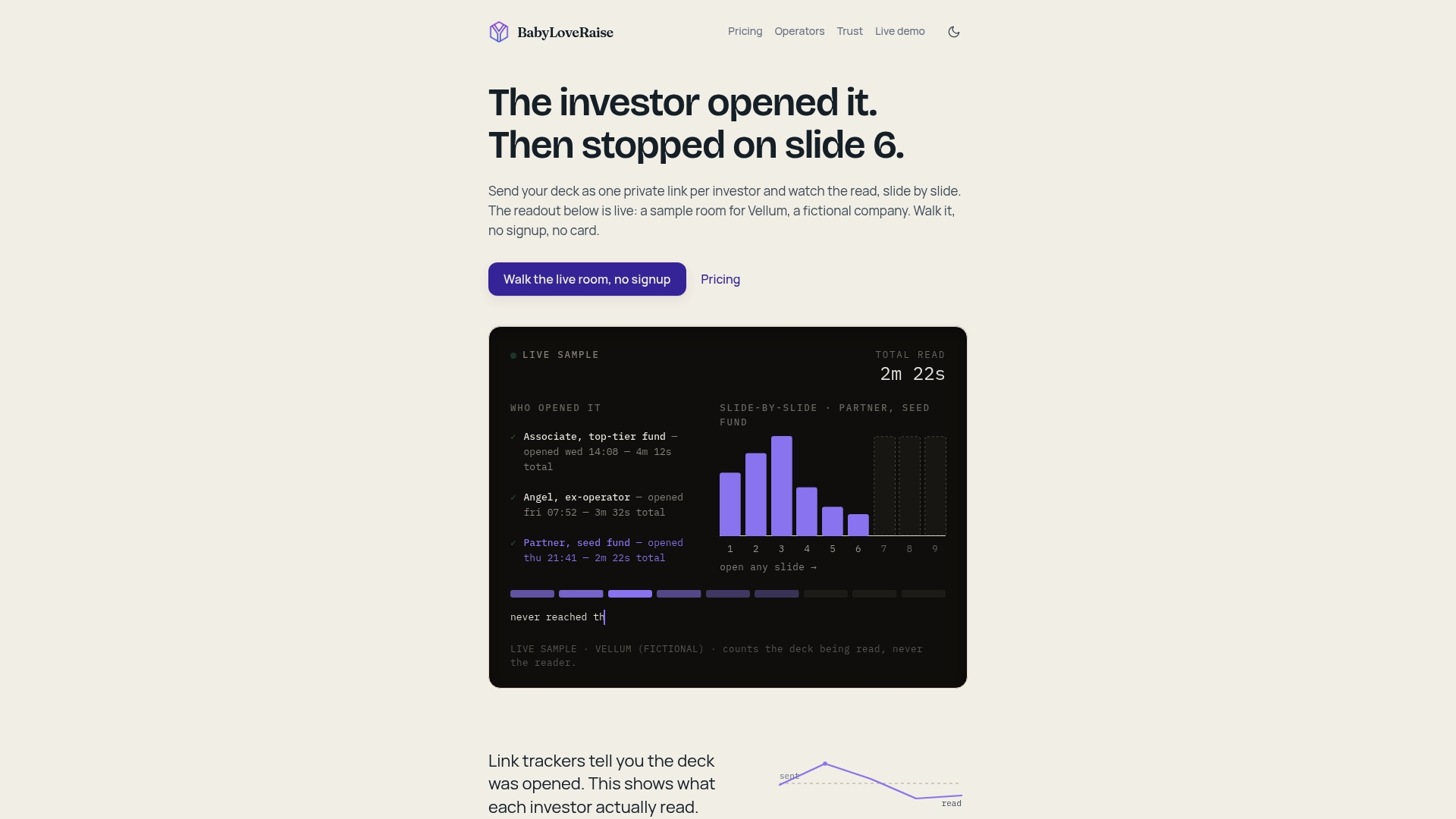
Every send comes with three link types (first send, forwardable, private), measured watermarking on downloads, and a retention model built around one raise, not a permanent profile. Pricing runs $149 per month or $399 per quarter for the raise room itself, and fundraising advisors managing multiple client raises can run firm-branded rooms through an Operator seat at $399 per month or $3,990 per year per seat. Founders who want editorial help before they send can add the editorial pass, priced on request. Check current availability and start a room on the pricing page today.
FAQ
What Is Privacy Friendly Analytics for Pitch Decks?
It’s a tracking approach that reports document-level engagement, who opened a deck, who finished it, and which slides held attention, without building a persistent profile of the recipient outside that raise. BabyLoveRaise’s per-slide engagement tracking is built specifically around this model.
Do I Need Investor Consent to Track Deck Opens?
You need a clear, affirmative disclosure whenever tracking happens in a context recipients would reasonably expect to stay confidential, per FTC guidance. A one-line notice in your send message stating that opens are tracked to prioritize follow-up generally satisfies this.
How Is This Different From Web Analytics Tools?
Web analytics tools measure site visitors across sessions and pages. Fundraising-specific analytics measure a single document’s engagement inside a single raise, with no cross-site tracking and, ideally, no persistent recipient identifier at all.
What Should a Privacy Disclosure Say?
Keep it to one sentence: state what’s tracked (opens, time on slide, completion) and why (to prioritize follow-up), and mention that the data isn’t used for anything beyond the raise. That framing lines up with the transparency practices the FTC has flagged in confidential-context cases.
How Much Does a Privacy-First Raise Room Cost?
BabyLoveRaise’s raise room runs $149 per month or $399 per quarter, and advisory firms running multiple client raises can use an Operator seat at $399 per month or $3,990 per year. The editorial pass add-on is priced on request through the same pricing page.