
Stop Leaks and Close Faster: Private Pitch Deck Links for Founders
Use per investor access controlled pitch deck links to prevent leaks, track per slide engagement, and follow up within 24 hours. Includes FTC aligned...
October 6, 2026 · 11 min read

The fastest way to protect your pitch deck and actually learn from it is to share it through an access-controlled, trackable link, sent as a separate link per investor, with a follow-up rule tied to what happens after they open it. Create one controlled link today, then set a rule: if it gets a second view, follow up within 24 hours. BabyLoveRaise and the FTC’s small-business cybersecurity guidance both point to the same underlying logic: a deck is safer and more useful as a monitored link than as an email attachment.
TL;DR:
- Tracking investor engagement through per-investor links provides clear signals about interest, especially when combined with follow-up within 24 hours of second views.
- Using access controls like passwords, expirations, disabled downloads, and watermarks helps protect sensitive information while maintaining visibility on who accesses the deck.
- Preparing a lightweight, mobile-friendly deck with a clear opening summary and tested links ensures quick load times and effective communication.
- Building a workflow with tiered access—cold outreach, partner sharing, deep diligence—aligns security measures with investor intent and prevents version drift.
- A dedicated fundraising platform automates tracking and security controls, reducing manual effort and improving oversight during active capital raises.
BabyLoveRaisebabyloveraise.comKnow How Investors Read Your DeckSend one raise room link, see who opens and finishes your deck, and focus follow-ups on the investors who actually engaged.Visit BabyLoveRaise
Table of Contents
- Which private link method fits your raise
- Get your deck ready before you send the link
- Build a sharing and follow-up workflow
- Security checklist and FTC-aligned practices
- How a raise room covers this checklist automatically
- Common pitfalls when sharing a deck by link
- How to customize access for different investor groups
- Legal considerations when sharing a deck by link
- What founders get wrong about sharing their deck
- Try a raise room built for this exact workflow
- FAQ
- Sources
Which private link method fits your raise
Not every link does the same job. Some protect the file, some report on the reader, and most do a partial version of both.
- View-only viewers embed the deck in a browser window so investors never download a native file, which limits forwarding but usually gives you only basic open data.
- Passworded or expiring links add a gate and a shelf life. These suit early outreach when you are still vetting who gets to see the full plan.
- Tracked viewers log opens, time on each slide, and repeat visits, turning the deck into a feedback source rather than a one-way send.
- Watermarked downloads stamp the recipient’s name or email on any PDF they save, which discourages casual reforwarding without blocking the download outright.
- Self-hosted links (a file on your own domain or Drive folder) are the easiest to set up but offer the weakest controls and almost no analytics.
For a cold first outreach, a passworded, expiring, tracked link is the safer default. Once an investor is deep in diligence and asking for a downloadable copy, a measured watermark is a reasonable trade: you lose some control but keep a record of who has the file. According to FTC guidance on small-business cybersecurity, access-controlled links that support passwords, expiration, and disabled downloads are a core defense against sensitive documents circulating beyond their intended audience.
Get your deck ready before you send the link
A link only works as well as the file behind it. Run through this before your first send:
- Pick a slide viewer over a flat PDF when you want per-slide analytics; a static file tells you it was opened, not what held attention.
- Trim the file, embed or use web-safe fonts, and cut heavy video or animation that slows load time on a phone connection.
- Open with a one-slide summary, naming the ask and the headline traction number, so a skimming investor still gets the point.
- Test every link and embed from a separate device before sending, including any demo video or data-room cross-link.
A deck that loads slowly or breaks on mobile costs you the investor’s attention before they reach slide two.
Build a sharing and follow-up workflow
Treat each investor as a separate link, not a shared one. A first-send link goes out cold and is easy to revoke if the conversation stalls. A forwardable link suits an investor who wants to loop in a partner. A private link, tied to one email and non-forwardable, fits later-stage diligence where confidentiality matters more. Per-investor links solve a real problem: without them, “never opened it” and “read it twice and went quiet” look identical from your side.
- First open tells you the email cut through; no open after 48 hours usually means a subject-line or timing problem, not disinterest yet.
- Completion through the last slide signals real engagement worth a same-day follow-up.
- Per-slide dwell time flags which section slowed the reader down, often the traction or financial slides.
- Rereads days after the first open often precede a partner meeting or term sheet discussion.
Pro Tip: Send your follow-up within a few hours of a tracked reread. Rereads cluster right before internal investor discussions, and your timing can land you in that conversation.
Our guide to tracking investor engagement walks through reading these signals slide by slide.
Security checklist and FTC-aligned practices
A few habits cut most of the risk that comes with sharing anything investor-facing by link.
- Require a password and set a short expiry window, and disable downloads by default, re-enabling them only for investors in active diligence.
- Apply a measured watermark to any download you do allow, so a leaked copy can still be traced to its source.
- Set up SPF, DKIM, and DMARC on your sending domain. The FTC’s phishing guidance recommends these authentication records specifically to cut down on spoofed emails impersonating your outreach.
- Keep distribution lists short, revoke access the moment a conversation goes cold, and keep one canonical version of the deck instead of five emailed copies floating around.
A professional, access-controlled link also does quiet work for your brand. A clean, password-protected link signals organizational discipline in a way a bulky, unprotected attachment never does, and it costs the investor nothing in extra friction — and you can polish your deck branding with pitch-ready logos for investment banking to enhance that professional impression.
SPF, DKIM, and DMARC are the same three records the FTC recommends configuring to help your domain resist spoofing, and they alert you when someone tries to impersonate your outreach. For step-by-step setup on the link side, our access control walkthrough covers passwords, expiry, and download toggles in one pass.
How a raise room covers this checklist automatically
A room built specifically for fundraising folds most of the checklist above into the product itself. Per-slide analytics and first-read alerts replace manual link-checking. Three link registers, first-send, forwardable, and private, map directly to the per-investor workflow above. Downloads carry a measured watermark, pricing runs per raise instead of per seat, and the room converts to a free permanent archive once the raise closes instead of hitting a paywall. The tracking stays document-level rather than investor profiling: it reports what happened to the file, not a dossier on the reader. Ad-hoc link sharing is fine for a handful of warm intros; once you are sending to a real list of investors, a dedicated room removes the manual tracking work.
Common pitfalls when sharing a deck by link
The most common mistake is sending the same link to every investor and then losing track of who did what. Without per-investor links, two very different outcomes, total silence and a thorough read followed by a pass, look exactly alike in your inbox.
A second pitfall is locking the deck down so hard it becomes a liability of a different kind: no analytics, downloads disabled with no exception path, and a password sent in a separate email that gets lost. If an investor cannot open the file within a minute, many will not ask twice.
Version drift causes real damage too. A founder updates the deck after an investor call, then forwards a new link instead of updating the one already in that investor’s inbox, so two versions circulate and the numbers no longer match in later conversations.
Expiration settings cause their own friction. A link set to expire in 48 hours can lock out a partner meeting scheduled for next week, so match expiry windows to your actual outreach cadence, not an arbitrary default. Finally, watch your email deliverability: a link in a cold email from an unauthenticated domain is more likely to land in spam, which is part of why the FTC’s phishing guidance treats sender authentication as a baseline, not an extra.

How to customize access for different investor groups
Not every investor needs the same level of access. A useful default is to tier it by stage of conversation.
Cold outreach to a long list of angels or scouts calls for first-send links: passworded, short expiry, downloads off, and easy to revoke in bulk if your plans change. Investors who respond and ask for a second look can move to a forwardable link, since they may want a partner’s opinion before a first call, and the forwarding itself is a useful engagement signal.
Once a fund enters real diligence, switch to a private, non-forwardable link tied to that specific email, with downloads enabled and watermarked so a saved copy still traces back to its source. Syndicate or group rounds benefit from a shared forwardable link with a longer expiry, since multiple people at the same fund often review a deck together. The common thread: tighter access should track higher investor intent and deeper diligence, not the other way around, and every tier should still log opens and slide-level engagement so you keep a read on interest regardless of how locked down the link is.

Legal considerations when sharing a deck by link
A pitch deck often contains information a founder would rather not see in a competitor’s inbox: revenue figures, customer names, cap table details, and sometimes aggregated personal data about users. Treat it with the same discipline the FTC’s guidance on peer-to-peer and business file sharing applies to any uncontrolled file distribution: limit who receives a copy, track where copies exist, and avoid folders or tools with weak default permissions.
If your deck includes any customer or user data, check that sharing it does not conflict with your own privacy policy or any data processing agreements you have signed. A non-disclosure agreement before sharing financial detail is common practice at some firms, though many investors decline to sign one before a first look, so do not let that requirement stall early outreach. Keep a simple internal log of who received which link and when access was revoked. That record matters if a leak ever needs tracing, and it also makes due diligence faster later, since you can show a clean chain of custody for sensitive figures rather than reconstructing it from memory.
What founders get wrong about sharing their deck
The most common mistake is mass-attaching a PDF to a dozen emails and hoping for replies, with zero visibility into who opened anything. A close second is following up on a fixed schedule instead of a read signal, which means chasing cold leads while a genuinely engaged investor goes quiet because nobody reached out when their interest peaked.
Keep the first view short enough to respect the investor’s time, send a separate link per investor, and let per-slide dwell data tell you which section of the story is not landing yet. Guesswork is the expensive option. A disciplined, data-driven follow-up habit, built on actual read signals rather than a calendar reminder, consistently beats sending the same reminder email to everyone on the list.
— Paul
Try a raise room built for this exact workflow
We built BabyLoveRaise around the workflow above because a pitch deck during an active raise behaves nothing like a normal shared file: it needs per-investor links, honest read signals, and a way to tell a skim from a close read.
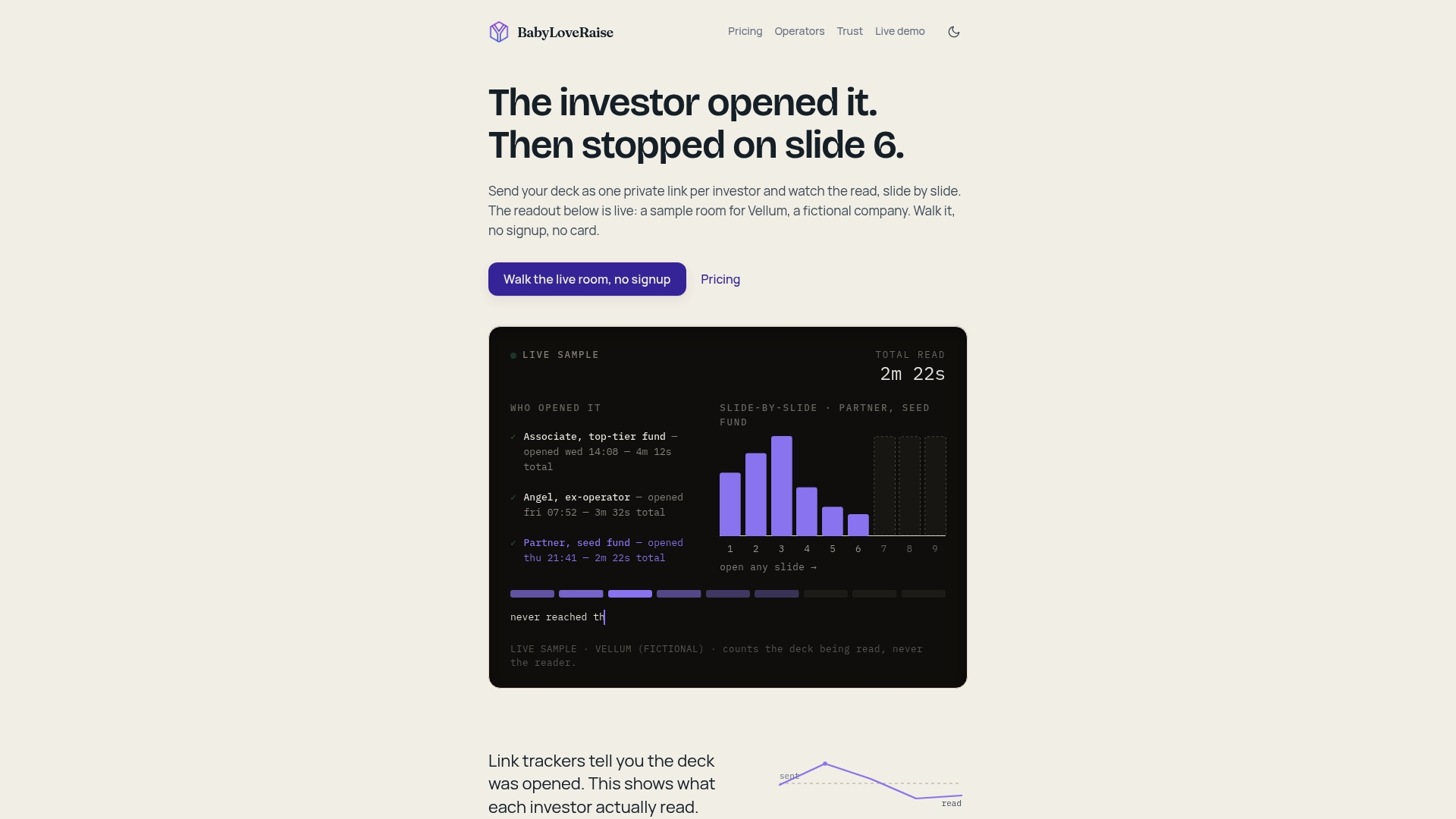
- The raise room gives you per-slide analytics, first-read alerts, and three link registers (first-send, forwardable, private) for $149 per month or $399 per quarter.
- Downloads carry a measured watermark, and when your raise closes the room becomes a free permanent archive instead of hitting a paywall.
- Advisory firms and fractional CFOs running several client raises can run firm-branded rooms through an Operator seat; current prices are on the operators page.
See current plans and what is included on our pricing page, or start a room directly at BabyLoveRaise.
FAQ
What is a private pitch deck link?
A private pitch deck link is a controlled-access URL, usually passworded or tied to a specific email, that lets an investor view a deck without receiving a downloadable file by default. It typically logs opens and, on more purpose-built platforms, per-slide engagement so the sender can see how the deck was actually read.
How do I send a pitch deck securely to investors?
Send each investor a separate access-controlled link rather than one shared link or a plain email attachment, and enable a password, a reasonable expiry window, and disabled downloads as your default setting. The FTC recommends these exact controls for sharing sensitive business documents.
What should I do if an investor hasn’t opened my deck?
If a tracked link shows no open after 48 hours, the issue is usually the email itself rather than disinterest, so try a different subject line, a shorter note, or a direct follow-up through a mutual connection. Check that your sending domain has SPF, DKIM, and DMARC configured, since an unauthenticated domain can land your email in spam before it is ever opened.
Can investors forward my private pitch deck link?
It depends on the link type: a first-send or private link is typically non-forwardable and tied to one recipient, while a forwardable link is meant to be shared, often so a partner at the same fund can review it. Choosing the right type upfront avoids the ambiguity of not knowing whether a second viewer is a new lead or the same investor’s colleague.
Does BabyLoveRaise track investors personally?
BabyLoveRaise reports on the document rather than building a profile of the reader: it tracks opens, per-slide dwell, and completion for a given link without compiling a persistent record about the investor as a person. That document-level approach is covered in more detail on our trust page.