
Expiring Deck Links That Track Who Reads Every Slide for Founders
Server enforced, per recipient expiring deck links that keep analytics, watermarked files, and per slide tracking. Start with a 24–48 hour initial window.
September 9, 2026 · 8 min read

An expiring deck link automatically cuts off access at a set time, after a fixed number of views, or once the first open triggers a countdown. For investor decks, the safer model is server-enforced expiry paired with per-recipient links, which preserves accurate attribution and closes the access window fast. Industry practice increasingly favors this combination over a single shared link, and platforms like BabyLoveRaise build the entire raise workflow around it.
TL;DR:
- Using server-enforced expiry with unique links provides better attribution and faster access control compared to shared links or client-side timers.
- Date/time expiry is ideal for strict deadlines, while click limits and first-open TTL offer flexible exposure caps regardless of open times.
- Implementing per-investor unique links with tiered expiry and passcodes enhances security during diligence stages, especially with sensitive financial data.
- Archiving or expiring links without deletion preserves engagement data, which is crucial for both legal review and historical analysis.
- BabyLoveRaise’s platform automates expiry, tracking, watermarking, and access control, reducing manual effort and improving security during fundraising.
BabyLoveRaiseTrack Investor Deck Engagement ClearlyBabyLoveRaise gives founders a hosted raise room with first-read notifications and per-slide engagement tracking for every shared deck.Explore BabyLoveRaise
Table of Contents
- How Expiring Links Work: Date, Click, and Unique-Per-Recipient Modes
- Security Tradeoffs: Why Server-Enforced Expiry Matters for Investor Decks
- Practical Controls Founders Should Enable When Sharing Deck Links
- Step-by-Step: Set Up, Share, Monitor, and Expire a Deck Link
- Operational Concerns: Preservation, Reactivation, and What Stops Logging
- Fundraising Templates: Matching Expiry Patterns to Each Stage
- How Our Raise Rooms Handle Expiring Links
- Get Server-Enforced Expiring Links Without Building the Infrastructure Yourself
- Sources
How Expiring Links Work: Date, Click, and Unique-Per-Recipient Modes
Three expiry mechanics dominate deck sharing, and each one solves a different problem.
- Date/time expiry shuts the link off at a fixed calendar moment, useful for a diligence window with a hard deadline.
- Click-count or view-limit expiry kills the link after a set number of opens, which caps exposure regardless of when someone opens it.
- First-open TTL starts a countdown the moment the recipient opens the link, so an unopened link stays valid indefinitely until someone actually clicks it.
The bigger decision isn’t which timer to use. It’s whether you send one shared link to your whole investor list or a unique link per recipient. OpenVC’s documentation on unique deck links recommends generating a separate tracking link for every investor in your CRM, specifically to avoid the attribution mess that comes from one floating URL passed around a partner meeting.
What happens after expiry matters too. Most platforms let you set a custom expired-message page, a redirect to a contact form, or simple instructions to request renewed access. Pitch’s link management docs show this configured at the link level, alongside passcodes and per-link analytics, so you’re not stuck with a generic “link expired” dead end.
Security Tradeoffs: Why Server-Enforced Expiry Matters for Investor Decks
Client-side expiry, the kind built into free HTML link generators, checks the visitor’s own device clock to decide whether a link is still valid. The problem is structural: the real destination URL sits in the page source the whole time, and anyone who inspects the page or resets their system clock can bypass the timer entirely. Flyn’s own documentation on its expiring link generator is upfront that this approach fits low-stakes uses like event pages, not sensitive documents.
Server-enforced expiry works differently. The destination stays hidden until the server checks the request against its own rules, which means it can enforce click limits, passcodes, and identity checks that no amount of client-side tampering will defeat.
Statistic Callout: Server-side authentication systems commonly issue short-lived access tokens rather than permanent links. Deck’s Auth SDK documentation describes link tokens built with short time-to-live windows and one-time use as a standard pattern for reducing how long an intercepted token stays useful.
Pro Tip: Set your first-send window short, often 24 to 48 hours, then extend it manually once you confirm the right person opened the deck. A brief initial window costs you nothing if the investor is responsive, and it caps your exposure if the link gets forwarded somewhere you didn’t intend.
Practical Controls Founders Should Enable When Sharing Deck Links
Every control below reduces leak risk without making investors jump through hoops that kill momentum.
- Per-investor unique links with either one-time access or a click limit, so you know exactly who opened what.
- Date-based windows layered on top of click limits, giving you two independent triggers instead of relying on just one.
- Passcodes for diligence-stage access, and identity verification if you’re sharing financials or cap table detail beyond the standard deck.
- Watermarked downloads stamped with the recipient’s name or email, disabled downloads where the deck is view-only, and basic screenshot mitigation for slides with sensitive figures.
- Clear extend/revoke rules, with a default of letting the link expire and archiving the room rather than deleting it outright.
That last point matters more than founders expect. Revoking access mid-raise without warning reads as distrust to an investor who’s still actively reading. Expiring on schedule and archiving quietly does the same job without the awkward message. BabyLoveRaise’s access control guidance walks through combining these settings without over-engineering the investor’s experience.
Pro Tip: Reserve identity verification for finalist-stage diligence only. Adding it to a cold outreach link is the fastest way to make a busy investor abandon your deck before they’ve even seen slide one.
Step-by-Step: Set Up, Share, Monitor, and Expire a Deck Link
Run through this sequence the first time you send a link during an active raise.
- Prepare the deck. Finalize the version you’re sending, decide whether downloads should be watermarked or disabled entirely, and confirm the narrative and slide order are ready for outside eyes.
- Choose link mode and expiry parameters. Pick unique-per-recipient for tracked outreach or a forwardable link for something like a demo day audience, then set a date, a click limit, or a first-open TTL depending on the scenario.
- Share with a short message that includes any passcode or portal instructions, so the investor isn’t confused when a security prompt appears.
- Monitor opens and slide-by-slide engagement as responses come in. This is where you separate investors who genuinely read the deck from ones who never opened it.
- Extend or revoke based on what you see. A finalist who’s read every slide twice earns an extended window. A link that’s gone silent for two weeks can quietly expire.
- Export or archive engagement logs before the link deactivates if your process requires a record of who accessed what and when, particularly useful heading into legal or diligence review.
Operational Concerns: Preservation, Reactivation, and What Stops Logging
Expiry and deletion are not the same action, and mixing them up costs founders real data.
- Confirm whether your platform deletes analytics when a link expires or simply archives the room. FileDeck’s documentation on document expiry shows expiry hiding a document from libraries and disabling its download endpoint while the file itself stays on the server, ready to reactivate without a new URL.
- Tracking typically stops the moment a link expires, so export engagement data before deactivation if you need it for follow-up notes or an investor update.
- Some platforms preserve engagement logs through reactivation and keep the same link history intact. Confirm this behavior before you rely on it for a raise that might stretch over several months.
- For recordkeeping, prefer archiving the raise room over deleting the link object outright. An archived room with intact logs is useful reference material during a later round; a deleted link leaves you with nothing. BabyLoveRaise’s notes on deck version control cover how this plays out across multiple raise cycles.
Fundraising Templates: Matching Expiry Patterns to Each Stage
Different stages of a raise call for different expiry logic, not one setting applied everywhere.
- Cold outreach: short windows, often a few days, with click limits rather than pure date expiry so a forwarded link doesn’t spread unchecked through a fund’s partner list.
- Diligence: per-investor unique links with a longer TTL for finalists, plus identity verification once the conversation moves past a first read.
- Post-close: convert the room to a read-only archive with analytics preserved, useful for reference during a future round or when a new team member needs deck history.
Each pattern trades a little friction for a lot of control, and the right one depends entirely on how far along the conversation is.
How Our Raise Rooms Handle Expiring Links
BabyLoveRaise tracks who opened the deck, how long they spent on each slide, and issues measured watermark downloads instead of blanket restrictions that annoy legitimate readers. Share links come in three registers, so the expiry logic matches the actual risk of each send. The result is fewer wasted follow-ups. You stop guessing who read the deck and start knowing, which changes what you say in the next email entirely.
— Paul
Get Server-Enforced Expiring Links Without Building the Infrastructure Yourself
A raise room is provided instead of a bare file link, so every expiry rule discussed above, per-recipient tracking, click limits, watermark downloads, is already built into how the room works rather than something configured from scratch.
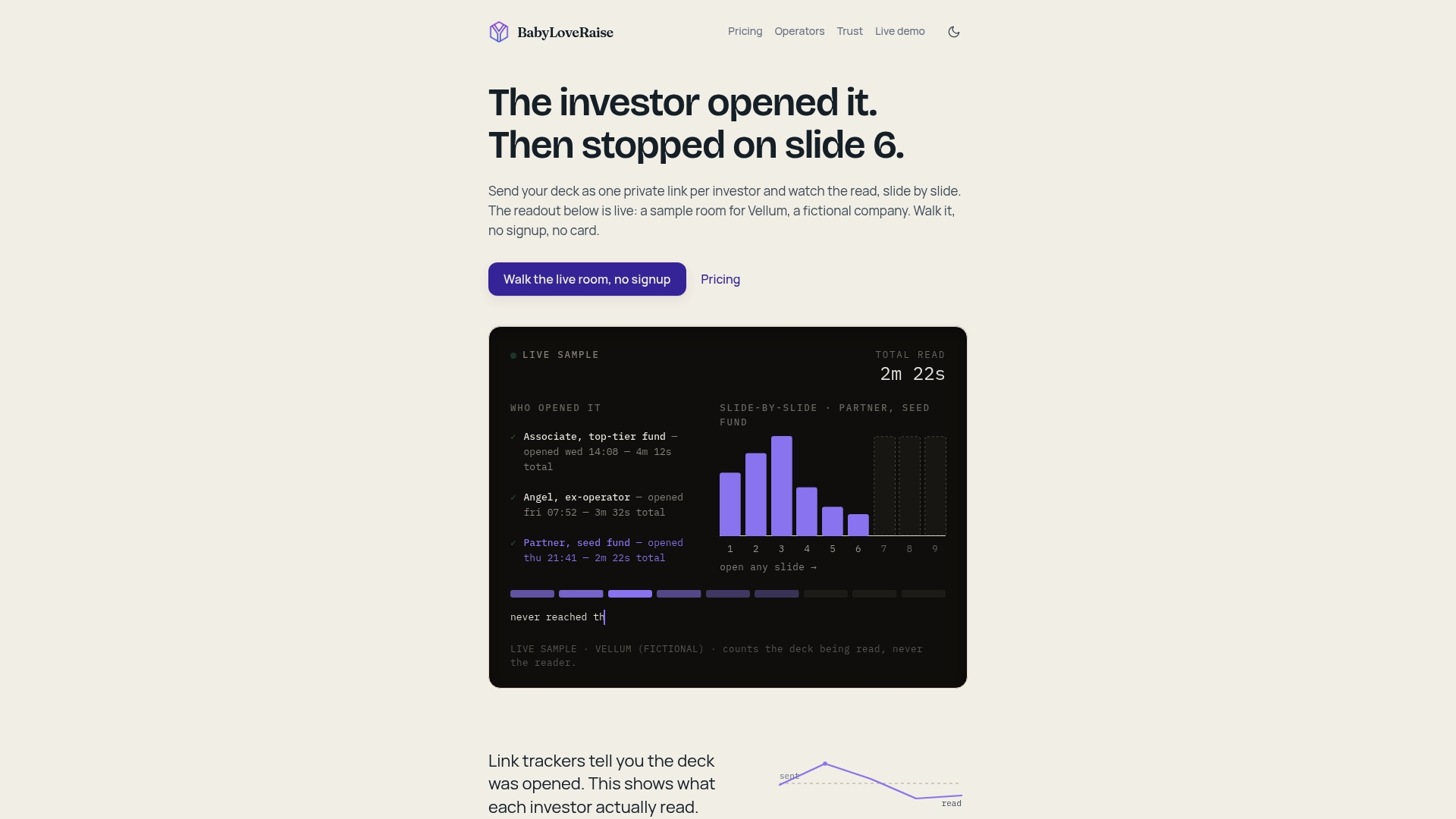
The room notifies you the moment an investor opens the deck and logs per-slide attention, so you can tell the difference between “never opened it” and “read every slide and passed.” Downloads carry a measured watermark instead of blanket lockdowns, and when the raise closes, the room converts to a free permanent archive rather than disappearing behind a paywall. Fundraising advisors and fractional CFOs running multiple client raises can use a white-label Operator tier to keep every room on-brand. If you’re about to send your deck to a new batch of investors, set up a raise room on BabyLoveRaise before that next email goes out, and check the access control walkthrough for the specific settings covered here.
Sources
- Create a unique deck link | OpenVC Help Docs
- Free Expiring Link Generator | Flyn
- Set an expiry date on a document – FileDeck
- Share an external link to your presentation | Pitch Help Center