
Reply Within Hours: Read Receipt Etiquette for Founders
Use reopens, downloads, and per-slide dwell to time investor follow-ups: reply within hours after a second signal, nudge at 1 week, and stop after 2 weeks.
September 4, 2026 · 11 min read

Follow up when you see a reopen, a download, a forwarded link (a new viewer at the same firm), or multiple viewers from one firm. Message within a few hours of that second meaningful event. If none of those happen, send one gentle nudge around a week out, then let it go two weeks after the last recorded view.
TL;DR:
- Reopens are strong indicators of internal discussion and should be responded to within hours, especially if combined with a read-through past 50 percent.
- Downloads, though rare, have outsized predictive value and warrant follow-up on the same day if the deck is likely entering internal review.
- Tracking should utilize per-recipient links, avoid attaching static PDFs, and include a clickable call to action to generate high-quality signals.
- Observing where viewers linger or leave during per-slide dwell analysis can reveal content leaks and guide deck improvements.
- Maintaining a scaled, routed workflow for alerts ensures quick, relevant responses without overreacting to noise or privacy concerns.
Table of Contents
- What Is Read Receipt Etiquette for a Pitch Deck?
- What Engagement Events Actually Mean
- When and How to Follow Up
- Setting Up Shares and Tracking That Actually Work
- How to Read Per-Slide Engagement and Fix the Deck
- Privacy and Etiquette: What to Say and What to Skip
- What Read Receipts Are and Why They Exist
- Where Read Receipts Show Up During a Raise
- Handling Privacy Concerns Without Losing the Signal
- An Advisor’s Workflow for Managing Multiple Raises
- How BabyLoveRaise Handles the Timing for You
- Sources
What Is Read Receipt Etiquette for a Pitch Deck?
Read receipt etiquette in fundraising means knowing which engagement signals justify a message and which ones you should quietly ignore. It is a narrower, higher-stakes version of the read receipt etiquette people practice in text messages: you can see something happened, but acting on it too fast or too literally reads as intrusive rather than sharp.
For founders and fractional CFOs running a raise, this isn’t about turning read receipts on or off in a messaging app. It’s about interpreting a stream of document tracking events, first open, reopen, download, forward, and per-slide dwell, and deciding which ones earn a reply. Get the read wrong and you either chase investors who already passed, or you sit silent while a partner meeting gets scheduled without you.
The purpose of tracking a pitch deck is not surveillance. It’s timing. A raise is a short window where the difference between a warm lead and a dead one is often just a few hours of response speed. Read receipts exist so you spend that speed on the right person, not on everyone who glanced at slide one.
What Engagement Events Actually Mean
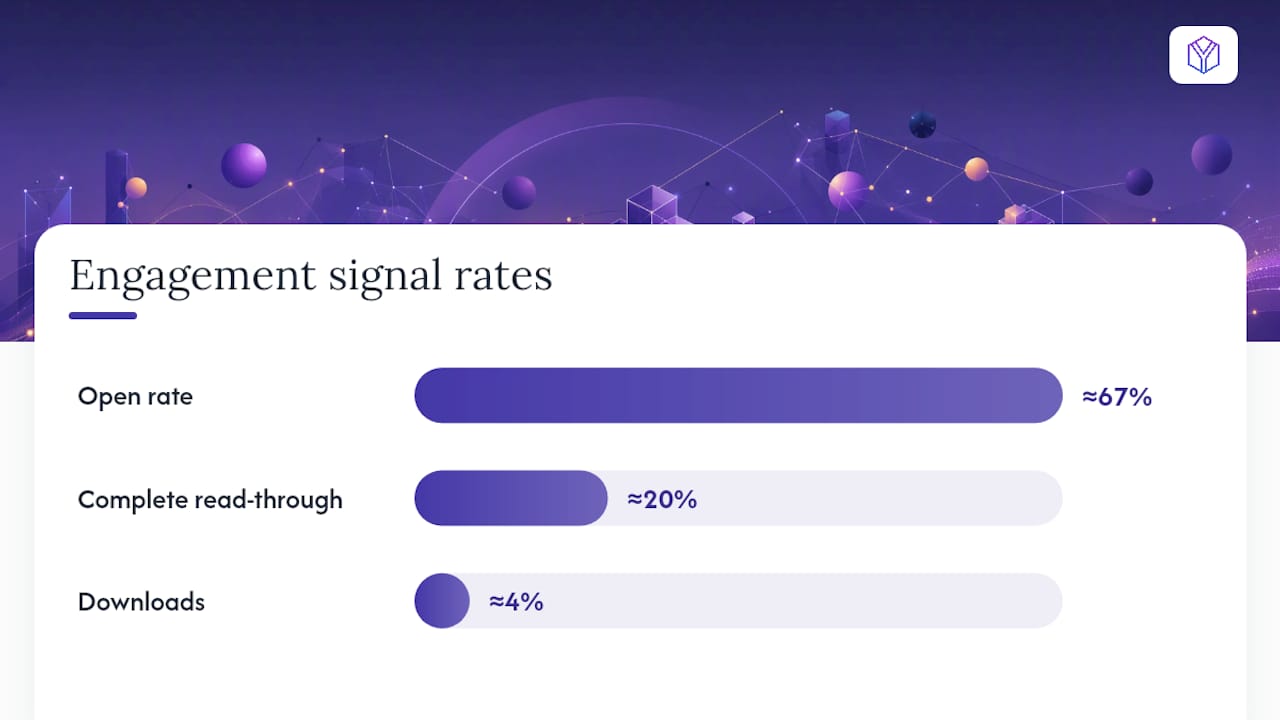
Not every open is created equal, and treating them all the same is the fastest way to waste a follow-up on nobody. A first open is often just a polite scan, someone clearing their inbox. A reopen is different: someone came back on purpose, and that pattern correlates with internal discussion at the firm roughly 26.5% of the time, based on a dataset of 24,541 tracked decks.
Downloads are rarer and heavier. People don’t download decks to skim them later. They download decks to hand them to someone else.
Signal strength at a glance: across a benchmark of investor reading sessions, open rate is approximately two-thirds, complete read-through is around one-fifth, and typical qualified sessions run 2 minutes 40 seconds to 4 minutes 10 seconds. Downloads sit at roughly 4%, but carry outsized weight as a predictor of next steps.
A simple tier system keeps you from overreacting to noise:
- Hot: download, forward to a new viewer, or multiple viewers from the same firm
- Warm: a reopen combined with a read-through past 50%
- Cold: one short open under 30 seconds, no return visit
Per-slide dwell adds the last layer. Where someone lingers, and where they bail, tells you more than the open count ever will.
When and How to Follow Up
Timing beats calendar habits here. Chasing on the second meaningful event, a reopen, a new viewer, or a download, works better than waiting a fixed number of days, and tying outreach to behavior rather than a rigid schedule tends to produce higher-quality replies than a generic check-in ever does.
- Reopen or new viewer detected: reply within a few hours. Reference the content area they revisited, not the exact time they spent there.
- Download recorded: treat it as a near-certain sign the deck is moving into internal review. Follow up the same day if possible.
- No engagement at all after about a week: send one low-pressure reminder. Keep it short.
- No activity two weeks past the last recorded view: stop chasing. Move that lead to cold and put your energy elsewhere.
Four short templates cover most situations:
- Reopen-triggered: “Saw you took another look, happy to walk through the unit economics slide if useful.”
- Multiple-viewer prompt: “Looks like a few folks on your team pulled up the deck, want to grab 20 minutes with the group?”
- Low-engagement nudge: “Following up in case this got buried, let me know if a quick call would help.”
- Unopened final touch: “Closing out this round soon, wanted to check if now’s still a good time to connect.”
Pro Tip: Never mention exact dwell time in a message. “I noticed you spent 47 seconds on slide 6” sounds like you’re reading over their shoulder. “I saw you went back to the traction numbers” sounds like you’re paying attention.
Setting Up Shares and Tracking That Actually Work
Bad tracking setup ruins good etiquette instincts. If you can’t trust the data, you can’t time anything.
- Use per-recipient or tiered links instead of one shared URL, so you can tell who forwarded what to whom.
- Never attach the PDF alongside a tracked link. Attachments get opened directly and erase the tracking signal entirely, which means you lose the exact data you built the whole workflow around.
- Add a measured watermark to any downloadable version, so a leaked copy is traceable.
- Keep one live call-to-action inside the deck itself, a demo link, a live metrics dashboard, something clickable that generates its own signal.
- Set alerts for reopens, downloads, and new viewers from the same firm domain. Those three events matter more than raw view counts ever will.
| Setup choice | Why it matters | Signal it protects |
|---|---|---|
| Per-recipient links | Identifies forwarding and new viewers at the same firm | Multiple-viewer detection |
| No PDF attachment | Keeps analytics intact instead of routing around them | Open, reopen, and dwell tracking |
| Measured watermark on downloads | Traces leaked or forwarded copies | Download attribution |
| Live CTA inside the deck | Generates a separate, high-intent click signal | Buyer intent beyond passive reading |
Version control matters too. Keep every update behind the same link rather than sending a new one each time you revise a slide, or you’ll fragment your own data and lose the ability to compare reads over time.
How to Read Per-Slide Engagement and Fix the Deck
Per-slide dwell is the most underused signal in a raise. Most founders check whether the deck got opened and stop there. The real information is in where people slow down, and where they leave.
If your traction data earns reopen behavior, that’s a strong argument for moving a one-slide traction snapshot to pages 2 or 3, then expanding the detail later in the deck. Investors tend to scan first and jump back to metrics on a second pass, so putting the headline number early gives that habit somewhere useful to land.
If a cluster of viewers consistently drops off at the same slide, that slide is a leak, not a coincidence. Fix it three ways: tighten the copy, swap a dense table for a chart, or move the underlying claim earlier so it doesn’t depend on someone reaching slide 11 to understand why you’re worth funding.
A basic hygiene checklist keeps the deck from working against you:
- 10 to 15 slides total, not 30
- 3 to 5 lines of text per slide, maximum
- Explicit, declarative slide titles instead of vague labels
- One clear call to action on the final slide
It’s your pacing. Slides 1 through 4 are doing too much work before the reader has decided to stay.
Privacy and Etiquette: What to Say and What to Skip
The line between attentive and creepy is thinner than most founders think, and it’s easy to cross without meaning to.
- Never state exact time-on-slide. “I saw you went back to unit economics” reads as attentive. “I saw you spent 52 seconds on slide 6” reads as surveillance.
- If an investor asks about tracking directly, keep the answer short: you use document controls and versioning to manage the raise process, not to monitor individuals.
- Document tracking on material you shared voluntarily is standard practice across fundraising, sales, and legal document workflows. It’s not a gray area.
- Never imply you know something the recipient didn’t knowingly generate, like device location or identity behind a forward you can’t confirm.
Keep the reference casual and content-based, never behavioral and precise. That distinction is the entire etiquette question in one sentence.
What Read Receipts Are and Why They Exist
A read receipt, in this context, is a signal generated when someone opens, reopens, or interacts with a document you’ve shared through a tracked link. In pitch decks specifically, that signal usually comes from a hosted viewer rather than an email return receipt, and it captures more than a yes/no open. It can log session length, per-slide dwell, and whether the same link got opened by a second person at the same company.
The purpose isn’t to catch anyone doing anything wrong. It’s to solve a specific problem unique to fundraising: silence is ambiguous. A founder who sends 40 decks and hears nothing back has no way to tell “nobody looked” from “everyone looked and passed” without some form of tracking. Those two outcomes require completely different responses. One means try a different angle or a different investor list. The other means the deck itself needs work.
Document tracking in this context matters because a raise moves fast and attention is the scarcest resource in the room. A founder who can tell hot leads from cold ones in real time spends their limited follow-up energy where it actually converts, instead of guessing based on gut feel or, worse, sending the same generic check-in to everyone on the list regardless of what they actually did with the deck.
Where Read Receipts Show Up During a Raise
Deck tracking shows up at a handful of predictable moments in a fundraising process, and each one calls for a slightly different response.
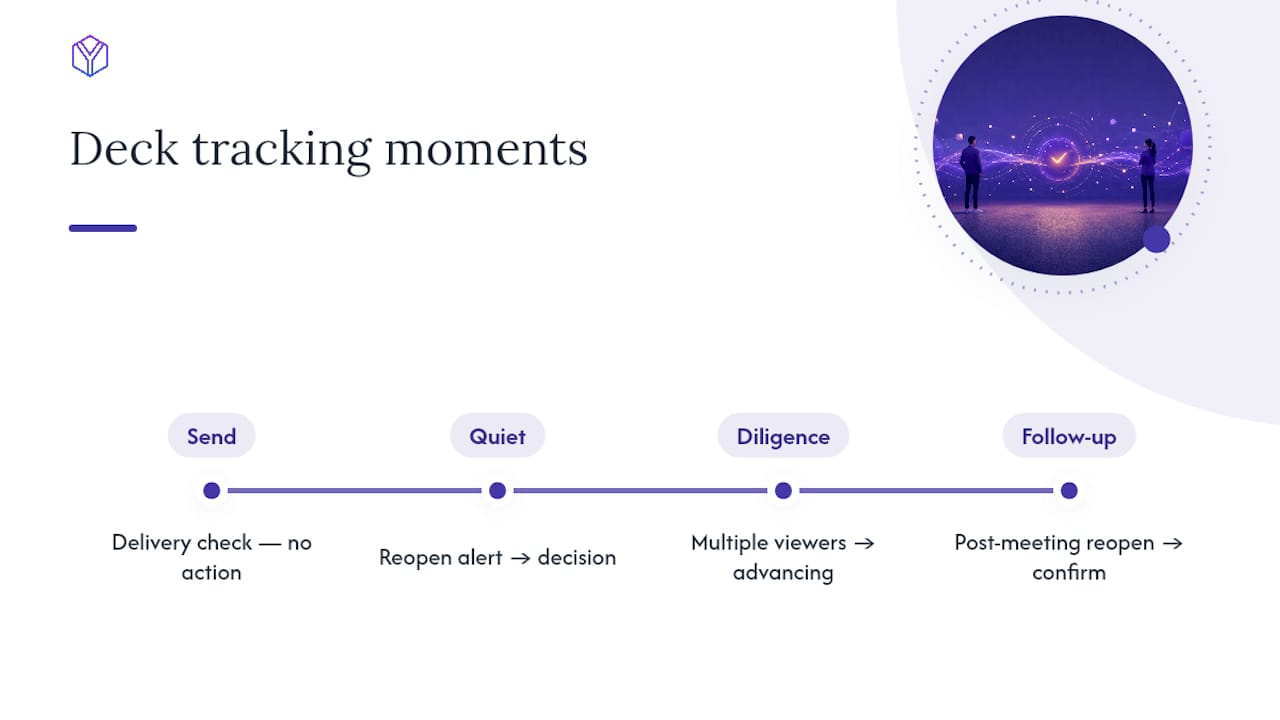
The first is the initial send, right after a warm intro or a cold outreach email. This is where a first open just confirms the email didn’t bounce and the recipient exists. It’s not a signal worth acting on by itself.
The second is the quiet period between first send and any reply, often the most anxious stretch of a raise. This is exactly when reopen and download alerts earn their keep, because they turn dead air into a decision point.
The third is during active diligence, when a firm passes the deck internally. Multiple viewers from the same company domain, sometimes on the same day, is one of the clearest tells that a deal is advancing past a single associate’s inbox.
The fourth is post-meeting follow-up, when an investor who already talked to you reopens the deck to check a number or show a partner. That reopen is different in tone from a cold reopen, it’s confirmation, not discovery, and it usually calls for a lighter touch than a first-contact nudge.
Handling Privacy Concerns Without Losing the Signal
The biggest privacy concern in pitch deck tracking isn’t legal, it’s tonal. Nothing about tracking engagement on a document you voluntarily shared crosses into surveillance the way, say, monitoring someone’s personal device would. The risk is in how you use what you see.
Investors generally expect some form of tracking on shared materials, the same way they’d expect a data room to log access. The etiquette failure happens when a founder references tracked behavior in a way that feels like they were watching over someone’s shoulder in real time.
Handle it with two simple habits. First, keep every reference to engagement vague enough to sound like attentiveness rather than monitoring, “noticed you circled back to the roadmap” instead of any specific timestamp or duration. Second, if a recipient asks how you knew something, be straightforward: you use a tracked link to manage the raise, and that’s disclosed by the nature of sending a hosted document rather than a static attachment. Nobody has ever been surprised that a hosted link reports back to its owner.
An Advisor’s Workflow for Managing Multiple Raises
Fractional CFOs running several client raises at once need a routing system, not just good instincts. The workflow that scales: monitor every active raise in one place, route each reopen or download alert to the specific team lead responsible for that founder relationship, and hold everyone to the same few-hours response window regardless of whose deck it is.
A typical sequence looks like this: reopen triggers an alert, the assigned lead sends a one-line reply referencing the content area revisited, and if a second viewer from the same firm shows up within days, that becomes the cue to propose a partner meeting directly instead of waiting for the investor to ask. Routing alerts to one accountable person who can act within hours, rather than letting alerts sit in a shared inbox, is what actually makes behavioral follow-up work at scale.
— Paul
How BabyLoveRaise Handles the Timing for You
Document engagement tools can turn the guesswork in this article into something you don’t have to track by hand. Instead of guessing whether silence means “never opened it” or “read it and passed,” some raise rooms give you a first-read notification the moment someone opens the deck, plus per-slide engagement data so you can see exactly where attention holds and where it drops.
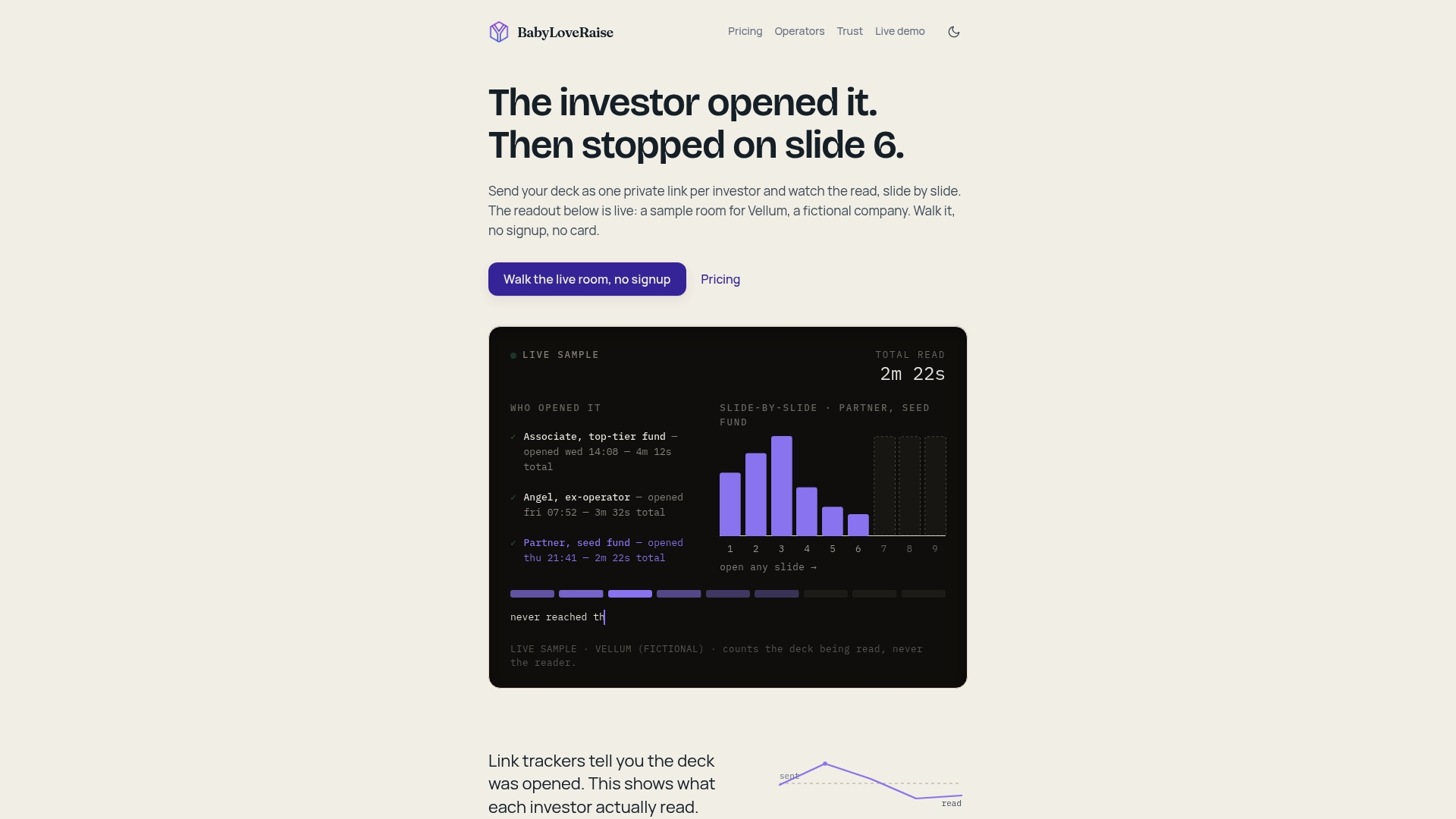
The room supports tiered share links, first send, forwardable, and private, so you can tell a genuine forward to a new partner apart from someone just reopening their own copy. Downloads carry a measured watermark, and alerts fire on reopens, downloads, and new viewers at the same firm, the exact three events this article flags as worth an hours-fast reply. For advisors managing several client raises, the Operator white-label tier runs firm-branded rooms across every active deal without per-seat data room pricing. Once your raise closes, the room converts into a free permanent archive instead of hitting a paywall. If you want to see how it applies to your own deck follow-up timing, start a room at BabyLoveRaise.
Sources
- How Investors Read Pitch Decks — Data from 24,541 Decks
- How to Send Your Pitch Deck to Investors (Most Get This Wrong) in 2026 — Peony