
ShareFile Alternatives for Fundraising Teams in 2026
Explore top ShareFile alternatives for fundraising teams in 2026. Discover tailored solutions like BabyLoveRaise to enhance pitch-deck engagement.
August 3, 2026 · 9 min read

For pitch-deck engagement, BabyLoveRaise is the strongest ShareFile replacement available to founders and advisory firms right now. ShareFile was built for general secure file exchange, not for the specific mechanics of a fundraise. That gap shows fast.
Three reasons BabyLoveRaise leads this shortlist:
- Per-slide engagement analytics tell you which investors read to the end and which skimmed past slide 4.
- Per-raise pricing means you pay for a raise, not a per-seat subscription that compounds forever.
- White-label Operator tier lets fractional CFOs and advisory firms run firm-branded rooms across every client raise.
Beyond BabyLoveRaise, the viable categories are: deal-focused enterprise VDRs (Datasite, Intralinks, FirmRoom), secure file-exchange platforms with audit trails (DocSend), and interactive document rooms (Digify). Each serves a different job. General cloud storage tools like Google Drive and Dropbox lack purpose-built fundraising features such as automated follow-ups and per-deck engagement analytics, so they are not serious contenders here.
Table of Contents
- Which ShareFile alternatives fit fundraising decks?
- How do you pick the right ShareFile replacement for your raise?
- Why BabyLoveRaise is the recommended pick for fundraising teams
- How to migrate a live raise from ShareFile to a new platform
- Key Takeaways
- The real cost of not knowing who read your deck
- BabyLoveRaise: a fundraising-first ShareFile replacement
- Useful sources and further reading
Which ShareFile alternatives fit fundraising decks?
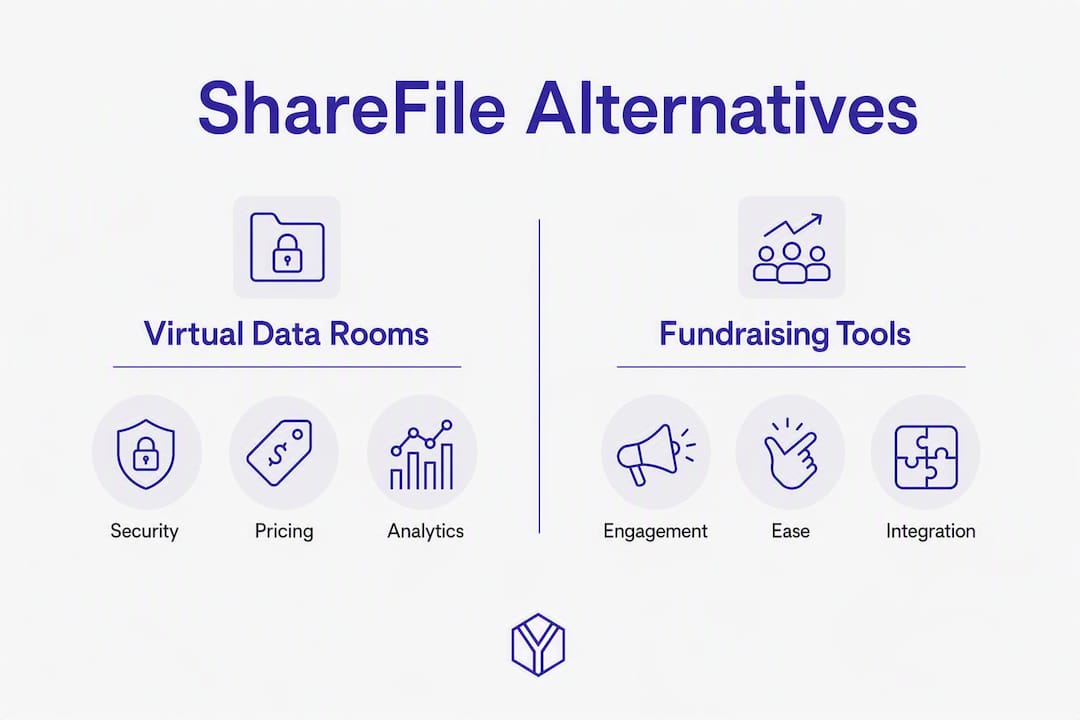
The table below maps four solution categories across the dimensions that matter most to founders and advisors running a raise.
| Dimension | Fundraising engagement room | Enterprise VDR | Secure file-exchange | Interactive document room |
|---|---|---|---|---|
| Best for | Pitch-deck engagement, seed/pre-seed raises | M&A, Series B+, regulated due diligence | Client file delivery with audit trail | Proposal-style decks with embedded analytics |
| Pricing model | Per-raise | Per-deal or enterprise licence | Per-seat subscription | Per-seat subscription |
| Engagement analytics | Per-slide dwell, first-read notification, read-depth | Page-level views, user access logs | Link-level opens, time spent | Page-level, some per-section |
| Security & hosting | SOC 2, cloud SaaS | SOC 2, ISO 27001, HIPAA, FedRAMP options | SOC 2, cloud SaaS | SOC 2, cloud SaaS |
| Share controls | First-send, forwardable, private links; watermarks; expiry | Granular permissions, NDA gates, watermarks | Link expiry, forwarding controls | Link expiry, viewer ID |
| White-label / Operator | Yes, multi-client Operator tier | Varies by vendor | Limited | Limited |
| Concierge services | Deck editorial passes, Build Map narrative | Deal advisory (some vendors) | None | None |
| Post-raise archive | Free permanent archive | Paid storage or export | Varies | Varies |
| Ease of migration | Import decks, set slide tracking, export engagement reports | Folder import, access mapping, SSO | Link redirect, folder export | Manual re-upload |
Trade-offs worth knowing before you choose:
- Fundraising engagement rooms prioritize speed and analytics depth; enterprise VDRs prioritize compliance and granular access control, but compliance posture adds cost and complexity that most seed-stage raises do not need.
- Per-raise pricing is predictable for a single raise; per-seat subscriptions compound quickly when an advisory firm runs five client raises simultaneously.
- Interactive document rooms give good narrative flow but typically lack the first-read notification and investor-level tracking that fundraising rooms provide.
Typical per-seat subscription pricing across ShareFile competitors usually ranges from $15 to $35 per user per month. A per-raise model sidesteps that math entirely for founders who raise once every 18–24 months.
Pro Tip: Before committing to any platform, ask the vendor to demo per-slide dwell reporting on a real deck. If they cannot show you which slide lost a specific investor’s attention, the analytics are not deep enough for fundraising use.

How do you pick the right ShareFile replacement for your raise?
Start with four questions before you open a single demo.
- Do you need per-slide analytics or just link-level opens? If you are running investor outreach and want to know which slides killed momentum, you need slide-level dwell data, not a raw open count.
- How many raises are you running at once? A solo founder doing one pre-seed raise has different economics than a fractional CFO managing six client raises. Per-raise pricing wins for the former; an Operator console wins for the latter.
- What happens to your data after the raise closes? Some platforms put your archive behind a paywall the moment you stop paying. That is a real operational risk if an investor asks for the deck six months later.
- Do you need enterprise compliance? SOC 2 covers most startup use cases. If you are in a regulated sector or running a Series B with institutional LPs, look at platforms that carry ISO 27001, HIPAA, or FedRAMP coverage.
Questions to ask in every demo:
- Show me the per-slide heatmap for a specific investor link.
- Set an automated follow-up trigger after three days of no open.
- Walk me through white-label options and what the investor sees.
- What happens to my files and engagement reports if I cancel?
Red flags to watch for:
- No export of engagement reports. If you cannot pull your own analytics data, you are locked in.
- Per-seat minimums that price out small teams. A five-seat minimum at $25/seat is $125/month for a solo founder who needs one room.
- Vague post-close storage fees. Get the archive policy in writing before you sign.
Gartner Peer Insights confirms that buyers evaluating ShareFile replacements weigh integration, deployment model, and support alongside features. For fundraising teams, add archive policy and analytics export to that list.
Why BabyLoveRaise is the recommended pick for fundraising teams
BabyLoveRaise is built around the raise itself, not around generic file delivery. That distinction shapes every feature.
- Per-slide engagement: The dashboard shows who opened the deck, which slides held attention, and who read to the last slide. “Never opened” and “read everything and passed” are two different states, and the platform treats them that way.
- First-read notifications: You know the moment an investor opens the deck, so follow-ups land while the deck is still fresh.
- Three share-link registers: First-send, forwardable, and private links give you control over how the deck travels without blocking legitimate sharing.
- Watermarked downloads: Downloads carry a measured watermark tied to the recipient link.
- White-label Operator tier: Advisory firms and fractional CFOs run firm-branded rooms across all client raises. The investor sees the firm’s brand, not a third-party tool.
- Concierge editorial services: Optional deck editorial passes and narrative “Build Map” artifacts for founders who want hands-on help with the pitch itself.
- Permanent free archive: When the raise closes, the room converts to a free permanent archive. No paywall cliff, no scramble to export before your subscription lapses.
The privacy model matters too. BabyLoveRaise tracks engagement at the document level, reporting on how the deck performs, not surveilling individual investors beyond what they have consented to share.
“Per-deck engagement data, not raw download counts, is what turns investor outreach from guesswork into prioritized action.” Founders who know which investors finished the deck follow up with precision; those who only see download counts chase everyone equally.
For a deeper look at when a full virtual data room makes more sense than a fundraising engagement room, the secure data rooms guide for startups covers the decision criteria clearly.
How to migrate a live raise from ShareFile to a new platform
Moving mid-raise is less disruptive than it sounds if you run it in the right order.
- Map your existing folder structure and permissions. Document who has access to what before you touch anything.
- Export audit logs and all documents. Download engagement history and every file. Some platforms delete logs on cancellation.
- Set up your new branded raise room. Configure branding, share-link settings, and watermark rules before importing content.
- Import decks and configure slide tracking. Upload the pitch deck and verify that per-slide analytics are firing correctly on a test view.
- Run an investor smoke test. Send the new room link to two or three investors you trust and confirm that open notifications and slide data appear as expected.
- Switch share links and notify investors. Update all outbound communications with the new link. Keep the original ShareFile link live for a short overlap window.
| Raise stage | Estimated migration time |
|---|---|
| Pre-seed / seed (1 deck, small investor list) | 2–4 hours |
| Series A (multiple documents, larger LP list) | 1–2 business days |
Integration checklist before you go live:
- CRM sync confirmed (check your fundraising CRM setup if you use one)
- Investor management platform connected
- Single sign-on (SSO) tested if required
Migration red flags: Any platform that cannot export your engagement reports before cancellation, and any vendor that requires a minimum contract term longer than your raise timeline.
Pro Tip: Run the smoke test with a small cohort of two or three investors before switching all communications. One broken link or missing notification at full scale is harder to recover from than catching it early with a handful of contacts.
Key Takeaways
For fundraising-focused teams, per-slide engagement analytics and per-raise pricing are the two criteria that separate purpose-built tools from generic ShareFile substitutes.
| Point | Details |
|---|---|
| Top pick for founders | BabyLoveRaise combines per-slide analytics, per-raise pricing, and a free post-close archive. |
| When to choose a VDR instead | Series B+ raises, regulated sectors, or deals requiring ISO 27001, HIPAA, or FedRAMP coverage. |
| Demo must-have | Ask every vendor to show per-slide dwell data on a real investor link before committing. |
| Advisory firm economics | An Operator tier beats per-seat subscriptions when running multiple client raises simultaneously. |
| Archive policy | Confirm post-close storage terms in writing; paywall cliffs create real operational risk. |
See BabyLoveRaise pricing and Operator tier options before your next raise.
The real cost of not knowing who read your deck
The conventional wisdom says the hard part of fundraising is the pitch. The harder part is the silence after it. Most founders treat every non-reply the same: send a follow-up, wait, repeat. Per-slide analytics change that behavior in a specific way. When you can see that an investor opened the deck, spent 40 seconds on the market slide, and closed it at slide 6, you know the problem is not the intro. You know exactly where to focus the revision and whether a follow-up is worth sending at all.
The trade-off is real: switching tools mid-raise adds friction. Running a small smoke test with two or three investors before full cutover is the right call, not because the migration is technically hard, but because catching a broken notification early costs you nothing, while missing it at scale costs you a warm lead.
BabyLoveRaise: a fundraising-first ShareFile replacement
ShareFile handles secure file exchange. BabyLoveRaise handles the specific job of running a raise: per-slide engagement data that tells you which investors are serious, per-raise pricing that does not compound across your cap table, and a white-label Operator tier for advisory firms managing multiple founders at once.
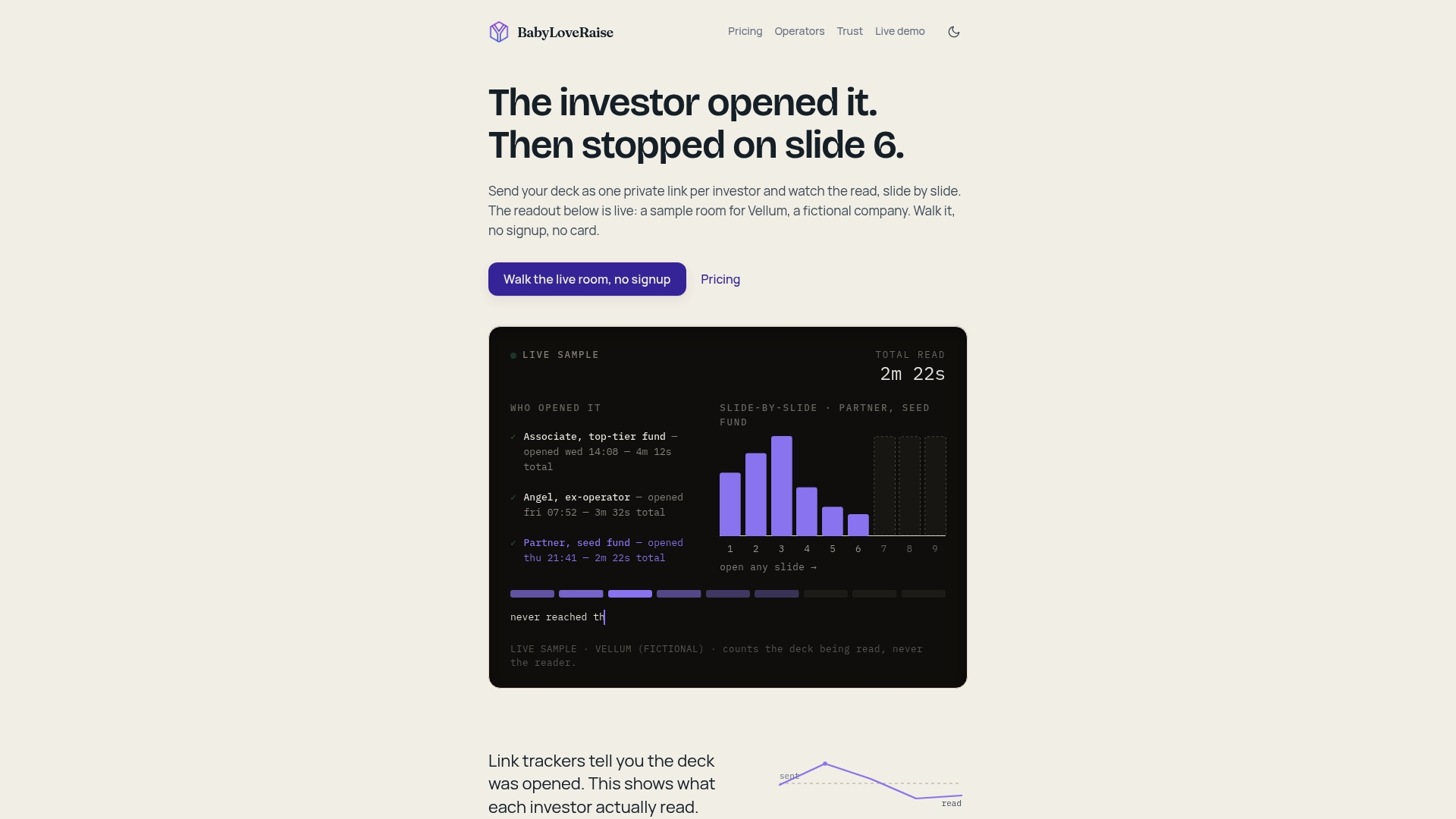
The platform includes first-read notifications, three share-link registers, watermarked downloads, optional concierge editorial services, and a permanent free archive when the raise closes. No per-seat math, no paywall cliff at the end.
Start your raise room at BabyLoveRaise and see the per-slide dashboard before your next investor meeting.
Useful sources and further reading
- Top ShareFile Alternatives & Competitors | Gartner Peer Insights — independent buyer reviews covering evaluation criteria across ShareFile competitors.
- Best Citrix ShareFile Alternatives for Secure File Sharing — covers security certifications (SOC 2, HIPAA, GDPR, FedRAMP) and common reasons teams switch.
- 10 ShareFile Alternatives That Work Harder for You — pricing ranges and feature comparisons across interactive document and file-sharing platforms.
- ShareFile alternatives for exchanging files with clients — explains where general cloud storage falls short for structured client workflows.
- Secure data rooms for startups: a practical guide — when to choose a VDR over a fundraising engagement room.
- Fundraising documents for founders: live raise checklist — what to import and organize when setting up a new raise room.
When evaluating any platform on this list, ask the vendor to demonstrate per-slide engagement analytics on a live deck during the demo. That single test separates tools built for fundraising from tools built for general file sharing.