
Turn Deck Views Into Meetings: A Raise Room Checklist for Founders
Replace emailed decks with a raise room for first read alerts and per slide metrics; follow a step by step checklist to turn views into meetings.
October 3, 2026 · 9 min read

A raise room is a hosted pitch deck room that replaces an emailed PDF or Drive link with first read notifications and per slide engagement metrics. Its primary job is to turn vague silence into two distinct, workable states: never opened and read to the end, so founders know who to chase and which slides to fix. It is not a substitute for a diligence or data room once real investor interest shows up.
TL;DR:
- A raise room provides real-time notifications when investors open the deck and tracks how far they progress through each slide.
- Engagement metrics highlight exactly where investors lose interest, allowing targeted follow-ups based on actual viewer activity.
- It is best used as the initial front door for a fundraising round, with financial and legal documents kept secure in a separate data room.
- The platform’s pricing is typically per raise, making it more cost-effective for multiple client raises than per seat licenses.
- Engagement data indicates who is actively reviewing the deck but does not reliably measure genuine investment interest or intent.
BabyLoveRaiseTurn Deck Engagement Into ActionBabyLoveRaise helps founders see who opened, finished, or skimmed their deck, so follow-ups and revisions start with clearer signals.Explore BabyLoveRaise
Table of Contents
- What a raise room does: core features and how they work
- Why founders and advisors use a raise room
- Where a raise room fits in the fundraising workflow
- How to set up and share a raise room: a step by step checklist
- When a raise room is not the right tool
- BabyLoveRaise as an example of the pattern
- Tactical priorities when using a raise room
- Getting started with BabyLoveRaise
- Sources
- FAQ
What a raise room does: core features and how they work
A raise room centers on one link that replaces the PDF attachment or Drive folder most founders default to. Founders can issue a single room link or generate per investor links, and revoke access to either at any point if a conversation goes cold or a deck needs correction.

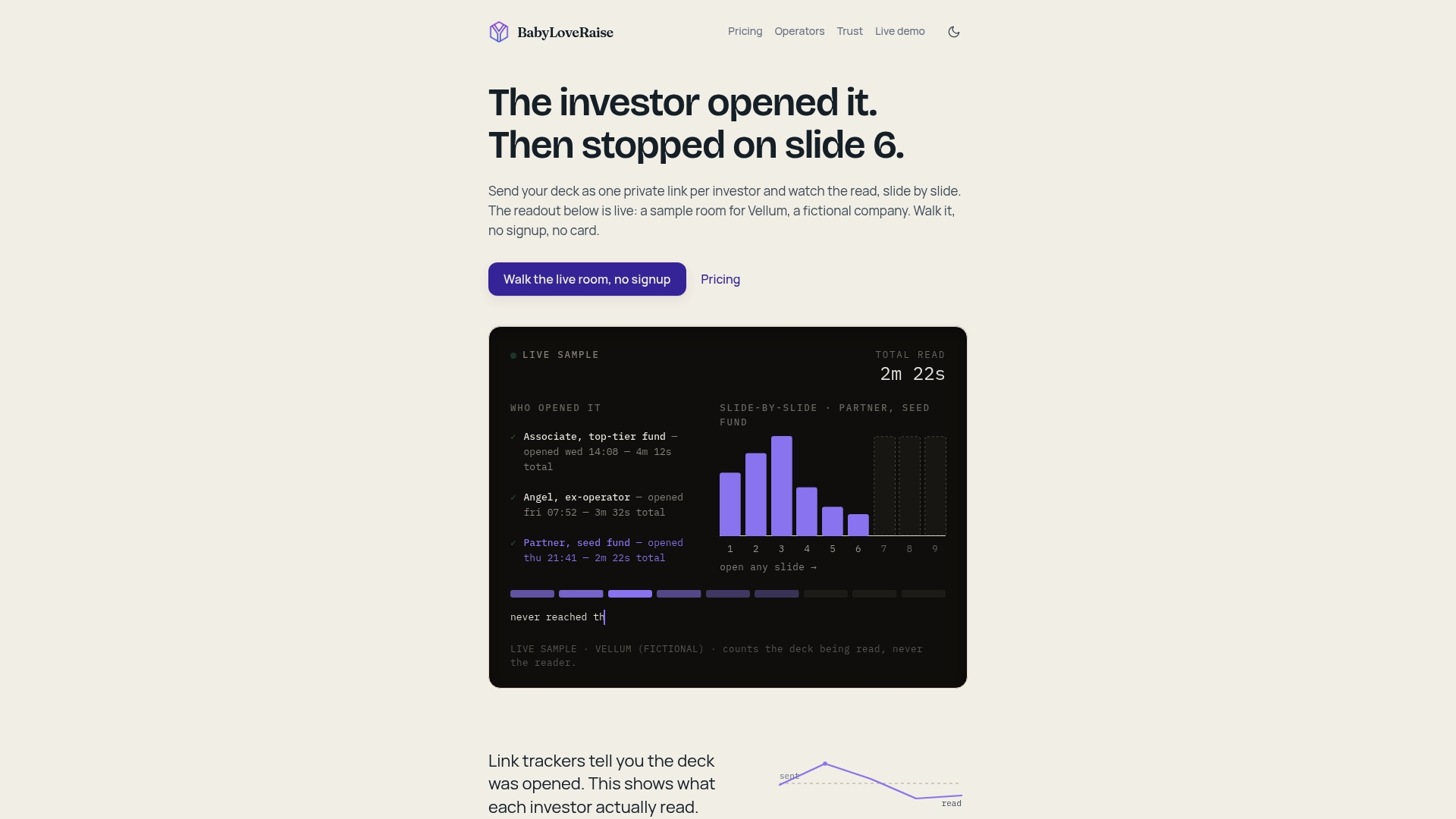
The room notifies the founder the moment an investor opens the deck for the first time, and separates two states that look identical in an inbox: never opened and read to the end. Per slide dwell time shows which pages hold attention and which get skimmed past, a pattern that tells a founder more about deck clarity than any single reply does.
Access controls let founders set password or domain restrictions, and downloads can carry a measured watermark so a forwarded file is still traceable. According to Startupfundraising, platforms built around secure, revocable sharing and per viewer analytics give founders one source of truth that a Drive folder and a spreadsheet cannot. When the raise closes, the room typically remains as a permanent archive instead of disappearing behind a paywall.
- Single or per investor links with revocation at any time
- First read notifications and never opened versus read to end status
- Per slide dwell metrics showing where attention holds or drops
- Access controls plus measured watermarked downloads
- Permanent post raise archive once the round closes
Why founders and advisors use a raise room
The core payoff is prioritization. Instead of guessing who is ignoring an email versus who simply has not opened it, founders can put their limited follow up energy toward people who actually engaged. Visible’s pitch deck tracking page frames this as answering operational questions: did they open it, how far did they read, which slides held attention.
- Follow up goes to real readers first, which cuts wasted chasing
- Slide level drop off points to exactly where the narrative loses people
- One tracked link replaces scattered PDFs, email threads, and guesswork
- Advisory firms running several client raises get per raise billing and white label rooms instead of per seat licenses forever
Pro Tip: Treat a second visit to the deck as your cue to follow up, not the first open alone, since a single quick open often just means someone is triaging their inbox.
The limits matter as much as the benefits. A read to the end signals attention, not a term sheet. Engagement data tells a founder where to focus a conversation; it cannot tell them what an investor is thinking, and treating dwell time as a proxy for interest invites false confidence.
Where a raise room fits in the fundraising workflow
A raise room works as the controlled front door to a raise, not the place where diligence happens. Startupfundraising.com’s guide to fundraising materials draws this line clearly: the teaser deck and presentation deck live in a tracked, shareable room, while financial models, cap tables, and legal documents stay in a data room opened only after real interest appears.
A practical sequence keeps the raise moving without overloading the front door:
- Build a target list segmented by stage, sector, and check size
- Get a warm introduction where possible, or send a short, tracked cold outreach
- Share the raise room link and watch for first read and dwell signals
- Follow up based on what the engagement shows, not on a fixed schedule alone
- Grant data room access once an investor asks for financials or legal documents
Tying these events to a CRM, even a simple spreadsheet, keeps the sprint disciplined. A column for “first read,” a column for “read to end,” and a trigger rule such as “read to end with no reply in 5 to 7 business days, send traction update” turns raw engagement data into a repeatable follow up system rather than a dashboard nobody checks.
How to set up and share a raise room: a step by step checklist
A raise room only works as well as the deck and the outreach around it. The setup sequence matters more than any single feature.
- Build a 12 to 15-slide teaser deck written for a self-guided read, not a live pitch
- Load the deck into the room and choose a privacy register: first send, forwardable, or private
- Generate per investor links where you want individual tracking, and turn on first read notifications
- Log every share in your CRM or spreadsheet the moment you send it
- Set a follow up rule, such as reaching out after a second visit or a completed read with no reply
- When you follow up, keep the note short, add one new piece of traction, and ask directly for a meeting
Pro Tip: A forwardable link is useful once an investor wants to loop in a partner, but switch sensitive updates to a private link so you still know exactly who is viewing them.
Startupfundraising.com’s guide on sending a pitch deck to VCs recommends a forwardable email under 100 words paired with a tracked link rather than a cold attachment, and following up with new traction if there is no response within 5 to 7 business days. A clarity first deck structure, like the 10-slide pre-seed outline from Klaritea, tends to produce cleaner engagement signals because investors can follow the story without a live walkthrough.
When a raise room is not the right tool
A raise room earns its keep when investor volume and tracking needs justify the setup. Below roughly ten meaningful targets and a fast close, a well-organized cloud folder and a spreadsheet often does the job with less overhead, a point startupfundraising.com’s materials guide makes directly.
- Small, fast rounds with a short investor list rarely need a dedicated platform
- Immediate confidential diligence sharing, such as cap tables or financials, belongs in a gated data room, not a pitch deck room
- Heavy tracking can read as surveillance if investors are not told what is being measured, so disclose it plainly
- Highly regulated documents or jurisdiction-specific disclosures should go through counsel before they are shared in any tracked format
BabyLoveRaise as an example of the pattern
One example of the raise room pattern provides per slide engagement metrics and first read notifications, so a founder sees exactly when a deck is opened and which pages hold attention versus which get skimmed. Share links can have different privacy registers, such as first send, forwardable, and private, and downloads can carry a measured watermark for traceability. Trust and access controls are detailed on the company’s trust page.
When a raise closes, the room may convert into a free permanent archive rather than locking behind a paywall. Some providers offer an Operator tier that lets advisory firms and fractional CFOs run white-label rooms across client raises, and may provide optional concierge editorial passes for founders who want a narrative review of the deck. Pricing can be structured per raise rather than per seat, mapping the cost to the fundraising event instead of an ongoing license.

Tactical priorities when using a raise room
The temptation is to treat every dashboard ping as a verdict. It is not. Use engagement data to decide who to contact next, never to decide what someone is thinking. A raise room earns its cost once investor volume or diligence complexity makes manual tracking unreliable, and advisors running several client raises should lean on white-label tooling instead of rebuilding the same spreadsheet for each one.
— Paul
Getting started with BabyLoveRaise
A single founder running a pre-seed or seed round gets the most direct benefit from fewer wasted follow ups and a clearer read on which investors actually engaged with the deck.
- Solo founders typically fit the raise room, billed per raise rather than per seat
- Advisory firms and fractional CFOs running multiple client raises fit the Operator tier, with white-label rooms and concierge editorial support available
- Both paths replace scattered email threads with one tracked link and a dashboard that separates real engagement from silence
Check pricing or the Operator plans to see which fits your next raise.
FAQ
What is a raise room used for?
A raise room is used to share a pitch deck during a fundraise while getting first read notifications and per slide engagement data. It replaces an emailed PDF or Drive link with a tracked front door that shows founders who opened the deck and how far they read.
How does a raise room differ from a data room?
A raise room hosts the pitch deck itself and tracks engagement, functioning as the first touchpoint in a raise. A data room holds diligence materials like financials and cap tables and typically opens only after an investor shows real interest, as described in startupfundraising.com’s fundraising materials guide.
How does a raise room compare to DocSend?
Both track document views, but raise rooms like BabyLoveRaise price per raise instead of per seat and add fundraising-specific features such as first read notifications and a permanent post-raise archive instead of a paywall once the round closes.
What are the main components of a raise room?
The core components are per slide dwell tracking, first read notifications, per viewer status, access controls with privacy levels, and measured watermarked downloads. Most raise rooms also keep a permanent archive of the deck and its engagement history after the raise ends.
Can engagement data tell me if an investor is interested?
Engagement data shows whether a deck was opened, how far someone read, and which slides held attention, but it cannot confirm investment interest on its own. Use it to prioritize follow ups and revise weak slides, not as a stand-in for an investor’s actual response.