
Startups: Treat Your Data Room as an Evergreen Fundraising Tool
A startup playbook for data room timing: prepare before outreach, grant access after investor interest, refresh quarterly, and use slide engagement to...
October 9, 2026 · 16 min read

Prepare your data room before you start fundraising, open controlled access only after an investor signals real interest, refresh the contents every quarter, and migrate platforms only during quiet stretches between milestones. That order protects momentum: founders who assemble the core files early move faster once a term sheet conversation starts, and those who keep the room current never have to scramble when an inbound message arrives.
TL;DR:
- Before the first meeting, align the deck, cap table, six to twelve months of financials, product metrics, and unit economics.
- Keep contracts, intellectual property records, forecasts, and technical appendices staged until diligence deepens; regulated or technical companies should tie budgets and timelines to milestones.
- Grant view access after specific diligence requests or term sheet discussions, and use repeat visits to prioritize investor outreach.
- Seed reviews may last weeks, while complex later or regulated deals can run for a couple of months; end broad access when the deal closes.
BabyLoveRaisebabyloveraise.comKnow Who Read Your Pitch DeckBabyLoveRaise tracks first reads and slide-by-slide engagement, helping founders distinguish unopened decks from investor reviews that reached the final slide.Explore the raise room
Table of Contents
- When to create your data room relative to fundraising stages
- What to include at each stage: pre-seed, seed, and later rounds
- Timing access and duration: who gets in and for how long
- Switching or migrating a data room mid-process
- Maintenance cadence: why a quarterly habit prevents scrambles
- How investors actually use your data room
- Using a raise room to time access and follow-ups
- What investors expect to see and how they read access logs
- How long data rooms typically stay open during a deal
- Timing’s effect on due diligence speed and deal momentum
- Closing the room and setting post-deal access policy
- The one rule that matters more than the rest
- How BabyLoveRaise supports this timing playbook
- FAQ
- Sources
When to create your data room relative to fundraising stages
The right moment to build a data room is before you need it, not after an investor asks for one. Andreessen Horowitz’s guidance on data rooms frames the early-stage room as a tool to help investors write their investment memo, which means the files exist to answer the questions a partner will ask internally, not to impress on first glance. Founders who have that memo-ready material assembled before outreach begins tend to move through meetings faster, because they are not stalling to pull numbers together mid-conversation.
Waiting until an investor requests materials puts you in a reactive position at the exact moment you want to look organized. A cap table that needs cleanup or financials that need reconciling under time pressure can cost you the week that a competing term sheet does not wait for.
Before your first investor meeting, assemble:
- A pitch deck that matches the numbers in your other files, not an older version.
- A current cap table showing ownership, option pool, and any outstanding convertible instruments.
- Monthly financials covering at least the trailing six to twelve months.
- Core usage or engagement metrics relevant to your product category.
- A simple unit economics summary: acquisition cost, margin, and retention basics.
Once that set exists, you have clear triggers for opening deeper access. A first meeting rarely warrants a full room. A follow-up request for diligence materials, an NDA signed ahead of deeper conversations, or a term-sheet discussion are the moments that justify granting access rather than sending a deck by email. Our practical guide to secure data rooms for startups covers how to structure that access without overexposing early-stage information.
What to include at each stage: pre-seed, seed, and later rounds
The contents of your data room should match the stage of the conversation, not the stage of your company. A pre-seed founder talking to an angel investor needs far less than a Series B company fielding diligence from a growth fund, and loading too much too early can bury the signal investors actually want.
a16z’s recommended starting point is a lean set of five core files for early-stage rounds:
- Pitch deck, kept current with your latest numbers.
- Cap table, showing current ownership and any pending dilution.
- Monthly financials, ideally trailing twelve months.
- Usage or product metrics relevant to your traction story.
- A unit economics summary that ties acquisition cost to margin and retention.
That MVP set exists because an investor’s first job is writing an internal memo, and these five files answer most of the questions that memo needs. Everything else, legal agreements, detailed technical documentation, longer financial models, can stay staged rather than loaded into the room on day one.
As a round matures into seed or Series A territory, the expected contents grow:
- Signed agreements with key customers, vendors, or partners.
- Intellectual property documentation, including any patents, trademarks, or licensing terms.
- A more detailed financial model with forward projections and key assumptions spelled out.
- Org chart and key hire background for leadership positions.
- Technical architecture documentation if the product’s defensibility rests on engineering choices.
Companies in regulated or technical sectors carry additional weight. a16z’s analysis of virtual data rooms in biotech financing points out that a well-curated room in that sector needs milestone-focused artifacts: Gantt charts showing program timelines, budget splits tied to use of proceeds, and clinical or regulatory appendices that show how the round de-risks specific milestones. A biotech company raising a Series B without that detail leaves investors guessing at how the money actually gets spent, which slows diligence rather than speeding it. Founders outside biotech can borrow the same logic: whatever your version of a “milestone” is, a product launch, a key regulatory approval, a manufacturing certification, show the budget and the timeline tied to it rather than describing it in prose alone.
The staging strategy that works best treats the room as layered rather than flat. Core files sit in the main folder from day one. Legal documents, detailed contracts, and technical appendices sit in a staged folder that you release once an investor has moved past the first filtering conversation. Our guide to due diligence documents for startup founders breaks this down by folder structure, which helps avoid the common mistake of either overwhelming an early-stage investor with legal paperwork or stalling a late-stage investor who needs it immediately.
Timing access and duration: who gets in and for how long
Opening your data room too early, to every investor who takes a first call, erodes the signal you are trying to create. Read-only access makes sense once an investor has moved past a general conversation and started asking specific diligence questions, requested documents by name, or raised the possibility of a term sheet. Broad distribution before that point just means more people with access and less information about who actually matters.
A graded approach to sharing solves the timing problem without requiring you to guess:
- A first-send register for the earliest viewers, where you want to know exactly who opened what and when.
- A forwardable register for investors who may loop in a partner or associate without breaking your tracking.
- A private register for the final stretch of diligence, where only a named handful should ever see the room’s contents.
Watermarking downloaded files adds another layer of control, particularly once you move past the first-send stage and documents start circulating to people you have not personally vetted. IBM’s data breach reporting makes the broader case for why conservative access controls, logging, and watermarking matter any time sensitive financial or strategic information leaves your direct control, fundraising diligence included.
Pro Tip: Treat every access grant as a timing decision, not just a permissions one. Ask who needs this, when, and for how long before you flip the switch.
How long to keep the room open depends on where you are in the process. During active diligence, most rounds stay open for several weeks to a couple of months, long enough for an investor to work through legal, financial, and technical review without the pressure of losing access mid-process. Once a deal closes or a round falls through, the room should either close to that investor, archive for your own records, or convert into a longer-term reference depending on your workflow.
Switching or migrating a data room mid-process
Changing platforms while an investor is actively reviewing your materials is one of the more avoidable mistakes founders make. A migration mid-diligence risks broken links in an investor’s saved bookmarks, lost access logs that you were relying on to gauge engagement, and a confusing message to someone you are trying to convince you run a tight operation.
The windows that work best for switching are the quiet ones: between funding milestones, during a lull when no active term sheet conversation is underway, or before you ramp up a new outreach push rather than in the middle of one. If you know a migration is coming, time it for the week after a round closes rather than the week before.
When migration is unavoidable, a short checklist keeps it clean:
- Export all existing access logs and engagement data before closing the old room.
- Run both the old and new rooms in parallel for a short window rather than cutting over instantly.
- Notify every active investor contact directly, rather than letting them discover a dead link.
- Test every shared link in the new room before sending it, including any that were previously set to expire.
- Confirm version consistency between the old and new rooms so no investor sees a stale deck. Our guide to pitch deck version control covers how to avoid that specific failure mode.
Maintenance cadence: why a quarterly habit prevents scrambles
A data room that sits untouched for months stops being an asset and starts being a liability the moment an investor asks for current numbers. The founders who handle inbound interest smoothly are the ones who treat quarterly updates as a habit rather than a fire drill.
Each quarter, refresh:
- Financial snapshots, so trailing figures never lag more than one quarter behind.
- KPI tables tied to whatever metrics define traction in your category.
- Product usage or engagement data, replacing anything that looks stale next to your pitch narrative.
A quarterly refresh taking a modest amount of time is cheap insurance against a scramble when inbound interest shows up without warning. That small, recurring block of time means your numbers are never more than a few weeks out of date, which matters most in exactly the moment you cannot control: an investor reaching out unprompted.
The maintenance habit also reduces the pressure to migrate platforms reactively. A room that is already current rarely needs an emergency rebuild, and clean, continuous access logs give you a more reliable read on which investors are engaging seriously over time rather than a single noisy snapshot.
How investors actually use your data room
Investors are not browsing your data room out of curiosity. They are extracting specific numbers to support an internal investment memo, confirming claims made in the pitch meeting, and actively looking for anything that contradicts the story you told. a16z’s framing of the early-stage data room as a memo-writing tool means the files you prioritize should be the ones that make that memo easier to write, not the ones that look most impressive.
The documents checked first are almost always the cap table and the financials, because those two files reveal more about the state of a company than any narrative slide can. A deck that claims strong growth next to a cap table showing unresolved dilution questions raises more concerns than it answers.
Engagement signals matter beyond the documents themselves:
- An investor who opens the room once and never returns is sending a different signal than one who revisits specific folders repeatedly.
- Per-slide or per-document dwell time can show which claims an investor is scrutinizing closely versus skimming past.
- Access logs that show a narrow set of repeat viewers often indicate a real internal champion pushing the deal forward.
Founders who read these signals correctly prioritize follow-up with the investors actually engaging rather than chasing everyone who took a first meeting.
Using a raise room to time access and follow-ups
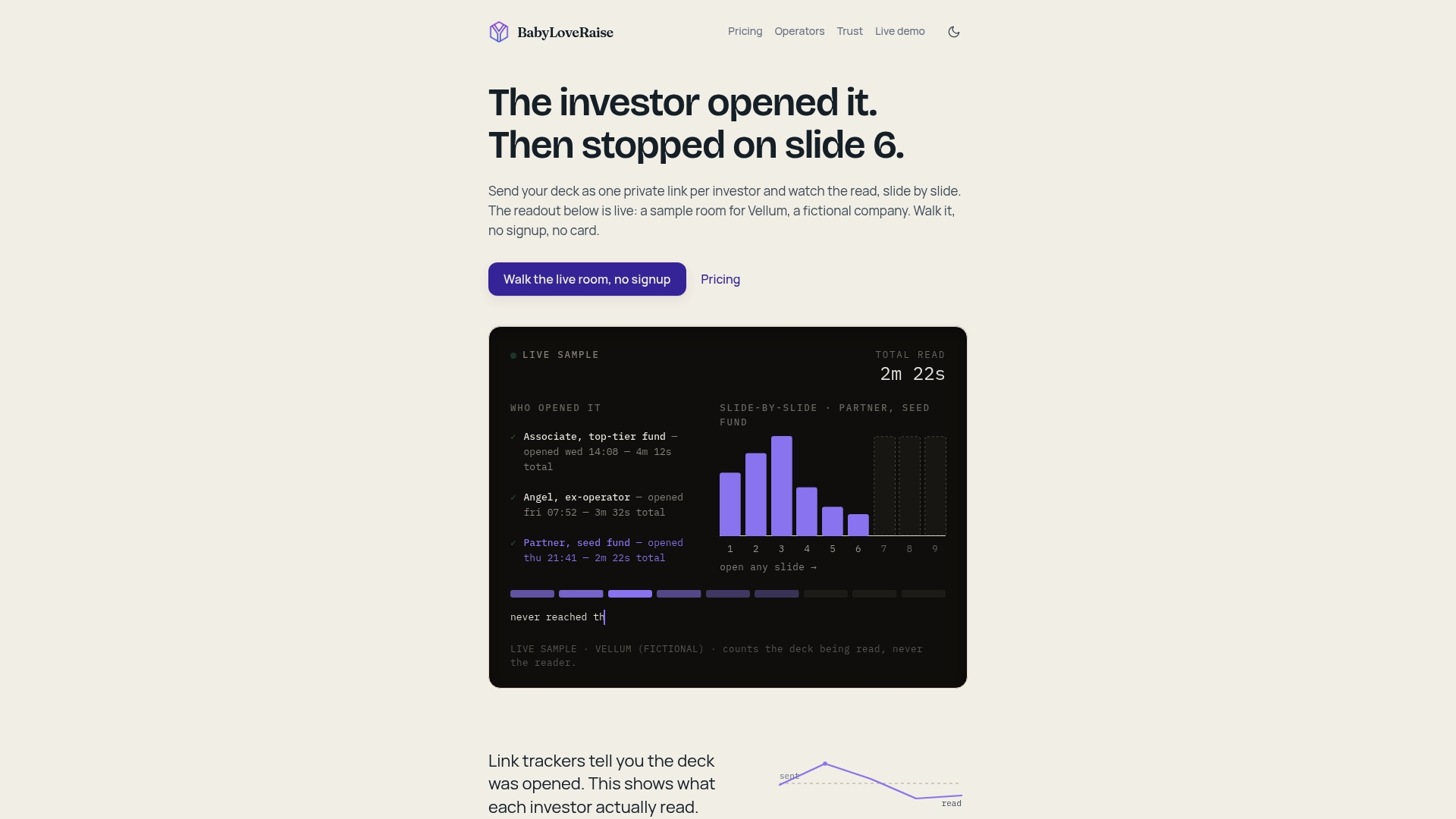
A practical example of this in action: a raise-focused room can flag the first time an investor opens a deck and show which slides they finished versus skimmed, turning “never opened it” and “read everything and passed” into two distinct, visible outcomes instead of identical silence. Tiered share links and watermarked downloads let a founder stagger access by investor without losing track of who has what, and a permanent free archive after the raise closes means that information never disappears behind a paywall once the deal is done.
What investors expect to see and how they read access logs
Investors expect a room that answers questions before they have to ask, which is why the core five files matter more than volume. A room stuffed with folders but missing a clean cap table reads as disorganized no matter how much other material surrounds it.
Access logs have become one of the more useful signals investors did not have a decade ago. A partner who revisits the financials folder three times in a week is doing something different than one who opened the room once and moved on, and founders who can see that same data get the same read in reverse. Repeated visits to legal or IP folders often signal that diligence has moved into a more serious phase, since those are not files anyone opens out of idle interest.
The expectation on the founder side is responsiveness tied to those signals. An investor who has clearly spent real time in the room and then gone quiet is a better candidate for a direct follow-up than one who never logged in at all, and treating both the same way wastes a limited amount of founder attention during an active raise.
How long data rooms typically stay open during a deal
Duration expectations shift with the type of transaction. A straightforward seed round with a handful of interested investors might keep a room open for a few weeks of active review, long enough to cover financials and legal basics without dragging into the kind of extended diligence that stalls momentum.
Larger rounds and more complex transactions, including Series B and later rounds or anything involving regulatory or technical complexity, tend to stay open longer, often stretching across a couple of months as legal counsel, technical advisors, and financial reviewers work through their respective pieces. a16z’s look at virtual data rooms in biotech financing illustrates this well: a program with multiple clinical milestones and a detailed budget structure simply takes longer to review properly than a straightforward SaaS metrics package.
Founders planning a longer runway, particularly those anticipating an eventual acquisition rather than just a funding round, benefit from starting the diligence process well ahead of any transaction. Guidance on running sell-side due diligence ahead of a sale recommends beginning three to six months before a planned transaction, which mirrors the same principle that applies to fundraising: the room that exists before anyone asks for it is the one that keeps a deal moving rather than stalling it.

Timing’s effect on due diligence speed and deal momentum
A data room that is ready before outreach begins compresses the entire diligence timeline, because the back-and-forth of requesting and producing documents happens before the clock starts rather than during it. Every day spent assembling a file an investor has already asked for is a day the deal’s momentum sits still, and momentum lost early in a raise is difficult to rebuild.
The inverse is just as visible. A disorganized room, missing files, outdated financials, a cap table that needs correcting mid-review, signals risk even when the underlying business is sound. Investors read friction in the process as a preview of friction in working with the founder after the check clears.
Rooms built on the memo-first principle, prioritizing the handful of files that answer an investor’s internal questions, tend to move through diligence faster simply because the reviewer is not waiting on anything. That speed compounds: a faster first round of diligence often means a faster term sheet, which means less time for a competing offer to materialize and change the founder’s leverage.
Closing the room and setting post-deal access policy
Once a round closes, access should not simply linger indefinitely for every investor who had it during diligence. A clean close means formally ending active diligence access for the room, while deciding deliberately what happens to the historical record.
The post-deal question is really about what the room becomes next. Some founders convert it into an internal archive for their own records, useful when the next round comes around and historical financials need to be pulled quickly. Others keep a limited version open for the investors who actually closed, as a standing reference for board updates and ongoing reporting.
What rarely makes sense is leaving broad access open to everyone who ever viewed the room during the raise, since that audience includes investors who passed as well as those who invested. A deliberate close, paired with a clear plan for the next round’s room, keeps sensitive information from drifting into the hands of people who no longer have a reason to see it.
The one rule that matters more than the rest
Founders usually err in one of two directions: opening the room to anyone who asks, or over-preparing for months before showing it to a single investor. Neither serves you. The rule that holds up across stages is simple: prepare early, open selectively, update quarterly. Everything else in this playbook is a variation on that one habit.
— Paul
How BabyLoveRaise supports this timing playbook
We built our raise room around the exact timing decisions this playbook covers. Per-slide engagement data and first-read alerts tell us when an investor has actually started paying attention, so we know when it makes sense to open deeper diligence rather than guessing. Tiered share registers and watermarked downloads let founders using our room stagger access by investor without losing track of who holds what.
A few ways we map directly to the problems above:
- First-read notifications and per-slide dwell data replace silence with a real signal on who is engaging.
- First-send, forwardable, and private link tiers let you control distribution timing without extra tools.
- A free permanent archive after close means your materials never hit a paywall cliff once the raise ends.
For founders running a raise directly, the raise room is available at $149 a month or $399 a quarter. Advisory firms and fractional CFOs managing multiple client raises can run white-label rooms through an operator seat, priced at $399 a month or $3,990 a year per seat. Founders who want hands-on help with the deck itself can add the editorial pass, with pricing available on request at our pricing page.
FAQ
What is a data room in a fundraising or investment context?
A data room is a secure, organized collection of a company’s financial, legal, and operational documents made available to investors during due diligence. In a fundraising context, it typically starts lean, centered on a pitch deck, cap table, financials, and usage metrics, and expands as diligence progresses, following a16z’s guidance on data room priorities.
What secure environment is typically used for M&A due diligence?
Mergers and acquisitions typically rely on a virtual data room to store and share sensitive financial, legal, and operational documents during diligence. The same core principles apply as in fundraising: controlled access, logging, and staged release of sensitive materials as the deal progresses.
How much do data rooms cost?
Pricing varies widely depending on the provider and feature set. The client offers their raise room and operator seat plans with prices listed on their website at our pricing page.
Is it “data room” or “dataroom”?
“Data room” is written as two separate words in standard American English usage, and that is the spelling used across financial, legal, and startup fundraising contexts. “Dataroom” as one word appears occasionally but is not the standard form.
When should a startup first open its data room to investors?
A startup should assemble its data room before outreach begins but only grant access once an investor signals real interest, such as requesting specific documents or moving toward a term sheet. Opening broad access too early reduces the usefulness of engagement signals and can expose sensitive information unnecessarily.
Sources
- The Insider’s Guide to Data Rooms: What to Know Before You Raise | Andreessen Horowitz
- IBM — Data Breach Reports