
Best Startup Fundraising Software for Early-Stage Founders
Discover the best startup fundraising software for early-stage founders. Find platforms tailored to your needs and boost your fundraising success!
August 6, 2026 · 16 min read

For most pre-seed and seed founders, a raise-room-first platform priced per raise gives you the fastest, lowest-friction path to close. You get real data on who actually read your deck, and you pay for the raise you’re running, not a seat license that runs forever.
Here’s the short version of who fits where:
- BabyLoveRaise — best for pre-seed and seed founders who want slide-level engagement analytics, per-raise pricing, and optional concierge editorial support
- Visible — best for seed and growth-stage founders who need investor CRM, pipeline tracking, and KPI dashboards in one place
- Foundersuite — best for founders who want a dedicated fundraising CRM with investor discovery built in
- Wefunder, StartEngine, Republic — best for founders running equity crowdfunding rounds or community-backed raises under Regulation Crowdfunding (Reg CF)
- Kickstarter / Indiegogo — best for consumer product or creative founders validating demand through rewards-based crowdfunding before approaching VCs
Stage mapping: BabyLoveRaise and Foundersuite fit pre-seed through seed. Visible scales from seed into growth. Crowdfunding portals work at any stage but suit founders with an existing audience or consumer-facing product.
Table of Contents
- What does “startup fundraising software” actually cover?
- What features should you compare across fundraising platforms?
- What pricing models will you see, and what should you budget?
- How does fundraising software fit into a real raise timeline?
- Which platforms should you actually consider?
- Six questions to ask every vendor in a demo
- Why engagement analytics actually improve your follow-up results
- Key Takeaways
- What most founders get wrong about fundraising software
- BabyLoveRaise gives you the raise room your pitch deck deserves
- Sources and further reading
What does “startup fundraising software” actually cover?
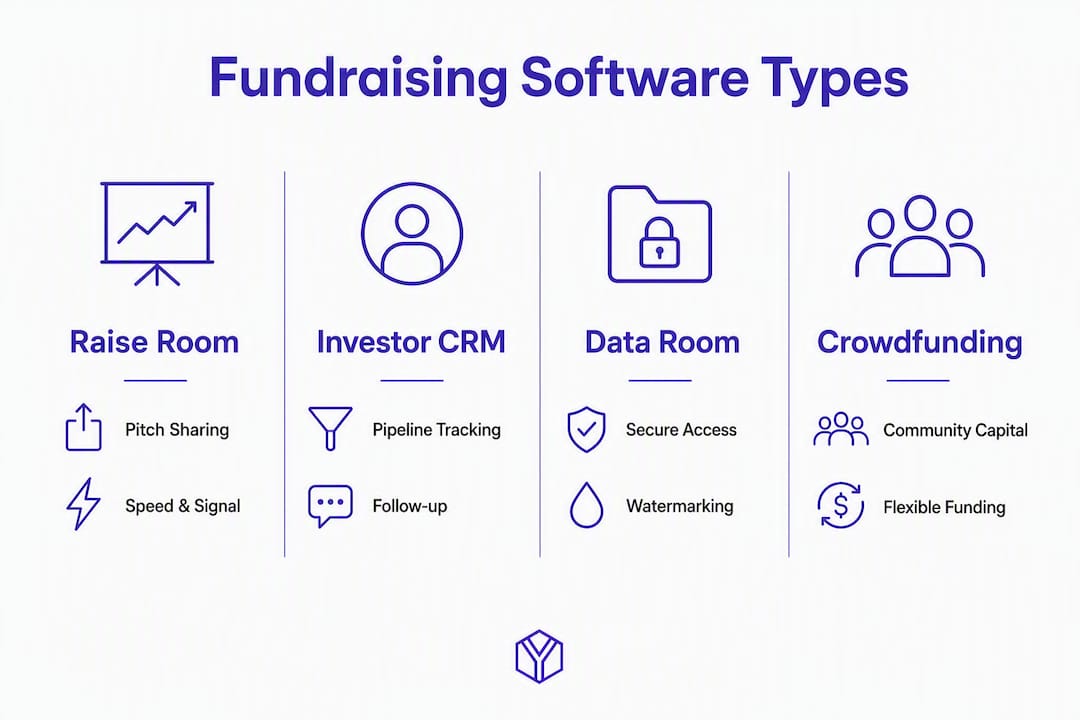
The phrase covers at least five distinct product categories, and conflating them is the most common mistake founders make when evaluating tools. Each category solves a different job.
| Category | Core job it solves | When to use it |
|---|---|---|
| Raise room / deck sharing | Share your pitch deck with per-slide engagement analytics and access controls | Active outreach phase, first investor meetings |
| Fundraising CRM / pipeline | Track investor contacts, deal stages, and follow-up cadence | Throughout the raise, from first outreach to close |
| Fundraising OS | Combine CRM, data room, dashboards, and reporting in one platform | Seed+ rounds with multiple stakeholders and complex workflows |
| Crowdfunding portal | Distribute your raise to a broad investor community under Reg CF or rewards models | Community raises, consumer products, or supplementing a VC round |
| Investor discovery database | Search and filter investors by stage, sector, and check size | Pre-raise research and building your target list |
The trade-offs matter. Raise rooms give you speed and signal quality but don’t replace a CRM. Specialized fundraising CRMs give you deal-focused workflows that general tools like HubSpot or Notion databases can’t match, but they won’t tell you which slide killed your pitch. Crowdfunding portals open distribution to thousands of investors but add compliance overhead and platform fees that can reach 7–8% of funds raised. Investor discovery databases are research tools, not deal-management tools. Separating these categories before you evaluate any vendor saves you from buying the wrong solution.
Pro Tip: Start with a raise room and a lightweight CRM. Add a data room when you get to diligence. Add crowdfunding only if your audience and product type genuinely support it.
What features should you compare across fundraising platforms?
Not all features move the needle equally. Here’s what actually changes outcomes during a raise, ranked by practical impact.
Deck analytics and per-slide engagement
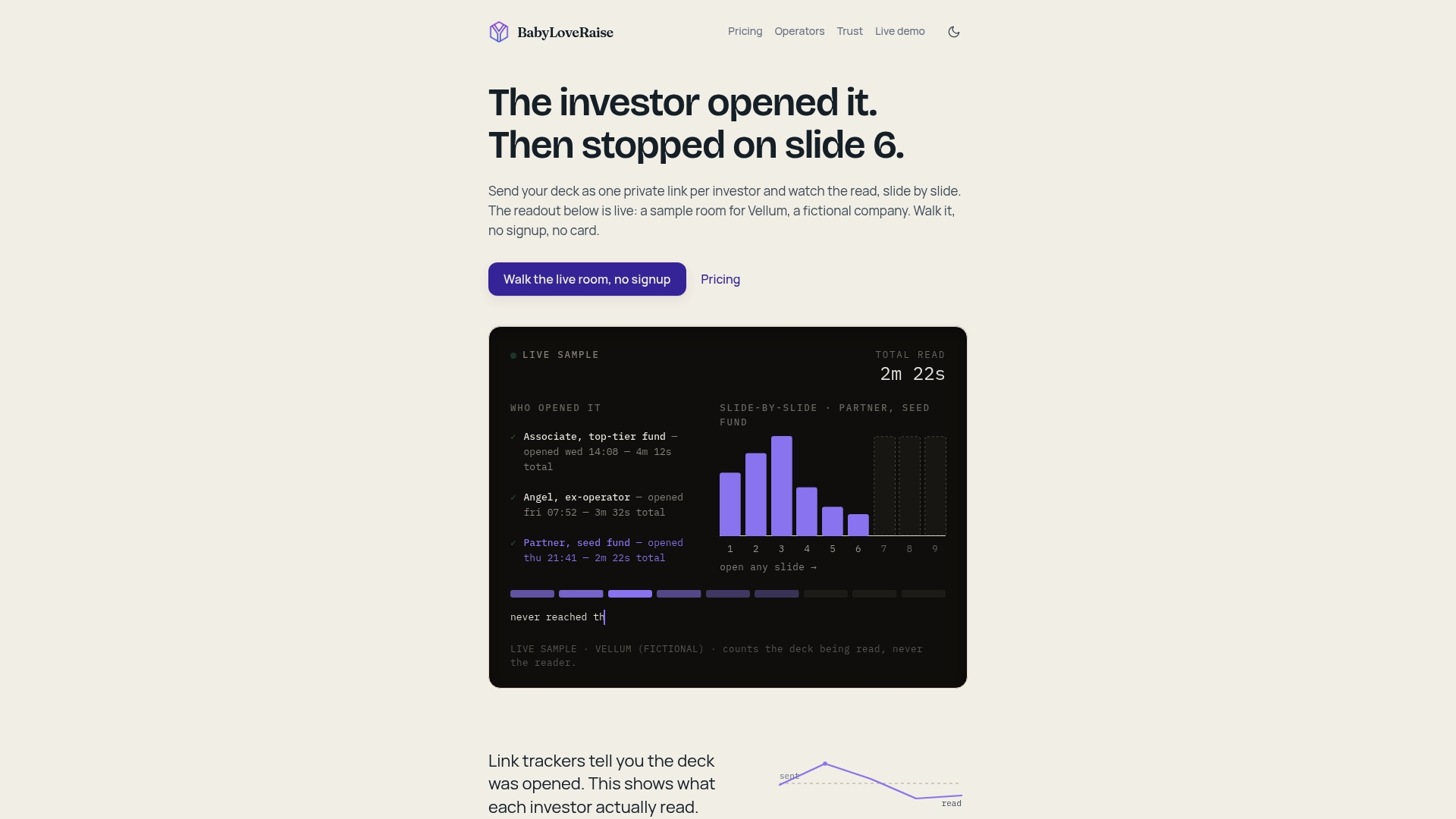
This is the feature most founders underestimate until they’ve run a raise without it. Knowing that an investor opened your deck, spent 45 seconds on the market slide, and skipped the financials entirely tells you more than a non-reply ever could. Investor tracking and engagement metrics are central to managing material sharing during active rounds. Platforms that report only “opened” vs. “not opened” leave you guessing about the quality of the read.

Investor CRM and pipeline management
A spreadsheet breaks down around investor 30. You need stage tracking (contacted, meeting booked, term sheet, passed), follow-up reminders, and a log of every interaction. The CRM should be built around a fundraising deal cycle, not a sales cycle. General CRMs force you to hack the pipeline stages to fit.
Secure data room with access controls
Once an investor asks for diligence materials, you need secure data rooms with access controls, watermarking, and audit trails. A Google Drive folder is not a data room. You need the ability to revoke access, see who downloaded what, and watermark documents so you know if materials leak.

Dashboards and KPI reporting
Investors at seed stage increasingly want to see a live metrics dashboard before they commit. Platforms that let you share a read-only KPI view reduce back-and-forth on data requests.
Investor discovery
Separate from your CRM, you need a way to build your initial target list. Some platforms include searchable investor databases; others integrate with third-party tools. Treat discovery as a research phase, not a feature you need in your deal-management tool.
Integrations and mobile experience
Email sync (Gmail, Outlook), Slack notifications, and calendar integrations reduce manual data entry. Mobile access matters for investors reviewing decks on their phones, so test the investor-facing experience on mobile before you commit to a platform.
Feature checklist for demos and trials:
- Per-slide engagement analytics (not just open tracking)
- Investor pipeline with customizable deal stages
- Access controls: link expiry, revoke access, password protection
- Document watermarking
- Audit trail / activity log
- KPI dashboard or metrics sharing
- Investor discovery or database integration
- Email and calendar sync
- Mobile-optimized investor view
- Data export (CSV or API)
- SOC 2 or equivalent compliance documentation
Pro Tip: At pre-seed, prioritize slide analytics and warm intro tools. At seed and beyond, add a full data room and cap table-compatible document handling before you open diligence.
What pricing models will you see, and what should you budget?
Fundraising software uses four distinct pricing structures, and each one creates different incentives.
Per-raise flat fee charges you once for the duration of a single round. You pay when you’re raising, and the cost stops when the round closes. This aligns the vendor’s incentive with yours: get the round done. BabyLoveRaise uses this model, which means you’re not paying a monthly seat license during the 18 months between raises.
Monthly or annual subscription is the most common model for CRM-style platforms. You pay regardless of whether you’re actively raising. For a founder running a 6-month seed round, a $99/month subscription costs $594 for the raise window, which is reasonable. The risk is that subscriptions continue after the raise closes unless you actively cancel.
Per-seat licensing is common in enterprise data room products. Costs scale with the number of users, which can get expensive when you add legal counsel, advisors, and multiple founders to the workspace.
Platform percentage fees apply to crowdfunding portals. Crowdfunding portals vary significantly in fees and mechanics, and the total cost of a crowdfunding raise includes platform fees, payment processing, and often legal/compliance costs for Reg CF filings. Wefunder, StartEngine, and Republic each publish their fee structures, and founders should model the total cost against the capital raised before committing.
Watch for these red flags in pricing: caps on investor count at lower tiers, charges for data export, per-document fees in data rooms, and surprise legal or escrow fees in crowdfunding contracts.
Practical budget guidance: For a pre-seed raise using a raise room plus a lightweight CRM, expect to spend $200–$600 total for the raise window. A seed round with a full data room, CRM, and KPI dashboard layer might run $500–$1,500 depending on round length and platform choice. Crowdfunding raises add platform fees on top of capital raised, so model those separately.
Free options exist (OpenVC offers free investor discovery; some CRMs have free tiers) but typically cap features, investor counts, or analytics depth. Free is fine for research; pay for the tools that touch active investor relationships.
How does fundraising software fit into a real raise timeline?
The tools you need change as the raise progresses. Here’s the sequence.
-
Pre-raise research (weeks 1–4): Use an investor discovery database or a tool like OpenVC to build your target list. Filter by stage, sector, and check size. Export to a spreadsheet or directly into your CRM. This is also when you prepare your fundraising documents checklist so diligence materials are ready before you need them.
-
Warm outreach and first sends (weeks 4–10): Activate your raise room. Send your pitch deck via a tracked link, not a PDF attachment. Your raise room notifies you on first open and records per-slide attention. Use that data to prioritize follow-ups: investors who read to the last slide get a same-day follow-up; investors who opened and dropped off at slide 3 get a revised deck or a different angle.
-
Pipeline management (ongoing through close): Your CRM tracks every investor through stages: contacted, intro meeting, follow-up, term sheet, passed. Log every interaction. Set follow-up reminders. A digital sales room centralizes materials so investors can return to your deck, financials, and updates without emailing you for a new link.
-
Diligence (weeks 10–20): When an investor signals serious interest, move them into your secure data room. Share due diligence documents in organized folders with access controls and watermarking. Revoke access for investors who pass. Track who downloaded what.
-
Close and post-close: Your raise room archives automatically. Your CRM becomes your investor relations log. Export all data before downgrading or canceling any paid tier.
Workflow ownership: The founder owns the raise room and CRM. Legal counsel owns the data room during diligence. An advisor or fractional CFO can run an Operator-tier white-label room across multiple client raises simultaneously.
Which platforms should you actually consider?
BabyLoveRaise
The recommended starting point for pre-seed and seed founders. BabyLoveRaise gives you a hosted raise room with per-slide engagement analytics: who opened your deck, which slides held attention, and which ones lost it. The dashboard separates “never opened” from “read everything and passed,” so your follow-ups go to actual readers and your deck revisions target the slides where attention dropped. Share links come in three types (first send, forwardable, private), downloads carry a watermark, and the room converts to a free permanent archive when the raise closes rather than locking you behind a paywall.
Pricing is per raise, not per seat. The Operator white-label tier lets fractional CFOs and advisory firms run firm-branded rooms across client raises. Optional concierge services include pitch deck editorial passes and narrative “Build Map” artifacts for founders who want hands-on help.
Ideal for: pre-seed and seed founders running active outreach who want engagement data to drive follow-up decisions. Also fits advisory firms managing multiple client raises.
Visible
Visible is a fundraising OS built for seed and growth-stage companies. It combines investor CRM, pipeline tracking, KPI dashboards, and investor updates in one platform. The update feature is particularly strong: founders can send formatted investor updates directly from the platform, which keeps existing investors engaged and builds a track record for future rounds. Pricing is subscription-based.
Ideal for: seed-stage founders who need CRM, dashboards, and investor updates in one tool.
Foundersuite
Foundersuite focuses on fundraising CRM with an investor database built in. You can search investors, track pipeline stages, and manage outreach from the same interface. It’s a practical choice for founders who want discovery and deal management without stitching together separate tools.
Ideal for: founders at pre-seed or seed who want investor discovery and CRM combined, without a separate database subscription.
Wefunder
Wefunder describes itself as the operating system for fundraising and supports private rounds, Reg CF raises, and syndicate structures. Its community of 1M+ investors makes it a genuine distribution channel for founders who want to supplement a VC round with community capital. The platform handles compliance workflows for Reg CF.
Ideal for: founders running a community or hybrid round alongside a VC raise, or those raising under Reg CF.
StartEngine
StartEngine is one of the largest equity crowdfunding platforms in the U.S., focused on Reg CF and Reg A+ raises. It suits founders with a consumer-facing product and an existing audience who can drive campaign momentum.
Ideal for: consumer product founders with an audience ready to invest, running Reg CF or Reg A+ raises.
Republic
Republic covers equity crowdfunding, crypto token raises, and real estate. For startup founders, its Reg CF infrastructure and investor community make it a credible alternative to StartEngine. Republic also runs a venture arm that occasionally co-invests in campaigns.
Ideal for: founders open to community capital who want a platform with a broader investor mix, including crypto-native investors.
Kickstarter
Kickstarter is rewards-based crowdfunding, not equity. Backers receive a product or perk, not a share in the company. It’s the right tool for consumer hardware, creative projects, or product launches where you want to validate demand and generate pre-orders before approaching investors.
Ideal for: consumer product or creative founders validating demand, not raising equity.
Indiegogo
Indiegogo offers both fixed and flexible funding models (you keep funds even if you miss your goal on the flexible option) and supports hardware, tech, and creative campaigns. Like Kickstarter, it’s rewards-based. The flexible funding option reduces campaign risk but can affect backer trust.
Ideal for: hardware and tech founders who want flexible funding terms and a global backer base.
Six questions to ask every vendor in a demo
Thirty minutes with a vendor rep can tell you almost everything you need to know if you ask the right questions. Here’s the script.
-
“Show me exactly what an investor sees when they open a shared link.” Watch the investor-facing experience live. If it’s clunky, slow, or requires the investor to create an account, that’s friction you’re adding to every send.
-
“How is pricing structured — per raise, per seat, or subscription — and what happens to my data when I downgrade or cancel?” Vendors who can’t answer the data-export question cleanly are a red flag. You need to own your investor list and interaction history.
-
“What compliance documentation do you have — SOC 2, ISO 27001, or equivalent — and how do access controls work for a data room?” For any platform touching diligence materials, this is non-negotiable. Ask to see the actual compliance report, not just a badge on the website.
-
“What integrations do you support natively, and what requires a Zapier workaround?” Native Gmail, Outlook, and Slack integrations save hours. Zapier workarounds break.
-
“Can you show me a case study or reference from a startup at my stage and sector?” A vendor who can’t produce a comparable reference is either new or hasn’t solved your specific problem before.
-
“What does your support SLA look like during an active raise — and is there a human I can reach?” Email-only support with a 48-hour SLA is fine for a CRM. It’s not fine when a data room link breaks the night before a term sheet conversation.
Red flags to watch for: no data export, investor count caps at lower tiers, complicated investor onboarding that requires account creation, unclear handling of cap table documents, and contracts that auto-renew annually without notice.
Quick demo test: ask the vendor to share a sample deck link with you as if you were an investor. Open it on your phone. Note how long it takes to load, whether it requires a login, and whether the experience feels professional. That’s what your investors will see.
Why engagement analytics actually improve your follow-up results
The evidence for engagement-driven follow-up is straightforward. When you know an investor opened your deck and spent time on the team slide but skipped the financials, you have a specific conversation to start: “Happy to walk you through the numbers if that would help.” When you don’t know, you send a generic “just checking in” that reads like every other founder’s email.
Timed follow-ups tied to deck opens and slide views improve reply rates for seed-stage founders when tracked and executed consistently. The mechanism is simple: you’re reaching out when the investor is already thinking about your company, not three days later when they’ve moved on.
How to interpret engagement signals in practice:
- Opened, read to last slide, repeat views: High-intent signal. Follow up within 24 hours with a specific next step (meeting request, data room access).
- Opened, dropped off at slide 3–4: The hook isn’t landing. Revise the problem and solution slides before the next send.
- Opened, spent 8+ minutes on financials: The investor is doing math. Send a one-page financial summary proactively.
- Never opened after 5 days: Try a different channel (LinkedIn, warm intro) or a different subject line. Don’t resend the same link.
The broader industry trend supports this direction. AngelList’s agentic AI fund management features show that platforms are layering AI agents on top of private-market workflows to surface signals faster. For founders, the practical takeaway is that engagement data is becoming table stakes, not a premium feature. Platforms that don’t offer it are falling behind.
Key Takeaways
The single most effective approach to startup fundraising software is to start with a raise room that charges per raise, add a lightweight CRM for pipeline tracking, and layer in a secure data room only when diligence begins.
| Point | Details |
|---|---|
| Start with a raise room | Per-raise pricing aligns cost with your actual raise window, not a perpetual seat license. |
| Prioritize slide analytics | Per-slide engagement data tells you which investors read your deck and which slides need revision. |
| Match the tool to the stage | Pre-seed needs deck analytics and warm intros; seed+ needs a full data room and CRM pipeline. |
| Crowdfunding is strategic, not default | Equity crowdfunding portals add compliance overhead and platform fees; use them when your audience supports it. |
| BabyLoveRaise for raise-room-first | BabyLoveRaise offers per-raise pricing, slide-level analytics, and an Operator tier for advisory firms. |
What most founders get wrong about fundraising software
The conventional wisdom says to pick one platform and run your entire raise through it. That sounds efficient, but it usually means you end up with a tool that does everything adequately and nothing exceptionally well.
The founders who close rounds faster tend to use a small, deliberate stack: a raise room for outreach and engagement data, a CRM for pipeline discipline, and a data room for diligence. Three tools, three jobs, no overlap. The mistake is buying a “fundraising OS” that promises to do all three and then discovering that the deck analytics are shallow, the CRM is generic, and the data room is just a folder structure with a logo on it.
The other thing worth saying plainly: engagement analytics are not surveillance. A well-built raise room reports on the document, not the person. It tells you that slide 7 held attention for 90 seconds, not that a specific named individual spent 90 seconds on it in a way that feels invasive. That distinction matters for how you talk about your tracking setup with investors, and it matters for choosing a platform that handles data honestly.
The per-raise pricing model also deserves more attention than it gets. Most founders evaluate software on monthly cost and don’t think about the total cost across a raise. A $49/month subscription sounds cheap until you realize you’ve been paying it for 14 months because the raise took longer than expected. A flat per-raise fee removes that exposure entirely.
BabyLoveRaise gives you the raise room your pitch deck deserves
Most founders send their deck as a PDF and then wait. They have no idea if the investor opened it, which slides landed, or whether the silence means “not interested” or “still thinking.” BabyLoveRaise fixes that with a hosted raise room that tracks per-slide engagement in real time, so you know exactly where to follow up and exactly which slides to fix.
Pricing is per raise, not per seat, which means you pay for the round you’re running and nothing more. The Operator white-label tier lets advisory firms and fractional CFOs run firm-branded rooms across multiple client raises. Optional concierge editorial passes give founders who want hands-on help a way to get their deck narrative tightened before the first send.
When the raise closes, your room converts to a free permanent archive. No paywall cliff. No scramble to export before your subscription lapses.
Start your raise room and send your next deck with the data to back up every follow-up.
Sources and further reading
- BabyLoveRaise: Investor Tracking Software Guide
- BabyLoveRaise: Fundraising CRM Alternatives
- BabyLoveRaise: What Is a Digital Sales Room?
- BabyLoveRaise: Secure Data Rooms for Startups
- BabyLoveRaise: Investor Follow-Up Strategy for Seed Founders
- BabyLoveRaise: Fundraising Documents Checklist
- BabyLoveRaise: Due Diligence Documents Guide
- BabyLoveRaise: How to Raise Funds for Your Startup
- AngelList Agentic AI Fund Management (Crowdfund Insider)
- Healthcare Startup Investor Pitch Checklist for Founders