
How to Raise Funds for Your Startup: A Founder's Playbook
Discover how can I raise funds for my startup effectively with our playbook. Learn strategies from pre-seed to Series A to secure your capital!
July 28, 2026 · 11 min read

The fastest path to startup capital depends almost entirely on your stage. At pre-seed, that means bootstrapping, friends and family, and angels or accelerators using a SAFE as your instrument. At seed, you’re targeting institutional angels and micro-VCs with real traction data. At Series A, you need revenue, retention, and a story that holds up to a partner meeting. Across all stages, YC’s fundraising guidance makes one thing clear: the goal of any first meeting is to get the next meeting, not to close. Here’s what to do this week:
- Define your raise amount and the milestones it funds (target a sufficient runway, typically over a year, to fund key milestones)
- Prepare your deck, a one-page data snapshot, and a minimal data room
- Build a tiered list of 60–80 investors by stage fit and check size
- Batch your first meetings into a 3–6 week window to create momentum
- Use engagement data (opens, slide-by-slide dwell, last-slide reached) to prioritize follow-ups with BabyLoveRaise
Table of Contents
- How can you raise funds for your startup at every stage?
- Which legal instruments should you use, and what documents do you need?
- What do investors actually expect to see before writing a check?
- What makes a pitch deck actually work?
- How do you build an investor list and run outreach that actually converts?
- How do you use deck engagement data to prioritize follow-ups?
- How BabyLoveRaise turns engagement data into fundraising progress
- What does a realistic U.S. fundraising timeline look like?
- What legal steps should you take before accepting capital?
- Key Takeaways
- What most fundraising guides won’t tell you
- BabyLoveRaise gives your raise room a real-time feedback loop
- Useful sources and templates
How can you raise funds for your startup at every stage?
Not every funding path fits every startup. VC is appropriate only for businesses built for outsized returns; alternatives like bootstrapping, grants, or SBA loans often make more sense for capital-efficient or slower-growth models.
| Funding option | Typical check size | Speed | Dilution | Best stage |
|---|---|---|---|---|
| Bootstrapping / revenue | Varies | Immediate | None | Pre-seed |
| Friends & family | Fast funding | Low–none dilution | Pre-seed | |
| Angel investors | Weeks to months | Low–moderate dilution | Pre-seed / seed | |
| Accelerators | Several months | Moderate equity | Pre-seed / seed | |
| Equity crowdfunding | Variable amounts | Weeks to months | Moderate dilution | Seed |
| Grants / SBA programs | Variable amounts | Weeks to months | None | Any |
| Micro-VC / seed funds | Several hundred thousand to a few million | Weeks to a few months | Moderate | Seed |
| Venture capital | Several million and up | Several months | Significant | Series A+ |
Hardware startups often combine grants with angels early; SaaS companies tend to move faster through angels into seed funds. Accelerators like YC or Techstars compress the timeline and add credibility that pulls subsequent investors.
Pro Tip: Mix sources intentionally. An accelerator check plus an angel syndicate can get you to seed without a priced round, keeping legal costs low and momentum high.
Which legal instruments should you use, and what documents do you need?
SAFEs dominate pre-seed because they reduce negotiation to two variables: valuation cap and discount rate. That means faster closings and lower legal bills compared to priced rounds. Convertible notes add an interest rate and maturity date, which creates pressure neither party usually wants at pre-seed. Priced equity makes sense at seed or Series A when you have enough leverage and capital to absorb the legal overhead.
Your minimum document checklist before you start outreach:
- Clean cap table (no phantom shares, no ambiguous founder equity)
- Incorporation documents (Delaware C-Corp is standard for VC-backed startups)
- IP assignment agreements for all founders and contractors
- Basic financials: P&L, burn rate, and 18-month projection
- SAFE or convertible note template (YC’s open-source SAFE is the industry default)
- A secure data room with organized folders for diligence
Pro Tip: Avoid priced rounds under roughly $1M–$2M. Legal fees for priced rounds can consume a meaningful share of a small raise. A SAFE closes faster and leaves more capital for the business.
What do investors actually expect to see before writing a check?
Investors underwrite measurable risk reduction, not potential. Your job in every meeting is to show which risks are already resolved: product risk, market risk, go-to-market risk, team risk. Narrative alone doesn’t move the needle.
The core evidence investors want:
- Revenue or ARR growth (week-over-week or month-over-month, not just the total)
- Retention and churn (especially net revenue retention for SaaS)
- Pilot conversions and customer references willing to take a call
- Unit economics: CAC, LTV, and payback period, even if rough
- Product adoption signals: daily active users, engagement depth, usage frequency
At pre-seed, investors accept thinner data but still want to see a signal. A handful of paying customers, a waitlist with strong conversion, or a pilot with a named enterprise customer all count. At seed, you need a cleaner ARR story and retention data.
What makes a pitch deck actually work?
A strong deck answers the investor’s questions before they ask them. Slide order matters less than clarity and evidence density. The standard slide checklist:
- One-liner: what you do in one sentence, for whom, and why now
- Problem: specific, quantified pain with a named customer segment
- Product: demo or screenshots, not feature lists
- Why now: market timing, regulatory shift, or technology unlock
- Market size: TAM/SAM/SOM with a bottom-up build, not top-down guesses
- Traction: your best number, front and center, not buried on slide 9
- Business model: how you make money and at what margin
- Ask and use of funds: exact amount, specific milestones it funds
- Team: relevant experience, not just titles
- Financial snapshot: 18-month burn and revenue projection
Common mistakes: burying traction, using market size slides that cite a $50B TAM with no path to capture it, and skipping unit economics entirely. Leave detailed financials, customer contracts, and technical architecture in the data room, not the deck.
Pro Tip: When an investor asks a question you can’t answer in the meeting, turn it into a follow-up: “Great question — let me send you the retention cohort data tomorrow.” That gives you a reason to re-engage and shows you have the data.
How do you build an investor list and run outreach that actually converts?
Warm introductions outperform cold outreach by a wide margin. When cold email is unavoidable, keep it to three sentences: what you do, one traction signal, and a specific ask.
Build your list in tiers:
- Tier A: Your top 15–20 investors by stage fit, check size, and portfolio relevance
- Tier B: 25–30 solid fits where you have some connection or warm path
- Tier C: 20–30 stretch targets or cold contacts to practice with
Run Tier B and C meetings first to sharpen your pitch. Then compress Tier A into a 3–6 week window. Concentrated timelines create the perception of momentum, which pulls investors toward decisions. A focused, well-prepared process typically closes in six to twelve weeks.
For investor tracking and outreach management, a lightweight CRM keeps your pipeline visible and prevents follow-ups from falling through.

Pro Tip: After meeting 1, send a short follow-up within 24 hours: two sentences recapping the key points, one data attachment, and a clear next step. Don’t wait for them to ask.
How do you use deck engagement data to prioritize follow-ups?
Sending a deck and waiting is the worst version of fundraising. Engagement analytics turn that silence into signal.
The workflow:
- Upload your deck to a raise room and send tracked links (not a PDF attachment)
- Flag investors who opened the deck, read past slide 5, and returned for a second view
- Schedule follow-ups within 24–48 hours of a high-engagement open
- For investors who opened but stopped at slide 3, revise that slide before the next send
- Assign follow-up owners if you’re working with an advisor or co-founder
Priority matrix: an investor who opened, reached the last slide, and returned twice is your hottest lead. An investor who never opened is a different problem entirely, probably a targeting or intro quality issue, not a deck problem.
Pro Tip: Run two deck versions simultaneously with different slide 3 treatments. The version that holds attention longer tells you which framing works. Iterate on dropout slides, not the slides investors already love.
How BabyLoveRaise turns engagement data into fundraising progress
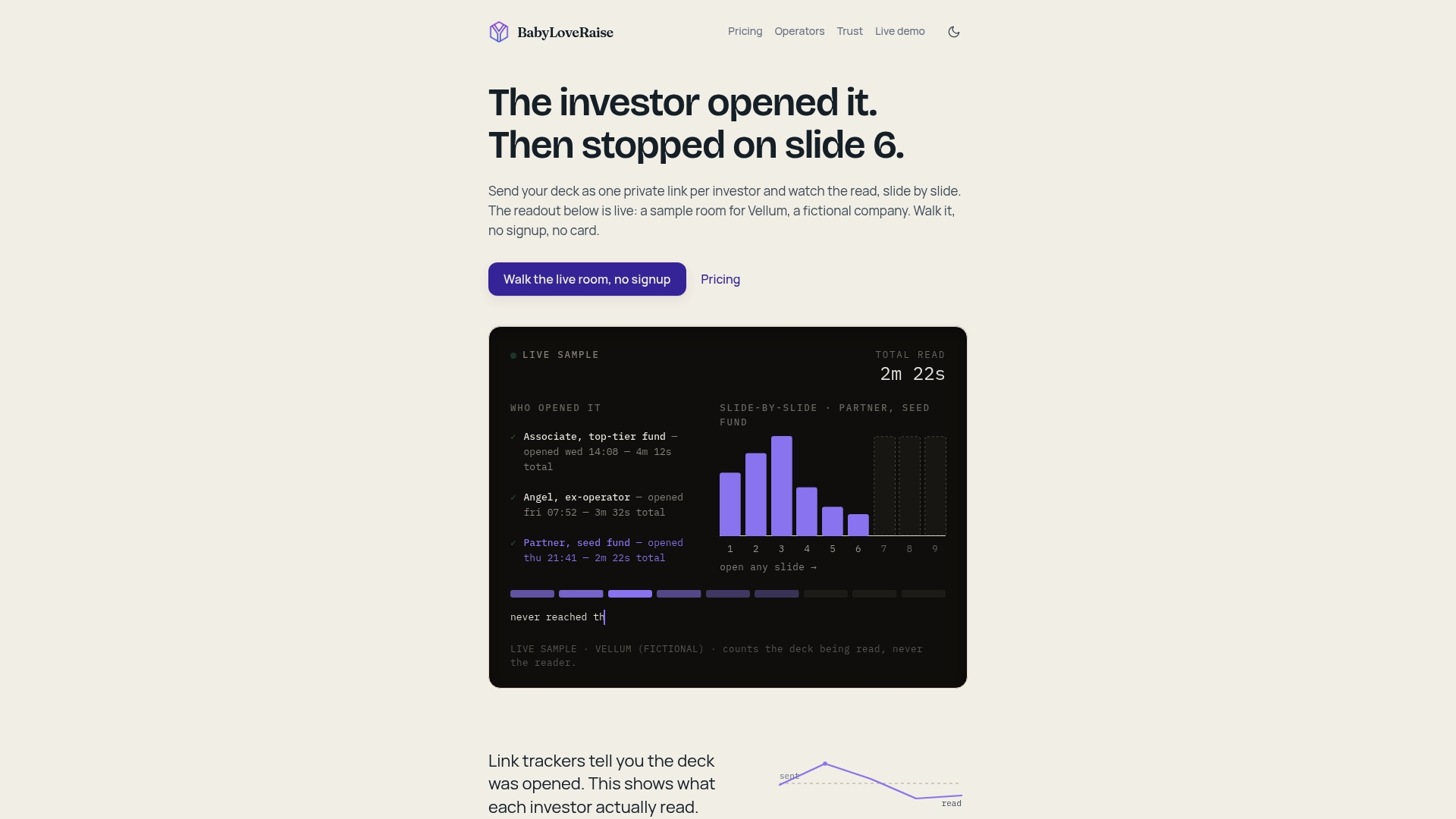
BabyLoveRaise gives founders a hosted raise room: one link replaces the PDF email, and the dashboard shows exactly who opened the deck, how long they spent on each slide, and whether they made it to the end. That distinction between “never opened” and “read everything and passed” changes how you spend your follow-up time.
Key capabilities:
- Per-slide dwell data: see which slides hold attention and which lose it
- First-read notifications: know the moment an investor opens your deck
- Three link types: first-send, forwardable, and private for different stages of the relationship
- Watermarked downloads: track forwarded copies without blocking sharing
- Operator/white-label tier: fractional CFOs and advisory firms run firm-branded rooms across multiple client raises
- Concierge editorial passes: for founders who want hands-on help with deck narrative and structure
When the raise closes, the room converts to a free permanent archive. No paywall cliff, no lost history.
Pricing is per raise, not per seat forever. See the full BabyLoveRaise pricing breakdown to find the tier that fits your raise size.
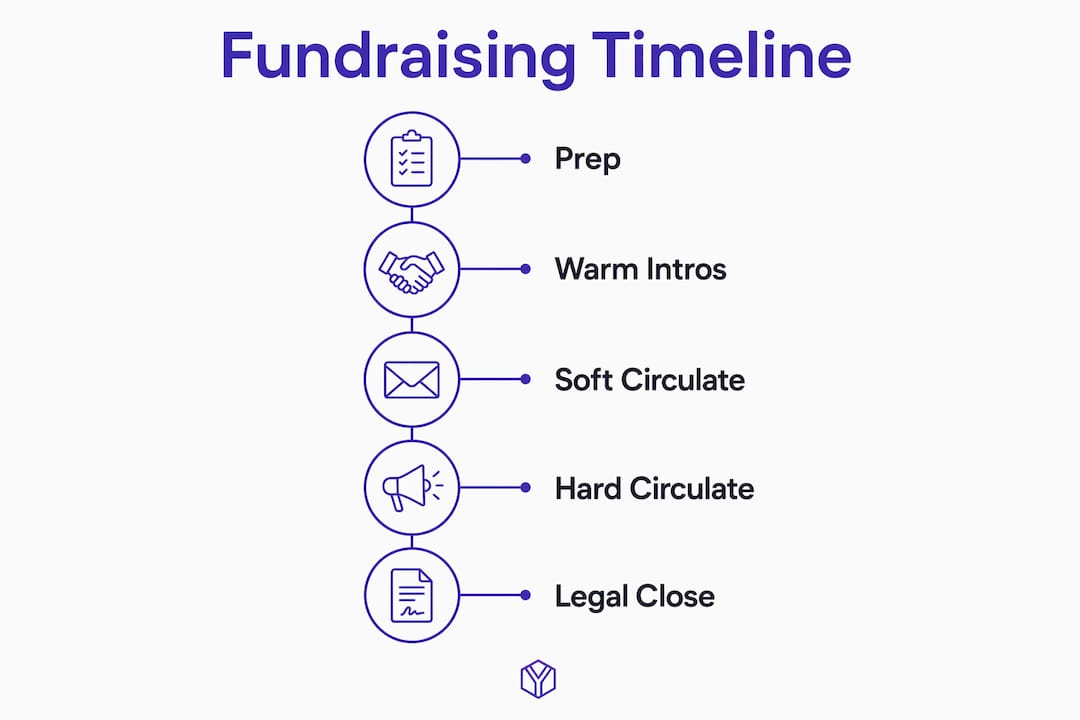
What does a realistic U.S. fundraising timeline look like?
| Phase | Typical duration |
|---|---|
| Prep (deck, data room, list) | 2–3 weeks |
| Soft circulate / warm intros | 1–2 weeks |
| First meetings (batched) | 3–6 weeks |
| Diligence and term sheet | 2–4 weeks |
| Close and wire | 1–3 weeks |
| Total | six to twelve weeks |
Legal costs vary by instrument. A SAFE-based raise typically runs a few thousand dollars in legal fees. A priced seed round can run $15,000–up to fifty thousand dollars or more depending on complexity. Budget for counsel regardless; the cost of a bad term sheet exceeds any legal fee. For financial modeling and burn-rate tracking, an accounting software evaluation can help you pick the right tool before investors start asking for clean numbers.
Pro Tip: Set a soft close deadline (“We’re targeting a close by [date]”) once you have your first committed check. That social proof and urgency pulls subsequent investors toward a decision.
What legal steps should you take before accepting capital?
The legal checklist before you sign anything:
- Confirm your cap table is clean and all equity is properly vested
- Verify IP assignment agreements cover every founder, contractor, and advisor
- Select your instrument: SAFE for pre-seed, convertible note or priced round for seed
- Budget for startup counsel; don’t rely solely on investor-referred lawyers
- Understand VC terms before you negotiate: valuation cap, liquidation preference, pro-rata rights, board composition
Negotiation priorities in order: valuation/dilution first, then board seats, then liquidation preference, then pro-rata rights. Everything else is secondary.
Pro Tip: Never negotiate in real time during a meeting. When a term comes up you’re unsure about, say “Let me review that with counsel and follow up.” Taking requests offline protects you from agreeing to something you’ll regret.
This article is general information, not legal or financial advice. Confirm current rules and instrument terms with a qualified attorney for your specific situation.
Key Takeaways
The single most effective fundraising strategy combines stage-appropriate instruments, batched investor outreach, and engagement data that tells you exactly who to follow up with and when.
| Point | Details |
|---|---|
| Match funding to your stage | Bootstrapping and angels for pre-seed; micro-VCs and seed funds once you have traction data. |
| Use SAFEs at pre-seed | SAFEs close faster and cost less in legal fees than priced rounds for raises under $1M–$2M. |
| Batch meetings in 3–6 weeks | A concentrated timeline creates momentum and typically closes a prepared process in roughly one to three months. |
| Prioritize by engagement | Investors who open, read to the last slide, and return twice are your hottest leads. Follow up within 48 hours. |
| Use BabyLoveRaise to track | Upload your deck to a raise room, monitor per-slide dwell, and let engagement data drive your follow-up sequence. |
What most fundraising guides won’t tell you
The hardest part of any raise isn’t the pitch. It’s closing the first check. Everything before that moment is practice, and everything after it gets easier because momentum is a real force in fundraising. Investors watch each other. A committed lead pulls the next investor faster than any deck slide ever will.
What founders consistently underestimate: the operational side. A messy cap table discovered during diligence has killed deals that were otherwise done. A vague “use of funds” slide signals that the founder hasn’t thought through the plan. And the gap between “we sent the deck” and “we know who read it” is where most raises quietly die.
For advisors running multiple client raises, the white-label operator tier changes the math entirely. Firm-branded rooms across a portfolio of clients, at a fraction of virtual data room pricing, with engagement data that tells you which client’s raise needs attention this week. That’s not a nice-to-have; it’s how you run a professional advisory practice at scale.
BabyLoveRaise gives your raise room a real-time feedback loop
Most founders send a deck and go dark. BabyLoveRaise fixes that. Upload your deck, share a tracked room link, and within minutes you know who opened it, which slides they read, and whether they made it to your ask. That data tells you who to call today and which slide to fix before the next send.
Per-raise pricing means you pay for the raise, not a seat license that runs forever. The Operator console tier lets advisory firms run firm-branded rooms across every client raise. And if your deck needs a narrative overhaul before it goes out, the concierge editorial pass covers that too.
Start your raise room and know exactly who’s reading your deck before your next follow-up call.
Useful sources and templates
- YC’s guide to seed fundraising: the clearest public playbook on meeting cadence, momentum, and what investors actually want
- Carta’s pre-seed state report: data on SAFE usage, legal costs, and instrument norms at pre-seed
- SBA fund your business guide: official U.S. government overview of grants, SBA loans, and non-dilutive options
- Carta’s startup fundraising guide: end-to-end overview of funding types, cap table basics, and diligence prep
- J.P. Morgan startup fundraising overview: practical guidance on warm intros, investor targeting, and relationship-building
- Nav startup loan guide: comparison of SBA microloans, equipment financing, and alternative debt options with typical ranges