
5 Steps to Archive a Deck After a Raise Without SEC Risk for Founders
Counsel aware checklist to archive post raise decks for founders. Preserve final versions, distribution and access logs, and slide analytics for follow up...
October 4, 2026 · 9 min read

A pitch deck archive after a raise is a permanent, access-controlled record that preserves the final deck and the investor engagement data behind it, and it should never be published or opened to the public without counsel review. Handled this way, it gives founders a reference for follow-up conversations, revision priorities for the next round, and a defensible compliance record if anyone ever asks how the raise was run.
TL;DR:
- The pitch deck archive must include the final deck, version history, distribution metadata, and detailed engagement data to reconstruct the raise accurately after a year.
- Keeping access controls tight and routing any public sharing through legal review prevents violating SEC rules and maintains compliance.
- Logging every permission change and maintaining detailed audit trails are essential for security, legal review, and future reference.
- Engagement analytics identify investor interest levels and help prioritize follow-up efforts, especially distinguishing those who viewed the deck fully from those who did not open it.
- Converting the active raise room into a secure, detailed archive involves snapshotting the final materials, exporting logs, and setting strict permissions to preserve context and support future diligence.
BabyLoveRaisebabyloveraise.comKeep Your Raise Record ClearBabyLoveRaise preserves your final deck and engagement context in a permanent archive after the raise closes.Visit BabyLoveRaise
Table of Contents
- What to keep: a checklist for a usable archive
- How SEC guidance shapes archive decisions
- Access models that keep the archive usable and compliant
- Turning engagement analytics into post-raise action
- Converting a closed raise room into a permanent archive
- Retention and recordkeeping that hold up later
- Why I built this around per-raise records, not per-seat software
- How BabyLoveRaise fits the archive checklist
- FAQ
- Sources
What to keep: a checklist for a usable archive
An archive only works if someone can reconstruct the raise from it a year later. That means more than saving the final PDF.
- Final deck and version history: the last version investors saw, plus timestamped snapshots of earlier drafts.
- Distribution metadata: which investor got which link, through which channel, and when.
- Per-slide engagement data: open events, time per slide, and whether each reader finished the deck.
- Investor Q&A and closing documents: email threads, data room questions, and any subscription or acceptance paperwork tied to the deck.
- Access logs and permission changes: who could view the room, when permissions changed, and any confidential-treatment filings tied to the materials.
The table below shows how each record type maps to its purpose.
| Record type | What it captures | Why it matters later |
|---|---|---|
| Final deck and versions | Timestamped snapshots of each draft | Shows what investors actually saw and when it changed |
| Distribution metadata | Recipient, link type, send date | Supports a solicitation and offer analysis if questioned |
| Engagement data | Opens, per-slide dwell, completion | Explains why certain investors were prioritized for follow-up |
| Q&A and closing docs | Investor questions, subscription paperwork | Ties the deck to the actual terms and decisions made |
| Access logs | Permission grants, revocations, filings | Proves who could see what, and when access changed |
Losing any one of these turns the archive into a loose PDF with no context, which defeats the point of keeping it.
How SEC guidance shapes archive decisions
The biggest mistake founders make after closing a raise is treating the archive like a portfolio piece and opening it to anyone with the link. That instinct runs straight into securities law.
Most pre-seed and seed rounds rely on Rule 506(b), which generally prohibits general solicitation, and the SEC’s guidance on offering pathways makes clear that whether a given communication counts as an offer is fact-specific. That is exactly why an archive should default to controlled access rather than public exposure: making a deck publicly viewable after the raise can retroactively complicate the story of who the offer went to and how.
Securities exemptions do not cancel antifraud duties. A practical field guide on securities compliance for private companies notes that issuers still carry Rule 10b-5 antifraud obligations even under a valid exemption, and recommends balanced disclosures, risk summaries, and independent legal review of offering materials.
A workable counsel workflow looks like this:
- Preserve distribution metadata alongside the deck so counsel can reconstruct who received what and when.
- Keep confidential-treatment options open where sensitive terms or metrics are involved, following the SEC’s confidential treatment guidance.
- Route any decision to widen access, especially toward public visibility, through legal review first.
Access models that keep the archive usable and compliant
A good archive balances two goals that pull against each other: easy enough to use internally, locked down enough to avoid an accidental offer to the wrong audience.
- Default to private links. Keep the archive on a private, access-controlled link and reserve forwardable or public registers for cases that genuinely need them.
- Watermark and measure downloads. A visible, measured watermark discourages uncontrolled redistribution and tells you when a download happened.
- Separate marketing from the archive. Keep any public-facing company page distinct from the raise archive so a casual visitor never lands on offering materials.
- Run a post-close permission audit. Revoke stale access, confirm who still holds admin rights, and log every change.
Our internal piece on tiered investor deck confidentiality walks through the three-register model in more detail for founders deciding how open to make each link.
Pro Tip: Treat every permission change, grant or revoke, as a logged event, not a quiet edit. It is the first thing counsel will ask for if questions ever come up.

Turning engagement analytics into post-raise action
The real value of an archive is not storage. It is what the engagement data inside it tells you to do next.
Per-slide analytics split investors into groups that look identical from the outside but mean very different things: someone who never opened the deck, someone who skimmed the first few slides, and someone who read to the end and still passed. Treating those three the same wastes follow-up effort on the wrong people.
- Investors who never opened the link need a different nudge than investors who read every slide and went quiet.
- A 48 to 72 hour follow-up window, timed to actual open and completion events, tends to land while the pitch is still fresh.
- Slides with the steepest drop in dwell time are the ones to rewrite before the next round, not the slides you personally dislike.
The two silences, “never opened it” and “read everything and passed,” look identical until you have the data to tell them apart.
Advisory firms and fractional CFOs running several raises at once get more out of this at the operator level: one dashboard across client rooms turns scattered read signals into a shared view of which decks and which investors need attention this week. Our post on fundraising document analytics and 48-hour follow-up covers the mechanics in more depth.
Converting a closed raise room into a permanent archive
Closing the round is not the end of the deck’s job. Converting the live room into an archive takes a few deliberate steps.
- Lock the final deck. Snapshot the last version and timestamp it so no further edits can slip in unnoticed.
- Export distribution and engagement logs. Pull investor lists, send dates, open events, and per-slide read data before the room’s live settings change.
- Archive Q&A and closing paperwork. Attach investor questions and any subscription or acceptance documents to the same record as the deck.
- Set final permissions. Move the room to a private, access-controlled state and add any counsel-reviewed disclosures the materials require.
- Confirm backup and restore access. Verify that someone other than the original admin can recover the archive if needed.
Our guide to pitch deck version control covers the snapshotting step in more detail for founders setting this up for the first time.
Retention and recordkeeping that hold up later
An archive is only as good as its weakest backup. A few habits make the difference between a usable record and a dead folder nobody trusts.
- Keep distribution logs and access audit trails for as long as practical, since they are cheap to store and expensive to lose.
- Separate the backup from the live archive, and check integrity periodically rather than assuming the copy still opens.
- Document any confidentiality or disclosure decisions at the time you make them, not retroactively.
- Treat the archive as a resource for the next round: a later due-diligence request or dispute is far easier to answer with intact records than with memory.
Why I built this around per-raise records, not per-seat software
Most document-tracking tools treat a fundraise like any other file share. A raise is not a generic document workflow: it has one deck, one narrow window of investor attention, and no second chance to see who actually read it. Pricing and preserving records around the raise itself, instead of a permanent per-seat license, matches how founders and advisory firms actually use the data: hard during the raise, then archived and quiet.
*— Paul
How BabyLoveRaise fits the archive checklist
We offer a way to convert a closed raise room into a permanent archive accessible after the raise. Engagement data, distribution metadata, and access logs from the active raise can carry over into the archive to preserve context.
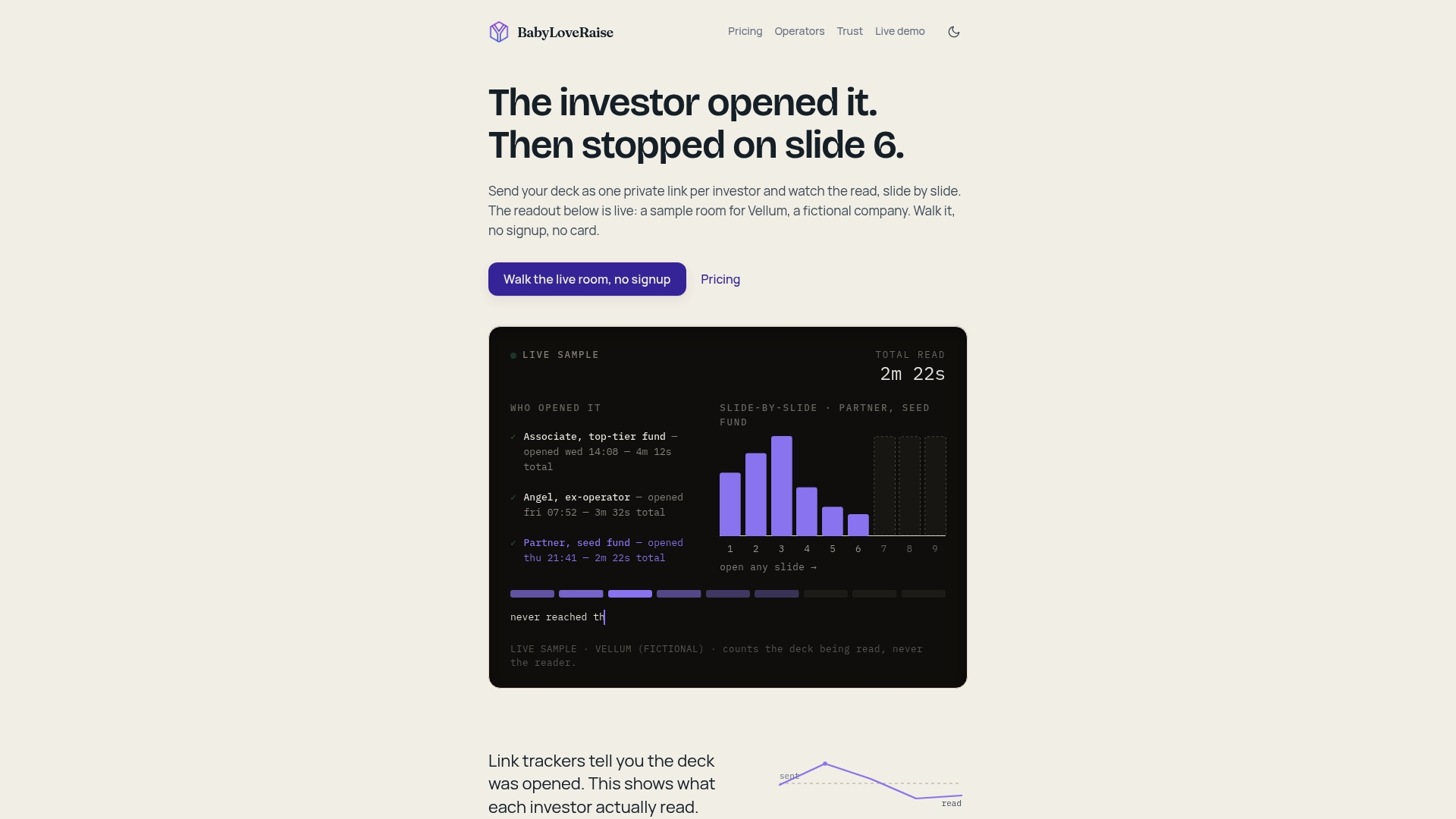
- Per-slide analytics and read-completion data can stay attached to the archived deck, as well as the live room.
- Distribution metadata such as who received a link and when can be preserved with the deck in the permanent record.
- A white-label Operator tier is available to advisory firms and fractional CFOs to manage archive workflows across client raises.
Check current plans on the pricing page, or see how the operator tier works for firms managing multiple raises at once.
This article is general information, not a substitute for advice from a qualified financial advisor. Consult a qualified financial professional about your own circumstances before acting on anything here.
FAQ
What counts as a pitch deck archive after a raise?
It is a permanent, access-controlled record of the final deck, its version history, distribution metadata, and the engagement data showing who opened and read it. A usable archive also includes investor Q&A and closing documents, not just the deck file itself.
Should an archived deck be made public after the raise closes?
No. The SEC’s guidance on offering pathways notes that whether a communication counts as a solicitation or offer depends on the facts, so a controlled, counsel-reviewed archive is the safer default than open public access.
How long should founders keep fundraising distribution and access logs?
Keep them for as long as practical, since storage is cheap and the records are hard to reconstruct later. They support any later due-diligence request and give counsel the facts needed for a solicitation analysis if one is ever required.
How do per-slide analytics help with follow-up after a raise?
They separate investors who never opened the deck from those who read it fully and passed, two outcomes that look the same without data. That distinction lets founders target follow-up and prioritize which slides to revise before the next round.
Can an archived deck be reused for a future fundraising round?
Yes, with a counsel review first since terms, metrics, and disclosures from the prior round may no longer apply. The archive’s version history and engagement data also show which slides need rewriting based on where investor attention dropped last time.
Sources
- SEC: Capital raising building blocks — offering pathways
- Securities compliance for private companies: a practical field guide