
Best DocSend Alternatives for Founders in 2026
Discover the best DocSend alternatives for founders in 2026. Find tailored solutions for fundraising, e-signatures, and document management.
August 4, 2026 · 16 min read

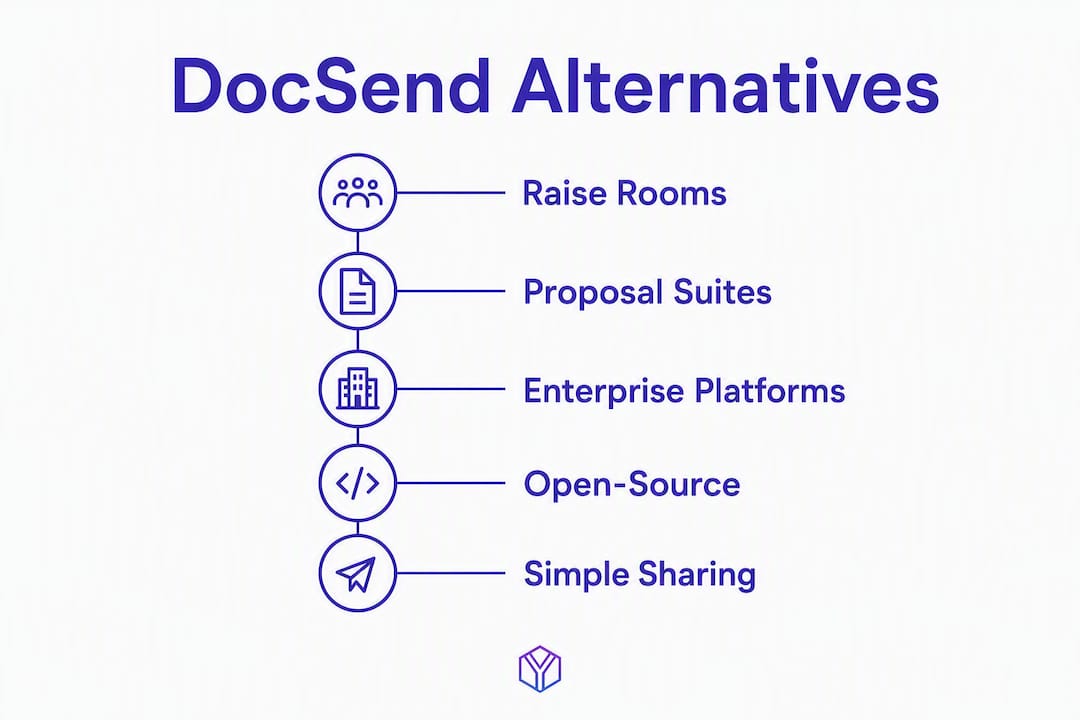
For most pre-seed and seed founders, the right DocSend alternative is a raise room: a hosted, fundraising-focused environment with per-slide engagement analytics, gated access, and deal workflow controls. BabyLoveRaise is built exactly for this. If you need e-signatures as the primary job, a proposal/e-sign suite fits better. If your team manages governance across hundreds of documents, an enterprise content platform makes more sense. For lightweight outreach on a tight budget, simple cloud sharing works, though you lose per-slide telemetry.
Quick decision guide:
- Raise room (BabyLoveRaise): best for pre-seed/seed outreach, per-slide engagement tracking, NDA gating, and post-raise archiving. Priced per raise, not per seat forever.
- Proposal/e-sign suites (PandaDoc, DocuSign, Proposify, GetAccept, Qwilr): best when signing is the primary workflow, not investor analytics.
- Enterprise content platforms (Highspot, Box, SharePoint): best for large teams needing folder governance, compliance, and multi-department access controls.
- Simple cloud sharing (Dropbox): best for zero-budget outreach where analytics are not required.
- Open-source/self-hosted (Papermark, Coneshare): best for security-conscious teams that want full telemetry ownership and have the ops capacity to maintain infrastructure.
Trust signals to require before committing: SOC 2 or ISO certification, a transparent public pricing page, a demo or free trial, and at least one investor-facing case study or published customer logo.
Table of Contents
- Which DocSend alternatives fit your fundraising workflow?
- Short profiles of the top DocSend alternative categories
- How do you choose the right alternative for your raise?
- Why are founders moving from single-link tracking to raise rooms?
- Shortlist of top DocSend alternatives for founders
- How do these platforms integrate with your fundraising stack?
- Key Takeaways
- The raise-room model is the right default, but know its limits
- BabyLoveRaise gives founders a raise room built for the pitch
- Useful sources for verifying features and pricing
Which DocSend alternatives fit your fundraising workflow?
Third-party market roundups now map the replacement market into five distinct categories: raise rooms, proposal/e-sign suites, enterprise content platforms, open-source/self-hosted projects, and simple cloud sharing. The table below uses those category labels so you can filter by what your raise actually needs, not by vendor marketing copy.
| Category | Best for | Pricing model | Analytics depth | Security controls | Integrations | Trial/free tier | Team & scaling |
|---|---|---|---|---|---|---|---|
| Raise rooms | Investor outreach, per-slide engagement, NDA gating | Per-raise or per-room | Per-slide dwell, first-read, viewer identity | Watermarking, link expiry, download revocation | CRM, email, e-sign | Free trial or free tier common | Operator/white-label tier for advisors |
| Proposal/e-sign suites | Contract workflows, proposals, closing docs | Per-seat or per-document | Page views, open/click events | Link controls, audit trail | CRM, e-sign, payment | Free tier or 14-day trial | Team seats, template libraries |
| Enterprise content platforms | Governance, compliance, large-team content ops | Per-seat (annual) | Aggregate content engagement | DRM, folder permissions, SSO | CRM, HRIS, SSO | Demo-only or limited trial | Enterprise SSO, admin console |
| Open-source/self-hosted | Privacy-first teams, telemetry ownership, cost control | Self-hosted (infra cost only) | Per-page tracking, viewer logs | Configurable; depends on deployment | Storage backends (Nextcloud, Google Drive, Dropbox) | Free (open-source) | Scales with infra; no vendor seat limits |
| Simple cloud sharing | Budget outreach, file access, basic link sharing | Freemium or per-seat | File open/download only | Password protection, link expiry | Office suite, email | Free tier standard | Team folders, shared drives |
Quick badges:
- Best for fundraising: raise rooms — per-slide analytics plus NDA gating in one workflow.
- Best for signing workflows: proposal/e-sign suites — DocuSign, PandaDoc, and similar tools own this lane.
- Best for telemetry ownership: open-source/self-hosted — no third party touches your investor data.
- Best for governance at scale: enterprise content platforms — Highspot and Box are built for this.
- Best free starting point: simple cloud sharing or open-source, with the trade-off of limited analytics.
Short profiles of the top DocSend alternative categories
Raise rooms
A raise room is a hosted, branded environment where a founder shares a pitch deck (and later, diligence documents) through a single link that records per-slide engagement, notifies on first read, and supports NDA gating and access revocation. This category is the one most directly built for the investor workflow.
Pros:
- Per-slide dwell time tells you which slides held attention and which got skimmed.
- First-read notifications let you follow up while the deck is still fresh in the investor’s mind.
- NDA gating and watermarking protect sensitive financials before a relationship is established.
- Post-raise archive conversion means you are not paying a recurring seat fee to keep your own records.
Cons:
- Narrower feature set than enterprise platforms; not designed for large-team governance.
- Less useful if e-signatures are the primary job.
Pricing shape: per-raise or per-room subscriptions, which align cost to fundraising activity rather than headcount. This matters for runway modeling.
Proposal and e-sign suites

PandaDoc, DocuSign, Proposify, GetAccept, and Qwilr all sit in this category. They are built around the document-to-signature workflow: create a proposal, send it, track opens, collect a signature. The analytics are real but shallower than raise rooms — you get page-level views and click events, not per-slide dwell curves.
Pros:
- Native e-signature removes a separate tool from the stack.
- Template libraries speed up repetitive proposal creation.
- CRM integrations (Salesforce, HubSpot) are mature and well-documented.
Cons:
- Per-seat or per-envelope pricing can get expensive fast; independent reviewers advise validating envelope quotas before committing because per-transaction costs compound quickly.
- Investor-grade analytics (per-slide dwell, viewer identity verification) are typically absent.
- Not designed for the raise-room workflow of hosting multiple documents with structured investor access.
Free tiers exist on most of these platforms, but they cap envelope volume or remove advanced features. A 14-day trial is the standard entry point.
Enterprise content platforms
Highspot and Box occupy this lane. They are built for large sales and marketing teams that need content governance, folder-level permissions, compliance logging, and SSO. The analytics focus on aggregate content performance across a team, not individual investor engagement on a single deck.
Pros:
- Strong DRM, folder permissions, and audit trails for regulated industries.
- Deep integrations with enterprise stacks (Salesforce, HRIS, SSO providers).
- Scales to hundreds of users without architectural changes.
Cons:
- Annual per-seat contracts make them expensive for a two-person founding team.
- The governance overhead is overkill for a single fundraise.
- Demo-only or limited trial access makes it harder to evaluate quickly.
CB Insights’ competitor mapping confirms these platforms occupy a distinct market niche from fundraising-focused tools, serving buyers whose primary need is governance rather than deal intelligence.
Open-source and self-hosted options
Papermark is the most visible open-source project in this space. Coneshare is another: it layers secure distribution, tracking, and virtual data room features over existing storage backends like Nextcloud, Google Drive, and Dropbox, which lowers the friction of self-hosting if you already have cloud storage in place.
Pros:
- No third party accesses your telemetry or investor data.
- Zero per-seat licensing cost; you pay only for infrastructure.
- Configurable to meet strict organizational security policies.
Cons:
- Requires operational discipline: patching, backups, and secure identity integration are your responsibility.
- Per-slide analytics depth varies by project maturity.
- No concierge support or managed onboarding.
Independent reviews consistently recommend self-hosted options for security-conscious teams and those trying to avoid recurring per-seat costs, but the ops burden is real.
Pro Tip: Self-hosting is worth the ops cost only if your team already runs cloud infrastructure and has someone who can own patching and access management. For a solo founder mid-raise, the distraction cost usually outweighs the savings. Reserve self-hosting for post-raise or for advisory firms with dedicated technical staff.
Simple cloud sharing
Dropbox (outside its DocSend product), Google Drive, and similar services give you file access, basic link sharing, and password protection. They are free or near-free and require no setup.
The trade-off is direct: market writeups consistently flag that free cloud-sharing options lack per-slide telemetry and advanced security controls. You know a file was opened; you do not know which slides were read, for how long, or by whom. For a founder trying to prioritize investor follow-ups, that gap is significant.
How do you choose the right alternative for your raise?
The selection logic starts with one question: what is the primary job this tool needs to do during your raise?
- Single-deck outreach to investors → raise room with per-slide analytics.
- Proposal creation and contract signing → proposal/e-sign suite.
- Due diligence document governance → enterprise content platform or secure data room.
- Budget-constrained lightweight sharing → open-source/self-hosted or simple cloud sharing.
Analyst-leaning comparisons stress matching tool categories to the fundraising job-to-be-done rather than chasing feature parity. A tool with 50 features you do not need is not better than one with 10 that fit your workflow exactly.
Questions to ask in any vendor demo (in priority order):
- Can you show per-slide dwell time on a live deck, not just total time spent?
- How does viewer identity verification work — email gate, NDA gate, or link-level password?
- Can I update the document after sending the link without breaking the link?
- What happens to my data when I cancel? Can I export the full audit trail?
- Does the platform integrate with my CRM (HubSpot, Salesforce, Affinity) natively or via Zapier?
- What is the pricing model on a sample volume: 50 investor sends, 3 documents, 2 team members?
- Where is the SOC 2 report? Can I request it during the sales process?
Red flags to walk away from:
- Opaque per-view fees that compound unpredictably as your investor list grows.
- No audit trail or the audit trail is not exportable.
- No watermarking or link revocation controls on a platform marketing itself as “secure.”
- The vendor owns your telemetry data and the terms of service are vague about how it is used.
- No published security certification and no willingness to share a SOC 2 report on request.
Trust signals to prefer: a public pricing page with clear per-raise or per-seat breakdowns, published SOC 2 or ISO mentions, at least one investor-facing case study, and concierge or dedicated onboarding for the raise workflow specifically.
Why are founders moving from single-link tracking to raise rooms?
The dominant shift in founder tooling is consolidation: instead of sending a single tracked link and managing follow-ups in a spreadsheet, founders now want a branded room that hosts the deck, diligence documents, and investor updates in one place. The room creates a more professional investor experience and gives the founder a single dashboard to manage the whole raise.
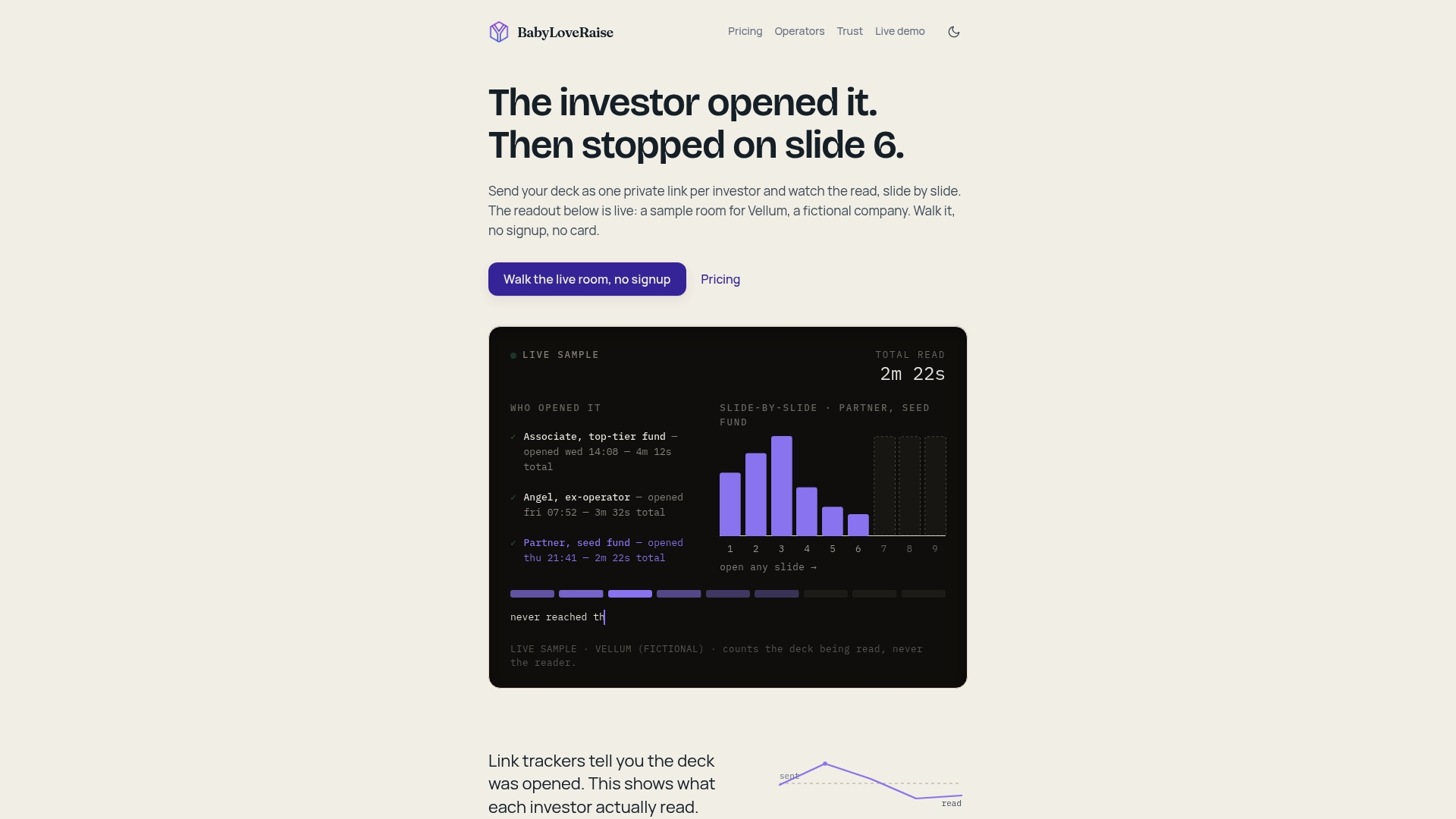
The drivers are practical. Legacy single-link viewers treat a fundraise like any file share: you get an open notification and a page count. What founders actually need is the difference between “never opened it” and “read every slide and passed” — two silences that look identical in a basic link tracker but require completely different responses. Per-slide dwell time makes that distinction visible.
Rising per-seat subscription costs on legacy platforms have also pushed founders to look for alternatives that align pricing to fundraising activity rather than headcount. A per-raise model means you pay when you are raising, not indefinitely.
BabyLoveRaise is built around this pattern. Per-slide dwell analytics, first-read notifications, NDA gating, watermarked downloads, and three link registers (first send, forwardable, private) are all native to the raise workflow. The Operator tier extends this to fractional CFOs and fundraising advisory firms running multiple client raises under a firm-branded room, at a fraction of virtual-data-room pricing. When the raise closes, the room converts to a free permanent archive rather than disappearing behind a paywall.
Security-focused reviews confirm that viewer verification and tracked sharing are legitimate, expected features in investor workflows — the question is not whether to use them, but whether the platform’s security posture is verifiable. For founders sharing financial projections and cap tables, that verification matters. You can read more about ethical pitch deck tracking and what “reporting on the document, not surveilling the person” means in practice.
Use cases where the raise-room model fits best:
- Pre-seed and seed outreach to a targeted investor list.
- Due diligence bundles where multiple documents need structured, gated access.
- Advisory firms managing 5–20 client raises simultaneously under a white-labeled brand.
Shortlist of top DocSend alternatives for founders
The G2 alternatives list and GetApp’s 2026 comparison both surface the same names repeatedly. Here is how each one maps to a founder’s actual needs.
BabyLoveRaise is the raise-room option built specifically for pre-seed and seed fundraising. Per-slide analytics, first-read notifications, NDA gating, and a per-raise pricing model make it the tightest fit for founders who need investor-grade engagement data without paying a per-seat fee indefinitely.
Papermark is the leading open-source alternative. It supports per-page tracking and custom domains, and it can be self-hosted for full telemetry ownership. The trade-off is operational: you own the infrastructure.
PandaDoc leads the proposal/e-sign category. It has a polished template library, native e-signature, and strong CRM integrations. Analytics are proposal-level, not per-slide. A free tier exists with limited features.

DocuSign is the e-signature standard. If closing documents is the job, nothing beats its legal recognition and integration breadth. It is not a pitch deck analytics tool.
Dropbox (the storage product, not DocSend) gives you file sharing and basic link controls. Free tier is generous. Analytics are minimal: open and download events only.
Qwilr turns proposals into interactive web pages with embedded analytics. Useful for sales teams and advisors who want a branded, interactive proposal experience. Less suited to raw deck sharing with per-slide dwell.
Proposify is a proposal workflow tool with approval routing and template management. Strong for teams that send many proposals; lighter on investor-specific analytics.
GetAccept combines document tracking, e-signature, and video messaging in a sales engagement wrapper. The video feature is genuinely differentiated for founders who want to attach a personal message to a deck send.
Highspot is an enterprise sales enablement platform. Content governance, playbooks, and team analytics are its strengths. The cost and complexity are enterprise-grade.
Box is a cloud content management platform with strong DRM, folder permissions, and compliance tooling. It is the right choice for due diligence governance at scale, not for a two-person founding team sending a first deck.
For founders building a healthcare startup pitch, the compliance requirements around what you share and with whom make security controls and audit trails especially important when choosing any platform on this list.
How do these platforms integrate with your fundraising stack?
Integration depth varies sharply by category, and it matters more than most founders realize at the start of a raise.
CRM integrations are the most commonly requested. Proposal/e-sign suites like PandaDoc and GetAccept have native Salesforce and HubSpot connectors that log document activity directly to contact records. Enterprise platforms like Highspot and Box integrate deeply with Salesforce and HRIS systems. Raise rooms typically integrate via Zapier or native webhooks, pushing first-read events and engagement data to your CRM of choice.
Deal management tools like Affinity, Notion, and Airtable are common in early-stage fundraising stacks. Most platforms in this space connect via Zapier or direct API. When evaluating, ask specifically whether the integration is bidirectional: can a CRM contact trigger a room invite, and does a room open event update the CRM record automatically?
E-sign integrations matter if you are using a raise room for outreach but need a separate tool for term sheets and SAFEs. BabyLoveRaise focuses on the outreach and analytics layer; for signing, pairing it with DocuSign or a similar tool covers the full workflow without forcing a single platform to do everything.
Email integrations are table-stakes. Every platform on this list supports sending links via email. The differentiator is whether the platform logs email-level engagement (did the investor open the email, not just the document?) and whether that data surfaces in the same dashboard as document analytics.
Storage backend integrations matter most for open-source/self-hosted options. Coneshare, for example, supports Nextcloud, Google Drive, and Dropbox as storage backends, which means you can layer secure tracking over storage you already own rather than migrating files to a new platform.
For a deeper look at how virtual data room software handles integrations at the due diligence stage, the feature differences between raise rooms and full VDRs become relevant once you move past initial outreach.
Key Takeaways
For most early-stage founders, a raise room with per-slide analytics is the most direct replacement for DocSend, and BabyLoveRaise’s per-raise pricing model is the most cost-aligned option for active fundraising.
| Point | Details |
|---|---|
| Match tool to job-to-be-done | Raise rooms fit investor outreach; e-sign suites fit signing workflows; enterprise platforms fit governance. |
| Require per-slide analytics in the demo | Ask to see per-slide dwell time in the first 10 minutes — if the vendor cannot show it, the feature is not production-ready. |
| Verify security documentation | Request a SOC 2 report or ISO certification before sharing financials or cap table data. |
| Confirm pricing on real volume | Model the cost at typical investor send volumes and document counts; per-seat fees compound faster than per-raise fees. |
| BabyLoveRaise for pre-seed/seed | Per-raise pricing, per-slide dwell analytics, NDA gating, and a free post-raise archive make it the tightest fit for early-stage outreach. |
The raise-room model is the right default, but know its limits
Most founders shopping for DocSend alternatives are solving the wrong problem. They are looking for a cheaper link tracker when what they actually need is a clearer signal about investor intent. Per-slide dwell time is not a vanity metric — it tells you whether the investor who “opened the deck” spent 45 seconds on the team slide and closed it, or read every slide twice and lingered on the financials. Those are different conversations.
The conventional wisdom is to pick the tool with the most features. The smarter move is to pick the tool whose analytics match the decisions you actually need to make during a raise: who to follow up with, which slides to fix, and when to update the deck without breaking every link you have already sent.
That said, raise rooms are not the answer for every workflow. If your primary job is getting a term sheet signed, a proposal/e-sign suite is faster and cheaper. If you are managing a 200-document due diligence process for a Series B, a full VDR is the right call. The mistake is using an enterprise governance platform for a 15-slide seed deck, or using a basic link tracker for a raise where investor engagement data would change your strategy.
For advisors running multiple client raises, the Operator tier model (white-labeled rooms across clients, single console) is genuinely underused. Most fractional CFOs are still sending PDFs via email and tracking opens in a spreadsheet. A branded room per client raise, with per-slide analytics and a post-raise archive, is a meaningful upgrade to the service offering.
One practical tip: before you commit to any multi-seat annual contract, run one raise on a per-raise plan. The data you collect in that raise will tell you exactly which features you actually use, which makes the next procurement decision much easier.
BabyLoveRaise gives founders a raise room built for the pitch
If you have been running your raise with a PDF attachment or a Drive link, you are missing the signal that changes how you follow up. BabyLoveRaise gives you a hosted raise room where every investor send is tracked at the slide level: who opened it, which slides they read, and where attention dropped. First-read notifications arrive in real time, so follow-ups land while the deck is still in front of them.
The pricing model is per raise, not per seat indefinitely. When the raise closes, the room converts to a free permanent archive. The Operator tier lets fundraising advisors and fractional CFOs run firm-branded rooms across all client raises from a single console, at a fraction of what a traditional virtual data room costs. Optional concierge services, including pitch deck editorial passes and narrative Build Map artifacts, are available for founders who want hands-on help before the deck goes out.
BabyLoveRaise is built for pre-seed and seed founders who need investor-grade analytics without a per-seat contract that outlasts the raise. See the plans and start a raise room at BabyLoveRaise pricing.
Useful sources for verifying features and pricing
Before committing to any platform, verify security certifications and pricing directly on vendor pages or request a SOC 2 report during the sales call. Published review aggregators are useful for cross-checking feature claims, but pricing pages change frequently.
- G2 DocSend Alternatives (2025): the most comprehensive user-review aggregator for this category; use it to cross-check G2 ratings and read verified buyer reviews before shortlisting.
- GetApp DocSend Alternatives (2026): useful for filtering by feature category and reading structured comparisons; includes free-alternative filters.
- Tolodora: 6 Best DocSend Alternatives in 2026: a category-level roundup that maps platforms to buyer needs; good for validating which category fits your workflow.
- Secret: 13 Best Alternatives to DocSend: strong on open-source and self-hosted options; use it to evaluate Papermark and similar projects, and to check envelope/usage quota notes on e-sign suites.
- EasyVC: 10 DocSend Alternatives in 2025: analyst-leaning writeup that emphasizes job-to-be-done matching; useful for the how-to-choose framework.
- CB Insights: DocSend Alternatives & Competitors: market intelligence mapping of vendor categories and buyer segments; use it to understand where each platform sits in the competitive landscape.
- Coneshare on GitHub: the open-source repo for self-hosted secure sharing with storage backend integrations; use it to evaluate self-hosting feasibility and supported backends.
- Nudge Security: DocSend Security Profile: independent security posture review; use it to understand what security checks to run on any document-sharing platform before sharing sensitive fundraising materials.