
Founders: Build a 40–50 Investor Target List With Deck Engagement
Seed and Series A founders: build a 75–100 longlist, prune to 40–50 active targets, score and sequence outreach, and prioritize follow up using per slide...
October 7, 2026 · 13 min read

Build an investor longlist of 75 to 100 names, prune it to a working shortlist of about 40 to 50 active targets, and run that shortlist through a five-step workflow: define qualifying criteria, build the longlist, qualify and score, tier and sequence outreach, then track and prioritize based on real engagement. Warm paths and quality filters matter more than raw volume at every stage.
TL;DR:
- Building a list of 75 to 100 investors and narrowing it to 40-50 targeted prospects is optimal for seed and Series A fundraising.
- Verifying lead investor status and warm introduction routes before outreach significantly improves success chances and saves time.
- Focusing on high-conviction, high-quality investors with strong warm paths yields better conversion rates than targeting well-known firms indiscriminately.
- Tracking engagement signals, such as deck opens and slide dwell time, enables smarter follow-up and priority setting during the raise.
- Maintaining a tiered outreach sequence, starting with top-tier targets and staggering contacts, accelerates momentum and competitive tension in the round.
BabyLoveRaiseTurn Deck Engagement Into ActionSee who opened, finished, or skimmed your deck, then focus follow-ups and revisions on the signals that matter.
- ✓First-read notifications
- ✓Per-slide engagement records
- ✓Target list of investors who finished
- ✓Measured watermark downloads
Table of Contents
- Define qualifying criteria before you start naming investors
- Build the longlist, then prune it into a real shortlist
- Research tools and warm-intro mapping that go beyond a firm’s name
- Tier your list and sequence outreach to build momentum
- Track engagement signals and let real data drive your follow-up
- What experienced founders get wrong about their investor list
- BabyLoveRaise turns deck engagement into a follow-up decision
- FAQ
- Sources
Define qualifying criteria before you start naming investors
Building an investor list without criteria is the fundraising equivalent of hiring without a job description. You end up with a pile of impressive names, half of whom cannot write the check you need and a third of whom do not even lead rounds at your stage. Practitioners who help founders build target lists recommend treating investor selection like a hiring process: set the filters first, then search.
Apply these filters in order, and drop any investor who fails an early one before you waste time checking the rest:
- Stage fit: does this fund invest in seed or Series A rounds right now, not two funds ago?
- Check-size math: can their typical check cover a meaningful piece of your round without over-concentrating their fund?
- Lead status: have they actually led a deal at your stage recently, or do they only follow?
- Sector conviction: have they made a thesis-driven bet in your space, not just a one-off opportunistic check?
- Portfolio conflicts: do they already back a direct competitor?
- Warm path availability: is there a credible introduction route, or would this be cold outreach?
Check size is easier to estimate than founders assume. A fund typically deploys 10 to 20 unique investments per vehicle with reserves held back for follow-on rounds, so dividing fund size by the number of partners and expected deal count gives a rough per-check range. A $150 million seed fund with four partners aiming for 25 initial checks is likely writing something in the $1 million to $3 million range, not $200,000 and not $10 million.
Lead versus follower status is the single most misjudged filter. Fundraising practitioners note that verifying whether a fund or partner actually leads deals at your stage outperforms relying on their stated thesis, and pitching the wrong person can close a firm to you for the entire round.
One guardrail belonging inside this criteria stage, not bolted on later. How you can legally approach investors shapes who belongs on your list at all. Under SEC guidance on general solicitation, Rule 506(b) of Regulation D prohibits public, non-selective advertising of a private offering, which means most seed and Series A rounds raised under 506(b) need to come through warm introductions or pre-existing substantive relationships rather than cold mass outreach or public posts asking for investors. Rule 506© permits general solicitation, but only if every purchaser is a verified accredited investor, which adds verification overhead most early-stage rounds skip. Demo days can be used without triggering general solicitation, but only when the event’s sponsors and advertising meet the SEC’s specific criteria, including not referencing a particular offering in promotional materials. This is why warm-path availability belongs in your criteria matrix from day one, not as an afterthought.

Build the longlist, then prune it into a real shortlist
Start wide, then cut hard. A longlist of 75 to 100 names gives you enough raw material to survive the qualifying process and still land on roughly 40 to 50 active targets, a range that fundraising practitioners treat as the sweet spot for seed and Series A rounds. Some founders think in terms of needing roughly 100 times their target round size in total addressable investor capital represented on the list, a rough sanity check rather than a formula, since actual check sizes and ownership targets vary by fund.
Score every name on your longlist against the same rubric so bias does not creep in deal by deal. A simple weighted matrix works:
- Stage fit (pass or fail, no partial credit)
- Lead history at your stage (weighted heavily, since this predicts whether a pitch converts to a term sheet)
- Warm path strength (direct intro, weak second-degree, or cold)
- Check size alignment (does their typical check cover a useful share of the round)
- Sector conviction (thesis match, demonstrated by recent deals, not website copy)
- Network strength (board seats, co-investor relationships, follow-on reputation)
Practitioners who specialize in this process emphasize that a smaller, high-conviction list consistently outperforms a large undifferentiated one, both in conversion rate and in how well the relationship survives a no.
Pruning happens in rounds, not one pass. First cut anyone who fails stage fit or lead status outright, that alone often removes a third of the longlist. Second cut ranks what remains by warm path and conviction score, dropping anyone below your acceptance threshold (most founders set this around a 6 out of 10 on a simple composite score). What survives becomes your active 40 to 50. Names that score well but lack a warm path do not get deleted, they move to a Tier 3 bucket for later cold outreach or demo-day introductions if your primary list stalls.

Timing matters here. Guidance on building a seed-round target list suggests a discovery sprint lasting a couple of weeks to surface raw names, followed by a pruning cycle of similar length to score and finalize the shortlist, after which you close the discovery window and start Tier 1 outreach. Leaving discovery open indefinitely only delays the work that actually moves a round forward.
Pro Tip: Keep your Tier 3 list alive in a separate CRM view instead of deleting it. Market shifts and new warm intros can promote a name back to active status weeks into your raise.
Research tools and warm-intro mapping that go beyond a firm’s name
A firm’s name on a list is nearly useless without the partner who would actually champion your deal inside their investment committee. No single database gets you there alone, which is why the research step blends free tools, paid databases, and plain reading.
- Free starting points: Crunchbase, AngelList, and fund portfolio pages establish who invests in your space and at your stage.
- Paid complements: investor databases with contact enrichment and deal-history tracking fill in the check-size and lead-status gaps that free tools miss.
- Partner-level signals: recent deal announcements, partner blog posts, and podcast appearances reveal what a specific partner is excited about right now, which practitioners find more predictive of genuine interest than a fund’s published thesis page.
- Portfolio founder signals: reaching out to founders already backed by a target firm tells you how that partner behaves post-investment, not just pre-investment.
Network mapping is where most of your warm paths surface. Run your own LinkedIn second-degree connections against your shortlist, check alumni networks from your school or past employers, and look at which angel groups or demo-day sponsors overlap with your sector. Research on investor access points finds that warm introductions materially outperform cold outreach as an access path, enough that most experienced founders treat cold email as a Tier 3 fallback rather than a primary channel. For founders looking to build the kind of real, ongoing relationships that generate these introductions in the first place, practical startup networking tactics are worth studying alongside the fundraising-specific advice.
Document every warm path the moment you find it, not when you are ready to send the pitch. A simple CRM field for “intro source” and “intro strength” (direct, weak second-degree, cold) lets you sort your Tier 1 list by access quality instead of guessing from memory which contacts are strong.
Tier your list and sequence outreach to build momentum
Treat your shortlist as three tiers, not one undifferentiated pile. Tier 1 is your top 10 to 15 targets: strong warm paths, confirmed lead status, high conviction scores. Tier 2 is the next 20 to 25: solid fit but weaker intro paths or less certainty on lead status. Tier 3 is everything else that survived pruning but needs more warming up or falls back to cold outreach.
- Launch Tier 1 first, in a compressed window. Reach out to all 10 to 15 within a one to two week sprint so responses land close together, creating the kind of competitive tension that produces term sheets rather than a slow drip of isolated conversations.
- Follow with Tier 2 about a week behind Tier 1. This staggered start means Tier 2 conversations can reference early Tier 1 momentum without looking rushed or desperate.
- Hold Tier 3 in reserve until you see how Tier 1 and Tier 2 respond, promoting names up as warm paths materialize or demand outpaces supply.
Cadence within each tier should be deliberate. Warm intros get a direct ask within days of the connection being made, since momentum fades fast. Cold outreach, when it is unavoidable and compliant with your offering exemption, gets no more than two to three touches spaced a week apart before you move on. Automation tools exist for high-volume cold outreach, but applying that kind of volume tactic to investor outreach usually backfires, since investors notice templated cadences and a fundraise depends on relationships, not reply rates.
Set a clear removal rule: if a Tier 1 or Tier 2 prospect goes three touches without a substantive response, move them to a passive list and stop active pursuit. Chasing non-responders burns time better spent on Tier 2 and Tier 3 promotion, and a long tail of unanswered follow-ups signals weakness rather than persistence.
Pro Tip: Save your single strongest Tier 1 investor for the second wave of outreach, not the first. A slightly delayed start on your best prospect lets you walk into that conversation with early momentum already visible.
The entire point of sequencing is to avoid leaking momentum: a trickle of outreach over two months reads very differently to investors than a concentrated sprint that produces three term-sheet conversations in the same week.
Track engagement signals and let real data drive your follow-up
Your CRM needs more than a contact name and a status field. For every investor on your active list, record the source of the contact, the intro path and its strength, the date and content of the last touch, the current pipeline stage, and your own conviction score for how likely they are to lead. A spreadsheet-based CRM template with three tabs, weekly review cadence, and dedicated deck-engagement fields covers this without requiring a dedicated sales tool.
Engagement signals matter as much as the contact record itself:
- Deck opened at all: confirms the material reached the right inbox and was not buried.
- Time spent on specific slides: flags which part of the pitch held attention versus which got skimmed.
- Deck finished to the last slide: suggests genuine evaluation rather than a glance.
The hard problem in self-tracked fundraising is that silence reads the same whether an investor never opened your deck or opened it, read every slide, and quietly passed. Per-slide engagement tracking separates those two states, turning an ambiguous non-response into two distinct actionable categories.
The practical consensus is clear on market conditions making this precision matter more. Carta’s 2025 private markets data shows total closed rounds fell to a six-year low even as total capital raised rose, meaning fewer, larger deals and more competition for a limited set of active checks, so wasted follow-up effort on non-readers carries a higher opportunity cost than it did when rounds were more plentiful.
Triage follows directly from the signal: investors who opened and finished the deck get an immediate, substantive follow-up within 48 hours, since tracked share links paired with a fast response window convert warm attention before it cools. Non-openers get a lighter, distinct cadence, a brief nudge rather than a full follow-up, since re-sending the same pitch to someone who never engaged rarely changes the outcome.
What experienced founders get wrong about their investor list
The most common mistake is chasing brand-name funds that do not actually lead at your stage, a vanity pursuit that costs weeks for a maybe. A close second is skipping the criteria step entirely and researching names before deciding what makes a name worth researching. Outreach fatigue follows naturally when a list has no tiers, since every name feels equally urgent.
The founders who raise efficiently run a short weekly list review, revise their deck between tiers rather than mid-sprint, and track engagement KPIs instead of gut feel. A single generous check from the wrong partner causes more damage at the board table than a smaller check from someone who fits long-term.
— Paul
BabyLoveRaise turns deck engagement into a follow-up decision
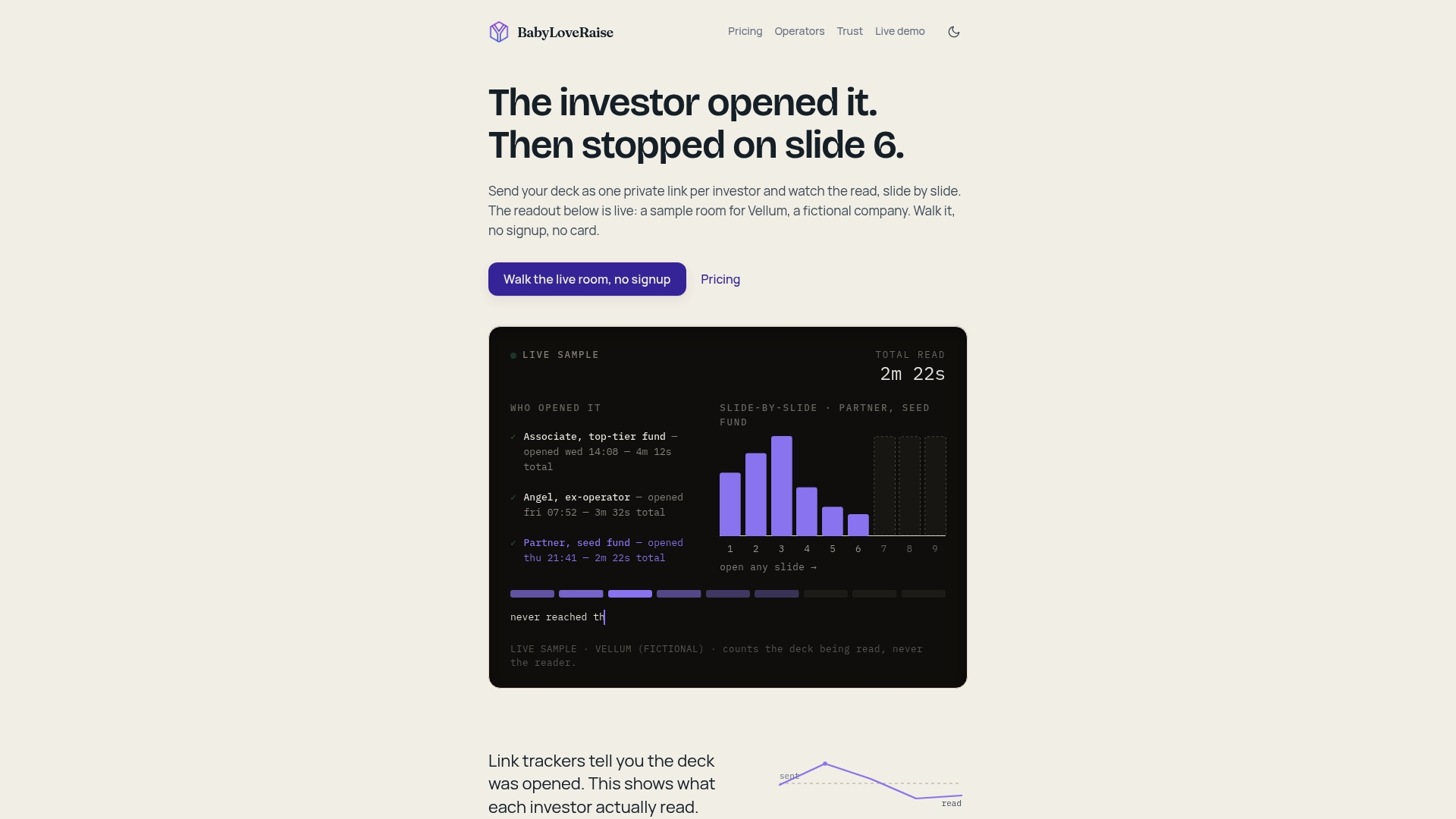
Knowing who finished your deck and who never opened it is the whole point of the triage rules above, and a hosted raise room built for this purpose gives you that signal without guessing. We built our platform around the fundraise itself: first-read notifications, per-slide dwell time, and a dashboard that shows which investors actually read your pitch versus which never touched it.
- Our flagship service tracks per-slide engagement for your active list; current prices are available on our pricing page.
- Another room lets you prep a deck before it goes live to investors; pricing details are available on our site.
- Operator seats provide a white-label console for running multiple client raises; current pricing information is available on our website.
- An editorial pass option offers human review of your deck narrative; pricing details can be found on our site.
When your raise closes, the room converts to a free permanent archive instead of disappearing behind a paywall. Check pricing and plans to see which room fits your raise.
FAQ
How big should an investor target list be for a seed round?
Most founders build a longlist of 75 to 100 names and prune it down to roughly 40 to 50 active targets, a range practitioners recommend for seed and Series A rounds. The exact count shifts with round size and how concentrated your sector’s investor base is.
What is the difference between a lead and a follower investor?
A lead investor sets the round’s terms, writes the largest check, and typically takes a board seat, while a follower joins on terms the lead negotiated. Verifying lead status before pitching matters because misdirected pitches to follow-only investors waste time and can close a firm to you for the round.
Can founders publicly solicit investors for a private round?
Generally no. SEC rules on private offerings state that Rule 506(b) prohibits general solicitation, so most seed rounds rely on warm introductions and pre-existing relationships, while Rule 506© allows public solicitation only when every purchaser is a verified accredited investor.
How do founders know if an investor actually read their pitch deck?
A hosted raise room with per-slide tracking shows whether an investor opened the deck, how long they spent on each slide, and whether they reached the end, which separates a true non-opener from someone who read everything and passed. BabyLoveRaise builds this signal directly into the share link so founders can prioritize follow-up based on real engagement rather than guesswork.
Why do smaller, high-conviction investor lists outperform larger ones?
A focused list lets founders research each partner deeply and tailor outreach, which practitioners find converts better than a long, undifferentiated list sent the same generic pitch. A smaller list also preserves relationships for future rounds, since a scattershot approach tends to burn bridges with investors who were never a real fit.
Sources
- State of Private Markets: 2025 in review
- SEC: General solicitation and private offerings
- How to Build Your Investor Target List