
Send Per Investor Tracked Share Links and Follow Up Within 48 Hours
See who opens your pitch deck and which slides hold attention. Send per investor tracked links, then follow up after 24–48 hours.
September 8, 2026 · 8 min read

A tracked share link is a raise-room URL that notifies you the moment an investor opens your deck and records their engagement slide by slide. Send one unique tracked link per investor instead of a static PDF, and you turn silence into information: you’ll know who’s reading, who’s stuck on slide one, and who finished and went quiet. BabyLoveRaise and similar raise rooms build this around the fundraise itself, not generic file sharing.
TL;DR:
- Using unique per-investor tracked links ensures accurate attribution of engagement data, making it clear who is genuinely interested in your pitch.
- Monitoring signals like slide dwell time, completion rates, and return visits helps prioritize investor outreach based on real engagement patterns.
- Setting up and sending tracked links takes minutes and allows you to update decks without losing engagement history, especially when using version-controlled hosted files.
- Response timing guidelines suggest immediate follow-up within 24 to 48 hours for highly engaged investors and gentle nudges after a week for less active ones.
- Maintaining trust requires using tracked data privately to inform decisions and avoiding revealing detailed slide behavior to investors to prevent damaging relationships.
BabyLoveRaisebabyloveraise.comSee Which Investors Read Your DeckBabyLoveRaise shows first reads, per-slide engagement, and completion, helping you follow up with investors based on real deck activity.Explore BabyLoveRaise
Table of Contents
- What Tracked Share Links Record (and Why Each Signal Matters)
- Why Unique Per-Investor Links Beat One Shared Link
- How to Set Up and Send a Tracked Share Link
- How to Read Engagement Data and Time Your Follow-Up
- Keeping Investor Trust While You Track Engagement
- A Practitioner’s View on Running Fundraising Analytics
- A Raise Room Built Around the Fundraise Itself
- Sources
What Tracked Share Links Record (and Why Each Signal Matters)
A tracked share link isn’t just a fancy download counter. It captures a handful of behavioral signals, and each one should change what you do next.
- First read: the moment an investor opens the deck triggers a notification, so you know your outreach landed and got attention within hours, not weeks.
- Per-slide dwell: time spent on each page shows whether your traction slide holds attention or your market-size slide gets skimmed in two seconds.
- Completed to last slide: reaching the final page is a strong signal of real interest, distinct from someone who opened the link and bounced.
- Return visits: an investor coming back a second or third time often means the deck moved into a partner discussion.
- Forward detection: catching when a link gets shared internally tells you your one investor conversation just became several.
Behavior should drive action, not just curiosity. If someone reads to the end and returns twice in 48 hours, that’s a call-now signal. If they open and close in ten seconds, your subject line worked but your hook didn’t. Hosted tracked links that record open events, per-slide time, and forward activity give founders exactly this kind of prioritization data, according to guides on pitch deck tracking.
Why Unique Per-Investor Links Beat One Shared Link
Sending the same link to every investor on your list feels efficient. It also destroys the one thing that makes tracking useful: attribution. If three investors click an identical URL, you cannot tell which one read to slide 14 and which one never opened it at all.
Unique per-investor links fix that instantly. Each investor gets their own URL, so every open, dwell time, and completion maps cleanly to a name in your CRM. Practitioners generally recommend generating a distinct link for each recipient rather than anonymizing engagement behind a shared one, specifically because attribution is the whole point of tracking in the first place.
- Clean attribution: no guessing which investor generated which engagement data.
- CRM integration: opens become pipeline events you can log against a specific contact.
- Low setup friction: most raise-room platforms generate a unique link in seconds once the deck is uploaded.
Email gates add a second layer, but they’re not always necessary. If you’re sending directly to a named investor whose email you already have, skip the gate. Add one only when the link might travel further than your original send, like a group email to a fund where you want to see which partner actually opened it.
Pro Tip: Generate the unique link right when you send the intro email, not after. Retrofitting attribution once a deck has already circulated is nearly impossible.
How to Set Up and Send a Tracked Share Link
Getting this right takes minutes, not hours. Here’s the sequence that works for a single founder or a firm running ten client raises at once.
- Export your deck as a PDF. Keep a master version numbered clearly (v3, v4) so you always know which file is live.
- Upload it to a raise room or document-analytics platform. Setup typically runs under two minutes once the file is ready, according to platform guides on deck view tracking.
- Enable notifications and per-viewer links. Turn on first-read alerts and confirm the platform is generating a distinct URL per recipient.
- Secure the link. Add a password, an NDA acknowledgment, or a link expiry date depending on how sensitive the raise is.
- Send the unique link and log it in your CRM. Treat the send itself as a pipeline event, not an afterthought.
A few things matter beyond the basic sequence:
- Watermark downloads if you’re worried about a deck circulating beyond the intended reader.
- Set an expiry date on links for investors who passed, so an old deck doesn’t quietly resurface months later with outdated numbers.
- Log every open as a CRM event, right alongside emails sent and calls booked, so your pipeline reflects real engagement instead of just outreach volume.
How to Read Engagement Data and Time Your Follow-Up
Data without a decision rule is just noise. A few heuristics make the difference between reacting well and reacting too fast.
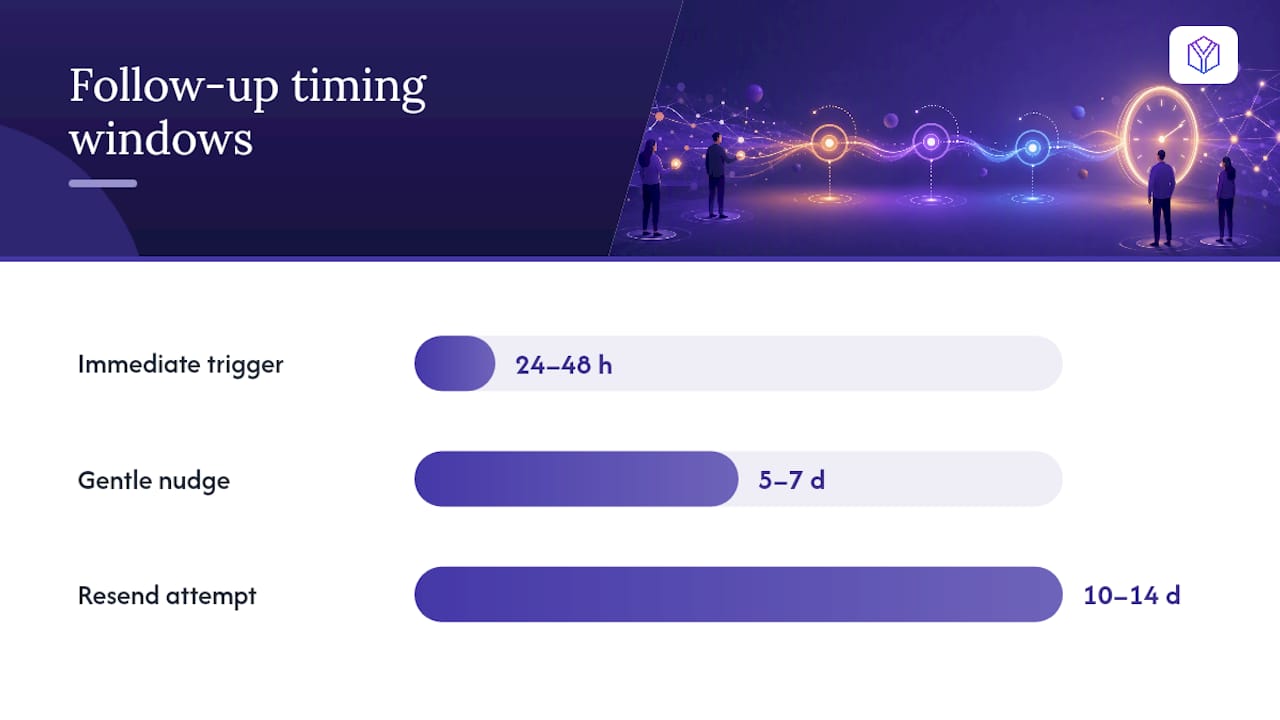
- Immediate follow-up trigger: an investor who reads the full deck and returns within 24 to 48 hours is actively discussing it internally. Reach out with new information, not a check-in.
- Waiting window: a single open with no return visit inside a week usually means the deck is sitting in a queue. A gentle nudge after 5 to 7 days works better than daily pings.
- No open at all: after 10 to 14 days with zero opens, the email itself likely got buried. Resend with a different subject line before assuming the answer is no.
Per-slide dwell should shape what you say, not just when you say it. Long time on your financial model slide with no follow-up question suggests they’re doing their own math, so send a short note addressing your burn rate or runway assumptions before they ask. Heavy attention on the team slide with a fast pass through traction might mean they’re not yet convinced you have the right people, worth addressing directly rather than waiting for a partner meeting to raise it.
Treating outreach as a funnel, tracking opens, deck engagement, and meeting conversion together, is the most reliable way to identify which investors are actually engaged versus which ones are being polite. A pattern worth watching closely: multiple opens from different devices or a forward flag often means the deck reached a partner or associate you never emailed directly, and that’s usually a sign the deal is getting a second look inside the fund.
Keeping Investor Trust While You Track Engagement
Document tracking works because it watches the file, not the person. A tracked share link tells you when your PDF got opened and which pages held attention. It does not track someone’s browsing habits, location history, or anything outside that single document. That distinction is worth being clear about, both to yourself and if an investor ever asks.
- Never quote per-slide times back to an investor in an email. Naming their exact behavior reads as surveillance, not diligence, and it can undo the trust you’re trying to build.
- Use the data privately to decide what to send next, not what to say next.
- If an investor asks for a plain PDF instead of a tracked link, send it. Some investors have firm policies against tracked documents, and pushing back costs you more goodwill than the data is worth.
Pro Tip: Frame tracked links internally as “deck analytics,” not “investor tracking.” The language shift keeps your own team focused on the document, which is the resource you’re actually improving.
A Practitioner’s View on Running Fundraising Analytics
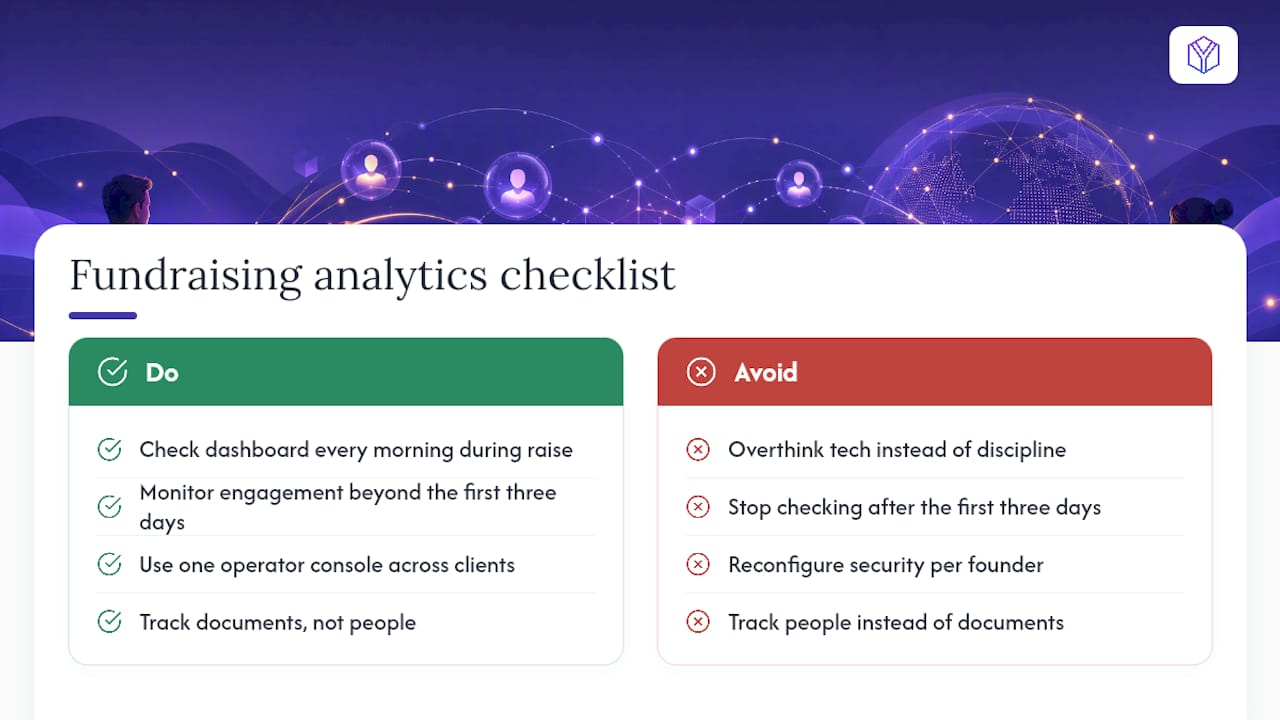
Founders overthink the tech and underthink the discipline. The checklist matters less than actually looking at the dashboard every morning during an active raise. My honest read: most founders check engagement data obsessively for the first three days after a send, then stop, right around when the signal actually starts to matter.
Advisory firms running multiple client raises face a different problem: consistency. An operator-style console that applies the same access controls and reporting across every client room saves a fractional CFO from reinventing security settings for each founder they support. The core rule doesn’t change with scale: track the document, never the person, and let engagement data guide timing, not tone.
— Paul
A Raise Room Built Around the Fundraise Itself
This raise room service is a direct alternative to emailing a PDF and hoping for a reply. Every feature in this article — first-read notifications, per-slide dwell, unique per-investor links, forward detection, and measured watermarks on downloads — comes built into a single raise room rather than stitched together across separate tools.
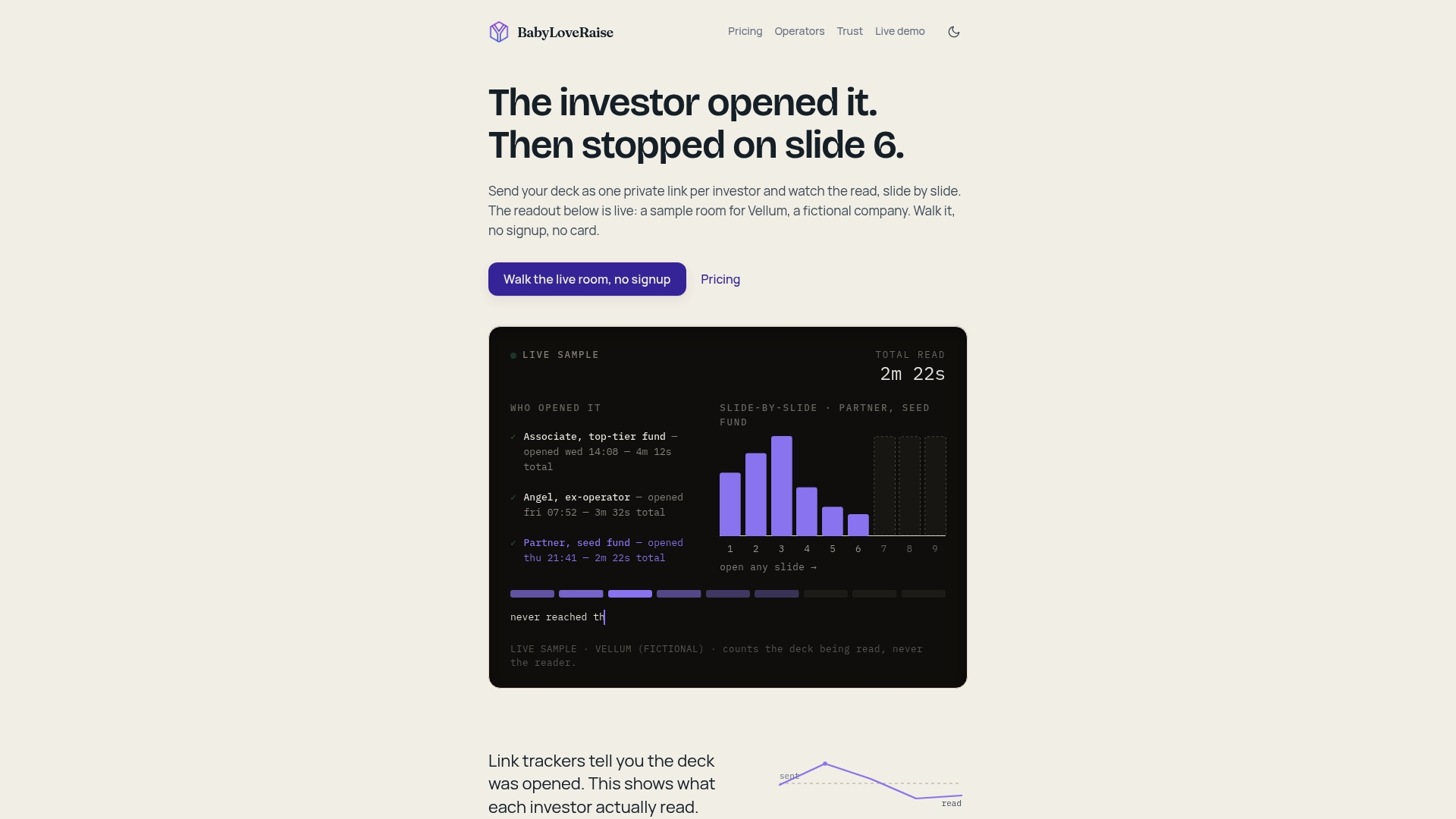
You get three link registers for different moments in a raise: a first-send link for initial outreach, a forwardable version when you want a deck to travel inside a fund, and a private link when you don’t. When the round closes, the room converts into a free permanent archive instead of hitting a paywall, so your engagement history doesn’t disappear the moment you stop paying. Advisory firms and fractional CFOs can access an Operator tier that runs multiple client rooms under one branded console, with optional concierge services such as deck editorial passes for founders who want a second set of eyes before the first send. Visit the BabyLoveRaise landing page to start a raise room and send your first tracked link today.
Sources
Go deeper on per-slide analytics or download notifications for founders. For access control and expiry settings, see pitch deck access control. For general presentation guidance, BeeSign’s advice on stakeholder buy-in is a useful companion read.
- How to Track Pitch Deck Views (Page by Page) — TiniDrop Blog
- How to Measure Investor Engagement and Close Your Round