
Win With 40–50 Targets: Investor Pipeline Stages for Founders
Founders' playbook for the six investor pipeline stages: build a 40–50 qualified shortlist, sequence outreach in three tiers, and use deck analytics to...
September 5, 2026 · 10 min read

Every fundraise runs through six stages: Research, Outreach Sent, First Meeting, Second Meeting or Diligence, Term Sheet, and Passed. The metric that separates founders who close from founders who stall is not list size. It’s conversion discipline. A tight shortlist of 40 to 50 highly qualified investors will outperform a spreadsheet of 500 cold names, and this guide shows you exactly how to build, score, and track that shortlist from first contact to signed term sheet.
TL;DR:
- Building a highly qualified investor list of 40 to 50 targets is more effective than a mass list of hundreds, as only about 2% meet qualification criteria.
- Prioritizing investors who read the deck fully and engage in the first meeting significantly increases the chances of progressing to a term sheet.
- Using a pipeline tracker with key fields like last touch date, next action, and intro path helps maintain momentum and identify bottlenecks.
- Segmenting investors into tiers based on fit and intro probability improves outreach efficiency and reply rates.
- Focusing on clean, actionable next steps and updating the tracker weekly prevents stalls and keeps the raise moving smoothly.
Table of Contents
- What Are the Investor Pipeline Stages, and What Moves an Investor Forward?
- How Many Investors Should Be in Your Pipeline?
- How Do You Prioritize and Sequence Outreach?
- What Do You Actually Do at Each Stage?
- Which Tracker Fields and Metrics Actually Matter?
- What Mistakes Kill Momentum, and Why Do Investors Move Non-linearly?
- How Do You Turn Tracker Data and Deck Analytics Into Better Follow-Ups?
- What Legal and Compliance Steps Apply During Diligence and Term Sheet Stages?
- A Founder’s Rule for Daily Pipeline Triage
- Run Your Pipeline Through a Room, Not a Guessing Game
- Sources
What Are the Investor Pipeline Stages, and What Moves an Investor Forward?
Each stage has a name and a job. The job is the part founders skip, and it’s why so many trackers turn into graveyards of stalled rows.
- Research: You’ve identified a firm or angel as a plausible fit based on stage, sector, and check size. Next action: confirm lead status and find an intro path.
- Outreach Sent: A cold email or warm intro request has gone out. Next action: follow up in 5 to 7 days if there’s no response, once, then move to Passed.
- First Meeting: The investor has taken a call or Zoom. Next action: send a follow-up within 24 hours with the deck and any requested materials.
- Second Meeting or Diligence: The investor is digging into numbers, references, or the market. Next action: deliver requested documents fast and flag a decision timeline.
- Term Sheet: The investor has issued terms. Next action: negotiate or run a competing process.
- Passed or Archive: The investor declined or went silent past a reasonable window. Next action: none, but log the reason for future rounds.
Pro Tip: Every row in your tracker needs a next-action date. A row with a stage label but no date is not “in progress.” It’s dead, and it’s cluttering your view of what’s actually moving.
The six-stage structure works because it maps to observable investor behavior, not to what you hope is happening in their head.
How Many Investors Should Be in Your Pipeline?
Founders load their pipeline with 300 names scraped from a list and wonder why nothing converts. The math explains why: roughly 2% of a large raw list actually meets rigorous qualification criteria for your stage, sector, and check size.
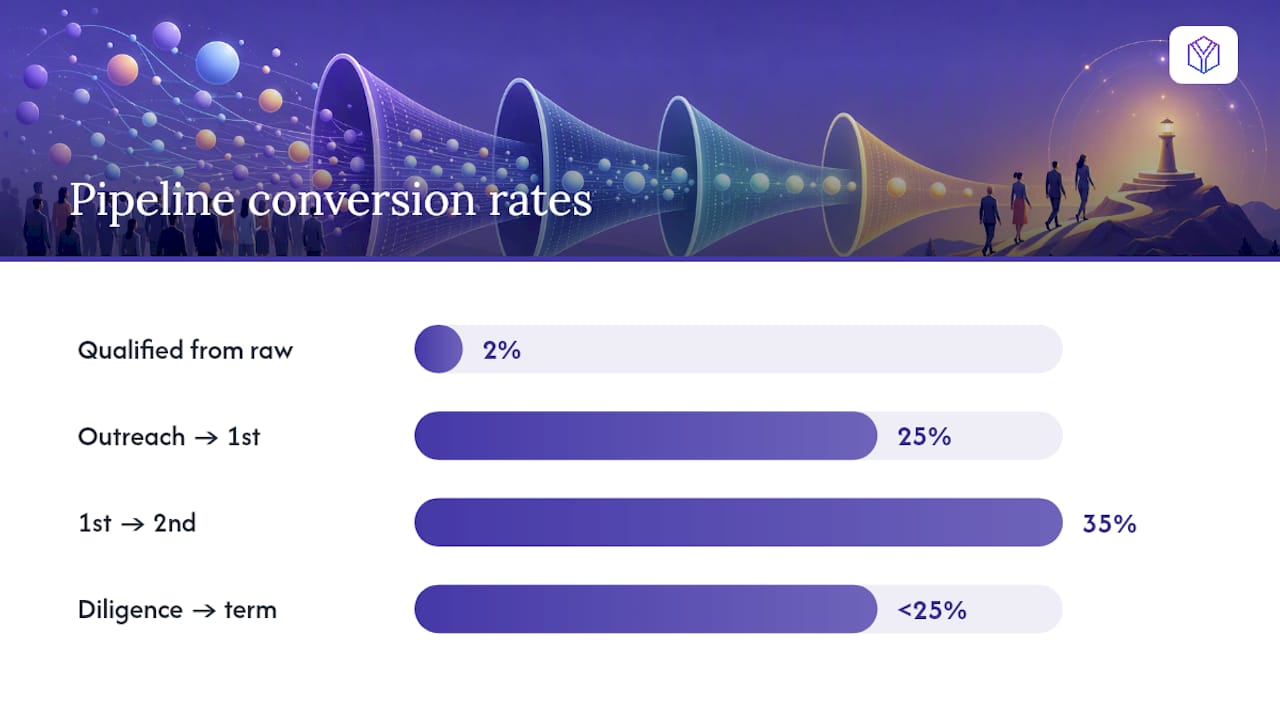
Start with a shortlist of 40 to 50 highly qualified targets rather than a raw list in the hundreds. For a typical seed raise, founders often work from 100 to 150 targeted names once you widen slightly beyond the core shortlist to account for natural attrition.
Conversion bands tend to compress hard at each stage:
- Outreach to first meeting: often 20 to 30% for warm intros, lower for cold.
- First meeting to second meeting or diligence: roughly 30 to 40% of meetings that go well.
- Diligence to term sheet: a minority of those, often under 25%.
Run the math backward. Working back through the funnel, that means you need a genuinely qualified list closer to 100, not 500. Smaller, verified lists beat mass collection because every added unqualified name dilutes your attention without adding real probability of a close.
How Do You Prioritize and Sequence Outreach?
Not every investor on your list deserves the same attention on day one. A three-tier structure keeps your best shots from getting buried under volume.
- Tier 1: high-confidence fits. The firm or partner actively leads deals at your stage, the check size matches, and you have a warm intro path.
- Tier 2: probable fits. Stage and sector match, but the intro is cold or the lead status is unconfirmed.
- Tier 3: opportunistic. Loosely relevant, no clear intro, worth a shot later but not a priority now.
Score each name against lead-fit, partner match, intro path, and check size before you send anything. Then apply a Kill List: mandate mismatch, sector mismatch, inactive fund, portfolio conflict, wrong check size, no plausible intro path. These filters alone remove 60 to 80% of a raw list before you write a single email.
Sequence outreach in batches of 20 to 30, starting with tier 2 as a calibration wave. Watch reply rates, adjust your subject lines and opening pitch, then activate tier 1 once your message is actually working.
Pro Tip: Never send your best-fit investors your first-draft cold email. Test the pitch on tier 2 first, fix what’s broken, then approach the investors you actually need to win.
What Do You Actually Do at Each Stage?
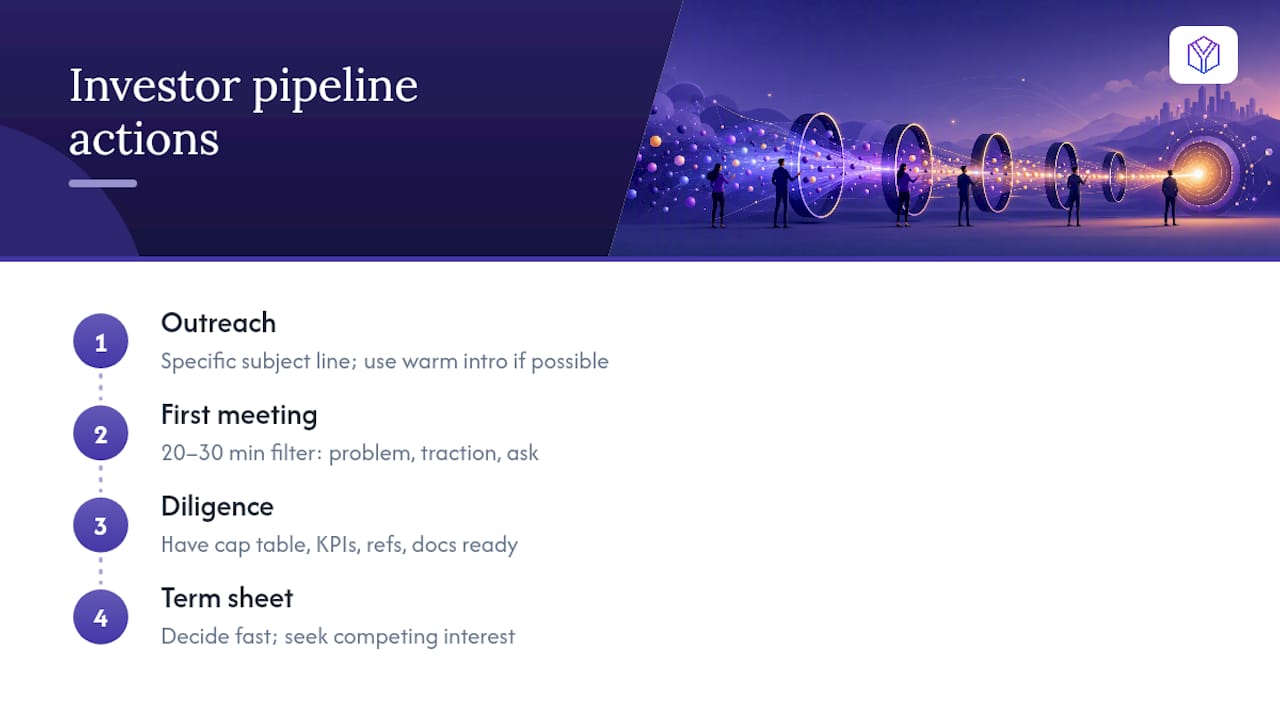
Outreach. A cold subject line should signal traction or a mutual connection, never a generic pitch. Open the first line with something specific to the recipient, a recent investment, a shared connection, a thesis match, not “I’m raising a seed round.” Use a warm intro whenever one exists; reserve sharp, specific cold pitches for firms where no path exists but the fit is strong.
First meeting. Treat the first call as a 20 to 30 minute filter, not a full pitch. Show the problem, the traction, and the ask clearly, and watch for signals that mean “continue”: specific follow-up questions, a request for the deck, or a mention of “let me talk to my partners.” Vague enthusiasm with no follow-up ask is often a soft pass.
Diligence. Have your cap table, KPIs, and reference contacts ready before an investor asks, not after. Common requests include customer references, cohort retention data, burn and runway detail, and any existing SAFE or note terms. Slow document turnaround is one of the fastest ways to lose momentum in this stage.
Term sheet. Once you have one term sheet, decide fast whether to negotiate immediately or use it to accelerate other conversations already in diligence. A single term sheet with no competing interest gives you far less leverage than two moving in parallel.
Which Tracker Fields and Metrics Actually Matter?
A pipeline tracker fails when it has too many fields to maintain or too few to be useful. The minimum viable set:
- Firm and partner name
- Stage
- Intro path (cold, warm, referred)
- Check size range
- Last touch date
- Next action and next action date
- Status (active, stalled, passed)
- Notes
Intro path deserves special attention. Warm introductions convert 3 to 5 times better than cold outreach, so a tracker that doesn’t distinguish the two is hiding your best lever.
Beyond the fields, watch velocity: average time-in-stage, week-over-week conversion rate between stages, and pipeline slope (are more rows moving forward or backward this week?). A stage where investors sit for three weeks longer than your average is a bottleneck worth investigating, not ignoring.
Block 30 minutes every Friday to update stages, confirm next-action dates, and kill dead rows. This weekly tidy is the operational habit that keeps a fast-moving raise from turning into a spreadsheet nobody trusts.
What Mistakes Kill Momentum, and Why Do Investors Move Non-linearly?
Spray-and-pray outreach, blasting 300 names with the same email, is the single most common way founders waste a raise’s early weeks. It produces high volume and low signal, and the response rate confirms it every time.
- Verify lead status before you invest energy in a relationship; a firm that only follows will rarely give you your first term sheet.
- Don’t assume silence means no. Institutional investors often loop back into diligence after a pause, especially around committee review cycles.
- Keep a formal Passed bucket, but revisit it each quarter. Timing, not fit, kills many early conversations.
Pro Tip: If an investor reopens diligence after weeks of silence, treat it as a new stage entry with a fresh next-action date, not a resumption of the old one. The context has changed even if the row hasn’t.
How Do You Turn Tracker Data and Deck Analytics Into Better Follow-Ups?
A tracker template with the fields above lets you back-solve your target list size. Decide how many term sheets you need, apply your realistic stage conversion rates, and calculate the qualified list size required, then build to that number, not beyond it.
The harder problem is knowing which rows to prioritize on any given day. Two investors can both show “no response” in your tracker, but one never opened your deck and the other read every slide and quietly passed. Those are different situations that call for different follow-ups, and a static tracker can’t tell you which is which.
- A deck that gets opened but abandoned on slide 4 signals a narrative problem, not a targeting problem.
- A deck read to the last slide with no response is a warm lead worth a direct follow-up call, not another email.
- First-read notifications tell you the moment attention starts, which is when a follow-up lands best.
This is where pitch deck engagement analytics turn a stalled row into an actionable one.
What Legal and Compliance Steps Apply During Diligence and Term Sheet Stages?
Diligence is where informal fundraising conversations turn into paper trails that matter later. Investors will typically request your cap table, prior SAFE or convertible note terms, IP assignment agreements from founders and early contributors, and any existing side letters. Missing IP assignments are a common surprise; if a cofounder or early contractor never signed one, resolve it before diligence starts, not during it.
Securities law shapes how you can talk about your raise at all. Most early-stage rounds in the United States rely on Regulation D exemptions, which restrict general solicitation depending on which exemption you use. If you’re raising under Rule 506(b), broad public pitching can jeopardize the exemption; Rule 506© allows general solicitation but requires verified accredited investor status for every participant. Loop in securities counsel before you decide how publicly to market the round.
Term sheets are typically non-binding on valuation and most terms, but confidentiality and exclusivity clauses often are binding the moment you sign. Read those sections carefully; a broad exclusivity period can freeze out other conversations at the worst possible time. Board seats, pro rata rights, and liquidation preferences in the term sheet will carry forward into the final financing documents, so treat term sheet review as a legal step, not just a negotiation step. A lawyer familiar with startup financing should review any term sheet before you sign, regardless of how well you trust the investor.
A Founder’s Rule for Daily Pipeline Triage
Prioritize any investor who read the deck to the last slide and took a first meeting over a cold name that never opened it. Attention is the earliest honest signal you’ll get in a raise, and it’s usually more reliable than a warm intro alone.
— Paul
Run Your Pipeline Through a Room, Not a Guessing Game
Some tools attempt to distinguish between investors who never opened a deck and those who read everything then passed, by providing notifications on deck openings and tracking per-slide attention.
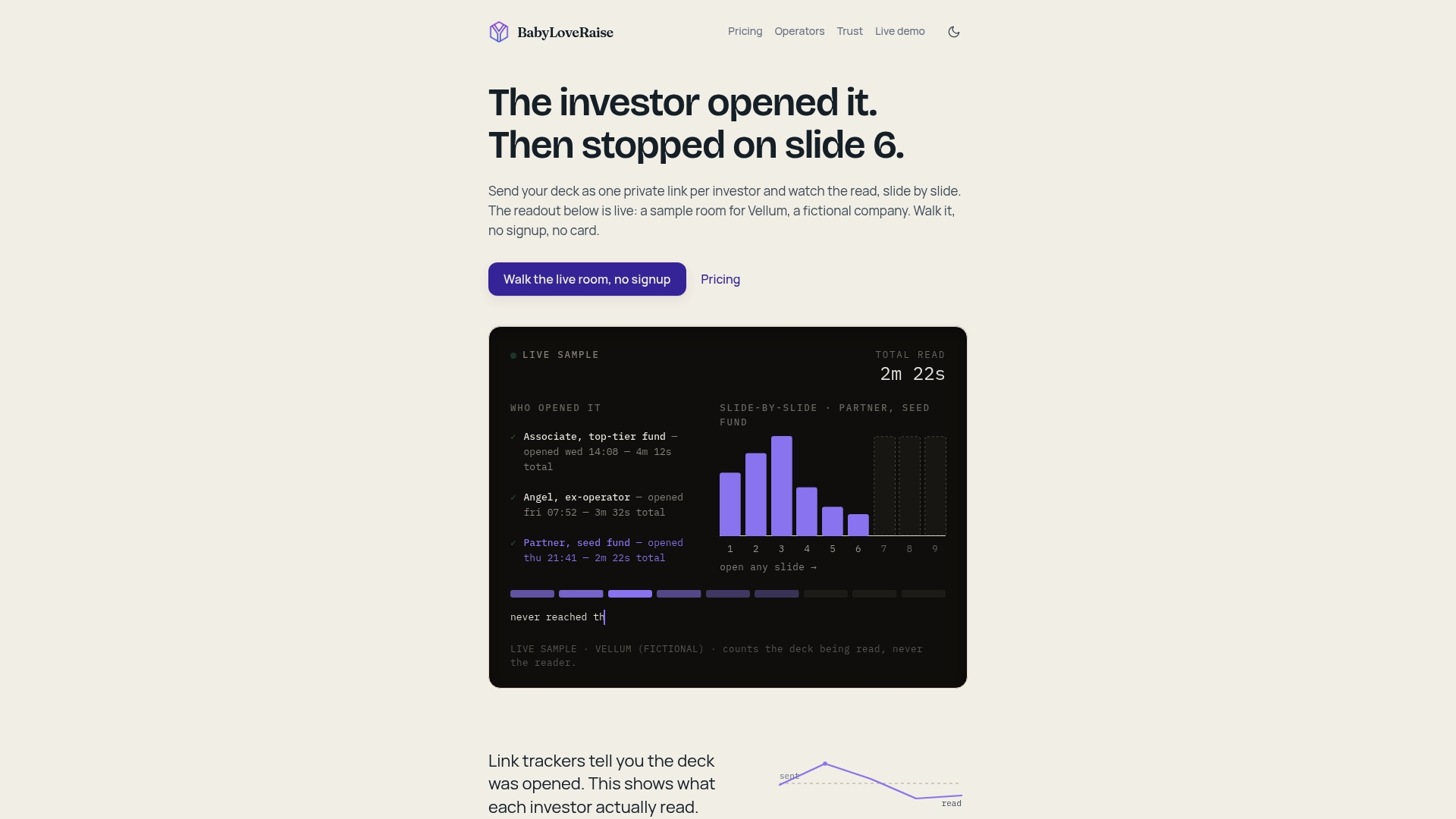
That data feeds directly into the tiering and next-action discipline covered above: a first-read notification tells you when to follow up, and per-slide engagement tells you whether the problem is your narrative or your targeting. Read the pitch deck notification breakdown for setup details, or go straight to BabyLoveRaise to set up your first raise room and start tracking real engagement instead of assuming it.
Sources
- How to build an investor target list | CRV
- Investor Pipeline Tracker: Free Template + Funnel Math · StartWise Blog
- How to Build an Investor Outreach List | Altura Data