
Founders & Advisors: Pick Per Raise Pricing for One or Two Raises
Guide for founders and advisors on per raise pricing versus subscriptions. Learn when per raise saves money, what it includes, and how to set up a raise room.
September 21, 2026 · 9 min read
Founders & Advisors: Pick Per Raise Pricing for One or Two Raises

Per-raise pricing charges for a hosted fundraising “raise room” per fundraise, not per seat or per month, indefinitely. It fits two buyers best: founders running one discrete pre-seed or seed round who need the cost to end when the round closes, and fractional CFOs or advisory firms who want to bill each client raise as its own line item rather than eating a recurring subscription between engagements. If your fundraising happens once or twice a year, per-raise pricing usually beats a subscription on cost and simplicity.
TL;DR:
- Per-raise pricing is ideal for founders raising only one or two rounds annually, as it charges a one-time fee that ends when the round closes.
- The cost for a single raise room is about $149 per month or $399 per quarter, making it cheaper than ongoing subscription plans for infrequent fundraisers.
- Advisory firms managing multiple client rounds may save money with operator-tier plans at $399 per month per seat, instead of buying separate one-off rooms.
- After a round closes, a well-designed raise room converts into a free, permanent archive, avoiding ongoing access fees.
- For ongoing fundraising or frequent investor relations, subscription models are typically more cost-effective than per-raise charges.
BabyLoveRaiseTrack Your Raise, Not Just Your DeckBabyLoveRaise gives founders a hosted raise room with first-read alerts and per-slide engagement analytics for each fundraising round.Visit BabyLoveRaise
Table of Contents
- What Per-Raise Pricing Actually Covers
- Benefits and Trade-Offs Worth Weighing
- How Do You Know If Per-Raise Pricing Fits Your Raise?
- What Does Per-Raise Pricing Cost Compared to Alternatives?
- How to Buy and Set Up a Per-Raise Room
- When I’d Choose Per-Raise Pricing Over a Subscription
- Get a Raise Room Built for Exactly This Purpose
- Sources
- FAQ
What Per-Raise Pricing Actually Covers
A per-raise room is built around the specific mechanics of a fundraise, featuring multiple sharing link types, detailed engagement analytics including per-slide attention tracking, measured watermarking on downloads for traceability, and post-close archiving that allows permanent free storage instead of restricting access.
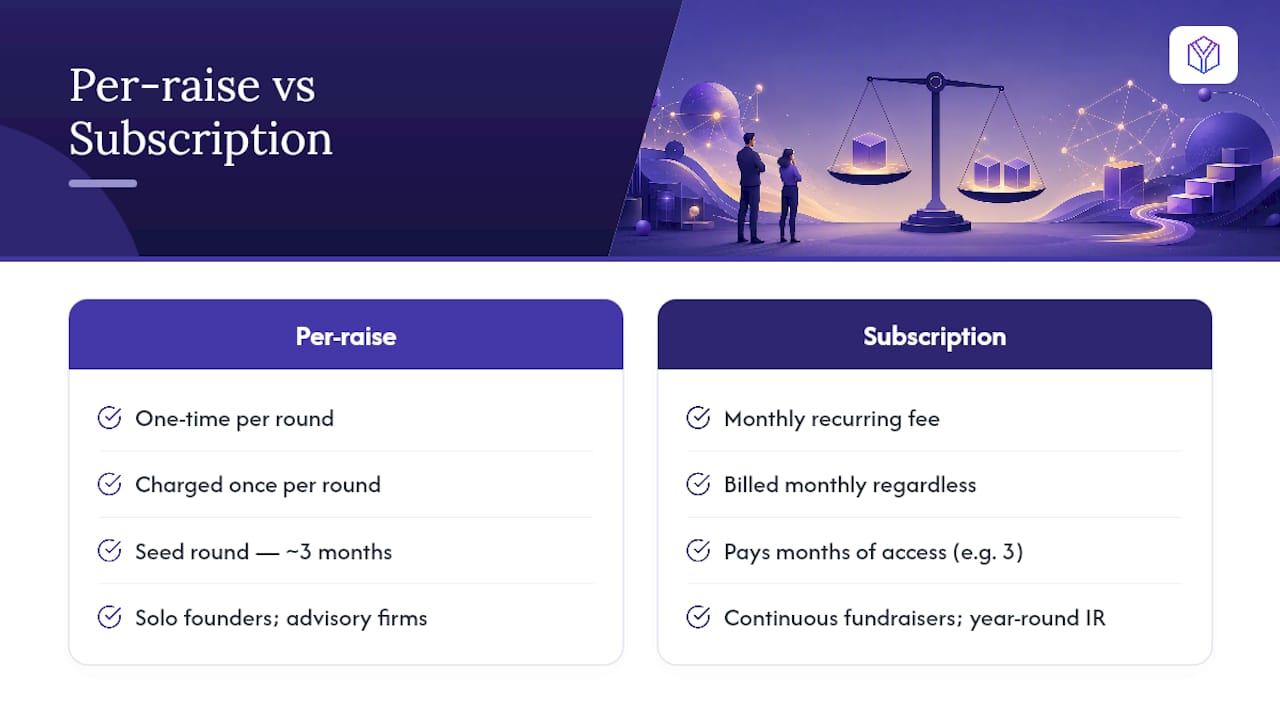
The billing shape is what separates per-raise pricing from the alternatives. A subscription model charges monthly whether you’re actively raising or not, which makes sense if you’re constantly fundraising or managing investor relations year round. Per-raise pricing charges once for the life of that specific round. For a solo founder raising a single seed round, that’s the difference between paying for three months of access and paying for exactly the round you’re running. For an advisory firm, it maps cleanly to how they already bill clients: per engagement, not per software seat.
Benefits and Trade-Offs Worth Weighing
Per-raise pricing solves a real cost problem, but it isn’t free of compromises. Here’s how the trade-off actually breaks down:
- Predictable one-off cost. You know the number before you start, and it doesn’t creep upward if your raise takes an extra month.
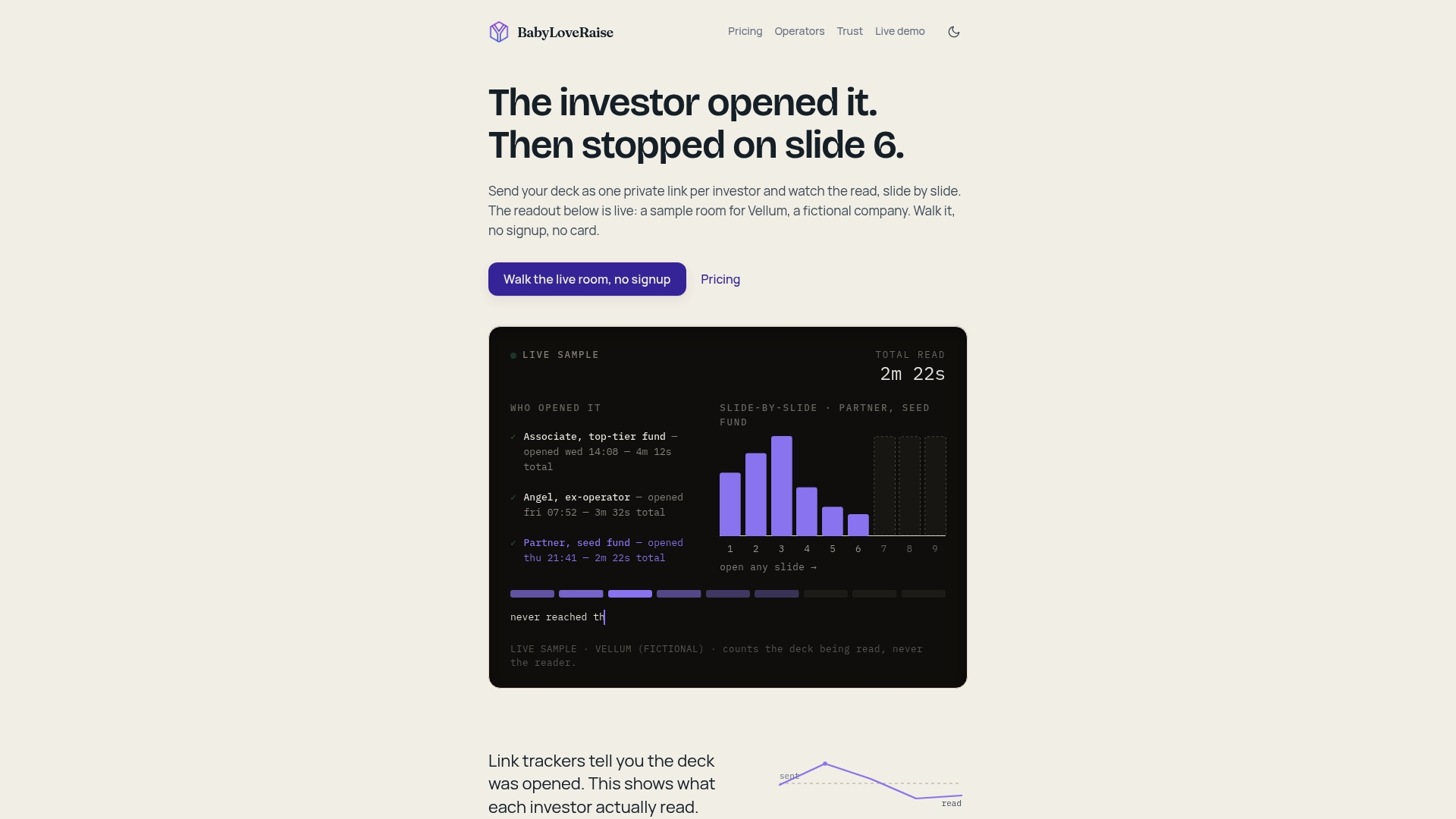
- Fundraising-specific analytics. Generic document trackers weren’t built to answer “did the partner read to the last slide or bail at slide four?” Per-slide dwell and completion data answer exactly that, and they’re the two signals worth prioritizing when deciding who gets a follow-up call first, according to BabyLoveRaise’s own analytics guide.
- Cleaner investor workflow. One link, three sharing tiers, no email chains going dark.
- Archive on close. You’re not staring down a paywall six months after your round closes, wondering if you’ll lose your data.
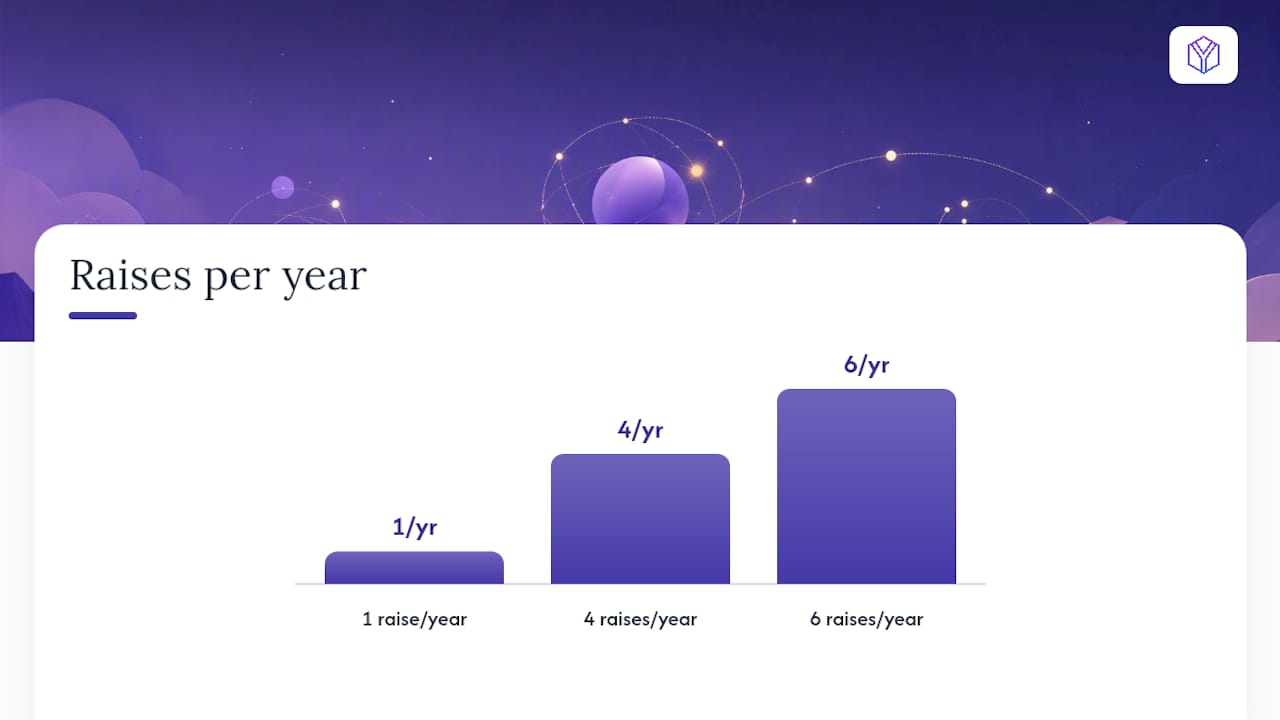
The trade-offs are real too. If you run four raises a year as an advisory firm, a stack of one-off fees can exceed what a subscription would have cost. Some one-off plans also cap seats or collaboration features that a monthly plan includes by default. And if you need continuous investor-relations access between rounds, a per-raise room designed for a single event isn’t the right tool.
Pro Tip: Match the pricing model to your raise frequency, not your company size. A pre-seed founder raising once should almost always choose per-raise. An advisory firm running six client raises a year should run the math on operator-tier pricing before defaulting to per-client subscriptions.
How Do You Know If Per-Raise Pricing Fits Your Raise?
Run through these questions before you commit to either model:
- How many raises will you run this year? One or two favors per-raise. Continuous fundraising or investor relations work favors a subscription.
- Do you need ongoing investor portal access after close, or does the round’s conclusion mark a natural stopping point?
- How many team members need seat access, and does the per-raise plan’s collaboration limit cause friction?
- How granular does your analytics need to be? If per-slide dwell time and last-slide completion matter to your follow-up strategy, confirm the room tracks that, not just “opened” and “not opened.”
- Do you run multiple client raises as an advisor? If so, ask about white-label Operator pricing instead of buying separate rooms per client.
- What’s your real budget ceiling for this specific round, independent of any other software spend?
When you talk to a vendor, ask specifically about archival behavior after close, whether links can be forwarded or restricted, how watermarking works on downloads, and what happens to ownership of the room’s data once the raise ends. Then do the math: multiply the one-off price by the number of raises you expect this year, and compare that total against a subscription price multiplied by the months you’d actually use it. For a single-round founder, that math almost always favors per-raise. For an advisory firm running many client rounds, it might tip the other way, which is exactly why operator-style per-client pricing exists as a middle path. A quick reference on what integrated fundraising software typically costs helps anchor that comparison.
What Does Per-Raise Pricing Cost Compared to Alternatives?
Context matters here, because “expensive” and “cheap” only mean something next to a real number. Integrated fundraising platforms that bundle deck sharing, CRM, and investor tracking typically run $50 to $300 per month, while assembling the same capability from separate point tools often costs $600 to $1,500 per month. That gap alone explains why founders increasingly choose integrated tools over cobbling together four separate subscriptions.
By the numbers: Fractional CFO retainers commonly run $3,000 to $15,000 per month, while a project-scoped engagement focused purely on fundraising preparation can run 60 to 80 hours and cost $6,000 to $12,000.
Three scenarios show how the math plays out in practice:
- A DIY pre-seed founder buying a single raise room for one quarter spends far less than even a month of fractional CFO time, since the room’s cost is bounded to the round itself.
- An advisory firm running eight client raises a year faces a real decision: eight separate one-off purchases, or an operator-tier plan priced per seat that consolidates billing across clients.
- A founder who needs ongoing investor updates after the round closes is better served by a subscription model, since a per-raise room is scoped to end at close by design.
Shaving even two to four weeks off a fundraising timeline through tighter financial storytelling can offset most of these costs outright, based on Inflection CFO’s analysis of fundraising economics. That’s the real comparison: not just software price against software price, but software price against the runway you save by raising faster.
How to Buy and Set Up a Per-Raise Room
Getting a room running well takes less time than most founders expect, but sequencing matters:
- Finalize your deck before you buy anything. A room’s analytics are only as useful as the deck they’re tracking, and case studies like Roami’s Series A deck show how much a tightened narrative shapes investor reaction.
- Build your investor list and email templates ahead of time so you’re not scrambling the day you send the first link.
- Purchase the room and set your access rules, deciding upfront which investors get forwardable links versus private ones.
- Send your first link and let the room log who opens it.
- Monitor per-slide engagement daily during the first week, when most of your signal arrives.
- Prioritize follow-ups based on last-slide completion, not just opens; someone who read the whole deck is a warmer lead than someone who opened it and vanished.
- Convert to archive on close so you keep permanent access without paying for a room you no longer need active.
Pro Tip: Don’t wait a week to check engagement data. The first 48 hours after your first send usually tell you who’s actually reading, and that window shapes your entire follow-up cadence.
When I’d Choose Per-Raise Pricing Over a Subscription
Per-raise pricing makes the most sense for two very specific profiles: a founder running one pre-seed or seed round who wants the cost to end when the round does, and a boutique advisory firm that bills clients per engagement and wants its software costs to mirror that same rhythm. In both cases, paying for the event instead of the calendar month just makes more sense.
Subscription or retained fractional CFO support earns its cost when fundraising isn’t a one-time event. If you’re raising continuously, managing ongoing investor relations, or need deep financial storytelling support across multiple quarters, a monthly retainer or platform subscription spreads that cost more sensibly than repeated one-off purchases would.
My rule of thumb: if you can count your raises this year on one hand, buy per-raise. If fundraising is closer to a permanent function of your job, a subscription or retainer probably serves you better.
— Paul
Get a Raise Room Built for Exactly This Purpose
The service charges per raise rather than per seat indefinitely, so the fee ends when the round closes instead of renewing monthly when not fundraising. The room includes per-slide engagement analytics, multiple sharing link types, watermarking on downloads, and permanent archive access after the raise closes.
Solo founders running a single pre-seed or seed round get the raise room at $399 per quarter or $149 per month, whichever fits the length of the raise better. Fractional CFOs and advisory firms managing multiple client raises can run firm-branded rooms through the Operator tier, priced at $399 per month per seat or $3,990 per year per seat, instead of licensing a separate subscription for every client. Founders who want hands-on help tightening the actual narrative can add the editorial pass on top of either plan. Check current pricing and start a room at BabyLoveRaise.
Sources
- Startup Fundraising Platform: What It Does, How to Pick
- Fractional CFO Cost: The Complete 2026 Pricing Guide for Founders
- Fractional CFO Economics: When and Why It | Inflection CFO
FAQ
What Is Per-Raise Pricing?
Per-raise pricing charges a one-off fee tied to a single fundraising round instead of a recurring per-seat subscription. BabyLoveRaise’s raise room, for example, runs $399 per quarter or $149 per month, scoped to the length of your actual raise.
How Much Does a Per-Raise Room Cost Compared to a Fractional CFO?
A per-raise room costs a fraction of a fractional CFO retainer, which commonly runs $3,000 to $15,000 per month. Many founders use a per-raise room for the deck itself and reserve advisor time for financial modeling and narrative strategy.
Should Advisory Firms Buy Per-Raise Rooms for Each Client?
It depends on volume. Firms running several client raises a year often save money and simplify billing with a white-label Operator seat, priced at $399 per month or $3,990 per year per seat, rather than purchasing separate one-off rooms for every client.
What Happens to the Room After the Raise Closes?
A well-built per-raise room converts to a free permanent archive at close instead of locking your data behind a paywall. BabyLoveRaise applies this model by default, so founders keep access without paying an ongoing fee.
Is Per-Raise Pricing Better Than a Monthly Subscription?
Neither model is universally better; it depends on raise frequency. A founder raising once or twice a year typically saves money with per-raise pricing, while continuous fundraising or ongoing investor relations work usually favors a monthly subscription.