
Raise Room vs. VDR: Founders and Advisors Act on Deck Reads
Compare a fundraising raise room with a VDR, then use first reads, slide engagement, and completion signals to time investor follow up during a seed raise.
October 10, 2026 · 9 min read

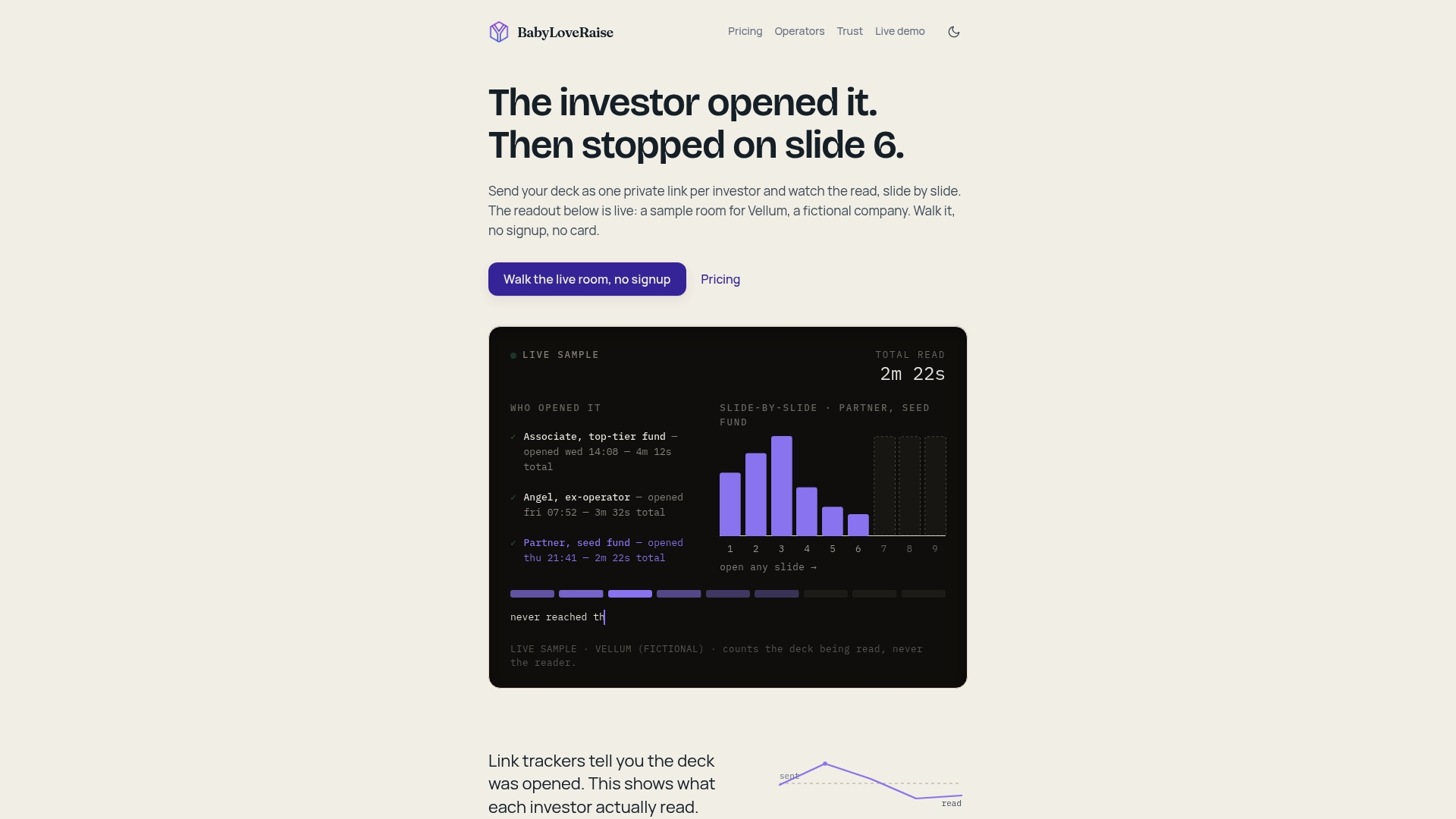
A raise room is a fundraising-hosted pitch-deck room that tracks first reads and per-slide engagement so you know exactly who to follow up with and when. It replaces the guesswork of a PDF attachment or a Drive link with real signals. Founders running a pre-seed or seed round and advisors managing several client raises at once are the clearest fit, and the rest of this piece shows exactly how to put that signal to work.
TL;DR:
- Send a raise room with your first investor outreach, then issue a fresh link after material deck revisions to compare engagement.
- Treat no open, an incomplete read, and a full read without a reply as different signals; a full read merits a direct call.
- Check engagement during the first 48 hours, then revise slides where dwell time drops before sending the next batch and compare fresh link results.
- A single raise costs $149 monthly or $399 quarterly; advisors handling multiple raises can choose an Operator seat for $399 monthly or $3,990 yearly.
- Confirm that read logs remain accessible after the raise, and check retention periods, access rules, and whether watermarking costs extra.
BabyLoveRaiseTurn Deck Reads Into Clear Next StepsBabyLoveRaise tracks first reads and per-slide engagement, helping founders follow up with investors and focus deck revisions where attention drops.Explore BabyLoveRaise
Table of Contents
- What a raise room actually is
- Core fundraising features to expect from a raise room
- Who should use a raise room, and when
- How to run a raise using deck engagement signals
- Pricing and buying considerations for founders and advisors
- What running raises teaches about follow-up
- Get started with BabyLoveRaise
- FAQ
- Primary pages and resources to learn more
- Sources
What a raise room actually is
A raise room is not a generic document share. It is built around the moments that matter in a fundraise: the first time an investor opens your deck, how long they spend on each slide, and whether they made it to the end. Those signals turn two silences that otherwise look identical, “never opened it” and “read it all and passed,” into two different, actionable states.

The room also tracks provenance through a share register, so you know which link reached which investor and whether it was forwarded. Downloads can carry a measured watermark, which discourages a deck from circulating anonymously while still letting you share freely with the people you intend to reach.
In practice, this produces signals like:
- A first-read alert the moment an investor opens the room, so you can follow up while you are still top of mind.
- Per-slide dwell time showing which slide held attention and which one lost the reader.
- A completion flag confirming whether an investor reached your closing slide or stopped early.
Core fundraising features to expect from a raise room
Not every tracked-link tool is built for a raise, so it helps to know what to check for before you commit to one.
- Per-slide dwell and engagement metrics: these show exactly where attention rises or drops, which turns “nobody is responding” into “the market slide is losing people.”
- First-read notifications and read-to-last-slide indicators: these tell you the moment to call, not just that a link was clicked, and whether the investor finished the story.
- Sharing registers with provenance: these show who the link actually reached and whether it was passed along, which matters when an associate forwards your deck without telling you.
- Measured watermarking and download controls: these protect a pre-money deck from circulating loosely while still letting you share it freely with the right people.
- A permanent post-raise archive: this keeps your materials and read history available after the round closes, instead of disappearing behind a paywall.
Pro Tip: Treat a skimmed slide the same way you would treat a pointed question in a meeting: rewrite it before your next send, not after your round stalls.
Who should use a raise room, and when
A raise room fits differently depending on who is running the raise. A solo founder benefits most, since the read data substitutes for the cofounder who might otherwise catch early warning signs in a deck. A pair of cofounders still gains from having a shared, objective view of engagement rather than relying on gut feel about who “seemed interested.” Fractional CFOs and advisors running multiple client raises get the most structural value, since consolidated tracking across rooms replaces a patchwork of email threads and guesswork.
Compared to a plain PDF or Drive link, a raise room gives you a timestamp for first contact, a slide-by-slide map of where attention lives, and a record of who actually finished reading.
The right moment to introduce it is at your very first outbound send, not after a few quiet weeks. Re-send a fresh room link any time you make a material deck revision, since that resets the read history and lets you compare engagement on the new version against the old one.
- Solo founders use the first-read alert as a stand-in for a second set of eyes on investor reactions.
- Cofounder teams use shared dashboards to agree on who gets priority follow-up.
- Advisors and fractional CFOs use consolidated views to manage several client raises without losing track of any single one.
How to run a raise using deck engagement signals
Running a raise with a tracked room follows a simple operational loop.
- Prepare the room: upload your deck, set your sharing register to first send, forwardable, or private depending on the investor, and enable first-read notifications and watermarking before your first outreach.
- Send with intent: include a short note that frames the ask and the room link, and keep your initial list tight so early signal is easy to read.
- Watch the first 48 hours: a first-read alert with no completion flag means the slide where dwell time drops is worth revisiting before the next batch goes out.
- Apply follow-up rules by signal: no open after several days means a different nudge than an open with low slide-two dwell, and a full read with no reply calls for a direct ask for a call.
- Revise the deck where dwell drops: per-slide data tells you exactly which slide to rewrite, rather than guessing which part of the story is weak.
- Resend and compare: a fresh room link after a revision lets you measure whether the new version holds attention longer on the slide that used to lose readers.
- Operators managing several raises: standardize message templates and follow-up windows across client rooms so engagement data stays comparable firm-wide.
Pro Tip: A full read with no reply within a few days is a stronger signal to call than a first-read alert with no completion, since it usually means interest without urgency.
For founders still assembling the materials that belong in the room, a live raise checklist is a useful starting point before the first send.
Pricing and buying considerations for founders and advisors
Per-raise pricing tends to suit early-stage founders better than per-seat licensing, since a round has a defined start and end and does not need an ongoing seat cost once it closes. Advisory firms and fractional CFOs running several client raises at once lean toward an Operator tier instead, since white-label branding and consolidated reporting across rooms save time that would otherwise go into managing separate tools per client.
Editorial or concierge add-ons, like a deck review pass, are worth treating as optional rather than required, useful when a founder wants a second set of eyes on narrative before the first send.
Before committing to any vendor, check:
- What happens to the archive and read history after the raise closes.
- How long read logs are retained and who can access them.
- Whether watermarking and sharing controls are included or billed separately.
What running raises teaches about follow-up
The biggest mistake founders make with engagement data is treating every open the same way. A first-read alert feels like momentum, but it is the completion flag and the per-slide dwell that actually tell you whether the story landed. Advisors running multiple client rooms tend to value one thing above the rest: a consistent read on engagement across every client, instead of five different inboxes telling five different stories.
The lesson that holds up across raises is simple. Silence is not one signal, it is several, and the only way to tell them apart is to track the read itself, not just the send.
— Paul
Get started with BabyLoveRaise
We built BabyLoveRaise around the raise itself, not around generic file sharing. Our raise room gives you first-read notifications, per-slide dwell metrics, sharing registers, and a permanent post-raise archive, priced per raise instead of locking you into a per-seat license you no longer need once the round closes.
If you are a fractional CFO or advisor running several client raises, our Operator seat gives you white-label rooms and consolidated reporting across every client. Founders who want a second set of eyes on their story before the first send can add the editorial pass.
| Plan | Best for | Price |
|---|---|---|
| The raise room | Founders running a single active raise | $149 per month or $399 per quarter |
| Operator seat | Advisors and fractional CFOs managing multiple raises | $399 per month per seat or $3,990 per year per seat |
Our rooms are designed to answer one question founders ask every week of a raise: did they actually read it. That question drives every feature we include.
Start by creating a room for your next send, enable first-read notifications, and see which slide holds attention before you send to your next ten investors.
FAQ
What makes a raise room different from a Drive link?
A raise room tracks first reads, per-slide dwell, and completion, while a Drive link only shows that a file was opened, if that. The raise room also keeps a sharing register so you know exactly who received which link.
When should I send a raise room link to investors?
Send it from your very first outbound message, not after you have already emailed a static deck. Re-send a fresh link any time you revise the deck so you can compare engagement on the new version.
What does BabyLoveRaise charge for a raise room?
The raise room is priced at $149 per month or $399 per quarter, while the Operator seat for advisors running multiple client raises runs $399 per month or $3,990 per year per seat.
Is a raise room worth it for a solo founder?
A solo founder often benefits the most, since the engagement data substitutes for a cofounder’s second opinion on how investors are actually reacting to the deck. First-read alerts and per-slide dwell both work the same way regardless of team size.
What happens to the room after the raise closes?
The room converts to a permanent free archive rather than disappearing behind a paywall, so the deck and its read history stay available. This differs from tools that cut off access once a trial or seat period ends.