
Five Steps to a Ready Raise Room: Data Room vs Deck for Founders
Founders: send the deck first, open a gated data room only after investor signals. Map each slide to a folder and use BabyLoveRaise analytics to...
September 17, 2026 · 8 min read

Send the pitch deck first, always. It gets you the meeting. The data room comes later, gated behind real interest, to verify what the deck claimed and get the deal closed. Build both before you start outreach, but only release the room once a partner asks or a second meeting is locked. Map every slide to its supporting document ahead of time so that release takes minutes, not days.
TL;DR:
- Investors typically request a data room only after showing serious interest, such as asking for specific documents multiple times or requesting an NDA.
- A well-structured mapping table linking each pitch slide to supporting documents speeds up data room setup and ensures all key materials are ready before outreach begins.
- Permission tiers and watermarks must be configured before sharing links to protect sensitive information and maintain control over document access.
- Building and analyzing the data room in advance allows founders to prioritize follow-up actions based on engagement metrics like slide dwell time.
- The most effective raises come from having a curated set of core documents prepared beforehand, enabling quick room opening and reducing delays during diligence.
BabyLoveRaiseTurn Your Deck Into a Raise RoomBabyLoveRaise helps founders share a pitch deck, see engagement by slide, and focus follow-ups on investors who actually read.Explore BabyLoveRaise
Table of Contents
- Data Room vs Deck: Two Tools, Two Jobs
- When to Send Which: Sequencing and Investor Signals
- Building the Checklist: Mapping Slides to Folders
- Security and Access Hygiene Before You Share Anything
- Five Steps to Convert a Finished Deck Into a Ready Room
- Turning Deck Opens Into Prioritized Follow-Ups
- Why Sequencing Beats Document Volume
- How BabyLoveRaise Turns a Finished Deck Into a Raise Room
- Sources
- FAQ
Data Room vs Deck: Two Tools, Two Jobs
A pitch deck sells. A data room proves. Conflating the two is why founders either scare off investors with a 40-tab document dump on day one, or stall a term sheet because nobody can produce the cap table when a partner finally asks for it.
The deck is a 10 to 15 slide narrative built for a fast skim, usually read in under four minutes on a phone between meetings. Its job is to get a second conversation, not to survive forensic scrutiny. The data room is the opposite: a structured evidence layer that investors use to check the deck’s claims against actual documents once they’re seriously considering a check. A data room primer from Peony frames the deck as the summary and the room as the source material behind it.
Size and shape shift by stage. A pre-seed room might hold a dozen documents. A Series A room can run much deeper because there’s more diligence surface: revenue history, contracts, team structure. What doesn’t change is the separation of roles.
- The deck persuades a stranger to take a meeting.
- The data room persuades a convinced partner to defend the deal internally.
- Sending either at the wrong stage weakens both.
When to Send Which: Sequencing and Investor Signals
Cold outreach means the deck goes out, nothing else. Investors decide whether to engage based on a quick read, not a document library, and CRV’s guidance on data room setup is explicit that a gated room should stay closed until a partner has internal conviction worth defending.
Three signals tell you it’s time to open the room:
- An investor asks for the same document twice, in different conversations, which usually means they’re building an internal memo.
- A partner, not just an associate, requests specific materials directly.
- Someone asks you to sign an NDA before sharing anything further, a near guarantee that real diligence is starting.
Open the room too early and you’ve handed a skimmer everything before they’ve earned it, often revealing weaknesses out of context. Wait too long after a partner asks, and you look disorganized right when trust matters most. The simple heuristic: deck for anyone, room for people who’ve already said yes internally at least once.
Building the Checklist: Mapping Slides to Folders

Every deck slide should point to a folder. That’s the whole trick, and it’s the single most actionable artifact in this entire process: a one-page table with the slide title in column one and the supporting document in column two.
Core documents investors expect to find, regardless of stage:
- A fully diluted cap table, not a simplified version that hides SAFEs or option pool math.
- A 24-month financial model with assumptions visible, not just outputs.
- IP assignment agreements for every founder and any contractor who touched the codebase.
- Signed customer contracts or letters of intent, even a handful, if revenue claims appear on the deck.
- Founder bios with references available on request.
- Recent board materials, if a board already exists.
At seed, keep this list tight. A seed-stage framework from Causo Hub recommends around 12 core items rather than an exhaustive room, since the deck is still carrying most of the pitch and a bloated room reads as compensating for a weak narrative. Series A rooms typically expand to cover deeper contract history, org charts, and prior investor updates because the diligence bar rises with check size. Either way, build the mapping table once, before outreach starts. It doubles as your own quality check: if a slide has no folder, that’s a gap you’ll get caught on later. Our guide to due diligence documents walks through the fuller inventory by stage.
Security and Access Hygiene Before You Share Anything
Set permission tiers before the first link goes out, not after someone forwards it somewhere you didn’t intend. Three tiers cover most raises: a pre-NDA overview open to anyone with the link, an NDA-gated tier for soft diligence, and an invite-only tier for active diligence with a specific partner.
- Use first-send links for initial outreach, forwardable links once you want warm intros to spread, and private links for the invite-only tier.
- Add dynamic watermarking on downloads so a leaked file traces back to whoever opened it.
- Enable audit trails so you can see exactly who accessed what and when, a standard feature in virtual data rooms according to Diligent’s overview of VDR capabilities.
Pro Tip: Check which slides get the longest dwell time before your first follow-up call. If everyone stalls on the same slide, that’s the slide to fix, not the pitch to repeat.
Analytics on who opened the deck and which slides held attention turn a guessing game into a prioritized call list, instead of chasing every name on your outreach spreadsheet equally.
Five Steps to Convert a Finished Deck Into a Ready Room
This takes several hours if you do it in order, not scattered across a week of half-finished folders.
- Freeze the deck version. Export a clean archival copy so nobody is diligencing an outdated draft mid-raise. Our guide to pitch deck version control covers how to lock this down.
- Build the one-page slide-to-folder mapping table and pull together the source documents it points to.
- Assign permission tiers to each folder, set watermarks and link expiration dates, and turn on analytics.
- Run a pre-send QA pass as if you were the investor: click every link, open every folder, check that nothing 404s.
- Once the deck is live, use open and dwell analytics to decide who gets a follow-up call first.
Founders who prepare the room this way before outreach, rather than assembling it reactively after a partner asks, tend to close faster simply because there’s no scramble at the exact moment momentum matters most.
Turning Deck Opens Into Prioritized Follow-Ups
A raise room built around fundraising behavior, rather than generic file sharing, changes what you do with the data you’re already generating.
- Per-slide engagement and first-read notifications flag the moment someone actually opens the deck, converting a silent open into a specific, timed follow-up instead of a guess.
- Tiered share links and measured watermarks let you release the gated room to a serious partner while keeping the broader outreach list on the lighter, first-send version.
- An editorial pass or Operator console option covers the four to eight hour conversion for founders, or advisors running several client raises at once, who’d rather hand off the setup than build it solo.
Why Sequencing Beats Document Volume
Founders who close fastest aren’t the ones with the fattest data room. They’re the ones who had the right dozen documents mapped and ready before a single investor asked, so the room opened in minutes instead of a scramble.
— Paul
How BabyLoveRaise Turns a Finished Deck Into a Raise Room
BabyLoveRaise gives you the one advantage a generic file share never will: you find out the moment a real conversation starts, instead of guessing whether silence means “never opened it” or “read it and passed.” That distinction alone changes who you call back first.
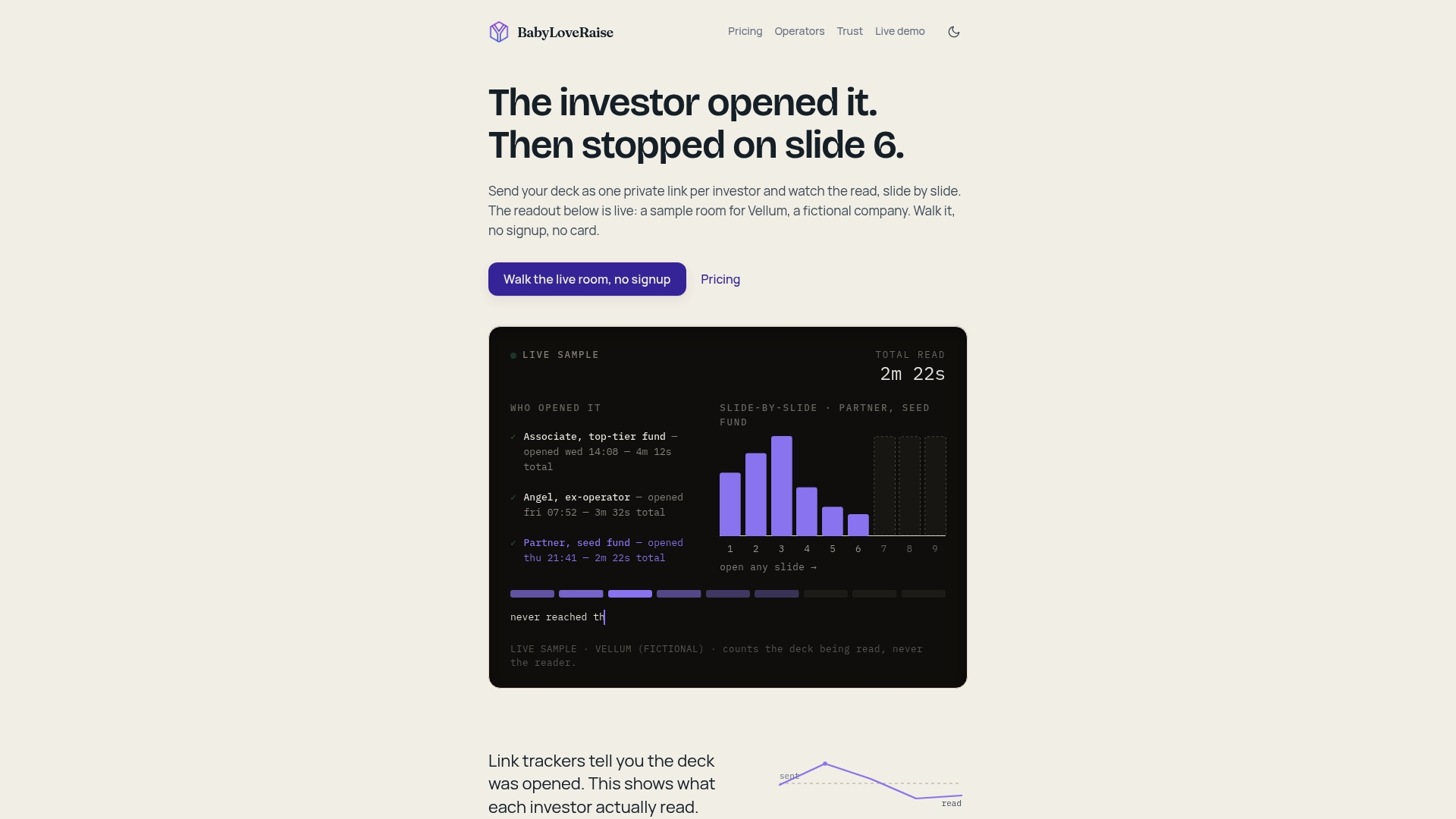
The room notifies you on first read and tracks per-slide dwell time, so revisions target the slide where attention actually died instead of a hunch. Share links come in first-send, forwardable, and private registers, and downloads can carry a measured watermark for anyone in the gated diligence tier. When the raise closes, the room converts to a free permanent archive rather than hitting a paywall. Founders who want a hands-on pass can add the editorial service, and fractional CFOs or advisory firms running multiple client raises can run firm-branded rooms through the Operator seat plans starting at $399 per month per seat. For a solo founder, the raise room runs $149 per month or $399 per quarter. Check current plans and get a room set up before your next round of outreach.
Sources
For deeper reading on documents and structure, see BabyLoveRaise’s guide to secure data rooms for startups and the comparison of pitch decks and investment memos. Founders refining outreach sequencing may also find Deeplead’s personalized outreach tools useful for prioritizing follow-ups once analytics come in.
FAQ
What Is the Purpose of a Data Room?
A data room lets investors verify the claims made in a pitch deck by reviewing source documents like the cap table, financial model, and contracts, usually once a partner is seriously considering an investment.
Is “Data Room” Two Words?
Yes, “data room” is written as two separate words in American English, not as one compound word or hyphenated.
What Does a Data Room Look Like?
It’s a structured, permission-gated folder system, often organized by category (legal, financial, product, team) with each folder mapped to a claim made somewhere in the pitch deck.
How Much Does a Data Room Cost?
Costs vary by platform and features; BabyLoveRaise’s raise room runs $149 per month or $399 per quarter, with current pricing for all plans listed on its pricing page.
Should I Send the Data Room Before the Pitch Deck?
No. Investors expect the deck first to decide whether to engage at all, and sending a gated room before that interest exists usually slows outreach rather than speeding it up.