
Pitch Deck vs. Investment Memo: A Founder's Fundraising Guide
Discover how to use a pitch deck and investment memo effectively for fundraising. Master the art of securing investor meetings and follow-ups.
August 10, 2026 · 13 min read

Use a deck to get the meeting. Use a memo to win the second one.
Here’s the short version:
- Cold outreach: A 6-slide teaser deck attached to a warm intro email gets read in under three minutes. A 10-page memo does not.
- Post-meeting follow-up: After a partner expresses interest, a well-structured memo gives them the written ammunition to take your deal to an investment committee.
- Due diligence: Both formats live side by side. The deck anchors the narrative; the memo answers the hard questions.
Key Takeaways
The most effective fundraising sequence uses a deck to open investor conversations and a memo to close them, with engagement data guiding every follow-up decision.
| Point | Details |
|---|---|
| Deck opens the door | Send a 6-slide teaser for cold outreach; save the full deck for warm intros and first meetings. |
| Memo wins the second meeting | A 5–8 page memo gives partners the written case they need to take your deal to an investment committee. |
| Write the memo first | Drafting the memo before the deck surfaces assumption gaps early and produces cleaner slides. |
| Consistency is non-negotiable | Every metric must match across deck and memo; contradictions are the single most damaging error. |
| BabyLoveRaise closes the loop | Per-slide engagement data from a raise room tells you who read the deck, who stopped early, and who to send the memo to next. |
Table of Contents
- What a pitch deck and an investment memo actually are
- How a deck and memo compare across the dimensions that matter
- What goes inside an investor memo
- What goes inside a fundraising deck
- How to sequence and distribute decks and memos across a raise
- How to convert a deck into a memo (and vice versa)
- Common mistakes that slow a raise or stop it cold
- How engagement analytics should change your next move
- The format debate misses the real question
- Sources
What a pitch deck and an investment memo actually are
A pitch deck is a visual presentation, typically 10–15 slides, designed to compress your company’s story into a format an investor can absorb in under five minutes. Its job is to generate enough curiosity for a follow-up conversation, not to answer every question.
An investment memo is a prose document, usually 5–10 pages, that functions as a decision document. It answers the questions a partner would ask in a meeting: Why this market? Why now? What does the model assume? VC memos are internal decision tools at many funds, and no deal moves to an investment committee without one. When you write your own, you’re giving the partner a head start on their write-up.
The practical difference is visible in two examples. A 6-slide teaser deck for cold outreach covers problem, solution, traction, market, team, and ask, with one chart per slide. A 5-page seed memo covers the same ground but adds the assumptions behind each number, the risks you’ve identified, and how you’d mitigate them. Same story, different resolution.
How a deck and memo compare across the dimensions that matter
| Dimension | Pitch Deck | Investment Memo |
|---|---|---|
| Best for | Cold outreach, first meetings, LP updates | Post-meeting follow-up, IC prep, due diligence |
| Length / time to consume | 10–15 slides / 3–5 minutes | 5–10 pages / 15–30 minutes |
| Level of detail | High-level; one claim per slide | Deep; assumptions, sources, risk mitigations |
| Narrative vs. data | Narrative-first; data supports story | Data-first; narrative frames the numbers |
| Visuals / assets | Charts, product screenshots, minimal text | Minimal visuals; tables and footnotes acceptable |
| How investors consume it | Skimmed solo or shared with a colleague | Read carefully; often forwarded to partners |
| Distribution | Raise-room link or PDF attachment | Email attachment or shared document link |
| Follow-up strategy | Track opens; follow up within 48 hours | Allow 3–5 days; follow up with a specific question |
Some typical recommendations include:
- For cold outbound, send the deck only, as a memo sent cold signals you don’t understand investor attention budgets.
- For warm intros after a first call, send both the deck and the memo.
- For post-term-sheet diligence, the memo often becomes the primary document while the deck serves as a reference.
One consistency trap founders fall into: the deck says $2B TAM and the memo says $800M SAM, with no explanation of the difference. VC decision-making relies on structured, documented rationales, and a number that shifts between documents reads as either sloppy or dishonest. Pick one market-sizing methodology and use it in both formats.
What goes inside an investor memo
A memo that actually moves a deal forward has a clear structure. Here’s the section order that works at pre-seed and seed:
- Investment thesis (2–3 sentences): The single reason this company wins. Write it so a partner can read it aloud in an IC meeting.
- Why now (1 paragraph): The market timing argument. What changed in the last 12–24 months that makes this the right moment?
- Market sizing (1–2 paragraphs): TAM, SAM, SOM with sourced figures. Use NVCA/PitchBook data or comparable third-party reports rather than founder estimates alone.
- Traction (1–2 paragraphs): Revenue, growth rate, retention, pipeline. Include the metric that matters most for your stage and explain why.
- Business model (1 paragraph): How you make money, unit economics, and the path to margin.
- Team (1 paragraph): Why this team, not just any team. Relevant domain experience, prior outcomes, and any gaps you’ve identified.
- Risks and mitigations (1 paragraph minimum): Named risks with a mitigation for each. This is the section most founders skip and the one partners read most carefully.
- Ask and use of funds (1 paragraph): The raise amount, the milestone it funds, and the next financing event it sets up.
- Appendix / data pointers: Links to your data room, cohort tables, and any third-party diligence materials.
Suggested length by stage: Pre-seed memos can run 3–5 pages because traction is thin and the thesis carries more weight. Seed memos should be 5–8 pages, with traction and model assumptions doing the heavy lifting. Series A memos often are longer, more detailed documents because the VC memo at that stage is metric-driven and needs to survive a full IC review.
Pro Tip: Write the risks section as if you’re the skeptic in the room. Name the three most credible objections to your deal and answer each one directly. When a partner must write an IC memo under time pressure, a memo that pre-answers the hard questions can materially affect whether the deal advances.
What goes inside a fundraising deck
The slide order that consistently works for early-stage rounds follows a simple narrative arc: hook the reader, establish the problem, present the solution, prove the market is large, show traction, explain the model, introduce the team, and close with the ask. That’s eight beats, and each one earns its own slide.

Stripe’s pitch deck guidance recommends allocating one slide per narrative beat and spending the most time on the opening hook. The first two slides determine whether an investor reads the rest, so the problem slide needs a specific, memorable framing, not a generic market pain statement. “Small businesses lose $50,000 a year to manual invoice errors” lands harder than “invoicing is inefficient.”
For visuals, the rule is simple: if a chart takes more than five seconds to read, it belongs in the appendix, not the body. Move detailed cohort tables, full financial models, and customer lists to an appendix so the main deck stays clean. For practical slide-by-slide guidance, the goal is one claim per slide, supported by one visual.
The 10/20/30 rule, popularized by Guy Kawasaki, suggests 10 slides, 20 minutes, and a minimum 30-point font. It’s a consumption guideline, not a rigid template, but the underlying logic holds: investors won’t give you more than 20 minutes for a first meeting, so every slide that doesn’t earn its place costs you time on the slides that do.
Allocate roughly two minutes per key slide in a live meeting, with the problem, solution, and traction slides getting the most time. The team slide often gets skipped in async review, so make sure your credentials appear in the deck’s first half as well.
Pro Tip: Build your deck in two versions: a “send” version with slightly more text for async reading, and a “present” version stripped to visuals and headlines. Sending the present version to an investor who reads it alone is one of the most common deck mistakes founders make.
How to sequence and distribute decks and memos across a raise
The format you send matters less than the moment you send it. Here’s the operational sequence:
Cold outbound:
- Write a 3-sentence email: the hook, one traction metric, and a specific ask (15-minute call).
- Attach a 6-slide teaser deck as a PDF or raise-room link. No memo.
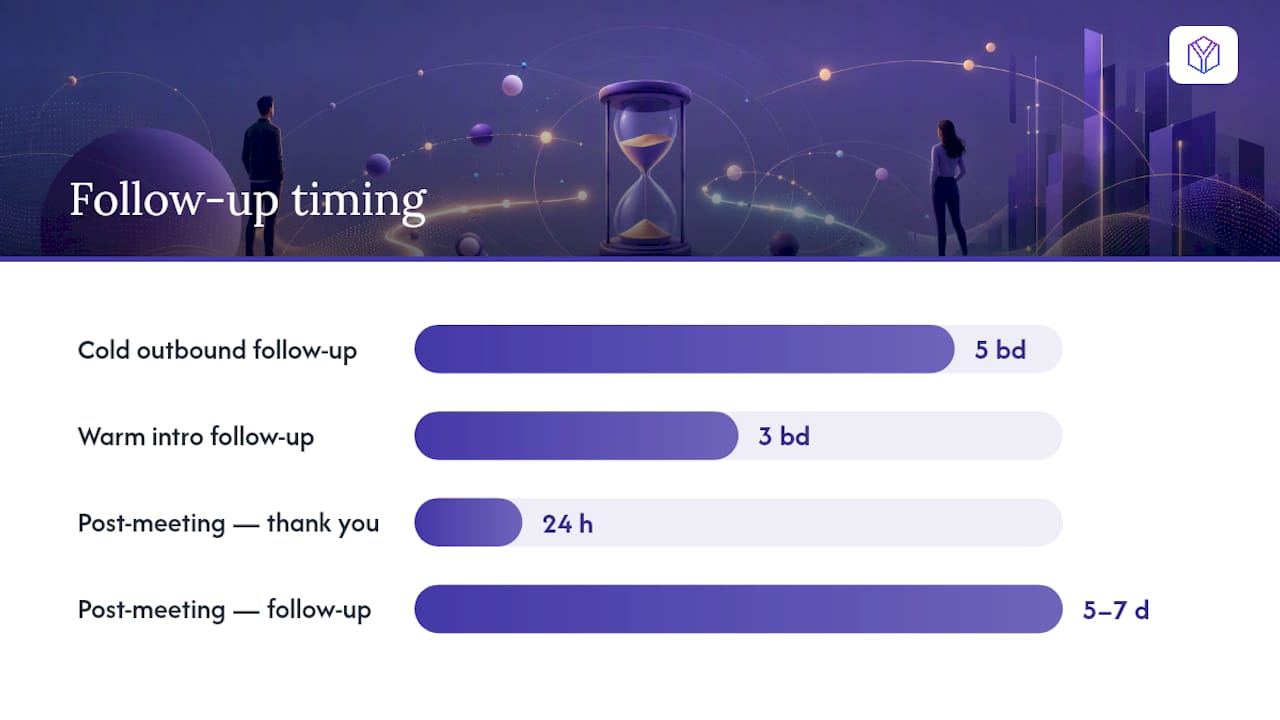
- Follow up once after 5 business days if no response. Keep it to two sentences.
Warm intro (after a mutual connection makes the introduction):
- Send a short email thanking the intro and attaching the full deck as a raise-room link.
- Include one paragraph of context: what you’re raising, the milestone it funds, and why you wanted to connect with this specific investor.
- Follow up after 3 business days if no read confirmation. If you’re using a raise room, you’ll know whether they opened it.
Post-first-meeting follow-up:
- Send a thank-you email within 24 hours. Attach the memo and a link to your data room.
- Reference one specific thing from the conversation to show you were listening.
- Follow up with a specific question after 5–7 days if you haven’t heard back. “Did the unit economics section answer your question about payback period?” beats “Just checking in.”
Multi-touch cadence: Three touches over two weeks is a reasonable ceiling before you move an investor to a lower-priority tier. After that, a monthly update email keeps the relationship warm without burning it.
For attachments versus links: PDF attachments work for cold outreach because they don’t require the investor to click through a login. Raise-room links are better for warm intros and follow-ups because they give you read confirmation and per-slide engagement data. For a broader fundraising sequencing playbook, the format decision and the timing decision are equally important.
How to convert a deck into a memo (and vice versa)
Most founders write the deck first and then try to expand it into a memo. The better approach is the reverse: write the memo first, then compress it into slides. Founders who draft the memo before the deck often surface gaps in their assumptions earlier and produce cleaner decks as a result.
Converting a deck into a memo: what to expand
- Deck bullet → memo paragraph: add the assumption behind the claim, the source for any number, and the implication for the business.
- Traction slide → traction section: include the full cohort table, the retention curve, and the explanation of any anomalies.
- Market size slide → market sizing section: cite a third-party source and explain your methodology for moving from TAM to SAM to SOM.
- Team slide → team section: add the specific experience that’s relevant to this problem, not just job titles.
Converting a memo into a deck: what to compress
- Thesis paragraph → one-liner on the cover slide.
- Market sizing section → one chart with a sourced footnote.
- Traction section → the single most compelling metric, visualized.
- Risks section → move to the appendix; don’t cut it entirely.
The tone shift is the hardest part. The memo version gives a partner something to quote in an IC write-up.
Pro Tip: After converting, read both documents back-to-back and flag every number that appears in both. If any figure differs by more than rounding, fix it before you send anything.
Common mistakes that slow a raise or stop it cold
Most fundraising mistakes aren’t strategic. They’re editorial. Here’s what investors notice:
- Contradictory metrics across formats: The deck shows one revenue figure; the memo shows another. This is the single most damaging error because it signals either carelessness or manipulation.
- Memos that run too long: A 20-page memo at pre-seed reads as a founder who can’t prioritize. VC memos for internal use typically run around 3,000 words; your founder memo should be shorter, no longer.
- Over-stylized slides: Heavy animation, custom fonts, and full-bleed photography slow load times and distract from the argument. Design should serve clarity, not replace it.
- Hidden assumptions: Stating a $5B TAM without showing the math is a red flag. Investors will ask; answer it in the document before they have to.
- No risk section: Skipping risks doesn’t make the deal look cleaner. It makes the founder look naive.
- Weak or missing CTA: Every document needs a clear next step. “We’d love your feedback” is not an ask. “We’re closing this round by [date] and have room for one more lead” is.
Pre-send checklist:
- All metrics match across deck and memo (revenue, growth rate, market size, team headcount).
- Every third-party number has a footnote or source citation.
- The ask is specific: amount, instrument (SAFE, priced round), and valuation cap or range.
- The memo’s risk section names at least three risks with mitigations.
- The deck’s appendix contains the data that supports every claim in the body.
Pro Tip: Read your deck and memo on the same day, back-to-back, as if you’re the investor seeing them for the first time. The contradiction you’ve been ignoring for two weeks becomes obvious in about 90 seconds.
How engagement analytics should change your next move
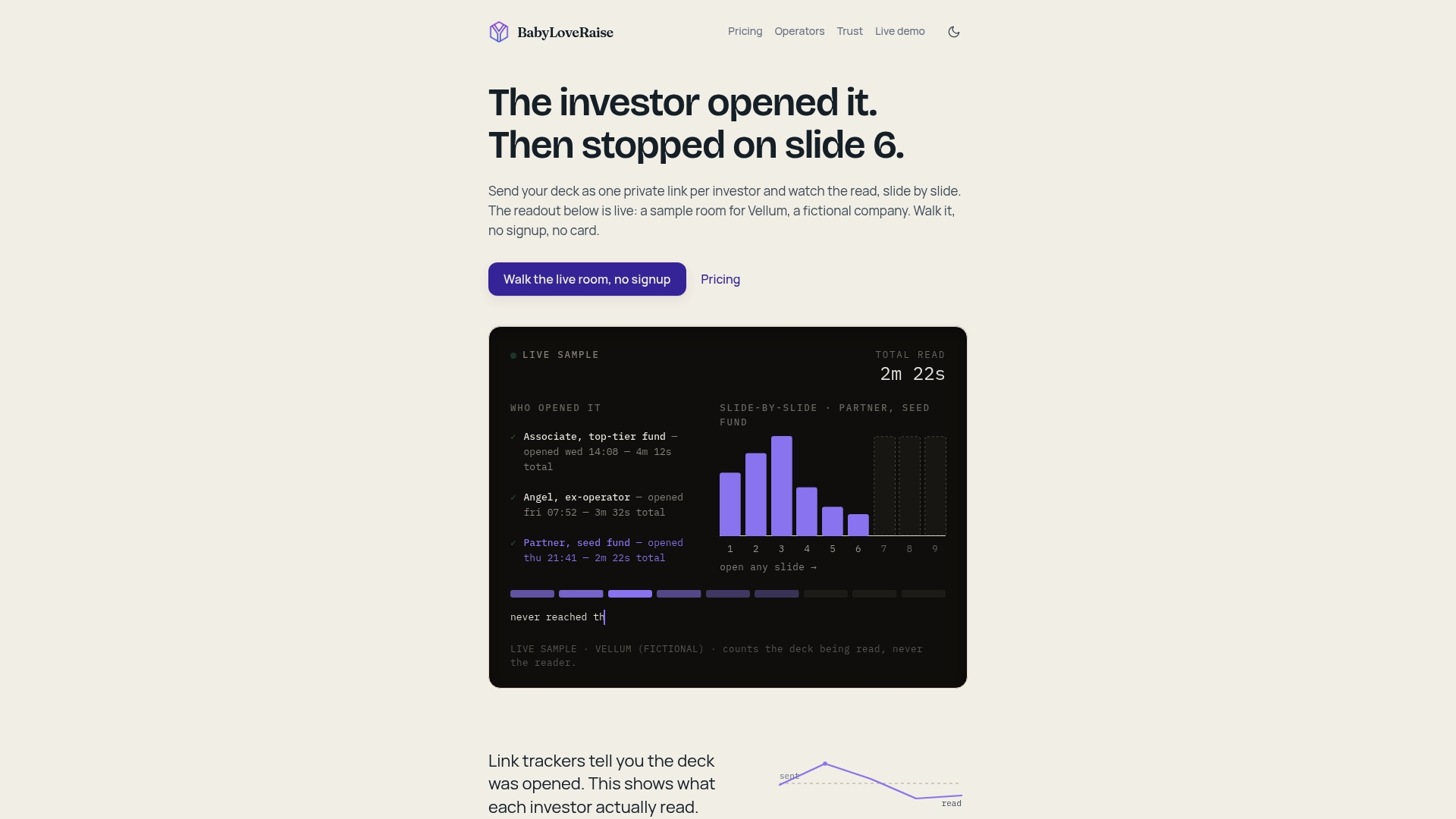
Sending a raise-room link instead of a PDF attachment gives you a signal most founders don’t have: you know who opened the deck, how long they spent on each slide, and where they stopped reading. That data changes the follow-up conversation entirely.
Here’s how to act on it:
- Opened but read less than 25% of the deck: Send a short follow-up with your top three questions answered upfront. They didn’t get far enough to form a real objection, so your job is to re-hook them.
- Read 50–75% but stopped at the financials slide: Your model needs a cleaner explanation. Send a one-paragraph summary of the unit economics with a link to the full memo.
- Read to the last slide but no response: This is a warm lead. Follow up within 48 hours with a specific ask: a 20-minute call, a reference check, or a question about fit with their thesis.
- Forwarded the link to a colleague: Someone is doing internal diligence. Send the memo proactively, before they ask.
Pitch deck analytics turn the two silences that look identical (“never opened it” and “read everything and passed”) into two different, actionable states. The follow-up strategy for each is completely different.
One note on tracking ethics: use a platform that reports on document engagement, not on the individual’s device or behavior. Investors know their reads are tracked when they open a raise-room link; that’s a normal part of the process. What’s not acceptable is covert surveillance or sharing tracking data with third parties. Transparency about what you’re measuring keeps the relationship professional.
The format debate misses the real question
The deck-versus-memo debate is mostly a distraction. The real question is whether your materials, in any format, give a partner enough to defend the deal internally. Most decks don’t. Most memos don’t either, because founders write them to persuade rather than to inform.
The founders who raise faster tend to do one thing differently: they write the memo first, not as a deliverable, but as a forcing function. The memo forces you to state your assumptions explicitly, name your risks, and explain your market sizing methodology. When you compress that into a deck, the slides are sharper because the thinking underneath them is sharper.
The sequencing matters too. Sending a 10-page memo cold is a mistake not because memos are bad, but because you haven’t earned the investor’s attention yet. The deck earns the meeting. The memo earns the term sheet.
What most articles on this topic won’t tell you: the format that wins isn’t the one that looks better. It’s the one that makes it easiest for the partner to say yes in a room full of skeptics. Write for that partner, not for yourself.
Track which investors actually read your deck
Knowing your deck landed is different from knowing it was read. BabyLoveRaise gives you a hosted raise room where every share link records first-read time, per-slide dwell, and read depth, so you know whether to send the memo or re-send the deck. Downloads carry a measured watermark, and when the raise closes, the room converts to a permanent archive at no extra cost. For founders who want hands-on help, optional editorial passes and narrative Build Map artifacts are available. See what fits your raise at BabyLoveRaise pricing.
Sources
- Pitch Deck vs Investment Memo: A Founder’s Guide to the Two
- Your Pitch Deck Isn’t Enough
- How do venture capitalists make decisions? — Harvard Law School Forum on Corporate Governance
- Q3 2025 PitchBook–NVCA Venture Monitor (NVCA)