
48 Hour Follow Up: Self Hosted Deck Tracking for Seed Founders
Learn which deck tracking signals predict investor interest, when to follow up with a 48 hour rule, and how founders implement tracking with little...
September 18, 2026 · 9 min read

Self host deck tracking means instrumenting your pitch deck links so you can see who opened it, how long they lingered on each slide, whether they came back for a second look, and if they forwarded it to a partner. It matters because two silent investors, “never opened it” and “read every slide and passed,” look identical without this data. The immediate move: put a tracked link in front of your next batch of outreach and let return visits and forwards, not vague hunches, set your follow-up order.
TL;DR:
- Return visits within 48 hours, forwards, and downloads strongly indicate high investor interest and should prompt immediate follow-up within one or two days.
- Per-slide dwell time on key slides like financials and team signals genuine diligence, while brief opens or idle tabs suggest low engagement or noise.
- Building or choosing a tracking setup per investor reduces attribution issues and can be achieved with minimal engineering by using one link per firm and tracking open behavior regularly.
- Hosted raise-room platforms automate key signals such as slide dwell and forwarding detection, providing instant alerts that help prioritize outreach and optimize follow-up timing.
- Tracking is most valuable for identifying the best prospects, catching quietly disengaging slides, and confirming when lack of activity truly means no interest, not just unread messages.
BabyLoveRaiseSee Which Investors Read Your DeckBabyLoveRaise shows first reads, per-slide engagement, return visits, and forwards in one hosted raise room for your investor outreach.Explore BabyLoveRaise
Table of Contents
- What signals in deck tracking actually predict investor interest
- When should you follow up based on engagement signals?
- Should you self-host tracking or use a hosted raise room?
- How a hosted raise room turns signals into a workflow
- Where deck tracking actually moves the needle in a raise
- Try Deck Tracking on Your Next Batch of Investor Sends
- Sources
- FAQ
What signals in deck tracking actually predict investor interest
Total view time is the metric everyone watches and the one that misleads the most. Someone can leave a tab open for twenty minutes while making coffee. What matters is per-slide dwell, because it shows you where attention was actually spent.
An investor who lingers on your team slide and financials, then slows down again at the ask, is doing real diligence, not skimming. Slide-level engagement data like this is what turns a generic “they viewed it” notification into something you can act on, according to Pitchwise’s breakdown of pitch deck analytics. A single long read, by contrast, tells you almost nothing on its own.
Return visits carry more weight than first opens. When the same investor, or a second person from the same fund, opens your deck again within a couple of days, that is someone circling back to check a number or show a partner. DocBeacon’s analytics guide treats a second view as one of the highest-conviction signals a founder can get, ahead of raw time-on-page. Forwarding and downloads push that even further. A forward means your deck left the first inbox and entered an internal conversation you are not part of yet.
Here is what tends to separate real interest from noise:
- High conviction: a return visit within 48 hours, a forwarded link, or a saved download.
- Moderate conviction: a single complete read past the halfway point, especially if it lands on the ask slide.
- Low conviction: a sub-10-second open, a view with zero slide progression, or a deck left idle in a browser tab for hours.
Benchmarks help calibrate expectations here. Across 24,541 tracked decks, the median view lasted roughly 77 seconds and about 44% of shared links were never opened at all. That means a full read to the last slide already puts an investor above most of your list, and a quiet inbox for a week isn’t automatically a rejection. It might just be an unopened link.
When should you follow up based on engagement signals?
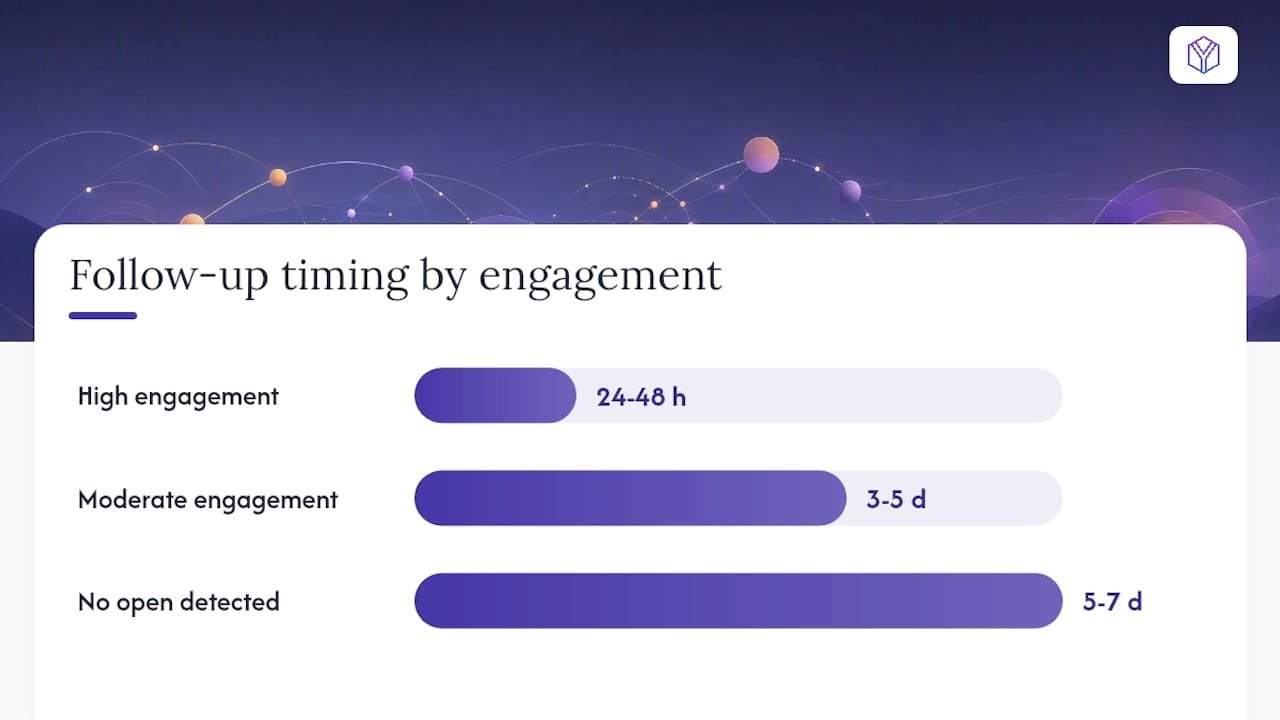
Timing beats content in most fundraising follow-ups, and the data should set your clock, not your gut. Guidance on measuring investor engagement breaks the response window into three simple tiers based on what your tracked link shows.
- High engagement (reopen, forward, or download detected): follow up within 24 to 48 hours. Momentum is real here, and waiting a week lets it cool.
- Moderate engagement (single full read, no return visit): wait 3 to 5 days before reaching out. This gives them room to discuss internally without you seeming anxious.
- No open detected after your first send: resend after 5 to 7 days, ideally with a slightly different subject line, since the first email may have simply been buried.
The trickiest part isn’t the timing, it’s the wording. Never reference the analytics directly. Nobody wants to hear “I saw you spent four minutes on our financials slide.” Instead, reference the content itself: “wanted to follow up and give more color on the unit economics” does the same job without sounding like surveillance. If someone forwarded the deck internally, a line like “happy to jump on a call with the full team” often lands well, since it acknowledges wider interest without naming the mechanism that told you.
Pro Tip: Move a contact between tiers the moment their behavior changes. An investor who sat in your “no open” bucket for two weeks and suddenly reopens the deck twice in one day should jump straight to your 24-hour follow-up queue, even if you’d mentally written them off.
Should you self-host tracking or use a hosted raise room?
Building your own tracking setup is possible, and for a founder with engineering resources, it can feel like the cheaper path upfront. A basic version usually means a link shortener with UTM parameters, a PDF viewer that reports scroll depth, and a lightweight backend to log events. The catch is attribution: without a unique link per firm, you lose the ability to tell which investor did what, and email gating on a homemade system tends to leak; people forward the raw file instead of the tracked link, and your data disappears the moment that happens, as explained in Best ASO Tool for SMBs and Startups.
Hosted raise-room platforms solve the attribution problem by design, at the cost of a subscription and less control over the exact tech stack. Setup takes minutes, slide-level dwell and forwarding detection come built in, and alerts fire the moment someone opens the deck.
| Factor | Self-hosted links | Hosted raise room |
|---|---|---|
| Setup time | Days to weeks (engineering required) | Minutes |
| Per-slide dwell tracking | Requires custom viewer | Built in |
| Forward detection | Difficult without gating | Built in |
| Attribution per firm | Manual link management | Automatic per-share-link |
| Ongoing cost | Engineering time | Per-raise subscription |
Whichever path you pick, a few basics separate a usable setup from a leaky one. Creating one instrumented link per firm preserves attribution even when you can’t force an email gate on every viewer. Beyond that:
- Sync engagement events to your CRM or spreadsheet so follow-up timing doesn’t live in a separate tool you forget to check.
- Set link expiration and decide upfront whether a watermark makes sense for sensitive financials.
- Build a per-slide view into your weekly review, not just an open/unopened toggle.
For a founder with zero engineering bandwidth, the minimum viable setup is one tracked share link per investor batch, a shared doc logging opens and reopens, and a calendar reminder to check it every 48 hours during active outreach.
How a hosted raise room turns signals into a workflow
BabyLoveRaise packages the signals above into a single room link instead of a pile of homemade tracking scripts. The room notifies you the moment someone opens the deck, then logs which slides they lingered on and which they skimmed. It offers three share-link registers, first send, forwardable, and private, so you can tell a first-time open from a deck that’s been passed inside a firm. Downloads can carry a measured watermark, and when the raise closes, the room converts to a free permanent archive rather than disappearing behind a paywall.
That feature set maps directly onto the follow-up cadence above:
- A first-read alert tells you exactly when to start your 24 to 48 hour countdown.
- Per-slide dwell on the financials or team page tells you which slide to defend in your next call, or rewrite before the next batch goes out.
- A forwardable link that gets reshared inside a fund is your signal to escalate outreach immediately, not wait out the standard window.
For advisory firms and fractional CFOs juggling several client raises at once, the Operator tier runs white-label rooms across every client under one firm-branded interface, at a lower cost per raise than a traditional data room built for due diligence rather than fundraising. Founders who want a second set of eyes on the deck itself, not just the analytics behind it, can add an editorial pass on top.
Where deck tracking actually moves the needle in a raise
Tracking earns its keep in three narrow places: prioritizing who to call first, catching a slide that’s quietly killing your funnel, and knowing when silence means “not opened” instead of “no.” That’s real, but bounded. No amount of per-slide dwell data fixes a weak market or thin traction; it just tells you faster that the deck isn’t the problem.
The lowest-friction way to test this is not a full platform migration. Take your next ten outreach emails, route them through a tracked link, and watch how your follow-up decisions change over two weeks. Most founders find the biggest shift isn’t in close rate, it’s in how much less time they waste guessing who to call back.
— Paul
Try Deck Tracking on Your Next Batch of Investor Sends
An alternative to building your own tracking scripts or paying for a data room designed around due diligence instead of fundraising offers per-slide attention data, first-read alerts, and forwarding detection out of the box, priced per raise instead of locking you into a perpetual seat license.
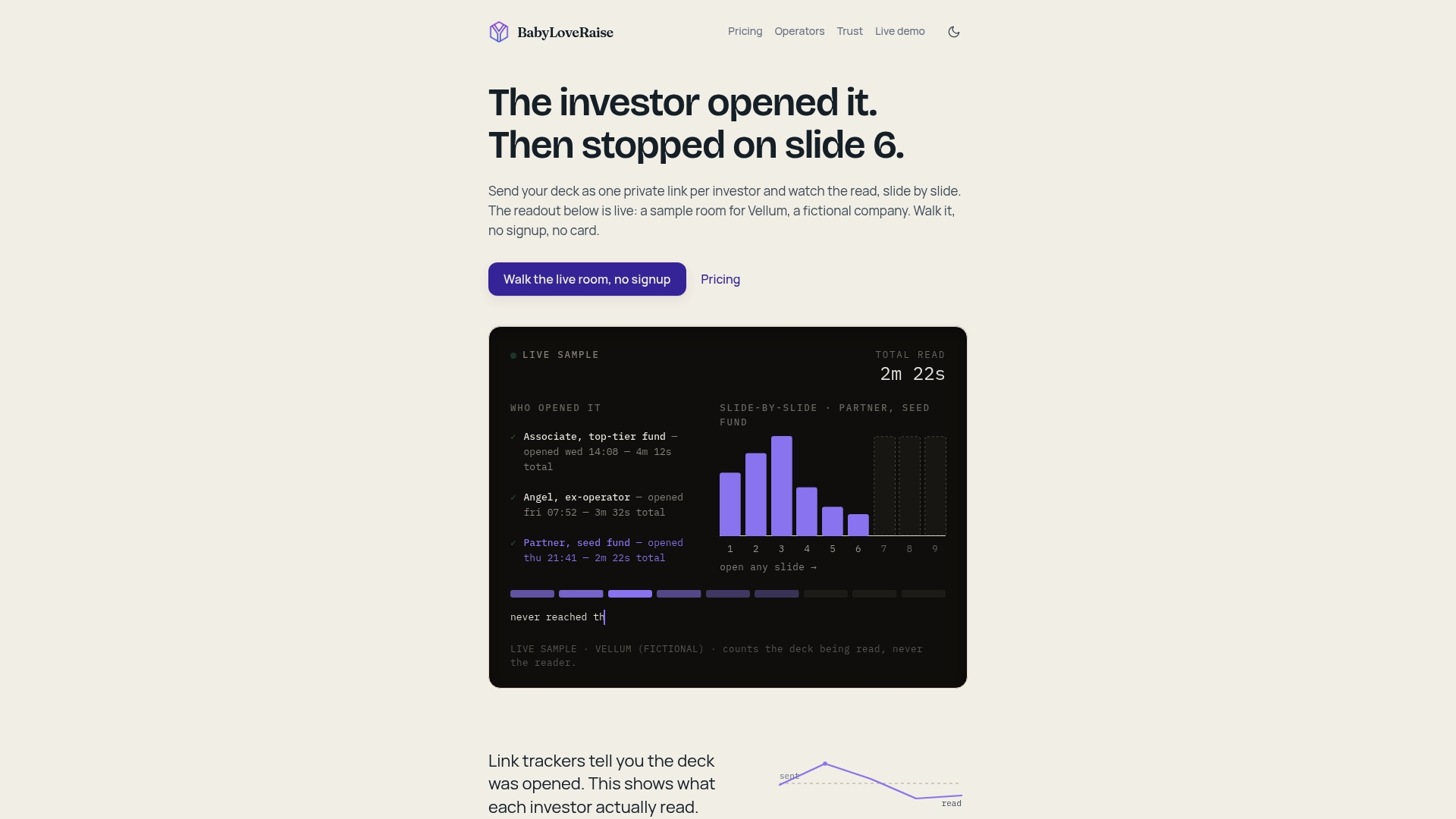
A solo founder can start a room on the raise room plan, currently listed at $149 a month or $399 a quarter, and see first-read alerts on the very next deck sent out. Advisory firms managing several client raises can look at an Operator seat for white-label rooms across every client account. If you want to see how the platform handles data before committing, the trust and privacy details lay out exactly what gets tracked and what doesn’t. Check current pricing and start your first room today.
Sources
- How Investors Read Pitch Decks — Data from 24,541 Decks
- How to Measure Investor Engagement and Close Your Round
FAQ
What Metrics Matter Most in Deck Tracking?
Per-slide dwell time, return visits, and forwarding behavior carry the most weight, far more than raw total view time. A reopen or forward is generally the strongest trigger to escalate outreach, while a single long session with no follow-up view usually signals lower conviction.
How Soon Should I Follow Up After a Deck Opens?
For high-engagement patterns like a reopen, forward, or download, follow up within 24 to 48 hours. For a single moderate read, wait 3 to 5 days, and if the deck hasn’t been opened at all, resend after 5 to 7 days.
Is Self-Hosted Tracking Better Than a Hosted Raise Room?
Self-hosting gives you more control but usually costs more engineering time and struggles with per-firm attribution and forward detection. A hosted option like BabyLoveRaise’s raise room sets up in minutes with per-slide tracking and alerts built in, priced per raise rather than per seat.
Does Tracking Mean Spying on Investors?
No. Legitimate deck tracking reports on document behavior, opens, dwell, forwards, not personal surveillance of the person reading it. Framing follow-ups around slide topics instead of citing exact tracked numbers keeps the practice from feeling invasive.
What Does BabyLoveRaise Cost for a Single Raise?
The raise room is listed at $149 per month or $399 per quarter. Advisory firms managing multiple client raises can look at an Operator seat, listed at $399 per month or $3990 per year per seat.