
Founders: No Login Pitch Decks with Per Slide Tracking
Founders: Send a no login, branded pitch deck with per slide engagement, expiring links, and watermarks so investors open, trust, and reply.
October 2, 2026 · 7 min read

The recommended approach is a branded no-login raise room link with per-slide engagement tracking, sent from an authenticated domain with clear context about who is sending it and why. This combination solves deliverability, investor trust, and follow-up prioritization in one step. BabyLoveRaise is one example of a platform built specifically for this fundraising workflow rather than generic file sharing.
TL;DR:
- A branded no-login raise room link with engagement tracking, sent from an authenticated domain, significantly improves deliverability, trust, and follow-up efficiency.
- Using expiring, controlled-forwardability links is ideal for internal sharing among investors, while branded raise rooms are better for initial outreach and trust-building.
- Setting up email authentication and using personalized messaging helps prevent links from being flagged as phishing or blocked by providers.
- Features like per-slide analytics, watermarks, expiring links, and privacy-focused tracking are essential for effective document sharing in fundraising; BabyLoveRaise covers all these essentials.
- Sending the deck link immediately after a meeting or upon investor request, rather than in cold outreach, increases the likelihood of engagement and meaningful follow-up.
BabyLoveRaiseTrack Every Investor’s Deck JourneyBabyLoveRaise gives founders a hosted raise room with per-slide engagement tracking, read notifications, and fundraising-specific follow-up signals.Explore BabyLoveRaise
Table of Contents
- Three ways to share a no-login deck and when to use each
- How to avoid phishing flags and blocked emails when you send a link
- Checklist of features to require from any no-login sharing tool
- When to send the link and templates you can reuse
- How a raise room built for fundraising implements this checklist
- What engagement signals actually tell you
- Try a raise room built for fundraising
- Sources
- FAQ
Three ways to share a no-login deck and when to use each
Not every send calls for the same method. Matching the tool to the moment keeps investors reading instead of hesitating over a suspicious link.
- Branded raise room link: best for first outreach and warm intros, since it carries your domain and tracks per-slide reads without forcing a signup.
- Expiring, controlled-forwardability link: best when an investor wants to share internally with partners, since you can allow forwarding while the link still expires on a schedule you set.
- Lightweight embedded viewer: best for post-meeting follow-ups where the investor already trusts you and just wants a quick refresher without leaving their inbox.
The decision rule is simple: use the raise room for anything that needs tracking and trust-building, use controlled forwarding when a group needs access, and save the embedded viewer for people who already said yes to a conversation.
Pro Tip: Never send the same link type to a cold investor and a warm one. Cold outreach needs tracking and authentication; warm follow-ups need speed.
How to avoid phishing flags and blocked emails when you send a link
Investors get pitched constantly, and a deck link that looks like phishing gets deleted or reported before it’s opened. A few technical and messaging habits can fix most of this.
- Set up SPF, DKIM, and DMARC on your sending domain so mail providers recognize you as a legitimate sender.
- Use your own branded domain for the link instead of a generic shortener, which strips context and raises suspicion.
- Write a subject line and preview text that name the specific deck and reference a real connection point, so the recipient expects the link before they see it.
- Add one verification sentence in the email body and a fallback contact, like a phone number or scheduling link, in case the recipient doesn’t trust the link itself.
The SEC filed a Form 8-K describing a phishing attack that began with a disguised document-sharing link and led to credential theft and mailbox compromise, a concrete reminder that document links are a real attack vector worth guarding against. The FTC’s phishing guidance recommends email authentication and warns that even legitimate notification emails can resemble phishing when they lean on hyperlinks.
Checklist of features to require from any no-login sharing tool
Before picking a tool or signing an advisor’s contract, confirm it covers these basics.
- Per-slide analytics that show first-read timing and whether the viewer reached the last slide, not just a single open event.
- Measured watermarks and download controls that discourage casual redistribution without blocking legitimate sharing.
- Three share registers, first send, forwardable, and private, so the permission level matches the relationship.
- Expiring links you control, plus per-raise pricing instead of a perpetual per-seat subscription.
- Privacy-focused tracking that reports on document engagement rather than surveilling the person reading it.
A tool covering all five gives you the same visibility a cofounder would offer if you had one reading over your shoulder, distinguishing a genuine pass from a deck nobody opened. BabyLoveRaise’s access control features map directly to this checklist.
When to send the link and templates you can reuse
Timing matters as much as the tool. A data room or full diligence packet in cold outreach signals desperation and invites early rejection before any relationship exists. Visible.vc’s guidance on pitch decks versus data rooms draws this line clearly: the deck opens the door, the data room supports diligence after interest is real.
- Cold intro: keep it to two sentences and a raise room link, asking the investor to opt in rather than assuming interest.
- Warm follow-up: after a meeting, send the deck link directly with one line referencing what you discussed.
- Investor-requested: send the link immediately with a clear next step, like a date for a follow-up call.
Prioritize replies to anyone who reaches the last slide before the next batch of cold sends goes out.
Pro Tip: Treat a completed read as a warmer signal than a fast open. Route your limited follow-up time toward the former.

How a raise room built for fundraising implements this checklist
BabyLoveRaise hosts a raise room that notifies founders on first read and records per-slide engagement, turning “never opened it” and “read everything and passed” into two distinct, actionable states instead of identical silence. The pricing structure runs per raise rather than per seat, and includes measured watermarks along with a permanent free archive once the raise closes, avoiding the paywall cliff common to generic document trackers.
For fundraising advisory firms and fractional CFOs running multiple client raises, a white-label Operator tier lets them run firm-branded rooms across every client. Founders who want hands-on help can add an editorial pass for a narrative review of the deck itself.

What engagement signals actually tell you
A completed read beats time on slide, and time on slide beats a raw open. One data point rarely tells the full story, though: an investor might open a deck on a phone during a commute and skim it without real intent. Combine analytics with notes from the actual conversation rather than treating the dashboard as the whole picture. The practical rule is to contact anyone who reaches the last slide within 48 hours, while the interest is still fresh.
— Paul
Try a raise room built for fundraising
Running a raise with a generic file share means guessing who actually read your deck. BabyLoveRaise gives you per-slide analytics, per-raise pricing instead of a forever subscription, measured watermarks, and three-tier share registers built around the way a raise actually moves.
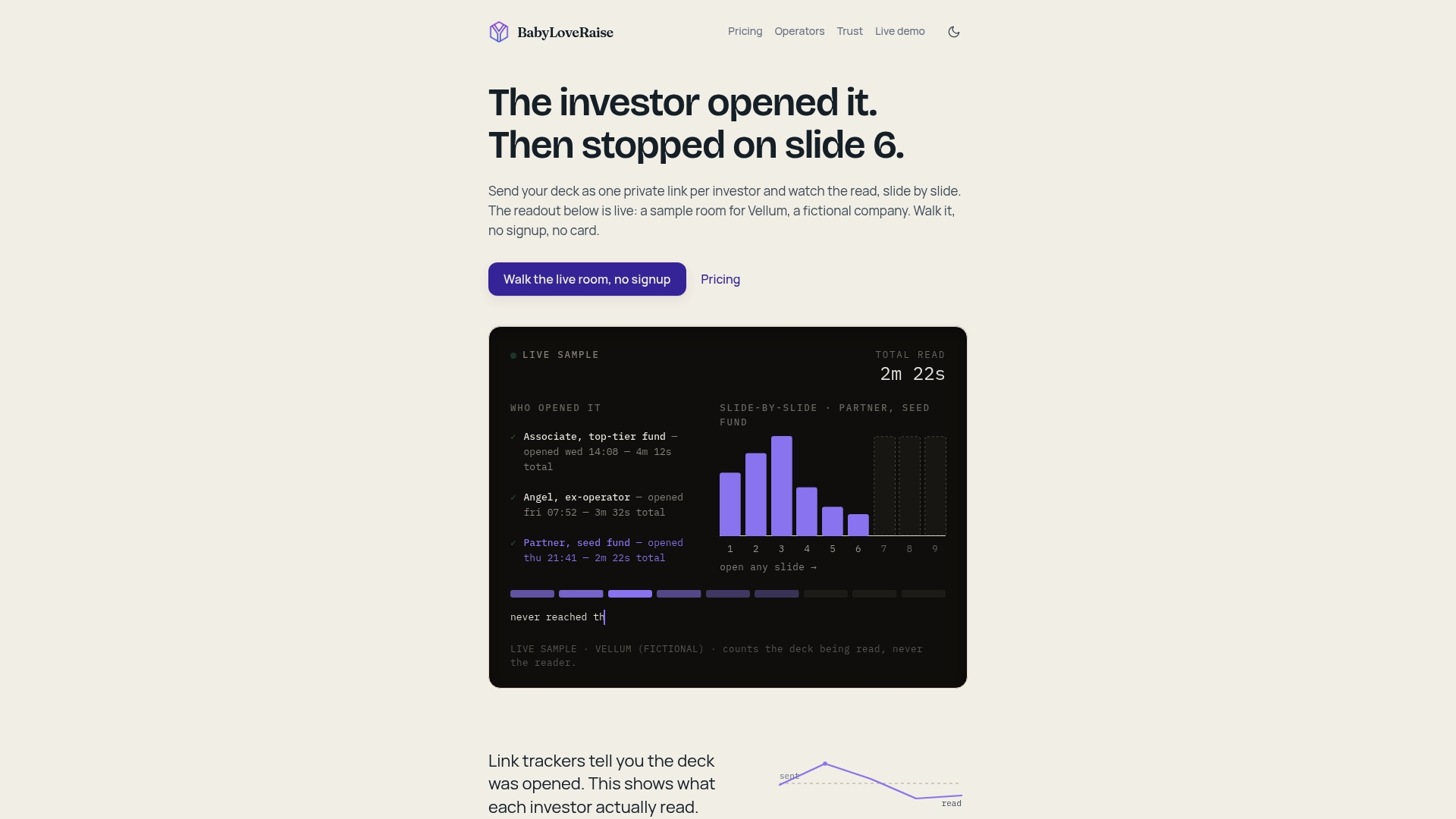
- Per-slide engagement tracking and first-read notifications so you know who’s reading before they reply.
- Per-raise pricing and a free permanent archive once the raise closes.
- White-label Operator tiers for advisory firms running multiple client raises.
Check plans and pricing on the BabyLoveRaise pricing page.
Sources
FAQ
Is it safe to send a pitch deck link without requiring a login?
Yes, as long as the link comes from an authenticated domain, the sender identity is clear, and the recipient has context before they click. The FTC’s phishing guidance recommends SPF, DKIM, and DMARC as baseline protection for exactly this kind of email.
What’s the difference between a pitch deck link and a data room?
A pitch deck is a short narrative meant to generate interest, while a data room holds detailed diligence documents meant for after interest is confirmed. Visible.vc recommends keeping the two separate so an early cold send doesn’t expose sensitive material too soon.
How much does a fundraising-specific raise room cost?
BabyLoveRaise’s raise room pricing includes options billed monthly or quarterly, with Operator seats available for advisory firms, all detailed on the pricing page.
Which engagement signal matters most for follow-up timing?
Reaching the last slide is a stronger signal than a quick open, and time spent on individual slides adds useful detail about where interest is strongest. Founders should prioritize outreach to anyone who finished the deck within roughly 48 hours of that read.
Do expiring links and watermarks actually stop leaks?
They reduce casual redistribution rather than guarantee it stops entirely, since a determined recipient can always take a screenshot. Measured watermarks and share registers that vary by permission level, first send, forwardable, or private, make redistribution traceable and less convenient.