
Founders: Two Week Rule to Stop Pursuing Investors and Prove Traction
Founders: stop pursuing investors. Run a two week two touch cadence, move one traction metric, and use slide analytics to reopen meetings.
September 27, 2026 · 13 min read

Stop pursuing investors and spend that same time proving your business works. The fastest path to funding is not more emails, it is measurable evidence that makes investors chase you. In the next 24 to 72 hours, send one final follow-up to your open threads, move every non-responder into a nurture bucket, and pick one traction metric to move this week.
TL;DR:
- Building a strong proof of business traction, such as customer demand or revenue, is more effective for investor interest than continuous outreach.
- Focus on one or two key metrics like revenue growth or retention each quarter to demonstrate progress that naturally attracts investors.
- Prioritize reaching out to investors whose stage, sector, and check size match your profile, and avoid chasing those who are unlikely to invest.
- Use deck engagement data to tailor follow-ups and identify whether silence indicates disinterest or need for content improvement.
- Pausing mass outreach to concentrate on business development often results in more meaningful investor responses than persistent cold emailing.
BabyLoveRaiseTurn Deck Silence Into SignalSee who opened your raise deck, who finished it, and which slides held attention before you decide who to follow up with.Explore BabyLoveRaise
Table of Contents
- The two-week rule: a checklist to stop chasing right now
- What evidence actually convinces investors to say yes
- Build an Ideal Investor Profile before you send another email
- When to keep pursuing and when to walk away
- How deck analytics turn guesswork into targeted follow-up
- The toll of constant outreach and how to protect your focus
- Funding paths that do not require chasing a single investor
- What happens when founders stop chasing and start building
- Planning your next 90 days after you stop the chase
- Why the best fundraising move is often to stop emailing
- How a raise room and editorial pass help you qualify instead of chase
- Primary sources and further reading
- Sources
- FAQ
The two-week rule: a checklist to stop chasing right now
Most founders keep threads alive out of hope rather than signal. A short, disciplined cadence fixes that. The pattern many operators use is a two-touch rule: one thoughtful follow-up after initial contact, then one closing note about two weeks later if there is still no real response.
- Send a follow-up that adds a new proof point, not just a check-in.
- If two weeks pass with no reply, send a short closing note that leaves the door open.
- Tag the outcome in your CRM: interested, silent, passed, or nurture.
- Move anyone in “silent” or “passed” into a nurture list tied to your update cadence.
- Block your calendar so outreach gets no more than a fixed slice of the week, with the rest on customers and product.
This is the shift our investor follow-up strategy guide walks through in more detail, including message templates for each stage.
Pro Tip: Set a recurring weekly review of your CRM tags instead of chasing each thread as it goes cold. A batch review protects your time better than reacting thread by thread.
What evidence actually convinces investors to say yes
Investors are not waiting for a better pitch. They are waiting for proof the business works without them. SVB’s guidance on building a pitch deck frames capital as an accelerator of demonstrated progress, not a substitute for it, and points founders toward evidence like customer demand, revenue, customer growth, partnerships, engagement, and product-market fit.
The mistake most early-stage founders make is trying to move ten metrics at once. Pick one or two that matter most at your stage and put real effort behind them this quarter:
- Revenue growth or a signed pilot with a named customer.
- Retention or usage data showing people keep coming back.
- A partnership or channel deal that proves distribution.
- Direct customer feedback that shows demand before you built the feature.
Turning feedback into revenue is not automatic. Customer feedback drives measurable revenue growth when founders act on it systematically rather than collecting it and moving on.
Once you have a metric moving, write it into a short, updateable narrative: what changed, why it matters, and what it signals about the next 90 days. That narrative becomes the core of both your investor updates and the traction slide in your deck, which our pitch deck strategy guide covers in depth.
Build an Ideal Investor Profile before you send another email
Outreach without fit wastes both your time and theirs. Before you send another cold email, build an Ideal Investor Profile, a short list of the traits that actually predict a yes.
- Stage: confirm they lead or follow at your round size, not just “early-stage” in their bio.
- Sector thesis: check recent public writing or portfolio additions in your category.
- Check size and geography: match your raise amount and location to their stated range.
- Portfolio pattern: look for direct competitors, which usually rules a fund out, or adjacent bets, which often signals interest.
- Individual partner fit: a warm partner match beats a cold firm-level intro almost every time.
SVB’s guidance on finding the right venture capital firm frames this as matching investor mandates rather than chasing brand names, evaluating stage, sector, check size, and the specific partner you would work with.
Portfolio pages, partner blog posts, and fund newsletters are the fastest way to check fit before you reach out. A practical sequence: start with an associate, who often handles first-pass diligence, then earn an introduction to the partner once there is real interest.
When to keep pursuing and when to walk away
Not every quiet investor is worth another email. Learn to read the signals so you stop guessing.
- Stop signals: silence after two genuine touches, shifting requirements each time you talk, a stage or check-size mismatch, a portfolio conflict, or a partner who treats your time carelessly.
- Advance signals: a partner meeting actually gets scheduled, they request diligence materials, or they give you an explicit timeline for a decision.
A short, respectful script works better than a long justification. For the first follow-up, lead with a new proof point: “Wanted to share that we closed [a named customer win] since we last spoke.” For the final close, keep it brief: “Understood if the timing isn’t right, happy to reconnect when we have more traction to share.” When you land a real win later, a short momentum ping, not a full pitch, is often enough to reopen a conversation an investor had gone quiet on.
Pro Tip: Save your final close email as a template. Reusing a calm, low-pressure version keeps your tone consistent instead of sounding needier each time.
How deck analytics turn guesswork into targeted follow-up
The hardest part of following up is not knowing which silence means what. “Never opened it” and “read the whole thing and passed” look identical in your inbox, but they call for completely different responses.
A raise room built for this notifies you the moment someone opens the deck and tracks per-slide engagement afterward, showing which slides held attention and which got skimmed. That turns two silences into two distinct, actionable states.
- If they never opened it, a plain resend or a different subject line is worth trying.
- If they read to the last slide and went quiet, that is a real pass and belongs in your nurture bucket, not another cold nudge.
- If everyone stalls on the same slide, that slide, not your whole deck, is the thing to fix next.
That per-slide detail is what lets you focus deck revisions where attention actually drops rather than rewriting the whole thing. Our pitch deck tracking guidance covers how to use this data on the document, not the person. A raise room like this tends to earn its cost once you are sending a deck to multiple prospects.
The toll of constant outreach and how to protect your focus
Chasing investors nonstop has a cost beyond wasted hours. Every unanswered email reads as a small rejection, and stacking dozens of them at once erodes confidence in ways that bleed into product decisions and team morale.
The founders who recover fastest treat outreach as one input among several, not the whole job. A few habits help:
Set a hard weekly cap on outreach hours and protect the rest for customers and product, so a bad week of replies cannot dominate your mood. Separate your sense of progress from investor responses specifically: track it against your own metrics instead, since a slow week of emails does not mean a slow week of business.
Talk to other founders currently raising. The isolation of fundraising often feels worse than the rejection itself, and a peer who has been through the same silence normalizes it quickly.
Finally, notice when outreach starts crowding out the work that actually earns you leverage. A founder who spends a week rewriting cold emails instead of shipping a feature or closing a customer is optimizing the wrong variable. Stepping back from mass outreach is not giving up, it is redirecting effort toward the evidence that makes the next round of outreach unnecessary.
Funding paths that do not require chasing a single investor
Traditional venture funding is one option among several, and it is not always the right one for your stage or business model.
Bootstrapping with early revenue keeps you in control and forces the discipline that later makes a raise easier, since you are proving the business works before anyone else’s money is involved.
Crowdfunding can validate demand directly from customers while raising capital, particularly for consumer products where the pitch and the product are the same thing.
Grants, common in research-heavy or public-interest sectors, offer non-dilutive capital, though the application timelines are often longer than founders expect.
Revenue-based financing and lines of credit suit businesses with predictable recurring revenue that would rather pay a fee than give up equity.
Strategic partnerships with larger companies in your space can bring distribution, and sometimes direct investment, without a traditional fundraising process at all.
None of these replace the underlying need for evidence. A grant committee, a crowdfunding backer, and a venture partner are all asking a version of the same question: does this work without more of my help? Building toward that answer, rather than optimizing which door to knock on, is the higher-leverage move regardless of which path you choose.

What happens when founders stop chasing and start building
The pattern shows up often enough to be worth naming: a founder spends months on outreach with little to show for it, pauses that effort, and comes back stronger.
A common version looks like this. A team sends dozens of cold pitches, books a handful of first meetings, and closes none of them. Instead of increasing volume, they stop new outreach entirely for a stretch, focus on a single customer metric, and only resume once that metric has moved in a way worth reporting. The investors who previously went quiet respond differently to a short update describing a real result than they did to the original cold pitch.
The mechanism is straightforward. Silence from investors is rarely about the deck’s design. It is usually about risk they cannot yet resolve, and outreach volume does nothing to resolve it. Evidence does. A recalcitrant market, a stalled sales cycle, or a product that needs another iteration all get fixed by focused work, not by a longer prospect list.
The founders who benefit most from stepping back are the ones who use the pause deliberately: naming the one or two things that would change an investor’s mind, then going and doing those things before sending another email.
Planning your next 90 days after you stop the chase
Stepping back from active outreach is not a pause on growth, it is a redirection of effort toward the plan that makes the next raise faster.
Start with a 90-day plan built around the one or two metrics you chose earlier. Set a specific target for each, not a vague direction, so you know when you have hit the threshold worth reporting.
Rebuild your investor list in parallel using the Ideal Investor Profile work from earlier, so outreach resumes only once you have both a stronger story and a shorter, better-targeted list. Keep a lightweight monthly update going to your warmest contacts even while you are not actively pitching, since a short, consistent cadence keeps relationships alive without asking for anything.
Set a review point, roughly once a quarter, to check whether your metrics have moved enough to justify resuming active outreach, and revisit your Ideal Investor Profile as your traction and category evolve. A company that looked pre-seed six months ago may now fit a different check size or a different sector thesis entirely.
The founders who plan this way treat fundraising as a function of the business rather than a parallel job. Once the business generates real signal on its own, outreach becomes a lighter lift because the story does most of the work.

Why the best fundraising move is often to stop emailing
Most founders treat silence as a problem to solve with more messages. It usually is not. It is a signal that the story does not yet match the risk an investor is being asked to take, and no amount of follow-up changes that math.
The founders I have seen recover fastest are the ones who treat a stalled raise as information, not failure. In one pattern I have watched repeat, a team went quiet on outreach for a full quarter, focused entirely on a retention number that had been flat, and came back with three investors who had previously passed suddenly willing to take a second meeting. Nothing about the deck changed. The evidence did.
If your outreach has gone cold, the next email is rarely the answer. The next customer win usually is.
— Paul
How a raise room and editorial pass help you qualify instead of chase
Once you have decided to stop mass outreach and start targeting, the tools you use should reinforce that discipline rather than undercut it. A raise room gives you a single link to send instead of a PDF that disappears into an inbox: it notifies you the moment someone opens the deck, tracks per-slide engagement afterward, and lets you choose different sharing options depending on who you are sending to.
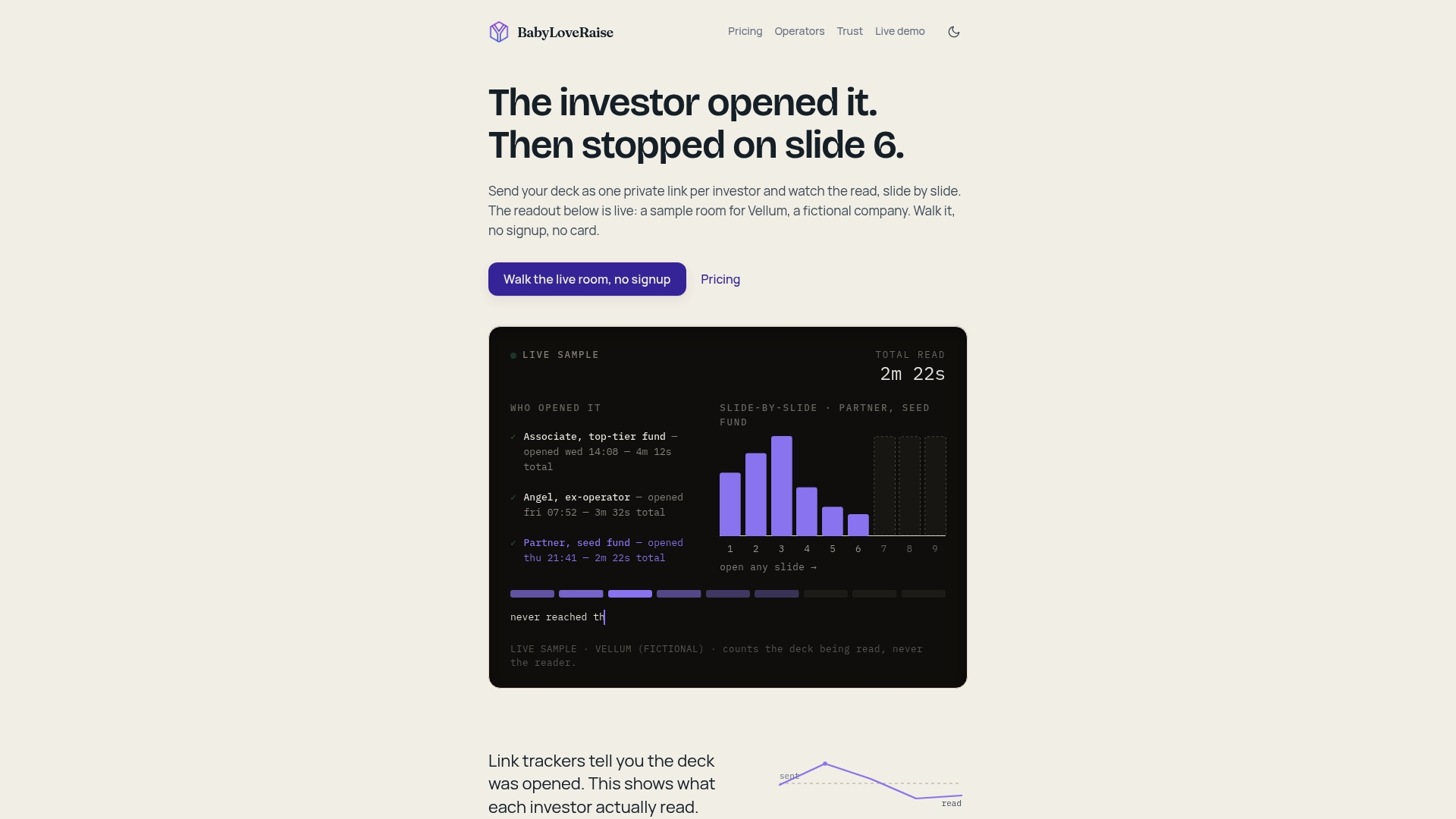
- Use the raise room with flexible pricing options on the pricing page once you are sending your deck to a targeted list and want real engagement data instead of guessing.
- Consider the editorial pass when your narrative needs an outside pass before it goes to your Ideal Investor Profile list.
- Fundraising advisors or fractional CFOs running multiple client raises can run firm-branded rooms through an Operator seat, priced at $399 per month or $3,990 per year per seat on the operators page.
When the raise closes, the room converts to a free permanent archive instead of disappearing behind a paywall.
Primary sources and further reading
For deeper detail, see SVB’s pitch deck guidance, SVB’s guide to finding the right VC firm, and a filed SAFE agreement example for contract-level context. Consult legal counsel before interpreting specific terms.
Sources
- How to create a pitch deck: Essential skills for early-stage and Series A funding | SVB
- SEC filing: SAFE example (Paktli Foods)
FAQ
What happens if you stop chasing investors?
You free up time to build the metrics and customer relationships that make investors take a second look on their own. Founders who pause mass outreach often use the time to move one traction metric, then return to a shorter, better-targeted investor list.
What should you avoid saying to investors?
Avoid vague or overstated claims about your market, competitors, or traction that a diligence call would quickly unravel. SVB’s pitch deck guidance notes that overstated claims and vague competitor descriptions reduce investor trust.
Can investors pull their money out after committing?
It depends entirely on the signed contract. A filed SAFE agreement shows that conversion, liquidation preference, and amendment terms are set by specific contract language and triggering events, not a general right to withdraw, so any specific scenario needs a read of the actual document and legal counsel.
Why do many investor conversations fail to convert?
Conversations often stall because the investor cannot yet resolve a specific risk, not because of deck design or follow-up frequency. Matching investor stage, sector thesis, and check size before reaching out, as SVB’s VC-matching guidance recommends, reduces this mismatch from the start.