
Founders: Two Pitch Deck Appendix Versions and Real Slide Signals
Turn your pitch deck appendix into a two part diligence workflow—an inline Q&A set and a detailed leave behind—and iterate by tracking which slides...
September 3, 2026 · 7 min read

The appendix is your deck’s diligence pack, not a place to dump extra slides. Two rules govern it: curate ruthlessly (proof beats storytelling here) and never send it unsolicited. Create one version for live Q&A use and a more detailed leave-behind version for asynchronous review, keeping them organized inline with your main deck.
TL;DR:
- Focus your appendix on proven claims like detailed financial models, unit economics, cohort retention, and real validation to answer investor questions effectively.
- Use two versions: a concise inline appendix for live Q&A and a detailed leave-behind for deeper diligence, both organized with clear navigation and consistent templates.
- Prioritize appendix content based on your stage and sector, such as validation metrics for pre-revenue or technical and regulatory details for biotech and hardware companies.
- Avoid common pitfalls like data dumps, unsolicited sending, contradictory figures, and overly lengthy appendices to maintain investor confidence.
- Iteratively improve your appendix by adding slides from actual practice questions, and leverage tools to track which slides investors engage with most to refine your presentation.
Table of Contents
- What Belongs in a Pitch Deck Appendix Investors Actually Ask For
- How Do You Use the Appendix During an Investor Meeting?
- Formatting the Appendix So It Doesn’t Look Like an Afterthought
- Which Appendix Slides Matter Most for Your Stage and Sector
- The Appendix Mistakes That Quietly Kill Investor Confidence
- An Actionable Habit for Iterating Your Appendix
- BabyLoveRaise Turns Appendix Guesswork Into Real Investor Signal
- Where to Go Deeper
- Sources
What Belongs in a Pitch Deck Appendix Investors Actually Ask For
Investors don’t read an appendix for inspiration. They read it to stress-test the ten claims you made in the front of the deck. Every slide back there should answer a question a sharp associate would ask on their second pass, not restate your mission in different words.
Start with the financial model. Show detailed monthly financial projections for the initial period, then transition to less frequent intervals as appropriate. Pair it with unit economics: CAC, LTV, payback period, and gross margin, laid out so the math is checkable in ten seconds, not buried in a footnote.
Cohort retention charts and funnel conversion steps come next. Investors want to see whether users who joined in month one behave differently than users who joined in month six. A single retention curve tells them more than a page of adjectives.
From there, build out the harder operational proof:
- A detailed cap table with pro-forma scenarios showing dilution after the option pool and this round
- A hiring plan and org chart with salary bands and start dates tied to milestones
- A competitive matrix covering four to six real peers, plus your TAM/SAM/SOM math shown, not asserted
- A tech architecture diagram and a note on IP or regulatory exposure where it applies
- Named customer quotes, signed letters of intent, or other validation evidence if you’re pre-revenue
This checklist mirrors what serious pitch deck appendix content should include, and it’s the same list investors quietly check off while you’re mid-pitch.
| Appendix category | What it proves | Typical number of slides |
|---|---|---|
| Financial model & unit economics | The math behind your growth claims | a few slides |
| Cohort retention & funnel | Users stick, not just sign up | a couple of slides |
| Cap table & hiring plan | Ownership and headcount are planned, not improvised | a few slides |
| Competitive matrix & TAM math | You know exactly who you’re up against | a couple of slides |
| Customer proof (quotes, LOIs) | Someone besides you believes this works | a couple of slides |
How Do You Use the Appendix During an Investor Meeting?
The appendix has two jobs, and they’re not the same job. One version lives inline in your main deck for live meetings. The other is a deeper leave-behind you send only after someone asks.
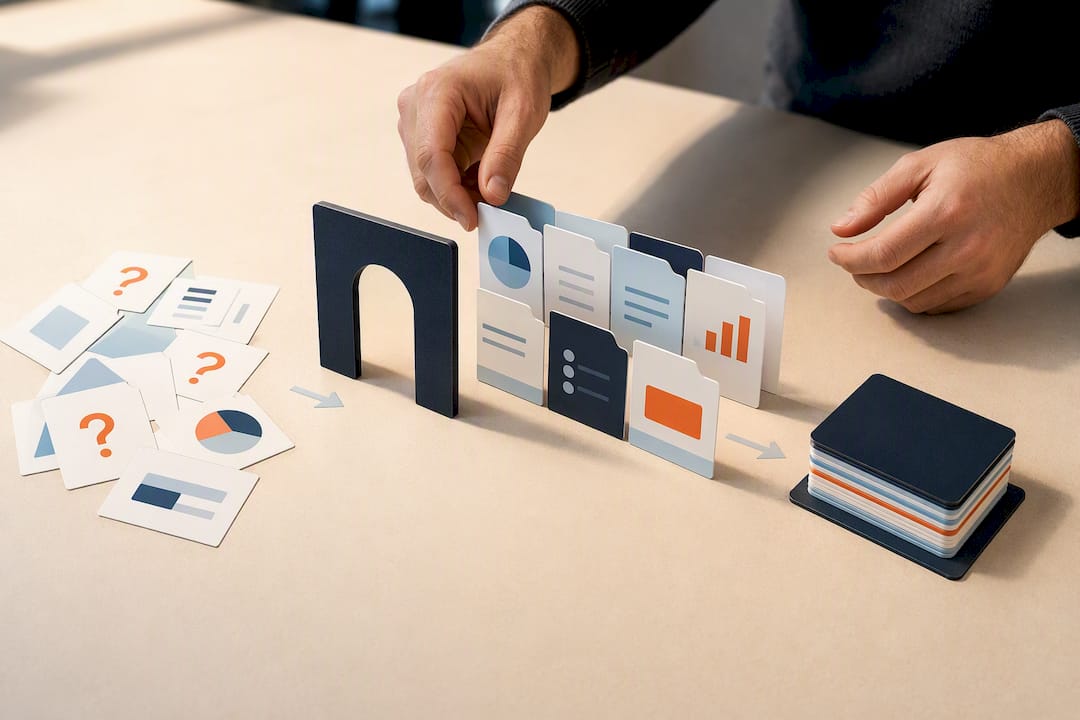
- Inline live Q&A appendix (a moderate number of slides). This stays in the same PDF as your narrative slides. When a partner asks about churn, you jump straight to slide A6 instead of promising to “follow up later.”
- Leave-behind deep dive (a larger, detailed set of slides). This version goes out after a meeting, usually to an associate doing deeper diligence, and can carry more raw detail than you’d flash on a screen live.
- Navigation matters more than volume. Give the appendix its own table of contents, label slides with IDs like A1, A2, A3, and reference them from footers on your main slides (“Detail in Appendix A4”).
Keeping everything in one PDF, rather than splitting files, cuts friction for investors who want to annotate or forward a single document during diligence.
Pro Tip: Run a “murder-board” practice session with cofounders or advisors before every real pitch. Every question you can’t answer cleanly becomes a new appendix slide. After three or four practice rounds, your appendix stops being generic and starts mirroring the actual questions your specific investors will ask.
Formatting the Appendix So It Doesn’t Look Like an Afterthought
Keep the same visual template as your main deck. Density can go up in the appendix. Nobody expects a cap table to breathe like a vision slide.
Open the appendix with a one-page table of contents that maps A1 through wherever you land, so an investor can jump straight to “Cohort Retention” without flipping through fifteen slides to find it.
File naming matters more than founders think. Use something like [Company]PitchDeck.pdf for the main send and [Company]DeepDive.pdf for the leave-behind, so nobody on the other end is guessing which file is which weeks later when they’re comparing you against six other companies.
A few habits that separate a prepared appendix from a pile of slides:
- Add a short divider slide before the appendix begins, so the shift in density feels intentional
- Use small footer text on main slides (“See Appendix A4”) instead of interrupting your narrative
- Design every appendix slide to stand alone: title, data, one takeaway sentence, understandable in under 20 seconds
That footer habit is a small thing. One analysis of appendix design found it functions as a quiet signal of preparedness that keeps your main story moving without cutting off the paper trail underneath it.
Which Appendix Slides Matter Most for Your Stage and Sector
Not every founder needs the same twenty slides. A pre-revenue consumer app and a Series A biotech company are answering completely different investor doubts.
- Pre-revenue: Lean on validation evidence, not projections. Waitlist velocity, signed LOIs, and proxy engagement metrics work as risk-killer evidence when you don’t have revenue to show yet.
- SaaS: Cohort retention, LTV to CAC ratio, and a channel-by-channel CAC breakdown matter more than almost anything else in the deck.
- Biotech and hardware: Regulatory timelines, protocol details, and manufacturing or compliance plans carry more weight than a slick competitive matrix.
- Series A and beyond: Investors expect a full monthly financial model, a multi-quarter hiring plan, and real case studies, not proxy metrics anymore.
Build the slides your stage actually demands first. Pre-revenue founders should prioritize validation evidence appropriate to their stage rather than detailed long-term plans.
The Appendix Mistakes That Quietly Kill Investor Confidence
Most appendix problems aren’t about missing information. They’re about how it’s handled.
- The data dump. Twenty unlabeled slides with no table of contents reads as chaos, not diligence. Curate hard and cut anything that doesn’t answer a real question.
- Sending it unsolicited. Blasting your full leave-behind to a cold investor signals you don’t understand the two-version workflow. Wait until it’s asked for.
- Contradictory numbers. If your appendix cap table shows different dilution than your main deck’s funding ask, that’s the fastest way to lose trust in a room.
- Overlong appendices. Fifteen to twenty-five slides is the practical range. Past thirty, it starts reading as disorganized rather than thorough.
An Actionable Habit for Iterating Your Appendix
The best appendix I’ve seen founders build wasn’t written in one sitting. It grew, one slide at a time, from real practice pitches. Run a murder-board with advisors, add exactly one appendix slide for every question that stumped you, and repeat before each real meeting.
After the meeting, don’t guess which slides landed. A tool like BabyLoveRaise’s per-slide analytics shows which appendix pages investors actually opened and lingered on, so your next revision targets real gaps instead of your own assumptions.
— Paul
BabyLoveRaise Turns Appendix Guesswork Into Real Investor Signal
BabyLoveRaise is the difference between hoping your appendix worked and knowing exactly which slides investors read. Once you send your raise room instead of a static PDF, you get a first-read notification the moment someone opens it, plus a per-slide breakdown showing whether they lingered on your cohort retention chart or skipped straight past your cap table.
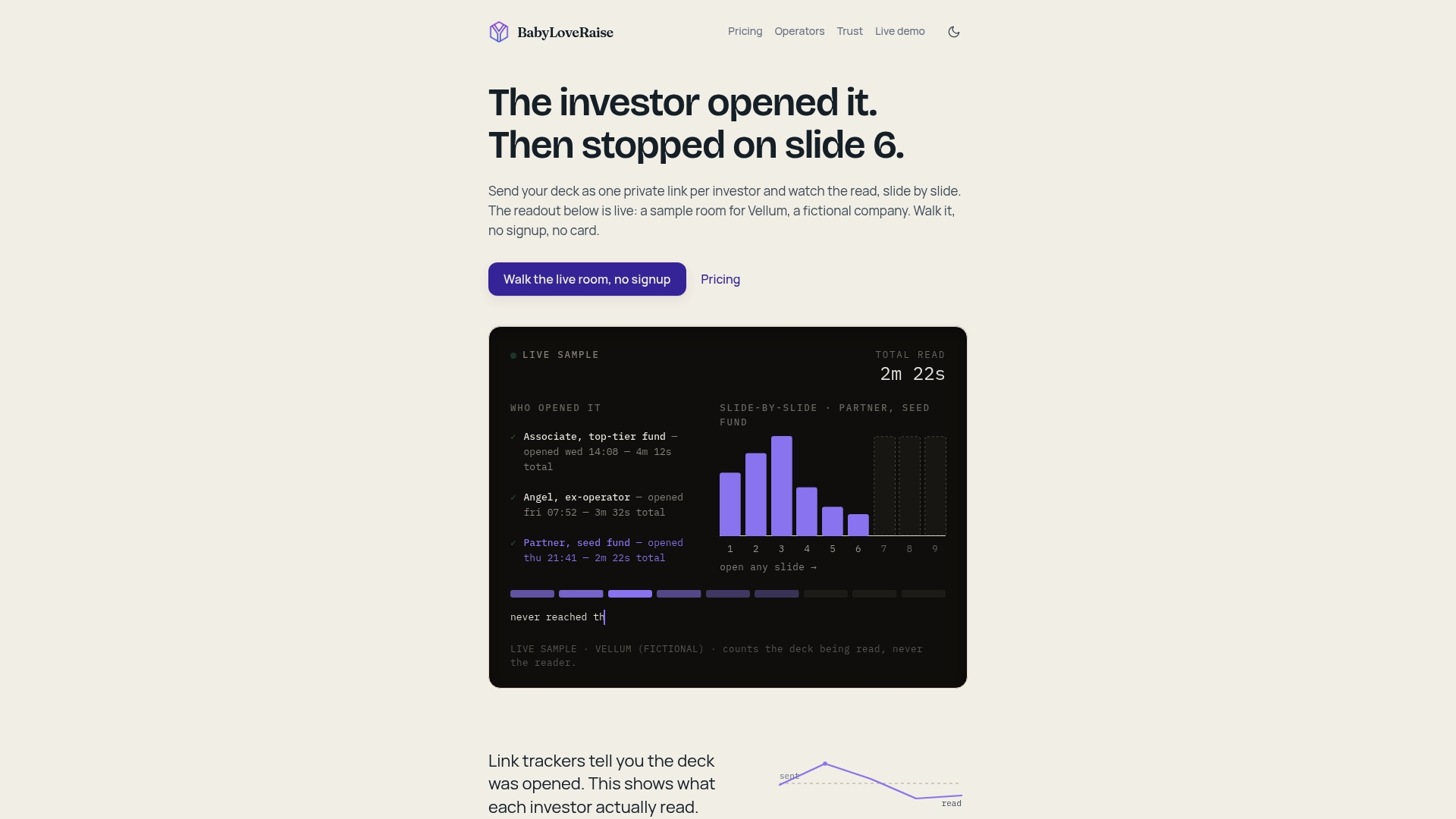
That data changes how you iterate. If three investors in a row stall on Appendix A6, you know your unit economics slide needs a rewrite before your next meeting, not after your round stalls out. Share links come in three registers, first send, forwardable, private, so you control exactly who sees your deeper leave-behind, and downloads can carry a measured watermark if you’re sending it further out than you’d like. When the raise closes, the room converts to a free permanent archive instead of disappearing behind a paywall.
Set up a raise room at BabyLoveRaise and see which appendix slides your next investor conversation actually needs, or read the pitch-deck access control guide first if you want to understand the share-link options before you send anything.
Where to Go Deeper
Review the appendix content checklist, the TechCrunch teardown, and a pre-revenue traction framework for templates and examples.
Sources
- Pitch Deck Appendix Guide: What to Include for VCs
- No Revenue? Show Startup Pitch Deck Traction That Works | Funding Blueprint
- Your fundraising pitch deck needs appendices. Here’s why | TechCrunch