
Forward-Tracking Disclaimer for Pitch Decks: What to Say
How to word a forward-tracking disclaimer for your pitch deck link: copy-ready text, forwarding etiquette investors expect, and what tracking can honestly show.
November 7, 2026 · 13 min read

A forward-tracking disclaimer is a short note, sent with your deck link, that tells the investor three things: the deck is confidential, the link is tracked, and forwarding to colleagues is welcome as long as it stays inside their review. Two or three plain sentences do the job. Anything longer reads like a legal threat and hurts the first impression you are trying to make.
This guide gives you wording you can adapt, explains what a disclaimer can and cannot do, and covers the etiquette on both sides of a forwarded link. It is written for pre-seed and seed founders who are about to send decks and want to know what is reasonable.
BabyLoveRaisebabyloveraise.comShare Your Deck With Clear TrackingBabyLoveRaise gives founders a raise room that records deck opens and per-slide engagement, with sharing registers for first sends and forwards.Visit BabyLoveRaiseTL;DR
- Put the notice in the email, not buried in the deck’s last slide. Keep it to two or three sentences in a friendly tone.
- Say the link is tracked in terms of the document (opens, pages read), never in terms of watching the person.
- Invite forwarding to partners and advisors, and ask for a quick heads-up. Investors need internal review, and blocking it often costs you the meeting.
- Do not ask for an NDA at first contact. Use link controls and clear wording instead.
- A disclaimer sets expectations. It does not enforce anything, so match it with unique links per investor.
Table of Contents
- What a forward-tracking disclaimer actually is
- What a disclaimer can and cannot do
- Should you ask for an NDA instead?
- Copy-ready wording
- How to disclose tracking without overstating it
- Forwarding etiquette from the investor side
- Make the link do the work
- What to do when the link gets forwarded
- Mistakes that make a disclaimer backfire
- Our perspective
- Setting this up in BabyLoveRaise
- A short checklist before you hit send
- FAQ
- Sources
What a forward-tracking disclaimer actually is
It is a notice, not a contract. Summaries of presentation disclosure statements describe the purpose as putting the audience on notice that the material is confidential and that reproducing or distributing it is restricted. In a fundraise, the “forward-tracking” part adds a second job: telling the recipient honestly that the link records activity.
There are really two statements folded together:
- The confidentiality statement. What is in the deck is for evaluating an investment, and it should not be posted or passed to competitors.
- The tracking statement. The link records opens and page-level reading, and it may show when the link has been opened by someone new.
Keep them separate in your head, because each has a different tone. The first is a request. The second is a disclosure. Neither is a threat.
What a disclaimer can and cannot do
A disclaimer can clarify that the deck contains confidential information, that projections are forward-looking estimates, and that the deck is for discussion rather than a formal offer. One pitch-design agency’s guide makes the same point: the notice sets expectations but does not guarantee outcomes or shield misleading claims.
So be realistic about it:
- It signals that you take your information seriously.
- It gives the investor a clear rule for what is fine (internal forwarding) and what is not (public posting).
- It does not stop a determined leak, and it does not excuse inaccurate numbers in the deck itself.
If your deck includes forward-looking projections, or you are unsure how your notice interacts with securities rules for your raise, ask your startup attorney. That is a legal question, and a template cannot settle it for your situation.
Should you ask for an NDA instead?
For a first send, no. One investor newsletter lists NDA requests among its investor pet peeves and says that asking for one is likely an automatic pass. Investors see many companies and generally will not sign for every deck they open.
That is why a light notice plus access controls is the more practical route. If you have a truly sensitive item, such as unreleased technical detail or a named customer under contract, leave it out of the first-send version and share it later, in a more restricted setting, with an investor who is serious. We cover that tiered approach in skipping the NDA with three tiers of confidentiality.
Copy-ready wording
Here are three versions, from lightest to most explicit. Adjust names and tone to match how you write.
The email line (first send)
Here’s our deck: [link]. It includes non-public company information, so please keep it within your team. Feel free to forward it to partners or advisors who need to weigh in. The link shows us when it has been opened, so we know when to follow up.
Three sentences: confidentiality, permission to forward, tracking. Nothing else is needed for most investors.
The forwardable version
This link is set up so you can pass it to colleagues. It records opens and which pages get read, and it is meant for the people evaluating our round. If someone outside your firm needs to see it, just let me know first.
Use this when you expect the investor to bring in a partner or expert. It tells them forwarding is expected, which is the opposite of a wall.
The private version
This version is for you only and contains figures we are sharing selectively. Please don’t forward the link. If a colleague should see it, tell me and I’ll send them their own.
The closing offer matters. It gives the investor an easy path that does not require breaking the rule. “Send them their own” keeps your tracking clean as well.
The footer on the deck itself
Confidential. Prepared for discussion with prospective investors. Contains forward-looking estimates that may differ from actual results. Not an offer to sell securities.
That last sentence is standard-sounding language, but whether it fits your round is a call for your attorney. Treat it as a placeholder, not a vetted legal text.
How to disclose tracking without overstating it
The common mistake is to describe tracking as more than it is. A link can tell you that it was opened, roughly how far the reader got, and which pages held attention. It cannot tell you what the person thought, whether the person who opened it is the investor or an assistant, or whether a skimmed page was skipped or already understood.
Good wording describes the document, not the person:
- Works: “The link shows when the deck is opened and which pages are read.”
- Overreaches: “We can see exactly what you do with this deck.”
- Works: “We use this to time our follow-ups.”
- Overreaches: “We’re monitoring your interest.”
The overreaching versions make the investor feel watched, and they also make claims you cannot back up. If you want to understand where the line sits, we wrote about pitch deck tracking that does not turn investors into profiles.
A good rule: if you would be uncomfortable reading your sentence aloud to the investor on a call, rewrite it.
Forwarding etiquette from the investor side
You will rarely write rules for investors, but knowing what they consider polite helps you word the notice so it reads as shared understanding.
Ask before sharing outside the firm. One venture firm’s post on confidentiality says investors should get a startup’s permission before sharing its deck, and should not discuss the metrics or customers of companies they backed or saw in other decks (Promus Ventures, 2015). That is the norm your disclaimer can lean on: you are asking for what good investors already do.
Internal forwarding is normal. Investors often need to bring in partners, technical experts or advisors, and many treat a pitch as an invitation to run that internal review. One angel investor argues that investors who cannot consult their team often “fly blind” and may simply pass. Whether you agree fully or not, the practical lesson holds: a notice that forbids all forwarding can stall a deal that was moving.

Do not ask investors to be your messenger. The same newsletter that flags NDA requests also notes that asking an investor to “share my deck” with others makes them spend social capital for you (First Look). If you want an introduction, ask for a specific one, to a specific person, with a forwardable blurb.
A quick etiquette table
| Situation | What the investor typically expects | What your notice can say |
|---|---|---|
| Partner at the same firm needs to see it | Forward freely | “Feel free to share within your team.” |
| Outside expert or advisor | Quick heads-up to the founder | “Let me know if someone outside the firm should see it.” |
| Co-investor or syndicate member | Founder’s permission first | “I’m happy to send them their own link.” |
| Another founder or portfolio company | Not appropriate | “Please don’t share with other companies.” |
| Posting online or in a group chat | Never | “Please keep this off public channels.” |
Make the link do the work
Wording sets expectations. The link settings are what give you visibility. The most practical advice we have seen: use a unique link for every investor, so that if something looks wrong you can see where it came from and cut off that one link. Writer Ash Rust says sharing links rather than attaching decks is fine and recommends unique links per investor for exactly that reason.
A workable setup:
- One link per investor or firm. Never reuse a single link across your whole target list.
- Name each link after the investor so your activity view is readable.
- Choose the register for the link. A first-send link can be lightly restricted, a forwardable link is meant to travel, and a private link is for numbers you are sharing selectively.
- Set an expiry or access end for investors who have passed, so old links do not stay open forever.
- Watch for new openers. If a link you sent to one person gets opened from an unfamiliar place, that is usually a colleague doing internal review. Follow up with an offer to answer questions, not an accusation.
If your team also shares documents through office suites, a tidy permissions setup helps the same way; cleaning up external sharing permissions is an example of how teams review who still has access to shared files.
For the mechanics of limiting who can open what, see how to set up pitch deck access control.
What to do when the link gets forwarded
You will often see a second or third opener appear. Handle it in this order.

Step 1: assume good faith. The most likely explanation is a partner or analyst doing the review you wanted. That is good news.
Step 2: send a short, useful follow-up. For example: “Looks like the deck is getting a look from your team. Happy to set up a call with anyone who has questions.” No mention of who, when or from where.
Step 3: look at which slides held attention. If the new reader stopped early on the same slide as the first reader, that slide is the problem. Our posts on tracking pitch deck views and reopens and following up after a second visit go deeper on timing.
Step 4: act on abuse only if there is abuse. If a link turns up somewhere it clearly should not be, such as a public forum or a competitor, cut that link and send a polite note. This is where unique links earn their keep.
Mistakes that make a disclaimer backfire
- Legalese in the first email. A block of capital-letter warnings tells the investor you expect a fight.
- Banning forwarding entirely. It conflicts with how due diligence works and invites a quiet pass.
- Claiming the tracking sees more than it does. If you write that you know who read what and why, you are promising something the data cannot show.
- Hiding the tracking. Saying nothing and then referencing “I saw you opened it at 9 p.m.” feels invasive. Mention tracking up front and the later reference feels normal.
- Using one disclaimer for everything. A first send to a cold investor and a data-room share with a lead are different situations. Match the register.
- Treating the notice as protection. It is a signal, not a lock. Your real protection is what you choose to put in the deck at each stage.
Our perspective
Founders tend to treat the disclaimer as a legal chore. We see it as the first piece of investor communication that is entirely yours.
A solo founder has no cofounder to read an email and say that it sounds defensive. A three-sentence notice that welcomes forwarding and says plainly that the link records opens does more for trust than a paragraph of warnings.
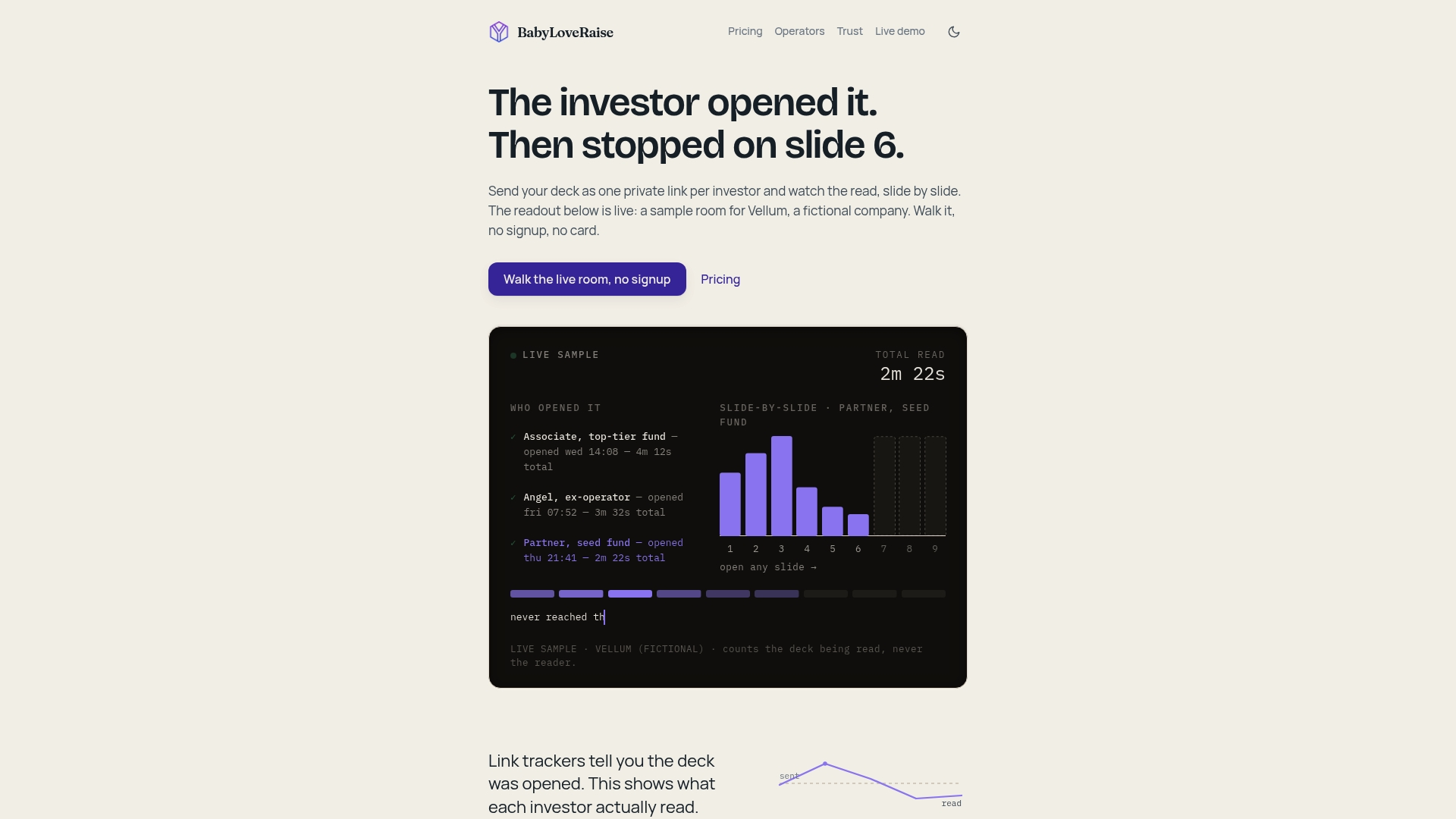
That is how we built BabyLoveRaise. Each room link comes in three registers, first send, forwardable and private, so the wording you write matches what the link actually does. The room reports on the document: who opened it, who read to the last slide and which slides were skimmed. It is not built to follow the person around.
The two silences that look identical in your inbox, “never opened it” and “read everything and passed”, become two different states, so your follow-up goes to actual readers. Treat the disclaimer and the tracking as one honest message: here is our deck, here is how we will use the activity, and please bring in whoever you need.
Paul
Setting this up in BabyLoveRaise
If you are about to send decks, the raise room gives you one link per investor, a notification on first read, per-slide engagement and three link registers, so the notice in your email matches the link behind it. Downloads can carry a watermark. When your raise closes, the room becomes a free permanent archive.
The raise room is $149 per month or $399 per quarter. Advisory firms and fractional CFOs running several client raises can look at the operator plans at babyloveraise.com/operators. See current options on the pricing page.
If you want a human read before you send, there is also an editorial pass for the deck itself. The pricing page has the details, and our trust page explains how we handle the material you upload.
A short checklist before you hit send
- Pick the register: first send, forwardable or private.
- Write the notice in the email in two or three sentences.
- Say that the link records opens and pages read, and say what you will use that for.
- Invite forwarding inside the investor’s firm and ask for a heads-up beyond it.
- Create a separate link for each investor and name it.
- Keep your most sensitive material out of the first-send deck.
- Decide in advance what you will do when a second reader appears: a friendly follow-up, not a challenge.
- Have your attorney review any language about securities, projections or offers.
For more on what to read from the numbers once they arrive, see pitch deck engagement metrics and how to track investor engagement.
FAQ
Do I legally need a disclaimer on my pitch deck link?
No single rule requires a forwarding or tracking notice on a deck link. It is a courtesy and an expectation-setter, and it is useful for that reason. Whether specific wording is needed for your offering, especially around projections or securities, is a question for your startup attorney.
Is it okay to tell investors not to forward my deck?
You can, but it often backfires, because investors commonly need to consult partners or experts as part of their review. A better approach is to welcome internal forwarding, ask for a heads-up before it goes outside the firm, and use a private link for the most sensitive numbers.
Should I mention that my link is tracked?
Yes, briefly and in plain terms. Say that the link shows when the deck is opened and which pages are read, and that you use it to time follow-ups. Stating it up front avoids the awkwardness of revealing it later, and describing the document rather than the person keeps the tone respectful.
What if someone I did not send the deck to opens the link?
Most often it is a colleague of the investor doing the review. Send a friendly note offering to answer questions. If a link appears somewhere clearly inappropriate, disable that one link and message the investor. This is why each investor should have a unique link.
Can an investor forward my deck to other investors?
Good investors ask first. Passing a deck to a co-investor or anyone outside the firm is generally considered something to clear with the founder. Your notice can say this directly and offer to send the other party their own link.
Sources
- Presentation disclosure statements overview, Legal Clarity
- What is a pitch deck disclaimer, Ink Narrates
- Investor pet peeves, First Look
- Loose Lips Sink Ships, Promus Ventures
- Should you send your pitch deck by PDF or link, Pitching Angels
- Quick rules for sharing pitch decks, Ash Rust
- SharePoint external sharing case study, Secure Techies